





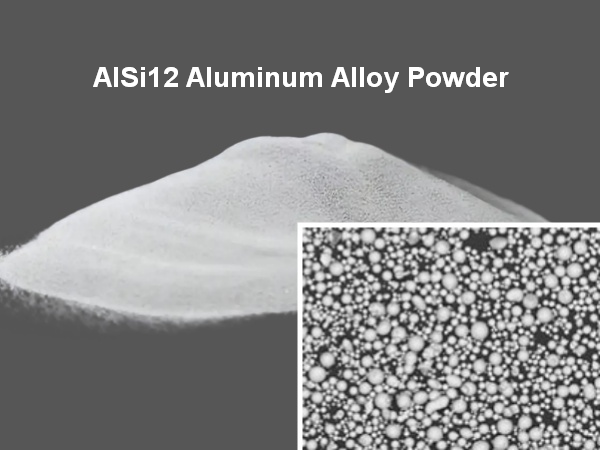
| Category | Parameter | Value / Specification |
|---|---|---|
| Typical Applications | Use Cases | Heat exchangers, radiators, thin-walled complex structures, automotive engine blocks, aerospace components requiring high thermal conductivity. |
| Applicable Processes | Technology | SLM (Selective Laser Melting), EBM (Electron Beam Melting) |
| Chemical Composition (wt.%) | Al | Bal. |
| Si | 11.0 – 13.0 | |
| Fe | ≤ 0.55 | |
| Mn | ≤ 0.45 | |
| Mg | ≤ 0.10 (Trace) | |
| Cu | ≤ 0.30 | |
| O | ≤ 0.08 | |
| Zn | ≤ 0.1 | |
| Ni | ≤ 0.05 | |
| Physical Properties | Particle Size Range (D50) | 15 – 53 μm (or 20 – 63 μm) |
| Sphericity | ≥ 0.95 | |
| Apparent Density | ≥ 1.30 g/cm³ | |
| Tap Density | ≥ 1.60 g/cm³ | |
| Flowability | ≤ 15 s/50g (Hall Flowmeter) | |
| Mechanical Properties | Status | As-Built / Heat-Treated (T6) |
| Tensile Strength | ≥ 250 – 300 MPa | |
| Yield Strength | ≥ 150 – 180 MPa | |
| Elongation | ≥ 8.0 – 12.0 % | |
| Thermal Conductivity | ~ 140 – 160 W/(m·K) |
What is AlSi12 Aluminum Alloy Powder for SLM 3D Printing?
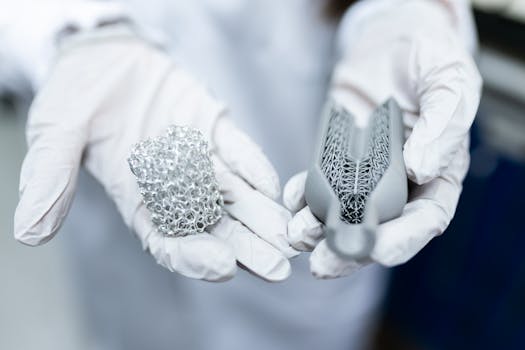
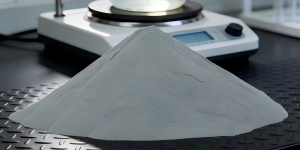
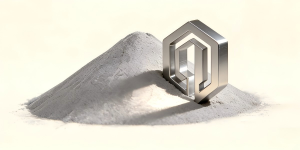
AlSi12 aluminum alloy powder is an aluminum-silicon alloy material with high silicon content, specifically designed for SLM (Selective Laser Melting) 3D printing technology.
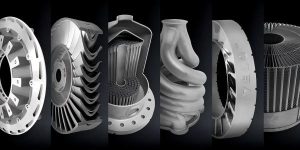
In simple terms, it is recognized in the industry as the “expert in casting and thermal conductivity.” Due to its silicon content of approximately 12% (making it a eutectic or near-eutectic alloy), it offers excellent flowability and resistance to hot cracking during 3D printing. It is highly suitable for manufacturing precision parts that require good thermal conductivity, high wear resistance, and complex thin-walled structures.
Here is a detailed breakdown of the material, its performance comparison with AlSi10Mg, SLM printing considerations, and the basic material parameters for AlSi10Mg.
Core Composition & Characteristics
AlSi12 belongs to the Al-Si (Aluminum-Silicon) binary alloy system.
- Silicon (Si) Content ~12%: This high silicon ratio places it in a “eutectic” state. Compared to AlSi10Mg, it has a lower melting point and excellent fluidity in the molten state. It has a low shrinkage rate during laser melting and solidification, which minimizes thermal cracking, making it ideal for printing extremely complex or thin-walled parts.
- Thermal Conductivity & Wear Resistance: The high silicon content gives AlSi12 outstanding thermal conductivity and a low coefficient of thermal expansion. Additionally, the silicon particles significantly enhance the material’s wear resistance.
Performance Comparison: AlSi12 vs. AlSi10Mg
In the field of SLM 3D printing, AlSi12 and AlSi10Mg each have their own strengths. The table below clearly illustrates the differences between the two:
| Feature Dimension | AlSi12(High Thermal Conductivity / Crack Resistance Expert) | AlSi10Mg(Comprehensive Strength / Industry Standard) |
|---|---|---|
| Silicon (Si) Content | ~12% (Eutectic) | ~10% (Near-eutectic) |
| Core Advantage | Excellent Flowability & Hot Crack Resistance | Higher Comprehensive Strength & Toughness |
| Thermal Conductivity | Excellent (Higher thermal conductivity) | Good |
| Tensile Strength | Relatively lower (approx. 280-460 MPa) | Higher (approx. 330-480 MPa) |
| Elongation at Break | Lower (typically 3%-8%) | Moderate (typically 3%-10%) |
| Typical Applications | Heat sinks, heat exchangers, complex thin-walled parts, molds | Structural brackets, drone fuselages, automotive chassis parts |
SLM Printing Considerations & Key Parameters
When using AlSi12 for SLM printing, special attention must be paid to the following process limits and design rules to obtain dense, defect-free parts:
1. Key Printing Parameters
- Powder Particle Size: Typically uses a particle size distribution of 15-53 μm or 15-45 μm to ensure excellent powder spreading flowability and packing density.
- Layer Thickness: The common powder layer thickness is 30 μm (pursuing high precision and surface quality).
- Laser Power & Scanning Speed: AlSi12 has lower laser absorptivity and a lower melting point. the optimal scanning speed range is typically between 150-300 mm/s. Excessive power or slow scanning speed can cause an overly large melt pool and rough surfaces, while insufficient power can lead to lack-of-fusion defects.
2. Crucial Design & Process Issues
- Minimum Wall Thickness: Although AlSi12 has good crack resistance, to prevent printing deformation, the wall thickness for small parts is recommended to be ≥ 0.3mm, and ≥ 0.5mm for medium to large parts.
- Overhangs & Supports: During printing, overhanging structures with an angle less than 45° to the horizontal plane must have supports added; otherwise, gravity will cause collapse.
- Powder Moisture Protection: Aluminum powder is highly susceptible to moisture. Damp powder will produce pores during printing. Genuine AlSi12 powder comes in vacuum-sealed packaging and should be used as soon as possible after opening.
- Post-Processing: After printing, heat treatment (such as stress relief annealing) is usually required to eliminate internal stresses and improve the dimensional stability of the part.
AlSi10Mg Basic Material Parameter Table
Combining previous content, here are the basic physical and mechanical property parameters for the “industry standard” aluminum alloy powder, AlSi10Mg, for your reference in material selection:
| Performance Category | Key Indicator | Typical Parameter Range |
|---|---|---|
| Physical Properties | Density | 2.67 – 2.70 g/cm³ |
| Melting Point Range | Approx. 570 – 585 ℃ | |
| Thermal Conductivity | 100 – 140 W/(m·K) | |
| Mechanical Properties | Tensile Strength (Heat-Treated) | 330 – 460 MPa |
| Yield Strength (Heat-Treated) | 230 – 350 MPa | |
| Elongation | 5% – 10% |
Summary:
If you need an aluminum alloy part that prioritizes ultimate thermal conductivity, high wear resistance, or has an extremely complex and thin-walled structure (requiring excellent crack resistance), then AlSi12 is a better choice than AlSi10Mg. However, if you are pursuing higher structural strength and better comprehensive toughness, AlSi10Mg remains the most cost-effective and widely used option currently.
Customization Services by Forgecise
Forgecise provides comprehensive aluminum alloy powder customization solutions, covering the full range of products from standard grades to customer-specific formulations. We support mainstream grades such as AlSi10Mg, AlSi12, AlSi7Mg,AlMgErZr,
AlMnErZr, AlRe, and can adjust composition, particle size distribution, and sphericity according to your application requirements. Whether it’s small-batch samples for R&D (starting from 1kg) or ton-level orders for mass production, we ensure high purity, low oxygen content (≤300 ppm), and excellent flowability of our powders, meeting the requirements of various processes including SLM, MIM, and LMD.