







| Category | Parameter | Unit | Value / Range |
|---|---|---|---|
| Chemical Composition (wt.%) | Cu (Copper) | wt.% | Bal. (Balance) |
| Sn (Tin) | wt.% | 9.0 – 11.5 | |
| P (Phosphorus) | wt.% | ≤ 1.0 | |
| Ni (Nickel) | wt.% | ≤ 0.10 | |
| Si (Silicon) | wt.% | ≤ 0.02 | |
| Sb (Antimony) | wt.% | ≤ 0.05 | |
| Fe (Iron) | wt.% | ≤ 0.1 | |
| Pb (Lead) | wt.% | ≤ 0.25 | |
| Al (Aluminum) | wt.% | ≤ 0.01 | |
| Zn (Zinc) | wt.% | ≤ 0.05 | |
| Mn (Manganese) | wt.% | ≤ 0.05 | |
| S (Sulfur) | wt.% | ≤ 0.05 | |
| O (Oxygen) | wt.% | ≤ 0.1 | |
| Physical Properties | Particle Size D10 | µm | ≥ 15 |
| Particle Size D50 | µm | 30 – 40 | |
| Particle Size D90 | µm | ≤ 60 | |
| Sphericity | — | ≥ 0.90 | |
| Apparent Density | g/cm³ | ≥ 4.2 | |
| Tap Density | g/cm³ | ≥ 4.5 | |
| Flowability | s/50g | ≤ 25 | |
| Mechanical Properties | Condition | — | As-Deposited |
| Tensile Strength | MPa | ≥ 520 | |
| Yield Strength | MPa | ≥ 400 | |
| Elongation | % | ≥ 30.0 | |
| Relative Density | % | ≥ 99.5 | |
| Hardness (HV) | HV | ≥ 170 |
1. Analysis of the CuSn10 Powder
This CuSn10 powder is specifically engineered for Selective Laser Melting (SLM) and exhibits a well-balanced set of properties ideal for high-performance wear-resistant components.
Key Advantages:
- Optimized for Additive Manufacturing
- Narrow particle size distribution (D50: 30–40 µm, D90 ≤ 60 µm) ensures excellent layer uniformity and minimal satellite formation.
- High sphericity (≥ 0.90) and good flowability (≤ 25 s/50g) enable reliable powder recoating—critical for process stability in industrial SLM systems.
- High apparent (≥ 4.2 g/cm³) and tap density (≥ 4.5 g/cm³) indicate dense packing, reducing porosity and supporting near-full densification (>99.5%).
- Exceptional Mechanical Performance (As-Deposited)
- High tensile strength (≥ 520 MPa) and yield strength (≥ 400 MPa) surpass many cast bronze alloys, demonstrating the benefit of fine microstructure achieved via rapid solidification in SLM.
- Outstanding ductility (≥ 30% elongation) is remarkable for a high-strength metallic part—this combination of strength and toughness is rare and highly desirable for dynamic load applications (e.g., gears, bearings).
- Hardness ≥ 170 HV provides good resistance to abrasive wear while retaining machinability and fatigue performance.
- Functional Superiority for Wear Applications
- The 9–11.5% Sn content forms a hard intermetallic phase (e.g., δ-Cu₃₁Sn₈) within a ductile Cu matrix, delivering classic bronze self-lubricating behavior under sliding contact.
- Low impurities (e.g., O ≤ 0.1%, P ≤ 1.0%) ensure minimal embrittlement and consistent performance across builds.
- The composition aligns with standard bronze grades (e.g., ASTM B505 Type C90300 or ISO 4382-2 CuSn10P), but the SLM-optimized powder form enables complex geometries impossible with casting or machining.
Ideal Applications:
- Aerospace: Lightweight, high-stiffness bushings, thrust washers, and gear components operating at elevated temperatures.
- Industrial Machinery: High-speed, high-load bearings, cam followers, and valve components requiring low friction and long service life.
- Medical Devices: Biocompatible (Cu/Sn are generally acceptable), wear-resistant surgical instrument joints.
In summary, this CuSn10 SLM powder represents a high-performance, production-ready material that bridges the gap between traditional bronze functionality and modern additive manufacturing capabilities—delivering complex geometry, superior mechanical properties, and reliable processability.
2. What is CuSn10 Powder for SLM (Selective Laser Melting)
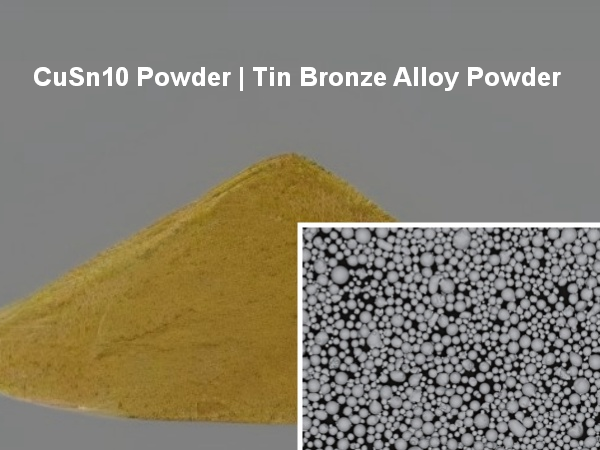
CuSn10 powder is a copper-based alloy powder developed based on traditional tin bronze (containing 10% tin), specifically designed for metal additive manufacturing processes. Prepared through advanced powder production techniques such as gas atomization or plasma rotating electrode process into highly spherical powder with narrow particle size distribution, it is suitable for Selective Laser Melting (SLM) technology. This material belongs to German standard cast tin bronze, complying with DIN EN 1982-2008, featuring excellent wear resistance, good electrical and thermal conductivity, and outstanding casting performance.
2.1 Chemical Composition Characteristics
| Element | Content Range | Function |
|---|---|---|
| Copper (Cu) | Balance (88.5-90.5%) | Base metal, provides electrical and thermal conductivity |
| Tin (Sn) | 9.0-11.5% | Provides hardness, wear resistance, and corrosion resistance |
| Phosphorus (P) | 0.5-1.0% | Deoxidizer, improves fluidity, forms hard phases |
| Lead (Pb) | ≤0.25% | Improves machinability |
| Nickel (Ni) | ≤0.10% | Enhances strength and corrosion resistance |
| Iron (Fe) | ≤0.10% | Strengthening phase, improves wear resistance |
| Manganese (Mn) | ≤0.10% | Improves strength and toughness |
| Aluminum (Al) | ≤0.01% | Deoxidizing element |
| Zinc (Zn) | ≤0.05% | Trace element |
2.2 Powder Characteristics
Physical Parameters
- Particle Size Distribution: 15-45μm (D50)
- Sphericity: ≥0.95
- Apparent Density: ≥4.2 g/cm³
- Tap Density: ≥4.8 g/cm³
- Flowability: ≤15 s/50g (Hall flowmeter)
Powder Quality Control
- Oxygen Content: ≤800 ppm
- Nitrogen Content: ≤300 ppm
- Moisture Content: ≤0.05%
3. CuSn10 Powder for SLM
3.1 Excellent Wear Resistance
- 9-11.5% tin content forms hard tin bronze phases, providing excellent wear resistance and anti-galling properties
- Suitable for sliding bearings, bushings, and other high-wear applications
3.2 Good Electrical and Thermal Conductivity
- Copper matrix provides excellent electrical conductivity (≥15% IACS) and thermal conductivity
- Suitable for electrical connectors and heat exchange components requiring heat dissipation
3.3 Excellent Corrosion Resistance
- Good corrosion resistance in atmosphere, fresh water, and seawater
- Suitable for marine engineering and chemical equipment
3.4 High Casting Performance
- Phosphorus element acts as a deoxidizer, significantly improving alloy fluidity and density
- Suitable for manufacturing complex-shaped precision parts
3.5 Good Machinability
- Addition of lead element improves material’s machinability
- Facilitates subsequent machining and finishing
4. SLM Process Parameter Recommendations
| Parameter | Recommended Range | Notes |
|---|---|---|
| Laser Power | 300-500 W | Copper alloys require higher power |
| Scan Speed | 800-1500 mm/s | Balance density and efficiency |
| Layer Thickness | 30-50 μm | Typically 40μm |
| Hatch Spacing | 100-150 μm | Affects surface quality |
| Preheat Temperature | 150-200°C | Reduces thermal stress |
| Protective Gas | High-purity argon (≥99.999%) | Prevents oxidation |
5. Typical Application Fields
5.1 Bearings and Bushings
- Sliding Bearings: Heavy-duty bearings, bearing shells
- Bushings: Hydraulic pump bushings, gear bushings
- Sleeves: Mechanical sleeves, wear-resistant sleeves
5.2 Gears and Transmission Components
- Gears: Worm gears, worm wheels
- Transmission Parts: Sprockets, ratchets
- Clutch Plates: Friction plates, clutch assemblies
5.3 Electrical Connectors
- Conductive Components: Electrodes, contacts
- Heat Sinks: Heat exchangers, heat sinks
- Connectors: Electrical connectors, terminals
5.4 Marine Engineering
- Ship Components: Propellers, marine bearings
- Seawater Pumps: Pump bodies, impellers
- Marine Equipment: Seawater corrosion-resistant components
5.5 Chemical Equipment
- Valves: Corrosion-resistant valves
- Pump Bodies: Chemical pump components
- Seals: Mechanical seal rings
6. Post-Processing Techniques
6.1 Heat Treatment
- Stress Relief Annealing: 500-550°C, hold for 1-2 hours
- Solution Treatment: 750-800°C, water quench
- Aging Treatment: 350-400°C, 2-4 hours
6.2 Surface Treatment
- Polishing: Mechanical polishing, chemical polishing
- Electroplating: Tin plating, nickel plating to improve corrosion resistance
- Coating: PTFE coating to reduce friction coefficient
7. Comparison of Copper-Based Alloy Powders
| Characteristics | CuSn10 Powder | CuAl10 Powder | CuNi30 Powder | Pure Copper Powder | CuCrZr Powder |
|---|---|---|---|---|---|
| Main Composition | Copper+10%Sn+P | Copper+10%Al+Fe | Copper+30%Ni+Zn | Copper≥99.9% | Copper+0.8%Cr+0.1%Zr |
| Alloy Type | Tin Bronze | Aluminum Bronze | Cupronickel | Pure Copper | Chromium Zirconium Copper |
| Electrical Conductivity | ≥15% IACS | ≥7% IACS | ≥4% IACS | ≥98% IACS | ≥80% IACS |
| Thermal Conductivity | ≥50 W/m·K | ≥55 W/m·K | ≥20 W/m·K | ≥390 W/m·K | ≥320 W/m·K |
| Hardness (HB) | 70-90 | 120-160 | 90-110 | 40-60 | 110-140 |
| Tensile Strength | ≥200 MPa | ≥350 MPa | ≥250 MPa | ≥150 MPa | ≥300 MPa |
| Yield Strength | ≥100 MPa | ≥200 MPa | ≥120 MPa | ≥70 MPa | ≥220 MPa |
| Elongation | ≥10% | ≥8% | ≥15% | ≥25% | ≥12% |
| Wear Resistance | Excellent | Excellent | Good | Poor | Good |
| Corrosion Resistance | Excellent (seawater) | Excellent (seawater, acid) | Excellent (seawater, acid) | Good (atmosphere) | Good (atmosphere) |
| High-Temperature Performance | Average (≤300°C) | Excellent (≤400°C) | Good (≤350°C) | Poor (≤200°C) | Excellent (≤500°C) |
| SLM Power Requirement | High (300-500W) | High (350-550W) | Medium-High (300-450W) | Very High (400-600W) | High (350-500W) |
| Typical Applications | Bearings, bushings, gears | Heavy-duty bearings, propellers | Marine equipment, condensers | Heat sinks, electrodes | Electrodes, molds, conductive parts |
| Cost | Medium | Medium | High | Low | High |
| Processing Difficulty | Medium | High | Medium | High | Medium |
7.1 Analysis of Copper-Based Alloy Powder Characteristics
1 CuSn10 (Tin Bronze)
- Advantages: Excellent wear resistance and self-lubricating properties, good seawater corrosion resistance, moderate cost
- Disadvantages: Relatively lower electrical and thermal conductivity, medium strength
- Application Scenarios: Sliding bearings, bushings, gears, marine engineering components
2. CuAl10 (Aluminum Bronze)
- Advantages: Extremely high strength and hardness, excellent wear and corrosion resistance, good high-temperature performance
- Disadvantages: Poor electrical and thermal conductivity, high cost, difficult to process
- Application Scenarios: Heavy-duty bearings, propellers, high-strength wear-resistant parts, chemical equipment
3. CuNi30 (Cupronickel)
- Advantages: Excellent seawater corrosion resistance, good strength and ductility, strong anti-biofouling capability
- Disadvantages: Poor electrical and thermal conductivity, high cost, nickel may cause allergies
- Application Scenarios: Marine engineering, ship components, condensers, heat exchangers
4. Pure Copper Powder
- Advantages: Extremely high electrical and thermal conductivity, low cost, good ductility
- Disadvantages: Low strength, poor wear resistance, high reflectivity makes printing difficult
- Application Scenarios: Heat sinks, electrodes, conductive connectors, heat exchangers
5. CuCrZr (Chromium Zirconium Copper)
- Advantages: Good electrical and thermal conductivity, high strength, excellent high-temperature performance and anti-softening capability
- Disadvantages: High cost, chromium and zirconium addition increases process complexity
- Application Scenarios: Resistance welding electrodes, molds, high-conductivity high-strength components, aerospace
8. Precautions When doing SLM Process
- High Reflectivity: Copper alloys have high laser reflectivity, requiring higher power and optimized process parameters
- Oxidation Sensitivity: Copper oxidizes easily at high temperatures, must use high-purity protective gas
- Hot Cracking Tendency: Need to control cooling rate during cooling process to avoid hot cracks
- Powder Storage: Must be stored in dry, inert gas-protected environment to prevent oxidation
- Post-Processing Necessity: Heat treatment is recommended to optimize mechanical properties and eliminate internal stress
- Application Limitations: Not suitable for long-term use at high temperatures (>300°C), relatively low strength
9. Summary
CuSn10 Powder for SLM has important application value in bearings, bushings, electrical connectors, and marine engineering fields due to its excellent wear resistance, good electrical and thermal conductivity, and outstanding casting performance. Although the high reflectivity and oxidation sensitivity of copper alloys pose challenges to SLM processes, high-performance tin bronze parts can be successfully manufactured by optimizing process parameters and strictly controlling protective atmosphere. This material is an important choice in the field of copper-based alloy additive manufacturing, especially suitable for manufacturing complex parts requiring wear resistance, electrical conductivity, and corrosion resistance.
10. Customization Services by Forgecise
Forgecise delivers comprehensive copper alloy powder customization solutions, spanning the complete spectrum from standard formulations to customer-specific high-performance copper-based alloys. We support mainstream copper alloy grades including CuSn10, CuAl10Fe3, CuNi30, Pure Copper (Cu≥99.9%), and CuCrZr, with the capability to precisely tailor chemical composition, particle size distribution, sphericity, and oxygen content to match your exact application requirements. Our copper alloy powders are optimized for demanding additive manufacturing processes including SLM, DED, BJT, and EBM, ensuring consistent printability, high density, and superior mechanical properties in your final components.
From wear-resistant to high-conductivity for heat exchangers and electrodes, Forgecise provides the material expertise and manufacturing flexibility to meet your unique copper alloy powder needs.