


| Category | Parameter | Specification |
|---|---|---|
| Basic Information | Material Name | CoCr01 (CoCrMoW) |
| Typical Applications | Suitable for dental and orthopedic medical markets. | |
| Applicable Processes | SLM, EBM | |
| Chemical Composition (wt.%) | Co (Cobalt) | Bal. (Balance) |
| C (Carbon) | ≤0.35 | |
| Cr (Chromium) | 24.5–28.5 | |
| Mo (Molybdenum) | 4.5–6.5 | |
| Si (Silicon) | 0–2 | |
| W (Tungsten) | 4.0–6.0 | |
| Mn (Manganese) | ≤1.0 | |
| Fe (Iron) | <0.5 | |
| O (Oxygen) | <0.1 | |
| N (Nitrogen) | <0.2 | |
| H (Hydrogen) | <0.1 | |
| Physical Properties | Particle Size D10 (μm) | ≥12 |
| Particle Size D50 (μm) | 25–40 | |
| Particle Size D90 (μm) | ≤65 | |
| Sphericity | ≥0.85 | |
| Apparent Density (g/cm³) | ≥4.0 | |
| Tap Density (g/cm³) | ≥4.5 | |
| Flowability (s/50g) | ≤25 | |
| Mechanical Properties (Heat-Treated) | Tensile Strength (MPa) | ≥1000 |
| Yield Strength (MPa) | ≥750 | |
| Elongation (%) | ≥8.0 | |
| Part Performance | Young’s Modulus (GPa) | ≥150 |
| Coefficient of Thermal Expansion (×10⁻⁶ K⁻¹) | 14.1 ± 0.5 | |
| Metal-Ceramic Bonding Strength (MPa) | ≥25 | |
| Vickers Hardness (HV10) | ≥300 |
1. Advantages and Features of This CoCr Alloy Powder
Based on the technical specifications provided for CoCr01 (CoCrMoW) CoCr Alloy Powder, its key advantages and characteristics for SLM applications can be summarized as follows:
1.1 Optimized for Medical & Dental Applications
- Biocompatibility Focus: Specifically engineered for the dental and orthopedic medical markets, meeting the stringent safety and performance requirements for implantable and intraoral devices.
- Superior Metal-Ceramic Bonding: Features a metal-ceramic bonding strength of ≥25 MPa, making it an ideal substrate for porcelain-fused-to-metal (PFM) dental restorations, ensuring long-term aesthetic durability without chipping.
1.2 Excellent SLM Processability
- High Flowability & Density: With a flowability of ≤25 s/50g, apparent density ≥4.0 g/cm³, and tap density ≥4.5 g/cm³, the powder spreads evenly during the SLM process. This minimizes porosity, ensures uniform layer deposition, and results in high-density printed parts with fewer defects.
- Controlled Particle Size Distribution: The D50 range of 25–40 μm (with D10 ≥12 μm and D90 ≤65 μm) is optimized for fine-feature resolution in SLM, enabling the production of complex geometries like thin-walled dental crowns and porous orthopedic structures.
- High Sphericity (≥0.85): Ensures consistent powder bed packing and stable melt pool dynamics, which is critical for achieving repeatable mechanical properties in additively manufactured parts.
1.3 Robust Mechanical Performance
- High Strength & Ductility Balance: Achieves a tensile strength of ≥1000 MPa and yield strength of ≥750 MPa in the heat-treated state, while maintaining an elongation of ≥8.0%. This combination prevents brittle fracture under masticatory or physiological loads, crucial for load-bearing medical implants.
- High Hardness & Wear Resistance: Vickers hardness of ≥300 HV10 provides excellent resistance to abrasion and wear, extending the service life of dental prosthetics and orthopedic components.
1.4 Stable Physical & Thermal Properties
- Predictable Thermal Expansion: A coefficient of thermal expansion of 14.1 ± 0.5 ×10⁻⁶ K⁻¹ closely matches that of dental ceramics, reducing residual stresses during the firing process and preventing cracking in PFM restorations.
- Consistent Elastic Modulus: Young’s modulus of ≥150 GPa provides adequate stiffness for structural support while avoiding excessive stress shielding in bone-integrated implants.
1.5 High Purity & Compositional Control
- Low Interstitial Impurities: Strict limits on oxygen (<0.1%), nitrogen (<0.2%), and hydrogen (<0.1%) minimize oxide inclusions and gas porosity in printed parts, enhancing fatigue resistance and biocompatibility.
- Balanced Alloying Elements: The precise Cr (24.5–28.5%), Mo (4.5–6.5%), and W (4.0–6.0) content ensures optimal corrosion resistance in physiological environments and stabilizes the microstructure during SLM processing and post-heat treatment.
CoCr01 (CoCrMoW) powder is a medical-grade, SLM-optimized alloy that uniquely combines process reliability (flowability, particle size), mechanical robustness (strength, ductility, hardness), and application-specific performance (metal-ceramic bonding, biocompatibility). It is specifically tailored to address the demanding requirements of additive manufacturing in the dental and orthopedic sectors, where precision, safety, and long-term functionality are non-negotiable.
2. CoCr01 (CoCrMoW) CoCr Alloy Powder Material Overview
CoCr01 (CoCrMoW) CoCr Alloy Powder is a cobalt-chromium-molybdenum-tungsten alloy powder specifically designed for Selective Laser Melting (SLM) and Electron Beam Melting (EBM) additive manufacturing processes. Classified as a biocompatible medical-grade metal, this material strictly adheres to international standards for dental and orthopedic implants. Through precise compositional control and advanced powder preparation techniques, it ensures that printed components meet the rigorous clinical requirements for mechanical properties, corrosion resistance, and metal-ceramic bonding strength, serving as a core foundational material for digital dental restorations and personalized orthopedic implant manufacturing.
2.1 Chemical Composition Characteristics
The alloy uses cobalt as the base (balance), with chromium content controlled at 24.5–28.5 wt.% to form a dense passive film providing excellent corrosion resistance and biocompatibility. Molybdenum (4.5–6.5 wt.%) and tungsten (4.0–6.0 wt.%) work synergistically to produce solid solution strengthening, significantly enhancing material strength and wear resistance. Carbon is limited to ≤0.35 wt.% to prevent excessive precipitation of brittle carbides, while silicon (0–2 wt.%) improves castability and aids in deoxidation. Impurity elements are strictly controlled: iron <0.5%, manganese ≤1.0%, and interstitial elements oxygen, nitrogen, and hydrogen are kept below 0.1%, 0.2%, and 0.1% respectively, fundamentally eliminating defects such as porosity and inclusions to ensure the density and biological safety of printed parts.
2.2 Powder Characteristics
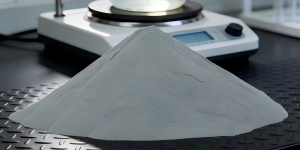
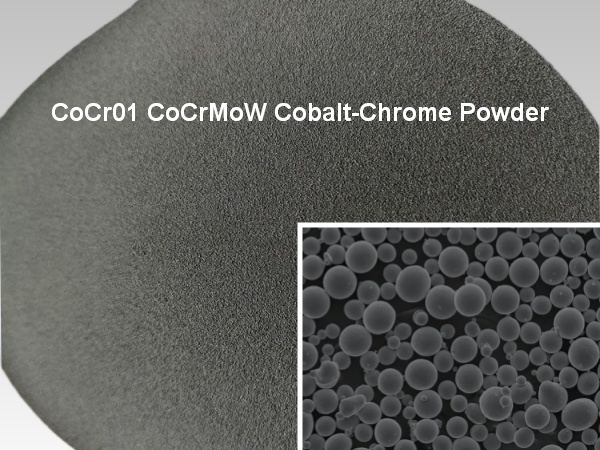
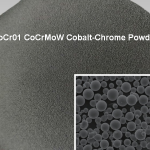
CoCr01 powder features a highly spherical morphology (sphericity ≥0.85) with a particle size distribution concentrated and optimized for SLM processing: D10 ≥12 μm, D50 = 25–40 μm, and D90 ≤65 μm, ensuring uniform powder spreading and fine feature resolution. It exhibits an apparent density of ≥4.0 g/cm³, tap density of ≥4.5 g/cm³, and flowability of ≤25 s/50g, demonstrating superior flow and packing behavior that effectively reduces defects like bridging and voids during spreading, laying the physical foundation for high-density, low-roughness printed components.
3. Technical Advantages
The core advantage of CoCr01 powder lies in its highly matched “process-performance-application” integration. Its optimized particle size and flowability guarantee process stability and repeatability in SLM. After heat treatment, it achieves a balance of high tensile strength (≥1000 MPa), good ductility (≥8.0%), and high hardness (≥300 HV10), overcoming the brittleness issues common in traditional cobalt-chromium alloys. With a metal-ceramic bonding strength of ≥25 MPa and a coefficient of thermal expansion (14.1 ± 0.5 × 10⁻⁶ K⁻¹) precisely matched to dental ceramics, it completely resolves porcelain chipping problems in PFM restorations. Furthermore, low interstitial element content ensures excellent biocompatibility and resistance to body fluid corrosion, fully complying with medical device standards such as ISO 22674, making it one of the few SLM-specific cobalt-based alloys capable of simultaneously meeting structural load-bearing, aesthetic restoration, and long-term biosafety requirements.
4. SLM Process Parameter Recommendations
For SLM fabrication using CoCr01 powder, a recommended processing window includes laser power of 200–300 W, scanning speed of 800–1200 mm/s, layer thickness of 30–40 μm, and hatch spacing of 80–100 μm, with substrate preheating to 150–200°C to effectively reduce residual stress and cracking risks. High-purity argon protection must be maintained throughout the process, keeping chamber oxygen levels below 100 ppm to prevent oxidative inclusions. A stripe scanning strategy combined with 67° interlayer rotation is advised to homogenize heat accumulation. Post-printing stress relief annealing in an inert atmosphere is required to obtain dense, crack-free components with stable mechanical properties.
5. Post-Processing Procedures
Post-processing of CoCr01 printed parts is a systematic procedure beginning with stress relief annealing at 800–900°C under vacuum or argon protection to eliminate residual stresses accumulated during SLM, preventing subsequent machining deformation or cracking. For load-bearing or fatigue-sensitive components, Hot Isostatic Pressing (HIP) is recommended to close internal micropores and further enhance density and fatigue life. Subsequent surface treatments including machining, sandblasting, and polishing are performed according to final application needs. Dental restorations require additional porcelain firing, glazing, and fine adjustment. Throughout the entire process, temperature profiles and atmospheric purity must be strictly controlled to avoid surface oxidation or carbon content changes that could compromise biocompatibility and metal-ceramic bonding performance.
6. Performance Specifications
In the heat-treated condition, CoCr01 alloy demonstrates comprehensive and balanced performance metrics: tensile strength ≥1000 MPa, yield strength ≥750 MPa, elongation ≥8.0%, Young’s modulus ≥150 GPa, Vickers hardness ≥300 HV10, metal-ceramic bonding strength ≥25 MPa, and a stable coefficient of thermal expansion at 14.1 ± 0.5 × 10⁻⁶ K⁻¹. All specifications meet or exceed relevant international standards for dental and orthopedic implants, ensuring long-term reliability and functionality in complex physiological environments.
7. Application Areas
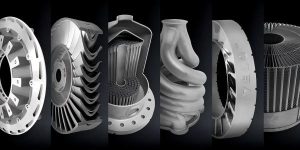
CoCr01 powder is primarily applied in digital oral healthcare for direct SLM fabrication of personalized dental crowns, fixed bridges, removable partial denture frameworks, implant abutments, and orthodontic brackets. It is also widely used in orthopedic implants for customized production of load-bearing structures such as hip prostheses, knee components, spinal fusion cages, and bone plates with screws. Leveraging its excellent biocompatibility, mechanical compatibility, and aesthetic adaptability, it has become an irreplaceable key material in additive manufacturing of high-end medical devices, driving the advancement of precision medicine and personalized therapy.
8. Comparison with Similar Powders
Compared to traditionally cast CoCr alloys, SLM-specific CoCr01 powder significantly improves part density and performance consistency through low gas content and narrow particle size distribution design, avoiding common casting defects like shrinkage porosity and segregation. Versus Ti6Al4V titanium alloy, CoCr01 offers higher hardness, wear resistance, and metal-ceramic bonding strength, making it more suitable for dental restorations under long-term masticatory loads, though its higher elastic modulus may introduce some stress shielding effects. Compared to nickel-chromium alloys, CoCr01 contains no sensitizing nickel, offering superior biological safety along with better corrosion resistance and aesthetics. Relative to other SLM cobalt-chromium powders (e.g., tungsten-free CoCrMo), CoCr01’s tungsten addition provides higher high-temperature strength and wear resistance, particularly suited for posterior high-load restorations and orthopedic wear interfaces, delivering more balanced and reliable overall performance.
9. Precautions
CoCr01 powder contains cobalt and chromium, which are potential sensitizers and carcinogens; full personal protective equipment (PPE) must be worn during handling, and operations should be conducted within negative pressure glove boxes or closed automatic powder feeding systems—open exposure is strictly prohibited. Powder must be stored in a dry inert environment to prevent moisture absorption causing print porosity. Before reuse, sieving and testing for oxygen content, particle size distribution, and flowability changes are mandatory; out-of-specification powder must not be recycled. Waste powder and contaminated materials must be disposed of as hazardous waste per regulations. Equipment optical windows require regular cleaning to prevent metal vapor deposition affecting laser transmission. Mixing powders from different batches or manufacturers is strictly forbidden; process parameters must be revalidated upon each powder change to ensure quality stability and safety compliance.
10. Summary
CoCr01 (CoCrMoW) CoCr Alloy Powder is a high-performance medical-grade cobalt-based alloy powder optimized for SLM/EBM additive manufacturing. Its precise chemical composition, excellent powder characteristics, and reliable process adaptability give it irreplaceable comprehensive advantages in dental restoration and orthopedic implant applications. This material not only achieves a balance of high strength, good ductility, and excellent biocompatibility but also resolves critical bottlenecks in aesthetic restoration with traditional cobalt-chromium alloys through precisely tuned metal-ceramic bonding strength and thermal expansion coefficients. As additive manufacturing technology matures and clinical validation deepens, CoCr01 continues to drive personalized medical devices toward higher precision, performance, and safety, serving as a vital bridge connecting advanced manufacturing with precision medicine.
10. Customization Services by Forgecise
Forgecise delivers comprehensive dental CoCr alloy powder customization solutions, spanning the complete spectrum from standard biocompatible formulations to customer-specific high-performance cobalt-chromium alloys. We support mainstream dental alloy grades including CoCr01 (CoCrMoW), CoCrMo, and low-carbon variants, with the capability to precisely tailor chemical composition, particle size distribution, sphericity, oxygen/nitrogen content, and thermal expansion coefficient to match your exact clinical and manufacturing requirements. Our dental CoCr alloy powders are optimized for demanding additive manufacturing processes including SLM, EBM, ensuring consistent printability, high density, superior mechanical properties, and reliable metal-ceramic bonding performance in your final dental restorations and orthopedic components.