

Intelligent Robotic Post-Processing for Metal Additive Manufacturing
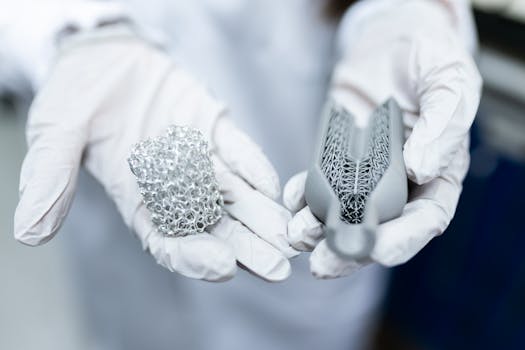
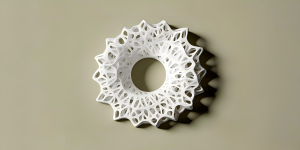
Metal additive manufacturing (3D printing) has revolutionized the manufacturing industry, enabling the production of complex, intricately designed components with higher efficiency and lower costs. However, these parts inevitably require post-processing, which adds time and financial costs per unit and can even negate the inherent advantages of additive manufacturing. Support structure removal is the primary and most critical step in metal AM post-processing, yet it remains a significant challenge.
Currently, support structures remain essential to ensure forming accuracy during printing; however, they must be removed to achieve finished products that meet dimensional, structural, and tolerance requirements. Most metal AM scenarios still rely on manual support removal. Meanwhile, automated post-processing technologies for metal AM have made notable progress. CNC milling is the most widely adopted method; this mature process has been implemented across various manufacturing settings and is often integrated with AM to form hybrid manufacturing models. The precision and repeatability of CNC equipment are unquestionable, but limited design flexibility and batch-to-batch material variations hinder its practical performance in this field.
Robots: The Breakthrough Solution
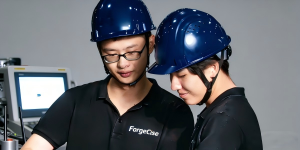
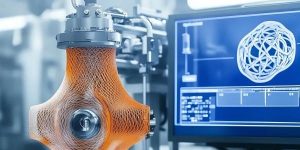
Neither traditional manual removal nor currently prevalent CNC machining can fully meet the multi-dimensional needs of metal AM customers. Forgecise is dedicated to leveraging advanced software and AI systems to deliver automated solutions tailored to varying operational conditions in the AM industry, specifically addressing support removal and surface mark cleanup. Robots have emerged as a superior alternative to conventional methods, offering unmatched speed, efficiency, flexibility, machining precision, operational stability, safety, cost-effectiveness, and energy efficiency. Integrating robotic arms into this process not only improves final product quality but also establishes a safer, more environmentally friendly, and cost-competitive end-to-end manufacturing system.
Software: ProTCAM
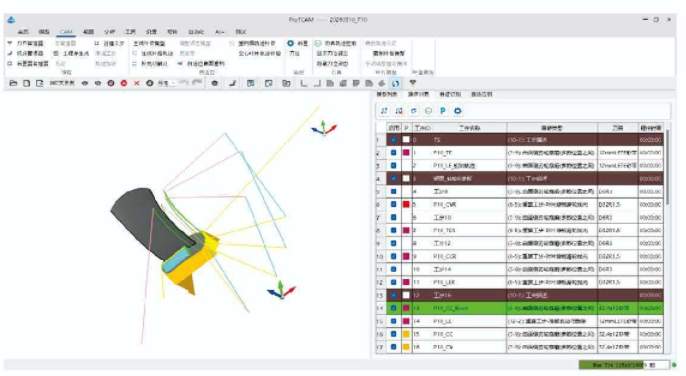
This core software is built on a fully domestically developed geometric engine platform with independently controllable core algorithms, including trajectory solving strategies for complex surface geometries. Key features include:
- Best Fit Alignment: Automatically fits the optimal part position based on actual measurement data, generating an aligned coordinate system as the machining reference.
- Positional Deviation Reverse Compensation: Metal 3D-printed parts often exhibit significant deformation. To control positional accuracy of cross-sections after machining, the system applies reverse deformation compensation to toolpaths using measurement data.
- Surface Processing: Powered by an independent geometric engine, it handles model processing including surface un-trimming (repairing incomplete surfaces with holes, gaps, or seams to restore original untrimmed geometry) and surface reconstruction (rebuilding multi-surface part models into a single unified surface).
Proprietary Hardware Technology
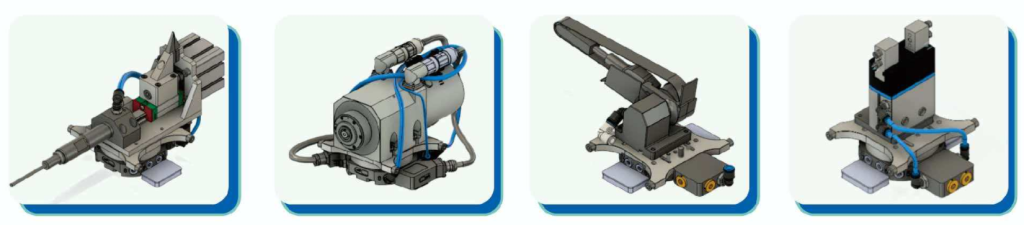
Like skilled technicians, Forgecise robots handle diverse tools with precision:
- Motion Chain Calibration: Uses optical measurement to automatically calibrate 8-axis robots with high accuracy, requiring no external sensors or manual intervention.
- Inspection Device: Employs optical measurement for automatic calibration of 8-axis robots, achieving high precision without external sensors or manual operation.
- Scanner Reference Frame: Aligns the 3D scanner coordinate system with the robot coordinate system via hand-eye calibration, enabling scan-based workpiece positioning and flexible fixturing.
- Tool Center Point (TCP): Individually calibrates all tools—including spindles, abrasive belts, chisels, and grippers—to establish a complete motion chain from cutting edge to workpiece.
Adaptive Tooling for Diverse Applications
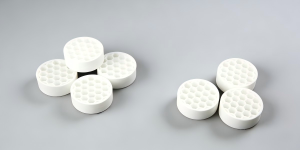
The system supports multiple end-effector and tool combinations, customizable to specific post-processing workflows. Optimal tool configurations are selected based on part series and surface finishing requirements, including five typical tools:
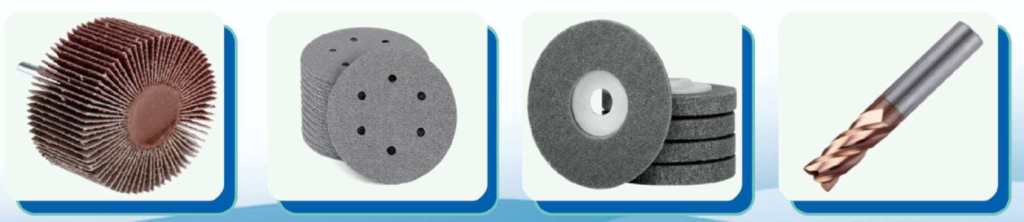
① Non-woven abrasive wheel (flap wheel)
② Perforated disc sandpaper
③ Center-hole flat grinding wheel
④ PCD-coated end mill
Key Application Industries & Customization Services
Forgecise’s intelligent robotic post-processing system is engineered for industries where metal AM parts demand high precision, reliability, and compliance with stringent standards:
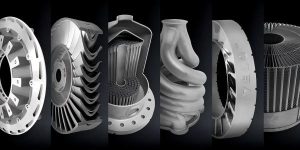
- Aerospace & Aviation: Finishing turbine blades, fuel nozzles, lightweight brackets, and heat exchangers with internal channels; removing supports from titanium/aluminum alloy parts while preserving fatigue strength and aerodynamic surfaces.
- Medical Devices & Implants: Polishing orthopedic implants, dental frameworks, and surgical instruments to biocompatible mirror finishes; deburring porous/lattice structures without damaging delicate features or introducing contaminants.
- Automotive & Motorsport: Post-processing lightweight structural components, exhaust manifolds, and custom cooling systems; ensuring dimensional accuracy for high-performance parts produced in small batches.
- Energy & Power Generation: Finishing gas turbine components, nuclear reactor parts, and oil/gas valves; handling high-temperature alloys (e.g., Inconel, cobalt-chrome) with consistent surface integrity.
- Industrial Machinery & Tooling: Deburring and polishing conformal cooling molds, jigs, and fixtures; adapting to varied geometries and materials without retooling.
Forgecise provides full customization services to match unique customer needs:
- Process-Specific Tooling Design: Tailoring end-effectors, abrasives, and cutting tools to part geometry, material, and surface finish requirements (e.g., soft brushes for lattice structures, rigid wheels for sealing surfaces).
- Software Integration & Workflow Optimization: Adapting ProTCAM to existing CAD/CAM ecosystems, integrating CT/CMM data for closed-loop correction, and developing custom trajectory strategies for proprietary AM processes.
- Turnkey Automation Cells: Designing and deploying complete robotic workcells with safety enclosures, dust extraction, and in-process inspection, scaled from R&D labs to high-volume production lines.
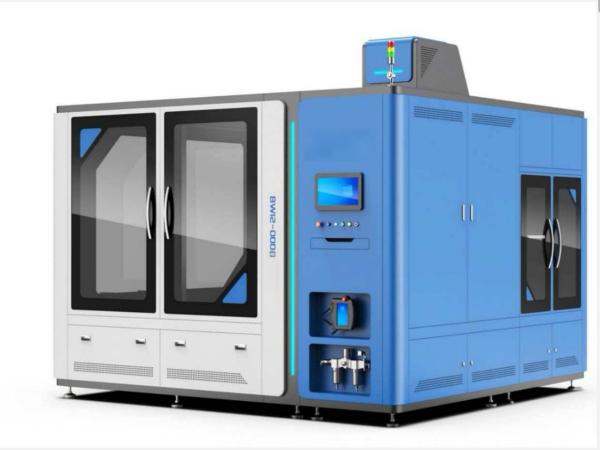
The Forgecise additive manufacturing support removal robot is engineered to solve the most critical bottleneck in metal 3D printing post-processing: efficient, precise AM support structure removal. Unlike manual or CNC-based methods, this robotic deburring 3D printed parts system integrates proprietary ProTCAM software with adaptive hardware to automate automated AM finishing across complex geometries—including lattice structure polishing and internal channels—without dimensional deviation. It excels at titanium alloy support removal and other high-value AM materials, making it ideal for aerospace, medical, and automotive applications. As a fully customizable platform, Forgecise delivers tailored custom AM post-processing solution s that transform support removal from a cost center into a streamlined, value-adding step in the additive manufacturing workflow.