






By Felix Lee, CEO at Forgecise | Published July 2026
Quick Summary: High-performance and luxury carmakers have moved 3D printing out of the prototype lab and onto the assembly line. Because supercars and limited-run vehicles use low production numbers, traditional factory molds cost too much. Today, manufacturers use additive printing for polymer cabin trims, aerospace-grade titanium exhausts, large body panels, solid gold controls, and structural chassis frames.
Table of Contents
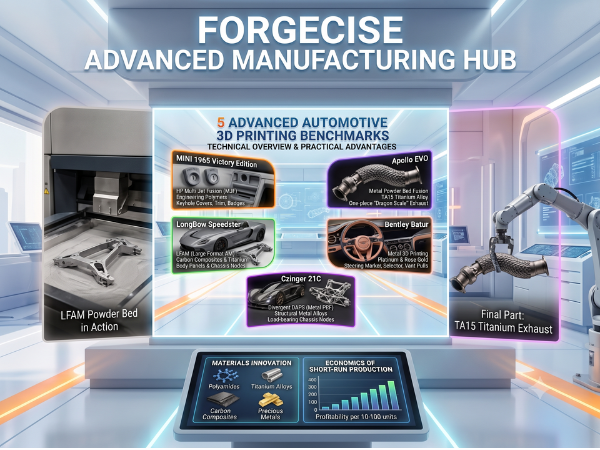
Technical Overview: 5 Benchmark Case Studies
| Vehicle / Brand | Printing Method | Material | End-Use Components | Main Practical Advantage |
|---|---|---|---|---|
| MINI 1965 Victory Edition | HP Multi Jet Fusion (MJF) | Engineering Polymers | Ignition keyhole covers, interior trim, steering wheel badges | Direct digital production from design to final parts |
| Apollo EVO | Metal Powder Bed Fusion | TA15 Titanium Alloy | One-piece “Dragon Scale” exhaust (123-hour print time) | Spreads out heat while adding geometric detail |
| LongBow Speedster | Large Format Additive Manufacturing (LFAM) | Carbon Composites & Titanium | Body panels (printed in 60 days) and chassis node connectors | Vehicle weight under 1,000 lbs (454 kg); fast body build |
| Bentley Batur | Metal 3D Printing | Platinum & Rose Gold | Steering wheel marker (Convertible #4), drive selector, air vent pulls | Custom precious metal parts without casting molds |
| Czinger 21C | Divergent DAPS (Metal PBF) | Structural Metal Alloys | Primary load-bearing chassis nodes | Road-certified structural frame printed from software models |
How 3D Printing Fits High-End Automotive Manufacturing
Automotive engineers used to view 3D printing as a fast way to make plastic mockups. That has changed. Today, niche vehicle builders put printed parts directly into high-performance cars.
Luxury cars and hypercars present three distinct manufacturing challenges:
- They require lightweight, high-strength parts.
- Production runs are small (often between 1 and 1,000 units).
- Buyers expect high levels of personalization.
Because building steel stamping dies or injection molds for a small run costs millions of dollars, additive printing offers a sensible alternative. Below are five recent examples showing how carmakers use this technology.
1. MINI 1965 Victory Edition: Digital Production Across the Build Cycle
BMW Group used additive printing across the full lifecycle of its limited MINI 1965 Victory Edition. Rather than restricting the tech to early design checks, engineers kept the digital files active straight through to final assembly.
- Technology: HP Multi Jet Fusion (MJF), a powder-bed polymer process built for consistent part strength.
- Parts Printed:
- Commemorative keyhole covers
- Custom interior decorative trim
- Steering wheel badges
- Practical Result: MINI skipped traditional tooling lead times, moving straight from computer models to finished cabin parts.
2. Apollo EVO: TA15 Titanium “Dragon Scale” Exhaust
Apollo Automobil built a single-piece titanium exhaust for its Apollo EVO hypercar. Named the “Dragon Scale” exhaust due to its textured outer surface, the component combines visual detail with thermal management.
- Material & Build Time: Aerospace-grade TA15 titanium alloy. Printing the single-piece exhaust takes roughly 123 hours.
- Design Purpose: The raised scale geometry is not just for looks. The texture increases the outer surface area of the pipe, helping dissipate high exhaust heat during hard driving.
- Practical Result: Apollo consolidated multiple exhaust pieces into one light, heat-tolerant titanium assembly.
3. LongBow Speedster: Large Body Panels Printed in 60 Days
British electric vehicle maker LongBow Motors used Large Format Additive Manufacturing (LFAM)—a large-scale extrusion method—to build body structures for its LongBow Speedster.
- Production Speed: Supplier RYSE 3D printed the full set of exterior body panels in 60 days.
- Vehicle Specs: The Speedster weighs less than 1,000 lbs (454 kg). To hit this target, the design uses:
- Lightweight composite body panels.
- 3D printed titanium node connectors joining the frame.
- Practical Result: LFAM allows small carmakers to produce full-size exterior panels without buying expensive press dies.
4. Bentley Batur: Solid Platinum and Gold Interior Trim
Bentley’s custom coachbuilding arm, Mulliner, offers printed precious metal interior parts for its limited Bentley Batur line.
- Platinum Applications: For a client’s Convertible #4 vehicle, Bentley printed a solid platinum marker installed at the top center of the steering wheel.
- Rose Gold Applications: Buyers can also choose 3D printed rose gold elements, including:
- The drive mode selector ring around the start button
- Steering wheel center markers
- Dashboard “organ-stop” air vent controls
- Practical Result: Bentley delivers hallmarked, solid gold and platinum interior features without creating specialized metal molds for single buyers.
5. Czinger 21C: Printed Metal Nodes for the Main Chassis Frame
Czinger Vehicles built its 21C hypercar around a 3D printed structural frame. Instead of limiting printed metals to brackets, Czinger uses additive nodes for the main chassis.
- Manufacturing System: The chassis uses the Divergent Adaptive Production System (DAPS), a software-driven process using metal powder bed fusion.
- Road & Track Testing: The Czinger 21C has completed track testing, public demonstrations, and structural safety checks required for vehicle homologation.
- Practical Result: Czinger proved that 3D printed metal joints can meet strict road-safety and crash standards in high-speed vehicles.
Three Clear Industry Trends
Looking across these five applications shows three practical shifts in automotive manufacturing:
- New Feedstock Materials: Production has grown from standard plastics to aerospace titanium, carbon fiber composites, and precious metals.
- Deeper Vehicle Integration: Printed parts have moved from decorative interior badges to structural chassis joints and hot exhaust pipes.
- Better Production Economics: Skipping hard tooling makes small production runs profitable right away.
Frequently Asked Questions
Why do supercar makers use 3D printing instead of metal casting?
3D printing eliminates expensive tooling molds for short production runs while saving weight. Casting requires costly initial dies that make low-volume manufacturing impractical. Printing lets engineers create light, complex parts directly from CAD files without upfront tooling costs.
Are 3D printed metal parts strong enough for vehicle chassis frames?
Yes, 3D printed metal joints pass standard crash tests and structural safety checks. The Czinger 21C hypercar uses metal powder-bed printed chassis nodes that met full vehicle homologation standards for road use.
What materials are car companies 3D printing today?
Carmakers print engineering polyamides, titanium alloys, carbon composites, and precious metals. Common examples include HP MJF nylon for cabin badges, TA15 titanium for exhausts, composite polymers for body panels, and solid platinum or gold for custom trim.
Final Thoughts
These five cases show that 3D printing in luxury cars has moved past basic testing. As machinery speeds improve and metal powder costs settle, expect these techniques to move from limited hypercars down into specialized electric vehicles and lower-volume premium cars.
About the Author
Felix Lee is the CEO at Forgecise, a digital manufacturing firm focused on industrial additive applications, supply chain strategy, and advanced vehicle structures.