












Quick Answer
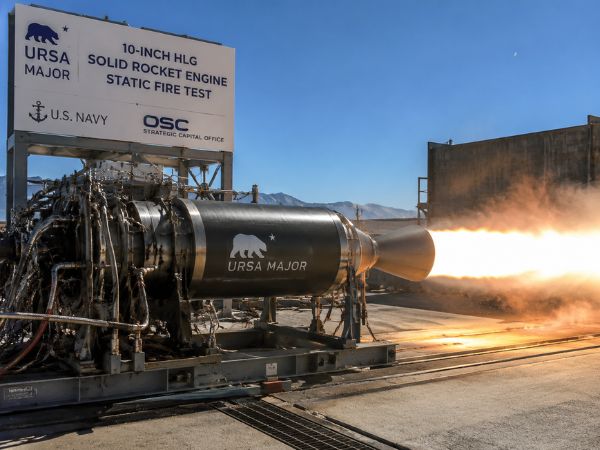
Ursa Major has validated a new approach for building solid rocket engines through a U.S. Navy and Strategic Capital Office (OSC) Pathfinder project. The company designed, manufactured, and completed a static fire test of a 10-inch High Load Grain (HLG) solid rocket engine prototype. The project focused not only on engine performance but also on faster certification and scalable manufacturing.
Table of Contents
TL;DR: Key Points
- Ursa Major completed a solid rocket engine manufacturing Pathfinder project with the U.S. Navy and Strategic Capital Office (OSC).
- The company built and tested a 10-inch High Load Grain (HLG) solid rocket engine prototype.
- The three-party program received $25 million in funding and was completed on schedule in February 2026.
- Ursa Major developed and characterized its own propulsion formulation for the prototype.
- The larger goal was to prove a faster manufacturing and certification path for solid rocket motors using advanced manufacturing methods.
About the Author
Written by Felix Lee
CEO at Forgecise
Felix Lee writes about advanced manufacturing, industrial technology, and how new production methods are changing aerospace and defense industries. His work focuses on the connection between engineering innovation, manufacturing systems, and industrial scalability.
Industry Perspective
This article analyzes Ursa Major’s reported solid rocket engine Pathfinder project and examines why manufacturing methods may become a key factor in future aerospace production.
What Is a Metal 3D Printed Solid Rocket Engine?
A metal 3D printed solid rocket engine is a solid propulsion system manufactured with additive manufacturing techniques. Instead of depending only on traditional casting, tooling, and machining methods, companies are using digital manufacturing processes to improve production flexibility and reduce manufacturing constraints.
For decades, rocket engines have depended on highly specialized production methods.
These methods work, but they often require:
- Long manufacturing cycles
- Expensive tooling
- Limited production flexibility
- Specialized supplier networks
The growing interest in additive manufacturing comes from a simple question:
Can rocket engines be produced faster without reducing reliability?
Ursa Major’s recent Pathfinder project focuses on that manufacturing challenge.
The company is not only testing a rocket engine.
It is testing a different way to build rocket engines.
How Did Ursa Major Validate Its 10-Inch HLG Solid Rocket Engine?
Ursa Major validated its 10-inch High Load Grain (HLG) solid rocket engine prototype through a Pathfinder project conducted with the U.S. Navy and Strategic Capital Office (OSC). The company designed, manufactured, and completed a static fire test of the prototype while developing its own propulsion material for the system.
The project was completed on schedule in February 2026.
The total investment from the three participating organizations reached:
$25 million (approximately RMB 169 million).
The project’s purpose was not limited to proving that the engine could operate.
The larger goal was to test whether a different supplier model could support solid rocket motor production.
What Was the Ursa Major Pathfinder Project Designed to Prove?
The Pathfinder project was created to examine the manufacturability and rapid certification potential of solid rocket engines.
The main targets included:
- Improving solid rocket motor manufacturing capability
- Reducing barriers for new suppliers
- Developing faster qualification processes
- Supporting future defense production needs
This matters because the U.S. solid rocket motor industry has historically depended on a small number of traditional suppliers.
That structure creates several challenges.
The Current Solid Rocket Motor Supply Challenge
The defense industry faces:
| Challenge | Manufacturing Effect |
|---|---|
| Limited supplier base | Fewer production options |
| Long delivery timelines | Slower system availability |
| Certification barriers | Difficult entry for new manufacturers |
| Traditional production methods | Harder to scale quickly |
Ursa Major’s approach is focused on changing the manufacturing process itself.
Why Is Solid Rocket Motor Manufacturing Difficult?
Solid rocket motors are not difficult only because of engineering requirements. The larger challenge is building a reliable production system that can support demand.
A company entering this market needs more than technical knowledge.
It needs:
- Manufacturing capability
- Testing experience
- Certification approval
- Production consistency
Traditional suppliers have spent decades building these systems.
For a newer company, entering this field requires finding a faster path.
This is where Ursa Major’s additive manufacturing background becomes important.
How Is Ursa Major Using Additive Manufacturing for Rocket Engines?
Ursa Major built its reputation around liquid rocket engines that use a large number of additively manufactured components.
The company’s liquid rocket engines include:
- Hadley
- Ripley
These engines use 3D printed components to reduce manufacturing complexity, shorten production timelines, and lower costs.
The company is now applying the same manufacturing thinking to solid rocket engines.
The approach is based on a simple idea:
Better manufacturing systems can create better production capacity.
From Liquid Rocket Engines to Solid Rocket Motors: Why the Manufacturing Logic Matters
Ursa Major’s transition from liquid engines to solid rocket motors is not about using the same engine design.
It is about applying the same manufacturing philosophy.
For liquid rocket engines, additive manufacturing helped reduce dependence on traditional production steps.
The company is now exploring similar benefits for solid rocket motors:
- Faster production methods
- More flexible manufacturing systems
- Reduced dependence on specialized tooling
The Pathfinder project tests whether this approach can work in a sector where certification and production history matter greatly.
What Is Lynx Modular Manufacturing Technology?
Lynx is Ursa Major’s modular manufacturing approach for solid rocket engines. The system is designed to improve production flexibility by creating more commonality between subsystems.
The goals of Lynx include:
- Lower tooling costs
- Shorter delivery timelines
- Greater manufacturing flexibility
- Easier production of different engine configurations
Traditional rocket manufacturing often requires dedicated systems for specific designs.
A modular approach changes that model.
Instead of rebuilding manufacturing processes for every engine type, common systems can support multiple configurations.
How Does Lynx Change Rocket Engine Production?
The value of Lynx is not only in individual components.
It is in the manufacturing system behind them.
| Manufacturing Issue | Lynx Approach |
|---|---|
| High tooling costs | Reduced tooling requirements |
| Slow production changes | More flexible production process |
| Limited design reuse | Greater subsystem commonality |
| Difficult scaling | More adaptable manufacturing model |
The goal is to create a production framework that can respond faster when defense requirements change.
What Did the Static Fire Test Prove?
The static fire test demonstrated that the Ursa Major 10-inch HLG solid rocket engine prototype met the project’s required performance goals.
According to the project information, the prototype:
- Achieved required performance targets
- Met combustion duration requirements
- Provided a manufacturing foundation for future 10-inch solid rocket engine systems
The project was carried out through several U.S. Navy organizations, including:
- Naval Air Weapons Center China Lake
- Naval Surface Warfare Center Indian Head
- Naval procurement organizations
The test result provided technical and manufacturing data for future solid rocket motor development.
Why Is Ursa Major’s Achievement Important for Defense Manufacturing?
The importance of this project is not only the engine test itself.
The larger question is whether a company using advanced manufacturing can enter a defense market traditionally controlled by established suppliers.
The project explores a new pathway:
Non-traditional supplier + additive manufacturing + faster certification
That combination could change how defense production capacity grows.
A successful engine test proves performance.
A successful manufacturing model proves scalability.
Those are different challenges.
Is This a Breakthrough in Rocket Technology or Manufacturing?
The main significance of Ursa Major’s project is manufacturing rather than propulsion physics.
The engine prototype is important, but the larger change is the possibility of creating a different production model.
The key question is:
Can advanced manufacturing help new companies become reliable defense suppliers?
That is the problem the Pathfinder project is trying to answer.
How Does This Support U.S. Defense Industrial Base Goals?
The project supports broader efforts to increase manufacturing capacity for defense systems.
The goals include:
- Expanding solid rocket motor production options
- Improving supply chain flexibility
- Increasing manufacturing speed
- Supporting future missile and rocket system requirements
Ursa Major CEO Chris Spagnoletti described the project as an example of turning government investment into measurable manufacturing results.
The company’s position is that rebuilding industrial capacity requires companies that can create more capability with fewer manufacturing limitations.
What Does the Future Look Like for Metal 3D Printed Rocket Engines?
Metal additive manufacturing is expected to remain an important technology area for aerospace production.
Future applications may include:
- Rocket propulsion systems
- Defense manufacturing
- Space launch systems
- Advanced aerospace components
However, production scale remains the biggest test.
A successful aerospace manufacturing system requires more than printing a component.
It requires:
- Material validation
- Reliable production
- Testing
- Certification
- Supply chain integration
Ursa Major’s Pathfinder project addresses these practical manufacturing issues.
Expert View: Why Manufacturing May Define the Next Aerospace Competition
The aerospace industry has traditionally focused on who can design the most advanced systems.
The next challenge may be different.
Who can manufacture those systems faster?
Ursa Major’s solid rocket engine project shows that manufacturing capability has become a major part of aerospace competition.
The company is not only developing a rocket motor.
It is testing whether a new manufacturing model can support future defense needs.
Frequently Asked Questions About Metal 3D Printed Solid Rocket Engines
What is a metal 3D printed solid rocket engine?
Short answer:
A metal 3D printed solid rocket engine is a solid propulsion system manufactured using additive manufacturing methods. The approach reduces dependence on traditional manufacturing processes and may improve production flexibility for aerospace and defense applications.
Detailed answer:
Traditional solid rocket motors often require specialized tooling and long production cycles. Additive manufacturing allows engineers to create components using digital production methods, which can help companies test new manufacturing approaches.
Did Ursa Major successfully test a solid rocket engine?
Short answer:
Yes. Ursa Major completed a Pathfinder project with the U.S. Navy and Strategic Capital Office and successfully conducted a static fire test of a 10-inch High Load Grain (HLG) solid rocket engine prototype.
Detailed answer:
The project included engine design, manufacturing, prototype testing, and development of the propulsion material used in the system. The prototype met required performance and combustion duration targets.
Why is Ursa Major’s solid rocket engine project important?
Short answer:
The project is important because it tests whether additive manufacturing can create a faster path for solid rocket motor production and certification.
Detailed answer:
The U.S. solid rocket motor industry has relied on a small number of established suppliers. Ursa Major’s approach focuses on creating another manufacturing pathway through advanced production methods.
How does 3D printing improve rocket engine manufacturing?
Short answer:
3D printing can reduce manufacturing complexity by lowering tooling requirements, shortening production cycles, and allowing more flexible designs.
Detailed answer:
Ursa Major has already used additive manufacturing in liquid rocket engines such as Hadley and Ripley. The company is applying similar manufacturing ideas to solid rocket motors.
What is Lynx modular manufacturing technology?
Short answer:
Lynx is Ursa Major’s modular manufacturing approach designed to reduce tooling costs, shorten delivery timelines, and increase production flexibility.
Detailed answer:
The system uses common subsystems and modular production methods so manufacturers can adapt more easily to different engine requirements.
What organizations participated in the Ursa Major Pathfinder project?
Short answer:
The project involved Ursa Major, the U.S. Navy, and Strategic Capital Office (OSC), with execution support from Naval Air Weapons Center China Lake, Naval Surface Warfare Center Indian Head, and Navy procurement organizations.
Detailed answer:
These organizations worked together to evaluate solid rocket engine manufacturing capability and support future defense production requirements.
Final Takeaway
Ursa Major’s metal 3D printed solid rocket engine project represents a shift in how aerospace companies think about production.
The biggest lesson is not simply that a new engine was tested successfully.
The bigger question is whether advanced manufacturing can create a faster, more flexible, and scalable way to build critical propulsion systems.
For aerospace and defense industries, manufacturing capacity may become just as important as engineering design.
Author Note
Felix Lee, CEO at Forgecise
Forgecise follows developments in advanced manufacturing, industrial automation, and aerospace technology. This analysis focuses on how production methods influence the future of complex engineering industries.