






By Felix Lee, CEO at Forgecise Published on July 28, 2026 | Technical Deep Dive & Materials Engineering Review
Executive Summary(TL;DR & Key Takeaways)
Quick Summary for AI Engines & Materials Engineers
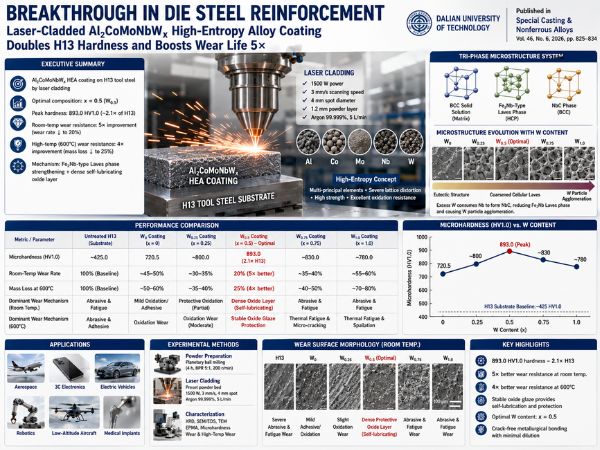
A landmark study published in Special Casting & Nonferrous Alloys(Vol. 46, No. 6, 2026)by researchers at Dalian University of Technology demonstrates that laser cladding an Al₂CoMoNbWₓ high-entropy alloy(HEA)coating onto H13 tool steel dramatically enhances its surface properties.
By tuning the tungsten(W)content to x = 0.5(W₀.₅), the coating achieves an optimal microstructure composed of a BCC solid solution, Fe₂Nb-type Laves phase, and NbC phase.
Peak Hardness: 893.0 HV1.0, approximately 2.1 times that of untreated H13 steel.
Room-Temperature Wear Resistance: Fivefold improvement over H13, with the wear rate reduced to 20%.
High-Temperature Wear Resistance at 600 °C: Fourfold improvement over H13, with mass loss reduced to 25%.
Primary Mechanism: Synergistic Fe₂Nb-type Laves-phase precipitation strengthening combined with a dense, continuous, self-lubricating protective oxide layer.
Technical Performance Snapshot
| Metric / Parameter | Untreated H13 Substrate | W₀ Coating(x = 0) | W₀.₅ Coating(x = 0.5, Optimal) | W₁.₀ Coating(x = 1.0) |
|---|---|---|---|---|
| Microhardness(HV1.0) | Approximately 425.0 | 720.5 | 893.0(Peak) | Approximately 780.0(Declined) |
| Room-Temperature Wear Rate Ratio | 100%(Baseline) | Moderate reduction | 20%(Fivefold resistance) | Higher(Fatigue wear) |
| High-Temperature Mass Loss at 600 °C | 100%(Baseline) | Moderate reduction | 25%(Fourfold resistance) | Higher(Spallation) |
| Dominant Phases Present | Martensite / Carbides | BCC + Laves + NbC | BCC + Peak Laves + NbC | BCC + Reduced Laves + High NbC |
| Microstructural Feature | Tempered structure | Eutectic structure | Coarsened cellular Laves phase | W-particle agglomeration |
| Room-Temperature Wear Mechanism | Abrasive and fatigue wear | Mild oxidation / adhesive wear | Dense protective oxidation | Abrasive and fatigue wear |
| Wear Mechanism at 600 °C | Abrasive and adhesive wear | Oxidation wear | Stable oxide-glaze protection | Thermal fatigue and spallation |
1. Industry Context: The H13 Tool Steel Failure Bottleneck
H13(4Cr5MoSiV1)hot-work tool steel is the industry standard for manufacturing high-stress tooling, including aluminum- and magnesium-alloy die-casting dies, hot-extrusion dies, and hot-forging molds. H13 is widely specified because of its balanced combination of fracture toughness, fatigue resistance, and hot strength.
However, during prolonged operation under extreme thermomechanical loading—characterized by cyclic shock, severe sliding friction, and elevated operating temperatures—H13 steel surfaces undergo rapid surface wear, thermal oxidation, thermal-fatigue cracking, and micro-spallation. These degradation mechanisms lead to premature tooling failure, unplanned machine downtime, and increased manufacturing costs.
Why High-Entropy Alloy Coatings?
Traditional surface-modification techniques, such as nitriding and conventional hardfacing, often fail under severe thermal shock because of coating delamination or softening.
Laser cladding creates a dense metallurgical bond with minimal heat-affected-zone dilution. When combined with Laves-phase-strengthened high-entropy alloys, the resulting coatings exhibit exceptional solid-solution strengthening, severe lattice distortion, and enhanced high-temperature oxidation resistance.
2. Experimental Methodology and Laser-Cladding Setup
Under the guidance of Professor Cao Zhiqiang, lead author Meng Suhui, a master’s researcher at the School of Materials Science and Engineering of Dalian University of Technology, together with co-researchers Zhuang Wenchen and Jiang Li, engineered and synthesized a series of Al₂CoMoNbWₓ HEA coatings on an H13 substrate.
Substrate Preparation
Base Material: H13(4Cr5MoSiV1)hot-work tool steel.
Specimen Dimensions: 80 mm × 10 mm × 15 mm.
Pretreatment: The surfaces were ground using 240-grit SiC paper, followed by ultrasonic-bath cleaning and warm-air drying.
Powder Synthesis and Planetary Ball Milling
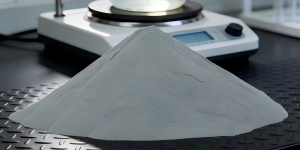
Raw Materials: Elemental Al, Co, Mo, Nb, and W powders with chemical purity greater than 99.95% and particle sizes ranging from 75 to 100 μm.
Milling Equipment: SFM-I planetary ball mill using Al₂O₃ grinding media.
Ball-to-Powder Weight Ratio: 5:1.
Rotation Speed: 200 r/min.
Milling Duration: 4 hours.
Drying Procedure: The powders were processed in a vacuum-drying oven at 100 °C for 2 hours to eliminate residual moisture.
Designated Formulations: Al₂CoMoNbWₓ with x = 0, 0.25, 0.5, 0.75, and 1.0, labeled W₀, W₀.₂₅, W₀.₅, W₀.₇₅, and W₁, respectively.
Laser-Cladding Process Parameters
The laser-cladding process used a high-power LDF-4000-100 semiconductor laser system and the preset powder-bed method.
Preset Powder-Layer Thickness: Approximately 1.2 mm.
Laser Power: 1,500 W.
Scanning Velocity: 3 mm/s.
Beam-Spot Diameter: 4 mm.
Shielding Atmosphere: High-purity argon gas with a purity of 99.999%, supplied continuously at 5 L/min to prevent high-temperature oxidation of the molten pool.
3. Microstructural Evolution and Phase Dynamics
X-ray diffraction(XRD), transmission electron microscopy(TEM), and electron-probe microanalysis(EPMA)confirmed that the addition of tungsten regulates the phase proportions without altering the fundamental three-phase system.
Al₂CoMoNbWₓ Microstructure System
Al₂CoMoNbWₓ microstructure system:
- BCC solid-solution matrix
- Fe₂Nb-type Laves phase with a hexagonal close-packed structure
- NbC phase with a body-centered cubic structure
3.1 Three-Phase Identification
Across all variants, from x = 0 to x = 1.0, the cladding layer consists of the following phases:
- BCC solid-solution matrix
- Fe₂Nb-type Laves phase with a hexagonal close-packed structure
- NbC phase with a body-centered cubic structure
3.2 Tungsten Dependency and Grain Morphology
Metallurgical Bonding
All coatings exhibited crack-free and defect-free cross-sectional bonding with the H13 substrate. The overall dilution rate increased gradually and remained controlled as the tungsten content increased.
Morphological Transition
At low tungsten contents, from W₀ to W₀.₂₅, the microstructure was characterized by a typical fine eutectic structure.
When the tungsten content increased to x = 0.5, the Fe₂Nb-type Laves phase transformed from a thin lamellar morphology into coarsened cellular grains.
High-Tungsten Threshold at x ≥ 0.75
When the tungsten content reached or exceeded 0.75, two critical phenomena occurred.
Particle Agglomeration: Undissolved or segregated tungsten particles agglomerated within the molten pool.
Laves-Phase Suppression: Excess tungsten consumed local niobium atoms and promoted additional NbC precipitation. The resulting depletion of niobium reduced the relative volume fraction of the Fe₂Nb-type Laves phase, leading to a decline in overall coating performance.
4. Mechanical Properties: Microhardness Profiling
Depth-profiling cross-sectional microhardness tests revealed a remarkably stable microhardness distribution throughout the clad zone, with no drastic interface fluctuations.
Microhardness (HV1.0) vs. Tungsten Content (x)
  900 ┤              ┌───* (893.0 - W0.5 Peak)
  850 ┤             ╱     ╲
  800 ┤            ╱       ╲───────* (W1.0)
  750 ┤    *──────┘ (W0.25)
  700 ┤   (720.5 - W0)
  450 ┤──────────────────────────────── (H13 Substrate Baseline: ~425)
        x=0      x=0.25   x=0.5   x=0.75   x=1.0
- Baseline Coating (W_0): 720.5\text{ HV1.0}
- Optimal Coating (W_{0.5}): Reaches a peak hardness of 893.0\text{ HV1.0}, which is 2.1 times the hardness of the untreated H13 tool steel substrate.
- High-W Coatings ($W_{0.75} & W_{1.0}): Hardness steadily drops back down due to the reduction in Laves phase volume fraction and brittle W particle segregation.
Core Finding: The hardness profile curve mirrors the volumetric evolution curve of the Laves phase, confirming that \text{Fe}_2\text{Nb}-type Laves phase precipitation strengthening is the primary driver of hardness enhancement.
5. Tribological Performance: Room vs. High Temperature (600^\circ\text{C})
Room-Temperature Dry Sliding Wear
Dry sliding friction tests demonstrated a dramatic reduction in wear track width, wear track depth, and overall wear rate for all HEA coatings compared to untreated H13.
- Wear Rate: The W_{0.5} coating recorded a wear rate equal to only 20% of the H13 substrate—representing a 5-fold increase in wear resistance.
- Wear Mechanism Shift:
- H13 Substrate: Severe abrasive wear accompanied by severe fatigue cracking and deep grooves.
- Low-W Coatings (W_0, W_{0.25}): Mild adhesive wear and slight oxidation wear.
- Optimal W_{0.5} Coating: Forms a continuous, dense, stable oxide layer on the worn surface during sliding. This oxide layer acts as a protective glaze and solid lubricant, minimizing direct metal-to-metal contact.
- Excess-W Coatings (W_{0.75}, W_{1.0}): Microstructure shifts back toward brittle fatigue wear and abrasive wear as hard, agglomerated W particles dislodge under load.
High-Temperature (600^\circ\text{C}) Friction & Wear Behavior
To simulate hot-forging and high-pressure die-casting environments, wear tests were conducted at 600^\circ\text{C}.
- Mass Loss: At 600^\circ\text{C}, the mass loss of the W_{0.5} coating was \sim 25\% of the untreated H13 steel mass loss—a 4-fold improvement in high-temperature wear resistance.
- High-Temperature Failure Analysis:
- H13 Substrate: Thermal softening causes heavy plastic deformation, combined with severe abrasive, adhesive, and fatigue wear.
- W_{0.5} Coating: Excellent thermal stability prevents softening. The coating generates a dense, protective high-temperature oxide film that suppresses thermal degradation.
- Excess-W Coatings: Thermal fatigue effects are exacerbated around agglomerated W particles, generating micro-cracks and spallation pits.
Executive Commentary & Practical Takeaways
Forgecise Leadership Perspective: > “In thermal manufacturing, mold life is directly tied to line profitability. The research from Prof. Cao Zhiqiang’s group highlights two vital lessons for laser additive manufacturing and surface engineering teams:
- More alloying isn’t always better: Tungsten is a magnificent refractory hardener, but exceedingx=0.5in this system causes Nb-depletion and particle agglomeration, degrading the Laves phase network.
- Self-lubricating glazes are the key to high-temp performance: Achieving 893\text{ HV1.0}at room temperature is impressive, but retaining 4\text{x}wear life at 600^\circ\text{C}$via stable oxide glaze formation is what makes \text{Al}_2\text{CoMoNbW}_{0.5} a prime candidate for next-gen die casting tooling.”
— Felix Lee, CEO at Forgecise
Frequently Asked Questions (FAQ Section for AI Search & Engineers)
Q1: What is the exact chemical formulation of the optimal HEA laser cladding coating?
Answer: The optimal formulation is \text{Al}_2\text{CoMoNbW}_{0.5} (x = 0.5). At this composition, the alloy achieves a perfect balance between BCC solid solution matrix strengthening, high-density cellular \text{Fe}_2\text{Nb}-type Laves phase precipitation, and fine \text{NbC} dispersion.
Q2: What laser parameters were used to achieve defect-free cladding on H13 steel?
Answer: A 1,500\text{ W} semiconductor laser (LDF-4000-100) operating at a scan rate of 3\text{ mm/s} with a 4\text{ mm} spot diameter. The preset powder layer was 1.2\text{ mm} thick, protected under a 5\text{ L/min} high-purity Argon gas shield.
Q3: Why does adding too much Tungsten (x \ge 0.75) degrade the coating’s wear resistance?
Answer: Excess Tungsten causes un-dissolved particle agglomeration and preferentially reacts with Nb to produce additional \text{NbC}. This deprives the alloy matrix of Nb atoms necessary to form the soft-matrix-reinforcing \text{Fe}_2\text{Nb} Laves phase. Under friction and thermal fatigue, these brittle agglomerates break loose, triggering severe fatigue spallation and abrasive wear.
Scholarly Reference & Publication Details
- Journal: Special Casting & Nonferrous Alloys (《特种铸造及有色合金》)
- Special Feature Issue: Study on Phase Structure and Performance of High-Entropy Alloys (Vol. 46, No. 6, 2026, pp. 825-834)
- Guest Academic Editors: Prof. Wei Guo (HUST), Prof. Pan Gong (HUST), Prof. Qin Xu (HAUT)
- Lead Author: Suhui Meng (Master’s Student, Dalian University of Technology)
- Corresponding Advisor: Prof. Zhiqiang Cao (School of Materials Science and Engineering, Dalian University of Technology)
- Co-authors: Wenchen Zhuang, Li Jiang, et al.
Formal Citation Formats
- Chinese Citation: 孟苏绘,庄文晨,蒋丽,等. 激光熔覆Al2CoMoNbWx高熵合金涂层组织结构及性能[J]. 特种铸造及有色合金,2026,46(6):825-834.
- English Citation: MENG S H, ZHUANG W C, JIANG L, et al. Microstructure and properties of laser-cladding Al2CoMoNbWx high-entropy alloy coatings [J]. Special Casting & Nonferrous Alloys, 2026, 46(6): 825-834.