




Published: August 2026
Last Updated: August 2026
Written by:
Felix Lee, CEO at Forgecise
Technical Review:
Forgecise Engineering Team
Table of Contents
Quick Answer
Wire EDM (Wire Electrical Discharge Machining, WEDM) is a precision cutting process used in metal 3D printing post-processing to remove build plates, separate supports, and create accurate profiles. Because Wire EDM cuts through electrical discharge instead of physical cutting force, it helps protect titanium, nickel alloy, and other stress-sensitive additive manufactured parts from deformation.
TL;DR
- Wire EDM is widely used after SLM and DED metal 3D printing to separate parts from build plates.
- It creates almost no mechanical cutting force, making it suitable for thin-wall and high-stress components.
- Slow Wire EDM provides higher accuracy and better surface finish than Fast Wire EDM.
- Cutting parameters control surface quality, heat affected zone (HAZ), and recast layer thickness.
- Wire EDM and CNC machining work together: Wire EDM handles separation and profiles, while CNC completes complex finishing.
About the Author
Felix Lee is the CEO at Forgecise, focusing on metal additive manufacturing workflows, industrial 3D printing applications, and post-processing solutions. His work involves helping manufacturers improve the reliability of metal printed components through better machining processes, quality control, and production planning.
This article shares engineering knowledge about Wire EDM used in metal additive manufacturing. Actual production parameters must always be validated according to machine type, material grade, geometry, and quality requirements.
What Is Wire EDM and How Does It Work?
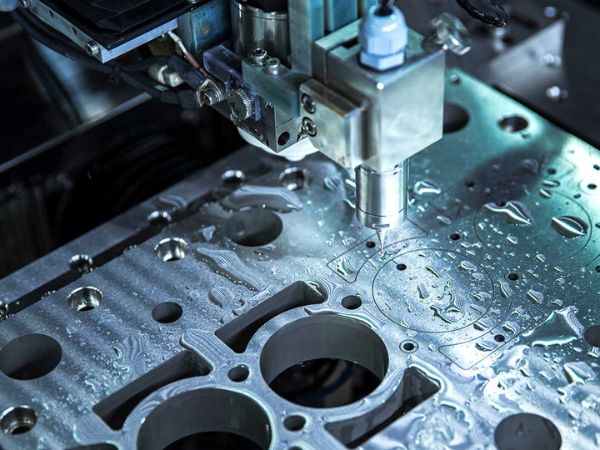
Wire EDM is a non-contact machining process that removes metal through controlled electrical sparks. A thin metal wire acts as an electrode. When a pulsed voltage is applied between the wire and the workpiece, repeated electrical discharges create high temperatures that melt and remove small amounts of material.
The process happens inside a dielectric fluid that controls the discharge and removes machining particles.
Unlike traditional cutting, Wire EDM does not push a cutting tool against the part.
This creates several advantages:
- Almost no mechanical cutting force
- Low risk of part deformation
- Ability to machine hard materials
- Suitable for fragile and stress-sensitive components
For metal additive manufacturing, this is important because printed parts often contain residual stress from repeated heating and cooling during the printing process.
What Materials and Fluids Are Used in Wire EDM?
Wire EDM commonly uses several types of electrode wires:
- Brass wire
- Zinc-coated wire
- Molybdenum wire
The working fluid depends on the machine type.
Slow Wire EDM (LS-WEDM)
Slow Wire EDM uses deionized water.
The wire moves in one direction and is discarded after use.
It provides:
- Higher accuracy
- Better surface quality
- Lower recast layer thickness
Slow Wire EDM is commonly used for aerospace and precision metal additive manufacturing parts.
Fast Wire EDM (HS-WEDM)
Fast Wire EDM usually uses emulsion-based working fluid.
The wire moves back and forth and can be reused.
It provides:
- Higher cutting speed
- Lower operating cost
However, accuracy and surface finish are usually lower compared with Slow Wire EDM.
Why Is Wire EDM Used After Metal 3D Printing?
Metal 3D printing creates complex parts, but the printed component usually requires additional processing before final use.
Processes such as:
- Selective Laser Melting (SLM)
- Directed Energy Deposition (DED)
often produce parts attached to a build plate.
The part must be removed without changing its geometry.
This is where Wire EDM becomes valuable.
Removing Parts From the Build Plate
The most common use of Wire EDM in additive manufacturing is separating printed parts from the substrate.
During printing, components are connected to the build plate through:
- Support structures
- Manufacturing tabs
- Base connections
Wire EDM can cut these areas with minimal stress.
This is especially useful for:
- Titanium aerospace parts
- Thin-wall structures
- High-value components
A milling operation may create pressure through clamping and cutting forces. Wire EDM avoids this problem because the wire never physically pushes against the material.
Removing Difficult Support Structures
Some support structures are difficult to remove manually or with traditional machining.
Wire EDM helps remove:
- Large support blocks
- Strong metallic supports
- Areas close to sensitive features
This reduces the chance of damaging expensive printed components.
Creating Precision Profiles
Wire EDM can also create accurate through-profile features.
Typical applications include:
- Slots
- Holes
- Precision contours
- Dimensional correction areas
However, Wire EDM has limits.
It mainly follows a two-dimensional cutting path.
It cannot replace CNC machining for:
- Closed cavities
- Complex 3D surfaces
- Multi-axis finishing
The best production approach usually combines both technologies.
Slow Wire EDM vs Fast Wire EDM: Which One Should You Choose?
The choice depends on the required accuracy, surface quality, and production cost.
| Feature | Slow Wire EDM | Fast Wire EDM |
|---|---|---|
| Wire movement | Single direction | Recirculating |
| Accuracy | Higher | Lower |
| Surface finish | Better | Rougher |
| Cost | Higher | Lower |
| Typical use | Aerospace precision parts | Rough cutting and support removal |
Slow Wire EDM Performance
For precision additive manufacturing components, Slow Wire EDM is usually preferred.
Typical results:
- Accuracy: up to ±0.005 mm
- Surface roughness: Ra <1.6 μm
- Fine finishing: approximately Ra <0.8 μm
- Thin recast layer
Common materials include:
- Titanium alloys
- Nickel-based superalloys
Fast Wire EDM Applications
Fast Wire EDM is often selected when cutting speed and cost are more important.
Typical uses:
- Support removal
- Rough cutting
- Tooling applications
A common manufacturing strategy is:
Fast Wire EDM for rough removal → Slow Wire EDM for precision finishing
Which Wire EDM Parameters Affect Cutting Quality?
Wire EDM quality depends on several process parameters.
The main factors include:
- Pulse width
- Pulse interval
- Peak current
- Wire speed
- Wire tension
- Working fluid conductivity
- Working fluid temperature
These parameters directly affect:
- Cutting speed
- Surface roughness
- Heat affected zone
- Recast layer thickness
Pulse Energy Control
Higher electrical energy increases cutting speed.
However, excessive energy can create:
- Rough surfaces
- Thick recast layers
- Micro-cracks
- Larger heat affected zones
Lower energy produces better surface quality but reduces cutting efficiency.
Titanium and Nickel Alloy Processing
Titanium and nickel-based superalloys require careful control because they are widely used in aerospace applications.
The main goal is reducing:
- Heat affected zone (HAZ)
- Surface damage
- Micro-crack risk
Recommended practices include:
- Lower single pulse energy
- Controlled cutting speed
- Trial cutting before production
- Approved parameter records
Production parameters should be tested and stored in process documents.
How Does Wire EDM Control Recast Layer and Surface Quality?
Wire EDM creates a thin recast layer because melted material cools and solidifies again after electrical discharge.
This layer is also called a white layer.
It has a different structure from the base material.
For normal parts, it may be acceptable.
For fatigue-sensitive aerospace components, it requires careful control.
Why Is the Recast Layer a Concern?
The recast layer may contain:
- Different microstructure
- Residual stress
- Micro-cracks
A part can pass dimensional inspection but still have surface integrity problems.
How to Reduce Recast Layer Problems
Common methods include:
Multiple Cutting Passes
A typical process:
Rough cut → Finishing cut → Precision finishing
The final passes use lower energy to improve the surface.
Additional Surface Treatment
Possible methods:
- Sand blasting
- Electrochemical polishing
- Chemical milling
For fatigue-critical parts, removing or controlling the recast layer should be part of the manufacturing plan.
How Can Engineers Prevent Deformation During Wire EDM?
Residual stress is one of the biggest concerns in metal additive manufacturing.
During printing, rapid heating and cooling create internal stress.
When supports or build plates are removed, this stress can release.
The result may include:
- Part movement
- Spring-back deformation
- Dimensional errors
What Is the Correct Cutting Sequence?
A common mistake is:
Cut outer profile first → release stress → part changes shape
A safer approach is:
- Keep the part connected to the build plate
- Complete internal precision cutting first
- Remove the final connection last
Additional Stress Control Methods
For large or thin-wall components:
- Use symmetrical cutting
- Use step cutting
- Use jump cutting strategies
- Use temporary support fixtures
Temporary reinforcement may include:
- Low melting point alloy filling
- Special support fixtures
For critical components, engineers may evaluate stress using:
- X-ray residual stress measurement
- Simulation analysis
What Should Designers Consider Before Wire EDM?
Wire EDM planning should start before printing.
Important design considerations include:
Threading Holes
Wire EDM requires the electrode wire to enter the part.
Closed profiles need a threading hole.
Designers should plan:
- Wire access
- Hole position
- Manufacturing allowance
Starting Point Selection
The cutting start point should be located on:
- Non-functional surfaces
- Non-visible areas
- Process tabs
Avoid:
- Precision fitting surfaces
- Sharp corners
- Appearance-critical areas
Starting from sharp edges can increase the risk of corner damage.
How Should Wire EDM Equipment Be Managed?
Stable equipment conditions are necessary for consistent results.
Important controls include:
Wire Diameter
Common wire diameter range:
0.1–0.3 mm
Smaller wires provide higher precision but can break more easily.
Machine Maintenance
Regular checks should include:
- Wire guide condition
- Wire tension
- Position accuracy
- Repeat positioning calibration
A worn guide system can cause:
- Wire vibration
- Accuracy loss
- Poor surface quality
Working Fluid Control
Working fluid affects discharge stability.
Control:
- Conductivity
- Filtration
- Temperature
Slow Wire EDM requires proper deionized water management because temperature changes can affect dimensional accuracy.
What Safety Controls Are Needed for Wire EDM?
Wire EDM uses high-voltage pulse power and industrial fluids.
Safety practices include:
- Proper grounding
- Electrical protection
- Ventilation
- Protective equipment
Fast Wire EDM fluids may cause skin irritation, so operators should use proper handling procedures.
Metal waste, filters, and used fluids should be collected and disposed of according to industrial regulations.
How Does Wire EDM Work With CNC Machining?
Wire EDM and CNC machining solve different manufacturing problems.
Wire EDM is best for:
- Part separation
- Stress-sensitive cutting
- Through-profile machining
CNC machining is best for:
- Complex surfaces
- Closed cavities
- Final dimensional finishing
A typical workflow is:
Metal 3D printing
→ Wire EDM separation
→ Stress relief / heat treatment
→ CNC machining
→ Surface treatment
→ Inspection
→ Laser marking
Common Wire EDM Problems and Solutions
| Problem | Cause | Solution |
|---|---|---|
| Dimension error | Incorrect compensation or machine accuracy | Calibrate machine and adjust settings |
| Surface lines | Unstable discharge | Adjust pulse and wire conditions |
| Thick recast layer | High energy input | Add finishing passes |
| Micro-cracks | Excess heat | Reduce pulse energy |
| Wire breakage | Tension, guide, or fluid problems | Check equipment |
| Deformation | Poor cutting sequence | Change stress release method |
How Should Wire EDM Parts Be Checked After Cutting?
Final inspection should include:
Dimensional Checks
Measure:
- Critical dimensions
- Profile accuracy
- Position accuracy
Surface Inspection
Check:
- Surface roughness
- Cutting marks
- Recast layer
- Micro-cracks
Production Records
For aerospace components, documentation should include:
- Wire EDM parameters
- Wire material batch
- Machine number
- Inspection results
These records should follow the component through production.
FAQ
What is Wire EDM used for in metal 3D printing?
Short answer:
Wire EDM is mainly used to separate printed parts from build plates, remove supports, and create accurate profiles without adding mechanical cutting force.
For metal additive manufacturing, this is valuable because printed parts often contain residual stress. Wire EDM helps protect thin-wall, titanium, and aerospace components from deformation during post-processing.
Is Wire EDM better than CNC machining for metal 3D printed parts?
Short answer:
Wire EDM and CNC machining serve different purposes. Wire EDM is better for stress-free cutting and separation, while CNC machining is better for complex shapes and final finishing.
Many manufacturers use both processes together to improve accuracy and reduce production risk.
Does Wire EDM damage titanium 3D printed parts?
Short answer:
Wire EDM does not create large mechanical deformation, but it can create a recast layer from electrical discharge heat.
For fatigue-sensitive titanium parts, engineers often use finishing passes or additional surface treatments to control this layer.
Why do metal 3D printed parts deform during cutting?
Short answer:
Deformation usually happens because residual stress is released during cutting.
A proper Wire EDM sequence keeps support connections longer and removes material gradually to reduce movement.
What is the difference between Slow Wire EDM and Fast Wire EDM?
Short answer:
Slow Wire EDM provides better accuracy and surface finish, while Fast Wire EDM provides higher cutting speed and lower cost.
Precision aerospace components usually use Slow Wire EDM, while rough support removal often uses Fast Wire EDM.
Final Notes
Wire EDM is not only a cutting method. In metal additive manufacturing, it is part of a larger production strategy.
The best results come from combining:
- Correct Wire EDM selection
- Controlled cutting parameters
- Residual stress planning
- Surface quality management
- CNC finishing
When engineers plan Wire EDM early in the additive manufacturing process, they can reduce deformation risks, improve part quality, and create a more reliable production workflow.
© 2026 Forgecise. Written by Felix Lee, CEO at Forgecise.