





| Category | Property | Value / Range | Unit |
|---|---|---|---|
| Chemical Composition (wt.%) | Fe | Balance | — |
| C | ≤0.07 | wt.% | |
| Si | ≤1.0 | wt.% | |
| Mn | ≤1.0 | wt.% | |
| Cr | 15.0–17.5 | wt.% | |
| Ni | 3.0–5.0 | wt.% | |
| Cu | 3.0–5.0 | wt.% | |
| Nb | 0.15–0.45 | wt.% | |
| P | ≤0.015 | wt.% | |
| S | ≤0.015 | wt.% | |
| O | ≤0.08 | wt.% | |
| N | ≤0.15 | wt.% | |
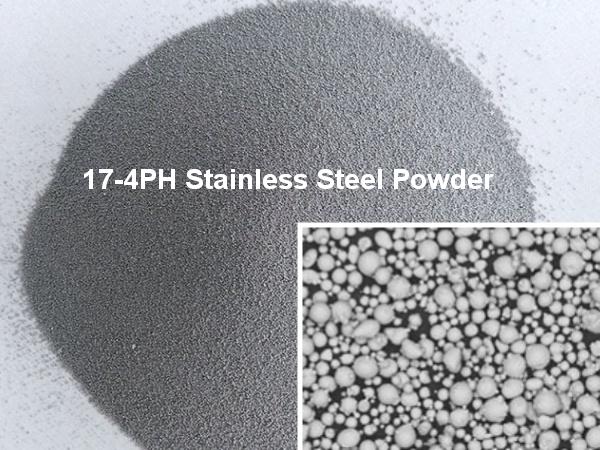
| Physical Properties | Particle Size (D₁₀/D₅₀/D₉₀) | ≥15 / 30–40 / ≤60 | μm |
| Sphericity | ≥0.9 | — | |
| Apparent Density | ≥4.0 | g/cm³ | |
| Tap Density | ≥4.5 | g/cm³ | |
| Flowability | ≤20 | s/50g | |
| Mechanical Properties | Status | Tensile Strength | Yield Strength |
| Heat-Treated | ≥1100 | ≥1000 | |
| Units | MPa | MPa |
> Please note: Specifications are subject to change without notice. Contact a Forgecise representative for the most current technical data.
2. Product Advantages Analysis
Based on the data sheet, the advantages of this 17-4PH powder are:
- Excellent Strength: The heat-treated mechanical properties show a tensile strength of ≥1100 MPa and a yield strength of ≥1000 MPa, indicating it is a high-strength material suitable for load-bearing parts.
- Good Processability: The powder has high sphericity (≥0.9) and excellent flowability (≤20 s/50g), which ensures a smooth powder spreading process during 3D printing (SLM).
- High Density: The high tap density (≥4.5 g/cm³) suggests the powder can achieve high packing density, leading to dense final parts with low porosity.
- Corrosion Resistance: The chemical composition (15-17.5% Cr) provides good corrosion resistance, typical of stainless steels.
3. What is 17-4PH Stainless Powder?
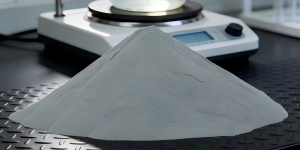
17-4PH Stainless Powder is a Precipitation Hardening Martensitic Stainless Steel Powder.
In Chinese standards, it is commonly designated as 0Cr17Ni4Cu4Nb, corresponding to the European standard 1.4542 and the American UNS number S17400 and SUS630 in Japan. Thanks to its unique combination of ultra-high strength, good corrosion resistance, and excellent processability, this powder has become one of the most widely used high-end stainless steel materials in metal Additive Manufacturing (3D printing) and Metal Injection Molding (MIM).
Here is a detailed breakdown of 17-4PH stainless steel powder:
Key Features & Advantages
1. Extremely High Strength and Hardness
Through a relatively simple solution treatment followed by aging treatment, elements like Copper (Cu) and Niobium (Nb) precipitate as nano-scale phases, producing a powerful strengthening effect.
- Tensile Strength: Can easily exceed 1300 MPa after heat treatment.
- Hardness: Can reach over HRC 40.
- Its strength far surpasses that of standard 304L or 316L stainless steels, making it comparable to ultra-high-strength steels.
2. Good Corrosion Resistance
With approximately 15%-17% Chromium (Cr), along with Nickel (Ni) and Copper (Cu), it performs exceptionally well in most industrial atmospheres, moisture, and moderately corrosive environments. Its corrosion resistance is superior to that of general martensitic stainless steels.
3. Excellent Powder Processability
High-quality 17-4PH powder is typically produced via gas atomization, resulting in a highly spherical morphology. This shape grants the powder outstanding flowability and high apparent density, making it ideal for forming dense, uniform layers in 3D printing recoating or MIM mold filling, thereby ensuring high density and precision in the final parts.
Typical Chemical Composition (wt.%)
| Element | Content Range (%) | Function |
|---|---|---|
| Chromium (Cr) | 15.0 – 17.5 | Provides fundamental corrosion resistance |
| Nickel (Ni) | 3.0 – 5.0 | Enhances toughness and aids corrosion resistance |
| Copper (Cu) | 3.0 – 5.0 | Key element for precipitation hardening |
| Niobium (Nb) | 0.15 – 0.45 | Forms precipitates and prevents intergranular corrosion |
| Iron (Fe) | Balance | Base element |
Major Applications
Due to its comprehensive advantage of requiring “extremely complex shapes, ultra-high strength, and decent corrosion resistance,” 17-4PH powder is widely used in high-end manufacturing sectors:
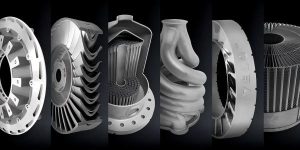
- Aerospace: Aircraft engine fuel nozzles, structural connectors, turbine components, etc.
- Medical Devices: Precision components for surgical instruments, orthopedic implants (such as bone screws and plates), etc.
- Industrial Manufacturing: High-precision molds, high-pressure valves, pump components, bushings, etc.
- Electronics & Automotive: Precision structural parts for mobile phones, automotive transmission sensor housings, fuel system valves, etc.
Quick Comparison: 17-4PH VS 316L Stainless Powder
- 17-4PH: Focuses on ultra-high strength and hardness. Its properties can be significantly adjusted through heat treatment, making it suitable for load-bearing structural parts.
- 316L: Focuses on ultimate corrosion resistance and excellent ductility. However, its strength is relatively lower (tensile strength typically around 500-600 MPa) and cannot be significantly enhanced through heat treatment.
4. Application in Additive Manufacturing
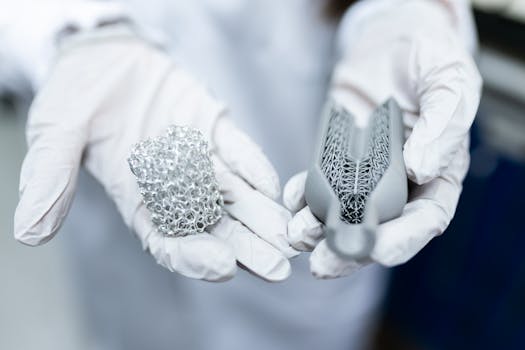
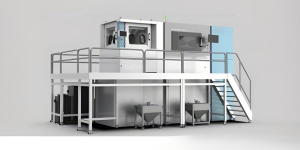
This 17-4PH stainless steel powder is specifically designed for Selective Laser Melting (SLM) processes. Its narrow particle size distribution (D50: 30-40 μm) and high sphericity ensure excellent flowability and uniform layer deposition, which are critical for printing complex structural parts with high precision. The material’s high strength and good corrosion resistance make it ideal for manufacturing industrial components that require both mechanical robustness and durability.
5. Forgecise Custom Services
Forgecise provides comprehensive customization services for various grades of stainless steel powders. We can tailor particle sizes and chemical compositions to meet your specific project requirements, ensuring optimal performance for your additive manufacturing applications.