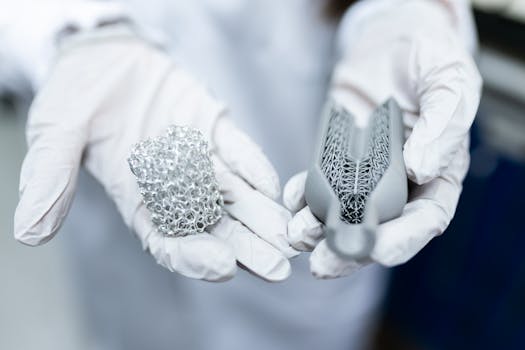











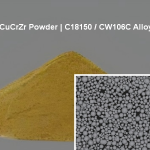
| Typical Applications | Suitable for manufacturing rocket engine combustion chambers, integrated circuit lead frames, induction coils, and continuous casting mold crystallizers. | ||||||
| Applicable Processes | SLM | ||||||
| Chemical Composition wt.% | Cu | Cr | Zr | Fe | Si | O | N |
| Bal. | 0.5-1.5 | 0.05-0.25 | ≤0.15 | ≤0.1 | ≤0.1 | ≤0.05 | |
| Physical Properties | Particle Size Range/μm | Sphericity | Apparent Density g/cm³ | Tap Density g/cm³ | Flowability s/50g | ||
| D10 | D50 | D90 | |||||
| ≥15 | 30-40 | ≤60 | ≥0.90 | ≥4.4 | ≥5.2 | ≤22 | |
| Mechanical Properties | Test Temperature | Heat-Treated | |||||
| Room Temperature | Tensile Strength | Yield Strength | Elongation | Thermal Conductivity W/(m·K) | Electrical Conductivity | ||
| /MPa | /MPa | /% | Room Temperature | 100°C | /%IACS | ||
| ≥350 | ≥250 | ≥30.0 | ≥280 | ≥300 | ≥85% | ||
1. Advantages and Features of This CuCrZr copper alloy powder
The core advantages of CuCrZr alloy powder for the SLM process lie in its high strength, excellent thermal and electrical conductivity, superior high-temperature stability, and good formability. This makes it an ideal material for manufacturing complex functional components in fields such as aerospace, electronics, and new energy.
1. 1 Excellent Mechanical and Thermal Properties
- High Strength: After heat treatment, it achieves a tensile strength of ≥350 MPa, yield strength of ≥250 MPa, and elongation of ≥30%, perfectly balancing strength and ductility to meet structural load-bearing requirements.
- High Thermal and Electrical Conductivity: Thermal conductivity is ≥280 W/(m·K) at room temperature and ≥300 W/(m·K) at 100°C; electrical conductivity is ≥85% IACS. These properties outperform many other copper alloys, making it ideal for integrated heat dissipation and conductive components.
- High-Temperature Stability: Precipitates formed by chromium and zirconium elements enhance resistance to softening, making it suitable for high-temperature operating conditions (e.g., rocket engine combustion chambers, induction coils).
1.2 Powder Characteristics Optimized for SLM
Low Oxygen Content: Oxygen content ≤0.1% minimizes oxide inclusions, thereby preserving the material’s electrical, thermal, and mechanical properties.
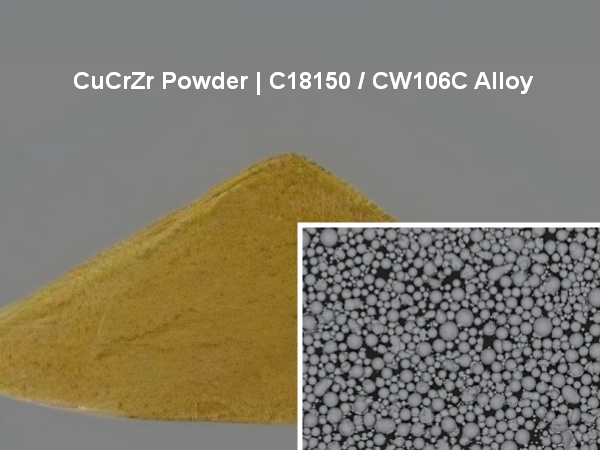
Optimal Particle Size Distribution: D10≥15 μm, D50 of 30-40 μm, and D90≤60 μm. This range ensures good flowability and uniform powder spreading, significantly reducing printing defects.
High Sphericity and Density: Sphericity ≥0.90, apparent density ≥4.4 g/cm³, and tap density ≥5.2 g/cm³. These properties ensure a stable melt pool and help achieve high part density (over 99%).
2. What is CuCrZr powder for Selective Laser Melting (SLM)
CuCrZr powder for Selective Laser Melting (SLM) is a high-performance copper alloy additive manufacturing material specifically designed for applications with high thermal conductivity, high strength, and high electrical conductivity requirements. Its core advantage lies in the precipitation strengthening provided by chromium and zirconium elements, which significantly enhances mechanical properties and high-temperature stability while maintaining the excellent thermal and electrical conductivity of the copper matrix. It is particularly suitable for manufacturing complex functional components in high-end fields such as aerospace, electronic packaging, and new energy. The following is a systematic explanation of its characteristics:
2.1 Material Overview
CuCrZr (Chromium-Zirconium Copper) is a precipitation-hardening copper alloy, typically designated as C18150 (US UNS standard) or CW106C (European EN standard). By adding 0.5–1.5% chromium and 0.05–0.25% zirconium to pure copper, fine Cr/Zr precipitates are formed, achieving a balance between strength and conductivity. In the SLM process, this material enables the fabrication of complex internal cavity structures (such as cooling channels and micro-channels) that are difficult to achieve with traditional casting or forging, making it an ideal choice for thermal management, electromagnetic shielding, and high-power devices.
2.1 Chemical Composition Characteristics
- Primary Element: Copper (Cu) serves as the matrix, with the balance (Bal.) content.
- Strengthening Elements: Chromium (Cr) at 0.5–1.5% and Zirconium (Zr) at 0.05–0.25%. These two elements synergistically form nanoscale precipitates, enhancing strength without significantly reducing electrical conductivity.
- Impurity Control: Iron (Fe) ≤0.15%, Silicon (Si) ≤0.1%, Oxygen (O) ≤0.1%, and Nitrogen (N) ≤0.05%. Strict control of impurities is maintained to prevent oxide inclusions from adversely affecting electrical and mechanical properties.
3. Powder Characteristics
- Particle Size Distribution: D10≥15 μm, D50=30–40 μm, and D90≤60 μm, ensuring uniform powder spreading and melt pool stability.
- Sphericity: ≥0.90. High sphericity ensures excellent flowability and high density.
- Density Indicators: Apparent density ≥4.4 g/cm³ and tap density ≥5.2 g/cm³, reflecting high powder packing efficiency.
- Flowability: ≤22 s/50g, meeting the basic flowability requirements of SLM equipment.
4. Technical Advantages
- High Strength and High Conductivity: After heat treatment, it achieves a tensile strength of ≥350 MPa, elongation of ≥30%, and electrical conductivity of ≥85% IACS, perfectly balancing structural and functional requirements.
- High-Temperature Stability: The chromium and zirconium precipitates are resistant to coarsening at high temperatures, providing excellent softening resistance, making it suitable for high-temperature conditions such as engine combustion chambers and induction coils.
- Excellent Formability: When paired with optimized process parameters, a density of over 99% can be achieved, significantly reducing porosity and crack defects.
- High Design Freedom: SLM technology enables the fabrication of complex internal cavities and gradient structures, fully leveraging the thermal conductivity advantages of CuCrZr.
5. Recommended SLM Process Parameters
In actual printing processes, it is recommended to use a laser power of approximately 360 W, a scanning speed of 800 mm/s, a scanning spacing of 0.08–0.12 mm, and a layer thickness of 20–30 μm. Additionally, preheating the substrate to 200–300°C is advised to reduce thermal stress. It is also important to consider the effect of laser wavelength on the absorptivity of copper alloys; some equipment utilizes green or blue lasers to significantly improve energy utilization and avoid defects such as lack of fusion and porosity.
6. Post-Processing Techniques
After printing is completed, stress relief annealing (at approximately 450–500°C for 2–4 hours) is required to eliminate residual stresses. This is followed by aging heat treatment (at approximately 480–520°C for 2–4 hours) to activate the chromium and zirconium precipitates, thereby enhancing strength and electrical conductivity. For components with high surface roughness requirements, plasma electrolytic polishing or chemical polishing can be used to improve surface quality, but care must be taken to avoid excessive corrosion that could lead to dimensional deviations.
7. Performance Indicators
- Mechanical Properties: Room temperature tensile strength ≥350 MPa, yield strength ≥250 MPa, and elongation ≥30%.
- Thermal Properties: Thermal conductivity ≥280 W/(m·K) at room temperature and ≥300 W/(m·K) at 100°C.
- Electrical Properties: Electrical conductivity ≥85% IACS.
- Density: Can exceed 99% with optimized processes.
8. Comparison with Other Copper Alloy Powders
Compared to pure copper (C11000), CuCrZr has higher strength (pure copper tensile strength is about 200 MPa) but slightly lower conductivity (pure copper can reach 100% IACS). Compared to CuNiSi (C70250), CuCrZr offers superior thermal conductivity (CuNiSi thermal conductivity is about 100–150 W/(m·K)), making it more suitable for high heat load scenarios. Compared to CuAlNi (C63000), CuCrZr has better ductility, making it more suitable for forming complex structures. Overall, CuCrZr achieves the best balance among “strength, thermal conductivity, and electrical conductivity.”
9. Precautions When Doing SLM Process
- Laser Reflection Issue: Copper alloys have a high reflectivity for infrared lasers. It is recommended to use green or blue lasers, or increase the laser power density.
- Oxidation Risk: The powder is prone to oxygen absorption. It should be stored and printed under an inert atmosphere (argon) to prevent oxide inclusions.
- Hot Cracking Tendency: High thermal conductivity leads to rapid cooling, which can easily cause hot cracks. It is necessary to optimize scanning strategies (such as rotational scanning and分区 scanning) and control heat input.
- Necessity of Post-Processing: The strength and conductivity of as-printed parts do not reach their peak values without heat treatment; aging treatment is mandatory.
10. Summary
CuCrZr powder for the SLM process is a representative material in high-performance copper alloy additive manufacturing. Its “high strength and high conductivity” characteristics give it irreplaceable advantages in fields such as thermal management, electromagnetic devices, and aerospace. Although challenges such as low laser absorptivity and hot cracking tendency exist, high-quality forming can be achieved through powder optimization, process parameter adjustment, and post-processing strengthening. With the development of green laser technology and intelligent process control, the application of CuCrZr in SLM will become even more widespread, driving the evolution of high-end equipment towards lightweight, integrated, and highly efficient designs.
Chromium Zirconium Copper, widely recognized by standard industrial designations such as C18150 powder and CW106C, is a premier choice for advanced manufacturing. As a specialized SLM copper alloy and 3D printing copper powder, it is highly valued for its exceptional high conductivity and strength derived from its precipitation hardening capabilities. This additive manufacturing metal powder serves as an ideal heat dissipation material for complex components.
11. Customization Services by Forgecise
Forgecise delivers comprehensive copper alloy powder customization solutions, spanning the complete spectrum from standard formulations to customer-specific high-performance copper-based alloys. We support mainstream copper alloy grades including CuSn10, CuAl10Fe3, CuNi30, Pure Copper (Cu≥99.9%), and CuCrZr, with the capability to precisely tailor chemical composition, particle size distribution, sphericity, and oxygen content to match your exact application requirements. Our copper alloy powders are optimized for demanding additive manufacturing processes including SLM, DED, BJT, and EBM, ensuring consistent printability, high density, and superior mechanical properties in your final components.
From wear-resistant to high-conductivity for heat exchangers and electrodes, Forgecise provides the material expertise and manufacturing flexibility to meet your unique copper alloy powder needs.