







| Category | Parameter / Element | Value / Content | Unit / Note |
|---|---|---|---|
| Chemical Composition | Fe | Bal. | wt.% |
| Ni | 17-19 | wt.% | |
| Al | 0.05-0.15 | wt.% | |
| Ti | 0.6-0.8 | wt.% | |
| Mo | 4.5-5.2 | wt.% | |
| Co | 8.5-9.5 | wt.% | |
| C | ≤0.03 | wt.% | |
| Si | ≤0.1 | wt.% | |
| Mn | ≤0.10 | wt.% | |
| Cr | ≤0.30 | wt.% | |
| P | ≤0.01 | wt.% | |
| S | ≤0.01 | wt.% | |
| O | ≤0.04 | wt.% | |
| N | ≤0.02 | wt.% | |
| Physical Properties | Particle Size (D10) | ≥15 | μm |
| Particle Size (D50) | 30-40 | μm | |
| Particle Size (D90) | ≤60 | μm | |
| Sphericity | ≥0.9 | – | |
| Apparent Density | ≥4.0 | g/cm³ | |
| Tap Density | ≥4.5 | g/cm³ | |
| Flowability | ≤20 | s/50g | |
| Mechanical Properties | Rockwell Hardness (As-Deposited) | 38-42 | HRC |
| Yield Strength (As-Deposited) | ≥1170 | MPa | |
| Elongation (As-Deposited) | ≥11.0 | % | |
| Rockwell Hardness (Heat-Treated) | 54-57 | HRC | |
| Yield Strength (Heat-Treated) | ≥1900 | MPa | |
| Elongation (Heat-Treated) | ≥4.0 | % |
2. Advantages of this MS1 Powder
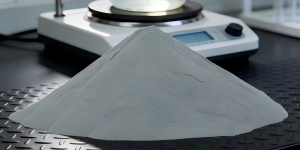
MS1 is a high-performance maraging steel powder characterized by its ultra-high strength and excellent toughness. Its low carbon content ensures superior weldability and minimizes the risk of cracking during the manufacturing process. The powder exhibits excellent flowability and high packing density, which are crucial for achieving uniform layers in additive manufacturing. Furthermore, MS1 responds exceptionally well to heat treatment, allowing it to achieve hardness levels exceeding 54 HRC and yield strengths over 1900 MPa, making it ideal for demanding industrial applications.
3. Application in Additive Manufacturing
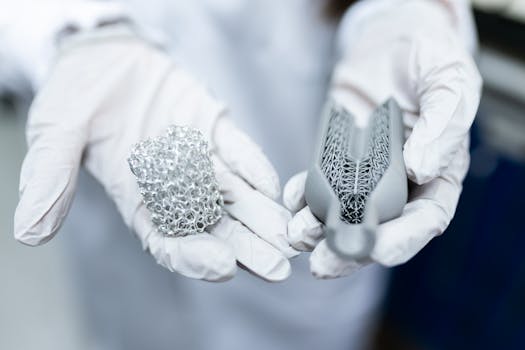
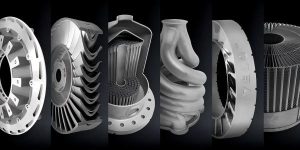
In the realm of additive manufacturing, specifically Selective Laser Melting (SLM), MS1 powder is a premier choice for fabricating complex, high-strength components. Its optimized particle size distribution (D50 30-40 µm) and high sphericity (≥0.9) ensure a smooth, consistent powder bed, leading to high-density parts with minimal porosity. This material is particularly valued for producing injection molds with conformal cooling channels, which significantly reduce cycle times and improve part quality. Additionally, its robust mechanical properties make it suitable for lightweight aerospace structures and durable tooling that requires resistance to wear and high stress.
4. What is MS1 Die Steel Powder for SLM?
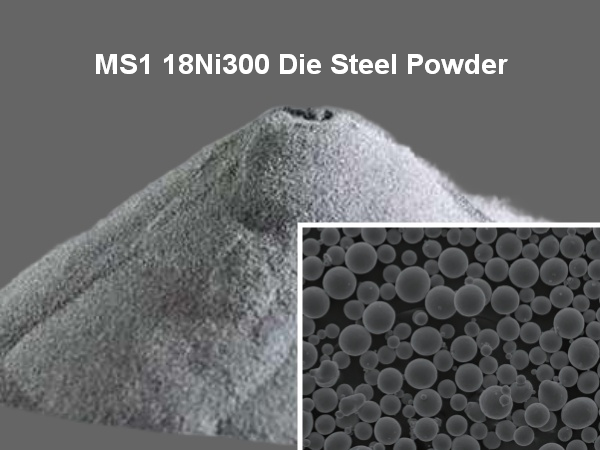
MS1 Die Steel Powder is a Maraging Steel powder specifically designed for metal 3D printing technologies like SLM (Selective Laser Melting).
In simple terms, it is recognized in the industry as the “expert in ultra-high strength and high toughness.” Compared to conventional die steels, parts printed with MS1 powder not only possess extremely high strength and hardness but also offer excellent toughness and weldability. The parts can be machined directly after printing and then undergo a simple heat treatment to achieve ultra-high strength. It is highly suitable for manufacturing injection molds with complex internal cooling channels, aerospace structural components, and high-performance industrial parts.
Core Grades & Chemical Composition
MS1 is not a standard grade from a specific country, but rather a common commercial designation in the metal additive manufacturing field (especially by 3D printer manufacturer) for this specific type of maraging steel. Its corresponding traditional material grades and chemical composition are as follows:
- Equivalent Grades:
- US Grade: US 18% Ni Maraging 300
- European/German Grade: 1.2709 (X3NiCoMoTi18-9-5)
- Typical Chemical Composition (wt.%):
- Ni (Nickel): 17.0 – 19.0% (Core element, forms the martensitic matrix)
- Co (Cobalt): 8.5 – 9.5% (Enhances age-hardening effect)
- Mo (Molybdenum): 4.5 – 5.2% (Provides high-temperature strength and hardness)
- Ti (Titanium): 0.6 – 0.8% (Key for age-hardening precipitation)
- Al (Aluminum): ≤ 0.15%
- C (Carbon): ≤ 0.03% (Extremely low carbon content ensures excellent weldability and toughness)
- Fe (Iron): Balance
MS1 Die Steel Powder Basic Parameter Table
Below are the typical physical and mechanical property parameters for MS1 powder designed for additive manufacturing (SLM):
| Category | Key Indicator | Typical Parameter Range |
|---|---|---|
| Physical Properties | Density | Approx. 8.0 g/cm³ |
| Powder Morphology | Sphericity ≥ 95% | |
| Particle Size (D50) | 15 – 45 μm or 15 – 53 μm | |
| Melting Point | Approx. 1410°C | |
| Mechanical Properties | Condition | As-built |
| Tensile Strength | Approx. 1000 – 1100 MPa | |
| Yield Strength | Approx. 900 – 1050 MPa | |
| Elongation | Approx. 8% – 10% | |
| Hardness (HRC) | Approx. 30 – 32 HRC | |
| Typical Applications | Use Cases | Conformal cooling injection molds, die-casting molds, aerospace brackets, high-load structural parts |
SLM Printing Considerations & Key Parameters
When using MS1 powder for SLM printing, pay attention to the following to obtain parts with nearly 100% density and no defects:
- Excellent Printability: MS1 is recognized as one of the most suitable metal materials for laser additive manufacturing. It has a wide process window, making it very easy to achieve parts with over 99.9% density and minimal thermal cracking.
- Aging Heat Treatment is Key: The printed MS1 parts are in a “soft” martensitic state (approx. 30 HRC), allowing for direct CNC milling, drilling, and other finishing operations. After machining, an aging heat treatment at around 480°C is required to precipitate intermetallic compounds, boosting the hardness to over 50 HRC for final performance.
- Heat Treatment Shrinkage: When designing high-precision molds, the uniform shrinkage caused by aging heat treatment must be accounted for. MS1 typically experiences a linear shrinkage of about 0.08% during age hardening, which needs to be pre-compensated in the 3D model before slicing.
- Conformal Cooling Channel Design: The biggest highlight of MS1 is manufacturing mold inserts with “conformal cooling channels.” 3D printing allows for complex internal channels that traditional machining cannot achieve, significantly shortening cooling cycles in injection or die casting (by up to 40%-60%) and greatly extending mold life.
- Recommended Printing Parameters:
- Layer Thickness: Typically 30μm, 40μm, or 50μm.
- Minimum Wall Thickness: To ensure success rate and strength, a minimum wall thickness of 0.3mm – 0.4mm or more is recommended.
Summary:
If you need to manufacture highly complex structures with extreme strength and toughness requirements, or high-performance molds and parts with internal conformal cooling channels, MS1 Die Steel Powder is currently the most mature and widely used premier choice in the metal 3D printing field.
Does it have other similar materials to MS1 Powder?
MS1 (Maraging Steel) indeed has several strong “alternatives” in the metal 3D printing field. However, in the industry, they are usually not named “MS2” or “MS3.” Instead, materials are chosen based on their specific properties (such as better corrosion resistance or higher temperature resistance).
Here are the three most common alternatives to MS1, along with a detailed comparison table:
Three Major Alternatives to MS1
- CX Die Steel (Corrosion-Resistant Maraging Stainless Steel)
CX can be seen as the “stainless brother” of MS1. It can also be heat-treated to achieve high hardness, but the biggest difference is its high Chromium (Cr) content, which gives it excellent corrosion resistance. If your mold is used to process corrosive plastics (like PVC) or for medical and food applications, CX is a better choice than MS1. - 42CrMo4 (High-Strength Low-Alloy Steel)
This is one of the most commonly used steels in traditional mechanical manufacturing. It offers excellent strength and toughness, but its corrosion resistance and ultimate hardness are not as good as MS1. Its advantage lies in its lower cost, and engineers are very familiar with its heat treatment processes. It is commonly used for high-load structural parts like automotive gears and shafts. - H13 (Hot-Work Die Steel)
Although not detailed earlier, H13 is the most direct competitor to MS1 in the die-casting mold field. H13 has excellent red hardness (the ability to retain hardness at high temperatures) and thermal fatigue resistance, making it highly suitable for severe hot-and-cold cycling environments like aluminum alloy die casting. In comparison, MS1 has higher ultimate strength at room temperature, but its high-temperature performance is slightly inferior to H13.
Performance Comparison: MS1 vs. Alternatives
| Feature Dimension | MS1 (Maraging Steel) | CX (Corrosion-Resistant Die Steel) | 42CrMo4 (Low-Alloy Steel) | H13 (Hot-Work Die Steel) |
|---|---|---|---|---|
| Core Advantage | Ultra-High Strength & Toughness | High Hardness + Corrosion Resistance | High Cost-Performance + High Toughness | High-Temp Resistance + Thermal Fatigue Resistance |
| Hardness (Heat-Treated) | Extremely High (48 – 54 HRC) | High (46 – 48 HRC) | Medium-High (Approx. 50 HRC) | High (48 – 52 HRC) |
| Tensile Strength | Extremely High (Approx. 2000 MPa) | High (Approx. 1600 MPa) | Relatively High (Approx. 1320 MPa) | High (Approx. 1800 MPa) |
| Corrosion Resistance | Average (Requires surface treatment) | Excellent | Poor (Prone to rust) | Average |
| High-Temp Performance | Average | Good | Average | Excellent |
| Typical Applications | Conformal cooling injection molds, aerospace structural parts | Medical/Food molds, molds for corrosive plastics | Automotive gears, shafts, general industrial structural parts | Aluminum alloy die-casting molds, hot extrusion molds |
Material Selection Tips
- Pursuing Ultimate Performance & Complex Structures: Choose MS1. It is currently the most balanced top-tier die steel in terms of comprehensive strength, toughness, and printing success rate, especially for inserts with conformal cooling channels.
- Corrosive Environments: Choose CX. For example, when processing flame-retardant plastics or medical catheter molds, CX prevents the mold from rusting and contaminating the product.
- Limited Budget & No Complex Channels: Choose 42CrMo4. If you are just using 3D printing to make a few high-strength brackets or connectors and don’t need the extreme hardness of die steel, it offers the best cost-performance ratio.
- High-Temp Die Casting Environments: Choose H13. If the mold needs to repeatedly contact molten metal at hundreds of degrees, H13’s thermal cracking resistance will be more reliable than MS1.
Customization Services by Forgecise
Forgecise provides comprehensive die steel powder customization solutions, covering the full range of products from standard maraging grades to customer-specific high-performance formulations. We support mainstream die steel grades such as MS1 (18Ni300/1.2709), CX, H13, and 42CrMo4, and can precisely adjust composition, particle size distribution, and sphericity according to your specific application requirements. Whether it is small-batch samples for R&D (starting from 1kg) or ton-level orders for mass production, we ensure high purity, low oxygen content, and excellent flowability of our powders, meeting the rigorous requirements of various additive manufacturing processes including SLM, DED, and BJT.