













Written by Felix Lee, CEO at Forgecise
Published: July 2026
Last Updated: July 2026
Table of Contents
Quick Answer
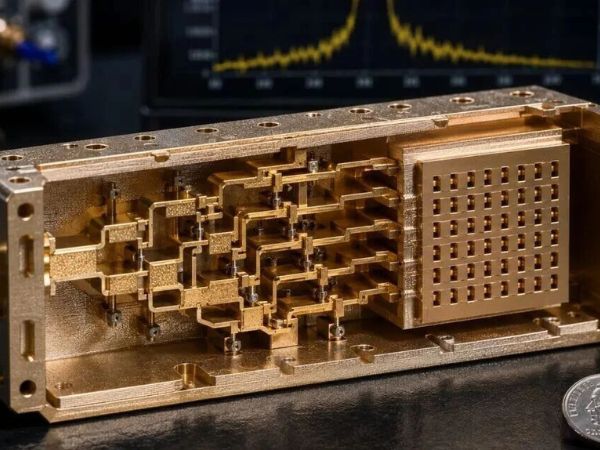
A 3D printed 6G antenna uses metal additive manufacturing to create complex high-frequency structures that are difficult to build with traditional machining. A 220GHz antenna design combines signal filtering, power distribution, and radiation in one metal structure, producing 16 signal outputs and feeding a 64-slot antenna array for future sub-terahertz communication systems.
TL;DR
- 6G networks may use sub-terahertz frequencies such as 220GHz to support higher data rates and advanced sensing.
- Higher frequencies create serious manufacturing problems because small errors can reduce antenna performance.
- Metal 3D printing allows engineers to create complex internal structures as one integrated component.
- The reported antenna combines a seven-stage resonant cavity filter power divider with a 64-slot radiation array.
- Large-scale manufacturing, cost, and production consistency remain the main challenges before commercial use.
A Small Metal Block That Could Help Build Future 6G Networks
A piece of metal smaller than a matchbox can now perform several jobs that once required multiple high-frequency components.
Inside this compact structure, there are no traditional welding points and no separate connection interfaces.
It receives one signal.
It divides that signal into 16 channels.
It removes unwanted frequencies.
Then it sends the cleaned signals through 64 tiny radiation slots to create a focused beam.
This is the idea behind a 220GHz slot array antenna developed with micro-metal additive manufacturing.
The interesting part is not only the antenna itself.
The bigger change is how engineers build it.
For decades, high-frequency hardware has been limited by manufacturing methods. Designers often had to simplify structures because machines could not create the exact shapes needed.
Metal 3D printing changes that process.
Instead of building many separate parts and connecting them later, engineers can print a complex electromagnetic structure as one piece.
For future 6G systems, this could become an important manufacturing path.
Why Does 6G Need 220GHz Antenna Technology?
6G networks are expected to explore higher frequency bands beyond today’s wireless systems.
One important area is the sub-terahertz frequency range, where frequencies approach the terahertz spectrum.
The 220GHz antenna operates in this challenging area.
At 220GHz:
- The wavelength is slightly above one millimeter.
- Signals can carry extremely large amounts of data.
- Antennas can create narrow and focused beams.
- The same technology can support advanced sensing applications.
However, higher frequency brings new problems.
The shorter wavelength means the system becomes much more sensitive to physical errors.
A small manufacturing difference that may not matter at lower frequencies can create major signal loss at 220GHz.
This creates a difficult engineering situation.
6G needs higher-frequency antennas for performance, but those same frequencies make the hardware much harder to manufacture.
What Makes 220GHz Antennas Difficult to Build?
High Frequency Systems Need Extreme Precision
At lower frequencies, engineers have more tolerance.
At 220GHz, every detail matters.
Manufacturers must carefully control:
- Internal cavity dimensions
- Metal surface quality
- Signal alignment
- Electrical connections
- Material performance
The antenna is not just a radiation device.
Its physical structure becomes part of the electrical system.
A small change in geometry can affect how signals move through the device.
Why Traditional Machining Has Problems at 220GHz
Traditional manufacturing methods such as:
- CNC machining
- Milling
- Drilling
have produced many successful RF components.
However, they become difficult when engineers need extremely complex internal structures.
Complex Internal Cavities
Many high-frequency devices require internal channels and cavities that normal machining tools cannot easily reach.
The problem is not only making the outside shape.
The challenge is creating precise structures inside the metal.
Surface Roughness Creates Signal Loss
At very high frequencies, the inside surface of metal waveguides becomes important.
Rough surfaces increase electrical resistance.
As frequency increases, these losses become more serious.
For 220GHz systems, manufacturers need very smooth and consistent metal surfaces.
More Components Create More Alignment Problems
Traditional designs often separate different functions.
For example:
- Filter
- Power divider
- Feeding network
- Antenna array
Each part must be manufactured separately and connected later.
Every connection creates another possible problem:
- Misalignment
- Energy leakage
- Signal loss
At high frequencies, these small problems can reduce overall efficiency.
Why Do 6G Antennas Need Larger Arrays?
High-frequency signals have a major challenge:
They lose energy faster over distance.
To solve this problem, engineers use larger antenna arrays.
A larger array can:
- Increase signal gain
- Focus energy more accurately
- Create stronger directional beams
But larger arrays create another problem.
More elements mean:
- More components
- More connections
- More manufacturing steps
- Higher cost
This creates a difficult balance.
Future 6G systems need larger antenna arrays, but traditional assembly methods make those systems harder to build.
How Does the 3D Printed 6G Antenna Work?
The main idea behind the 220GHz antenna is integration.
Instead of treating filtering and radiation as separate tasks, the design combines them into one structure.
The antenna uses a:
Seven-Stage Resonant Cavity Filter Power Divider
This component performs several functions at the same time.
It:
- Receives one input signal.
- Splits the signal into 16 output channels.
- Filters unwanted frequencies during signal distribution.
Traditional systems normally require a separate filter and power divider.
This design removes the need for those extra interfaces.
That means fewer points where energy can be lost.
How Does the 64-Slot Antenna Array Create a Focused Beam?
After the signal passes through the integrated filter power divider, the 16 output channels feed a radiation structure made of multiple small openings.
The antenna uses an:
8 × 8 slot array
with a total of:
64 radiation slots
These slots work together to create a controlled electromagnetic beam.
The arrangement of these slots is carefully designed to improve beam quality.
The structure helps:
- Increase antenna gain
- Control beam direction
- Reduce unwanted side lobes
- Improve radiation efficiency
For 6G communication, beam control is extremely important.
Higher-frequency signals can carry more information, but they also travel shorter distances and are more sensitive to obstacles.
A focused beam helps send energy where it is needed instead of spreading it in unwanted directions.
Why Is Metal 3D Printing Important for High-Frequency Antennas?
The main advantage of metal additive manufacturing is not simply making smaller components.
The bigger advantage is creating shapes that are difficult or impossible to produce using traditional methods.
A traditional manufacturing process usually looks like this:
Design parts → machine parts → assemble parts → adjust alignment
For high-frequency devices, every additional step creates another possible error.
The 220GHz antenna uses a different approach:
Design electromagnetic structure → print the complete metal component
The antenna is created as one continuous metal structure.
It does not require:
- Separate filter installation
- Multiple assembly steps
- Welding points
- Complex alignment between components
This reduces mechanical mismatch and limits signal loss caused by interfaces.
How Does Micro-Metal 3D Printing Help at 220GHz?
At very high frequencies, the surface of a metal component matters.
Electromagnetic signals interact with the inside surfaces of waveguides and cavities.
Poor surface quality can increase electrical resistance and reduce efficiency.
Micro-metal additive manufacturing provides a way to create complex structures with the precision needed for advanced RF components.
However, there is an important point:
3D printing does not automatically solve every manufacturing problem.
The technology still depends on:
- Material selection
- Printing accuracy
- Surface finishing
- Quality control
- Production consistency
The future challenge is not only creating one successful antenna.
It is creating many identical antennas with the same performance.
What Performance Did the 220GHz 3D Printed Antenna Achieve?
The reported 220GHz antenna achieved strong results for an integrated sub-terahertz device.
The measured performance includes:
| Performance Metric | Result |
|---|---|
| Operating Frequency | 220GHz |
| Input Signal | 1 channel |
| Output Signals | 16 channels |
| Antenna Structure | 8 × 8 slot array |
| Radiation Elements | 64 slots |
| Antenna Gain | 26.3 dBi |
| Aperture Efficiency | 50.7% |
| Out-of-Band Suppression | Better than 20 dB |
| Return Loss | Better than 10 dB |
These numbers show why integrated designs are attractive for future wireless systems.
The antenna combines functions that traditionally required multiple devices.
Instead of adding more parts, the design reduces the number of parts.
What Makes This Antenna Design Different From Traditional Systems?
A conventional high-frequency antenna system often requires separate components:
- Filter
- Power divider
- Feeding network
- Radiation array
The signal path may look like this:
Input → Filter → Divider → Feeding Network → Antenna
Every connection point can create losses.
The 220GHz 3D printed antenna changes the structure:
Input → Integrated Filter Power Divider → Antenna Array
The same metal body handles:
- Frequency filtering
- Signal distribution
- Radiation
This design approach is especially valuable at extremely high frequencies because connection problems become harder to control.
Can 3D Printed Antennas Help Move 6G From Research to Real Products?
The technology has demonstrated what is possible.
However, research performance and commercial production are different challenges.
A prototype can be carefully produced and tested.
A commercial product needs thousands or millions of units with stable performance.
This creates several manufacturing questions.
What Are the Biggest Challenges Before Commercial Adoption?
1. Production Yield
The first challenge is consistency.
A communication company cannot depend on one excellent antenna.
It needs large numbers of antennas that all meet the same standards.
Manufacturers must control:
- Printing accuracy
- Material quality
- Surface condition
- Final electrical performance
Small differences between printed parts could affect system reliability.
2. Manufacturing Cost
3D printing offers design advantages, but cost remains a practical issue.
Commercial production must consider:
- Equipment cost
- Printing time
- Material expenses
- Post-processing requirements
- Inspection processes
A technology must work technically and economically.
3. Scaling Complex Structures
The 220GHz antenna shows that very complex RF structures can be printed.
The next step is proving that these structures can be produced repeatedly at larger volumes.
The industry needs answers to questions such as:
- Can production speed improve?
- Can quality remain stable?
- Can costs compete with traditional manufacturing?
What Does This Mean for the Future of 6G?
The importance of this technology goes beyond one antenna.
It represents a different way of thinking about wireless hardware.
For many years, engineers designed products around manufacturing limits.
If a machine could not create a structure, designers changed the structure.
Metal additive manufacturing creates another option.
Engineers can design the electromagnetic performance first, then find ways to manufacture the structure.
That shift may become important as communication systems move into higher frequencies.
Where Could 3D Printed High-Frequency Antennas Be Used?
Future 6G Wireless Networks
Sub-terahertz antennas could support:
- Ultra-high-speed communication
- High-capacity wireless links
- Advanced beamforming systems
Advanced Sensing Applications
Higher-frequency systems can improve sensing performance.
Possible uses include:
- High-resolution imaging
- Industrial inspection
- Precision measurement
Satellite and Aerospace Communication
Future space communication systems may require:
- Compact antennas
- High gain
- Lightweight structures
- Precise beam control
Integrated printed antennas could become useful for these applications.
Industrial Automation
Factories may need wireless systems that combine:
- Fast communication
- Accurate sensing
- Real-time control
Higher-frequency antenna technology may support these future industrial networks.
The Future of High-Frequency Hardware May Be Printed
The 220GHz antenna shows a simple but important idea:
The next generation of wireless hardware may not come from adding more components.
It may come from creating smarter structures.
A single metal component can now perform tasks that previously required multiple separate devices.
For 6G, this matters because higher frequencies demand better control, better precision, and better manufacturing methods.
Metal additive manufacturing does not remove every challenge.
Mass production, cost, and consistency still need to be solved.
But the direction is clear:
Future communication systems may depend not only on better chips and software, but also on new ways of building the physical hardware that carries signals.
About the Author
Felix Lee
CEO at Forgecise
Felix Lee is the CEO at Forgecise, focusing on advanced manufacturing technologies, engineering innovation, and the relationship between digital design and industrial production.
His work examines how new manufacturing methods can help companies create complex products that were difficult to build using traditional processes.
Through technology analysis and industry research, Felix shares practical perspectives on how engineering solutions move from laboratory concepts toward real-world applications.
Article Information
Author: Felix Lee
Company: Forgecise
Published: July 2026
Last Updated: July 2026
Frequently Asked Questions
What is a 3D printed 6G antenna?
Short Answer:
A 3D printed 6G antenna is a high-frequency antenna created through metal additive manufacturing. It can combine complex structures such as filters, signal splitters, and radiation elements into one printed component, helping future wireless systems operate at frequencies like 220GHz.
Explanation:
Traditional antennas often require several separate parts connected together. A 3D printed design can create the entire electromagnetic structure as one piece, reducing connection problems and allowing more complex designs.
Why does 6G need 220GHz antennas?
Short Answer:
6G may use 220GHz and other sub-terahertz frequencies because they can support extremely high data rates and advanced sensing. The challenge is that these frequencies require much more precise manufacturing because small errors can create signal loss.
Explanation:
Higher frequencies provide more bandwidth, but signals become harder to control. Engineers need antennas with accurate structures, smooth surfaces, and efficient beam control.
How does the 220GHz antenna create 16 signal outputs?
Short Answer:
The antenna uses a seven-stage resonant cavity filter power divider. This structure receives one input signal, separates it into 16 output channels, and filters unwanted frequencies during the same process.
Explanation:
Traditional systems often use separate filters and power dividers. Combining these functions reduces the number of connections and helps improve high-frequency performance.
What are the benefits of metal 3D printing for antenna manufacturing?
Short Answer:
Metal 3D printing allows engineers to create complex internal structures that traditional machining methods cannot easily produce. It reduces assembly requirements and gives designers more freedom when creating high-frequency RF components.
Explanation:
The main benefit is not only speed or size reduction. The advantage is the ability to manufacture integrated structures that combine multiple electromagnetic functions.
Can 3D printed antennas be used in commercial 6G networks?
Short Answer:
They may become part of future 6G systems, but commercial adoption depends on improving production cost, manufacturing yield, and consistency. Laboratory results are promising, but large-scale manufacturing remains the next challenge.
Explanation:
Telecommunication hardware requires reliable production at large volumes. Companies must prove that printed antennas can deliver the same performance repeatedly.