



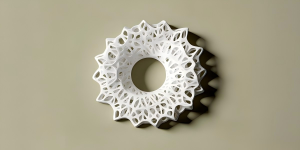





Aircraft interior parts are not selected like other aircraft parts. The material is decided by a burn test before anything is decided by strength. That single constraint is why interiors adopted additive manufacturing later than brackets and ducting, and why the parts that fit are specific.
Table of contents
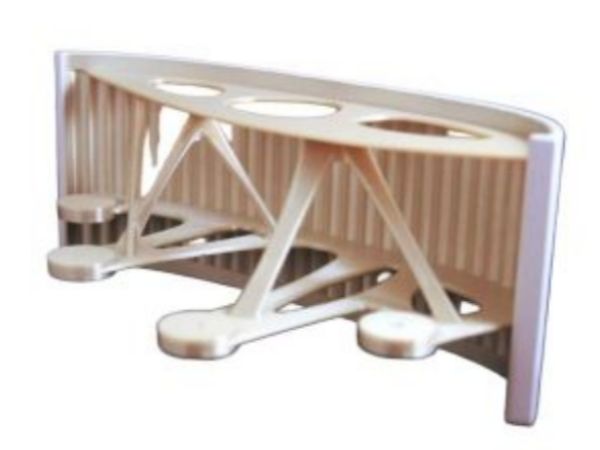
What governs an interior part
An interior component has to do three things at once: meet the flammability requirement, stay within a mass budget, and survive the abuse of daily service — trolley impacts, cleaning agents, repeated removal for maintenance. The design usually starts with the third and is then constrained hard by the first.
This is why a part that would be an obvious printed candidate in a bracket context is not one in a cabin. A nylon bracket with excellent specific strength is disqualified if the grade has not been tested to the burn requirement, regardless of how well it performs mechanically.
What FAR 25.853 actually tests
For large transport category aircraft, interior materials are evaluated under FAR 25.853. It is not a single test, and the three components answer different questions:
| Test | What it measures | Why it matters for a printed part |
|---|---|---|
| Vertical burn, 60-second and 12-second | Burn length, afterflame time, drip behaviour | Thin walls and lattice structures change the burn path compared with a solid moulding |
| Heat release rate | Peak and total heat released under a radiant source | Additives that pass vertical burn can still fail heat release |
| Smoke density | Optical density of smoke, typically Ds ≤ 200 | Porous, as-printed surfaces and unsealed lattices can increase smoke generation |
The practical consequence: a material certificate is a starting point, not a clearance. Whether a specific geometry passes depends on wall thickness, surface finish, and whether the part is coated or sealed. A printed part with an open lattice is a different test article from a solid moulding in the same polymer.
Materials that pass, and materials that do not
| Material | Process | Typical interior use | Watch point |
|---|---|---|---|
| PEI (ULTEM-type) | FDM / FFF, high-temperature | Ducting, air outlets, brackets, small structural cabin parts | Requires a high-temperature machine; grade and colour must both be qualified |
| PPSU | FDM / FFF | Bezels, housings, parts needing repeated cleaning | Same qualification question; not interchangeable with PEI on an existing approval |
| Flame-retardant PA12 | SLS | Non-structural covers, brackets, mock-up and tooling | Flame-retardant grades vary widely; confirm the exact grade holds the certificate |
| Standard PA12 | SLS | Tooling, jigs, non-flying parts | Not an interior flying material without qualification |
| Photopolymer resin | SLA | Patterns, visual models, non-flying prototypes | Post-cure and resin chemistry both affect burn behaviour |
We supply and print these grades, but we do not claim certification for any of them. The qualification route belongs to the organisation placing the part on the aircraft. What we can do is print the test articles to the same parameters, thickness and surface condition as the production part, so the burn test represents what will actually fly.
Part families where printing fits
- Air distribution ducting. Complex routing through structure that would otherwise need several moulded pieces and joints. Consolidation removes both mass and leak paths.
- Air outlets and diffusers. Geometry-driven, low load, high cosmetic requirement. Printing gives the shape without tooling.
- Bezels, covers and small housings. Where the mould tool would cost more than the batch is worth, and the design is still moving.
- Brackets and mounting hardware. Small, numerous, and each one a tooling cost in the conventional route.
- Seat and galley components. Non-primary parts where the mass budget and the service abuse are the design drivers.
- Tooling and mock-up. Drill jigs, assembly fixtures and full-scale cabin mock-ups, where printing is already standard practice.
Where it does not fit
Being clear about this is more useful than a list of successes. Printing is a poor answer when:
- The part is a large, simple panel in steady production. Thermoforming or compression moulding is cheaper per unit and already qualified.
- The design is frozen and the volume is high. Tooling amortises and printing’s advantage disappears.
- The surface is the product. Interior visible surfaces have cosmetic and cleanability requirements that as-printed surfaces rarely meet without a finishing step that erases the cost advantage.
- The part must be transparent or have a specific optical finish. Coating and polishing routes exist but change the qualification basis.
What to send for an interior part quote
Interior enquiries go wrong most often because the material was chosen before the requirement was written down. Send:
- The part and the space it fits into, since routing is usually the real constraint
- The flammability requirement as written in your specification, not summarised
- Whether the part is flying or is a mock-up, tool or prototype — this changes everything downstream
- Service conditions: cleaning agents, temperature, UV exposure, expected removal cycles
- Surface requirement: visible surface, painted, or hidden
- Quantity per shipset and annual volume
Our aerospace additive manufacturing page covers the structural side of airframe work, including the weight-reduction logic that applies to aircraft weight reduction. Broader material and process selection sits on metal 3D printing services, and printed parts can be quoted through parts manufacturing.
Updated: November 25, 2026. By Felix Lee.