





Release Date: 2026-04-19
Paul Li
CTO | Author18 years experience in the Research and Development of 3D printing equipment and additive manufacturing processes, empowering the efficient intelligent manufacturing of complex parts.
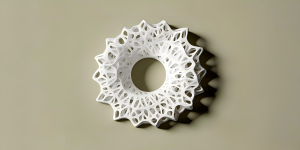
In the quiet corners of modern engineering workshops, a seemingly simple component—a suction cap—can tell a profound story about how manufacturing is changing. Not the kind of cap used in household vacuum cleaners, but a precision-engineered part designed for high-performance applications: its shape is intricate, its internal flow paths non-trivial, and its performance demands exacting reliability.
What makes this particular suction cap remarkable is not its function alone—but how it was brought to life: through a seamless integration of digital design, additive manufacturing, and iterative refinement. Unlike traditional parts that are shaped by subtractive methods or assembled from multiple pieces, this cap emerged as a single, cohesive metal object—born not from molds or machining centers, but from data, laser, and powder.
The Starting Point: A Raw Geometry with Potential
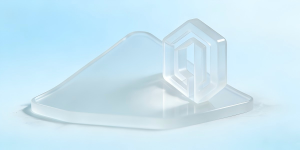
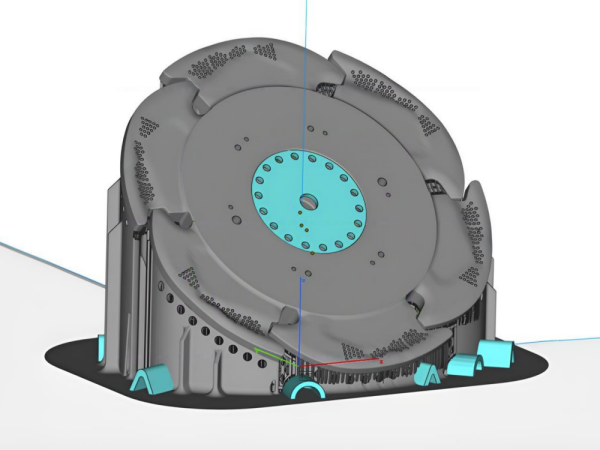
The journey begins with a digital model—a “raw” CAD geometry representing the intended form of the cap. At first glance, it appears complete: a circular body with radial arms, a central bore, and peripheral features for mounting or sealing. Yet this initial model is far from print-ready. It contains overhangs that would collapse without support, thick sections prone to residual stress, and internal cavities impossible to clean if printed as-is. More critically, it lacks functional optimization: the flow channels inside may be inefficient, the wall thicknesses uneven, and the structural ribs unnecessarily heavy.
This is where intelligent preparation begins—not as mere cleanup, but as design augmentation. Engineers reinterpret the model not just as a shape, but as a system: Where can material be removed without compromising strength? Where must reinforcement be added to resist cyclic loading? How can internal passages be reshaped to ensure smooth fluid or air movement? The goal is no longer simply “to make the part,” but “to make the best possible part.”
Refinement in Three Stages: From Form to Function
The evolution of the cap proceeds through three deliberate stages of digital refinement—each addressing a distinct challenge of additive manufacturing.
First, excess material and draft correction. Unnecessary bulk is trimmed away, especially near edges and transitions, while critical features like mounting flanges are given gentle chamfers or radii to prevent stress concentration. This step ensures manufacturability and reduces thermal distortion during printing.
Second, internal flow-path restoration. Many suction caps require precise internal channels—whether for vacuum evacuation, coolant circulation, or pneumatic actuation. In the original model, these paths may be blocked, undersized, or geometrically suboptimal. Using computational fluid dynamics (CFD)-informed design, engineers reconstruct the inner architecture: smoothing sharp corners, enlarging constrictions, and ensuring continuous, turbulence-minimized flow. This is not cosmetic—it directly impacts performance: faster response, lower energy consumption, and higher sealing fidelity.
Third, support and process integration. To prevent warping or collapse during printing, temporary support structures are algorithmically generated—thin, lattice-like scaffolds that anchor features and dissipate heat evenly. Crucially, these supports are designed for easy removal: they break cleanly after printing, leaving minimal surface marks. At the same time, features such as powder drainage holes and build-plate attachment points are added—small details that make the difference between a successful print and a failed build.
From Virtual to Physical: Printing and Beyond
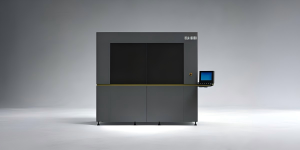
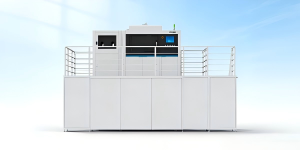
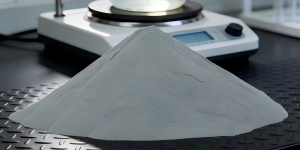
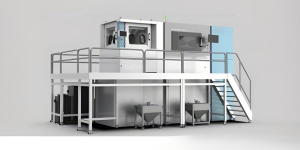
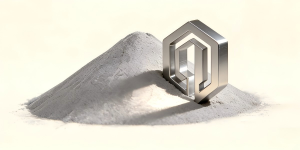
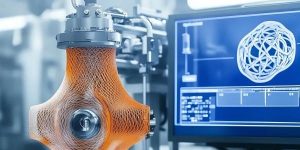
Once the optimized model is finalized, it enters the metal 3D printer. A fine layer of titanium or stainless steel powder is spread across the build platform; a high-precision laser then traces the cross-section of the cap, fusing particles into solid metal. Layer by layer, the part grows—no tool changes, no fixtures, no assembly steps. The result is a monolithic structure: no seams, no joints, no weak interfaces.
But the process doesn’t end at the printer’s door. After removal from the build plate, the cap undergoes post-processing: supports are gently broken away, surfaces are lightly smoothed, and critical sealing faces may be finished via minimal machining or polishing. Then comes inspection—not just dimensional check, but functional validation: does the vacuum hold? Do the internal channels flow as predicted? Are there hidden defects?
Remarkably, multiple variants—some in stainless steel (e.g., 316L), others in titanium alloy (e.g., TC4/TA15)—can be produced in parallel, allowing direct comparison of material behavior under identical loading and environmental conditions. This capability—to iterate materials, geometries, and processes rapidly—is what turns prototyping into true engineering development.
Why This Matters: The Quiet Power of Integrated Manufacturing
The suction cap may seem modest, yet its creation exemplifies a deeper shift in how we think about making things. In the past, complex functional parts were often compromises: simplified for manufacturability, over-engineered for safety, or assembled from many pieces that introduced failure modes. Today, with digital design and additive manufacturing working in concert, engineers can pursue functional integrity as the primary goal.
This means:
- Structures can be lightweight and stiff, because material is placed only where needed;
- Internal functionality—like fluidics or thermal management—can be embedded directly, rather than added later;
- Design changes no longer trigger costly retooling; a new version can be printed within days;
- And most importantly, the boundary between “design” and “manufacturing” dissolves—what you design is, quite literally, what you get.
Final Thought: The Part That Thinks
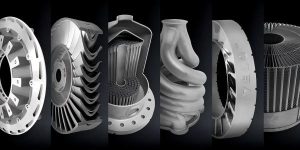
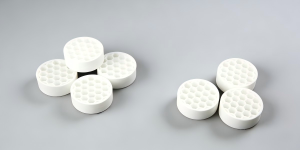
That suction cap, now resting among others on a clean tray, just the subtle texture of laser-melted metal and the quiet confidence of a well-optimized form. It is not merely a passive holder or seal; it is an active participant in a larger system, engineered to perform reliably, efficiently, and repeatedly.
Its story reminds us: the future of manufacturing isn’t about bigger machines or faster tools. It’s about smarter thinking—where every curve, every channel, every millimeter of material serves a purpose, and where the line between imagination and reality has finally blurred into a single, precise layer of metal.
About Forgecise
Forgecise is an innovator in additive manufacturing technology, dedicated to providing high-performance metal 3D printing materials, equipment, and process solutions for the mold manufacturing, energy power, and other industrial sectors.