






In modern B2B manufacturing and high-end sign fabrication, knowing exactly how to print on metal is a major competitive advantage. Whether you make rugged safety labels for heavy machinery, brand custom aluminum equipment enclosures, or print fine art on brushed copper, your work must be precise and last for years.
But printing on metal is different from printing on paper, plastic, or fabric. Metal surfaces bring specific physical and chemical challenges that can easily disrupt a production line if you do not handle them systematically:
- Non-Porous Surface: Unlike paper or wood, raw metals do not absorb liquid inks. The ink must bond directly to the surface.
- High Thermal Conductivity: Metals transfer heat quickly. This makes thermal curing highly sensitive to temperature shifts.
- Variable Surface Energies: From mill-finish aluminum to mirror-polished stainless steel, different metals have widely different surface energies. Without proper treatment, ink will scratch, peel, or bubble off.
This guide explains comparative technologies, the chemistry of adhesion, quality control standards, real-world case studies, and practical ways to solve your hardest metal decorating problems.
Choosing the Right Metal Printing Technology
Selecting the correct process is the first step. B2B procurement managers must balance production speed, setup costs, volume, and how long the print needs to last.
Here are the five main industrial metal printing options:
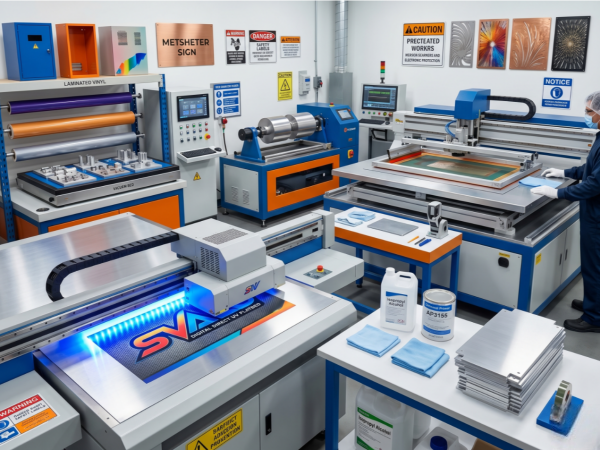
1. Direct UV Flatbed Printing
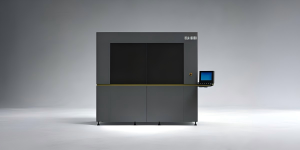
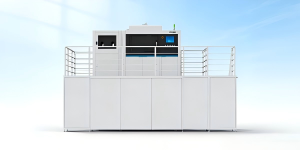
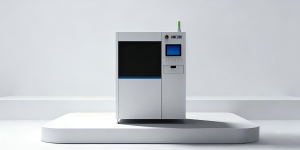
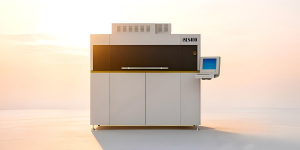
Direct-to-substrate digital ultraviolet (UV) flatbed printing is a modern digital process that does not use physical plates or screens. The printer places specialized photopolymer inks on the metal. These inks dry instantly under strong UV-LED lamps. This allows for quick customization, variable data printing, and affordable low-to-medium runs. It prints CMYK colors, high-density white underbases, and clear varnishes for textured finishes.
2. Silk Screen Printing
Silk screen printing is a classic manufacturing standard for high-volume B2B orders. The operator presses durable solvent-based or catalyzed epoxy inks through a custom mesh screen directly onto the metal. This forms a thick, tough chemical and physical bond that easily survives rough weather and physical wear. However, screen printing has high setup costs—often over $150 per run just to make and align the screens—making small batches highly impractical.
3. Dye Sublimation
Dye sublimation uses heat and pressure to turn specialized dyes into gas, fusing them directly into a polyester-coated metal sheet. Instead of sitting on top of the metal, the image becomes part of the polymer layer itself. This creates continuous-tone, museum-grade prints with excellent depth. However, dye sublimation only works on pre-treated, polyester-coated white panels and can fade if left in direct sunlight.
4. Pad Printing
For curved, irregular, small, or recessed 3D metal parts, pad printing is the standard choice. A flexible silicone pad transfers ink from an etched plate onto the metal component. While it only prints a small area and limited spot colors, it works incredibly well on industrial parts when paired with two-part epoxy inks.
5. Decal and Vinyl Mounting
High-tack laminated vinyl decals are a simple, low-cost option. You print the graphics on vinyl and stick them onto the metal sheets. This is cheap and easy for large structural panels or farm machinery, but decals are prone to edge peeling, winter freeze-thaw issues, and heat damage over time.
Technology Comparison Matrix
This table compares the primary metal decorating technologies to help B2B procurement managers choose the right method.
| Printing Technology | Target Volume | Durability Profile | Setup Cost | Color Versatility | Ideal Applications | Key Substrate Constraints |
| Direct UV Flatbed | Low to Medium | High (if properly primed) | Extremely Low | Full CMYK + White + Varnish | Custom signs, prototype components, textured metals | Surface must be flat or require dynamic height sensors |
| Silk Screen Printing | High | Exceptional ( | High ( | Spot Colors (PANTONE) or CMYK | Safety labels, industrial chassis, volume brackets | Limited to flat sheets; cannot print near sharp metal bends |
| Dye Sublimation | Low to Medium | High (Interior; UV sensitive outdoor) | Medium | Vibrant Continuous Tone | Fine art, interior office signage, premium giftware | Requires specialized polyester-coated white panels |
| Pad Printing | Medium to High | High (with 2-part epoxy inks) | Medium | Restricted Spot Colors | Industrial dials, cylindrical parts, enameled brands | Restricted print area size; limited to transfer pad dimensions |
| Decal / Vinyl Mount | Low to High | Moderate (Prone to outdoor wear) | Low | Full CMYK + Lamination | Agricultural machinery, large structural panels | Subject to edge peeling and winter freeze-thaw cycles |
Substrate Preparation and Adhesion Science
Permanent ink adhesion on non-porous metal surfaces depends entirely on chemical prep and the physics of surface energy. At Forgecise, we say that a print is only as good as the preparation.
Chemical Cleaning and Degreasing
Raw metals—like brushed stainless steel, copper, brass, or mill-finish aluminum—often carry leftovers from manufacturing. These include:
- Industrial cutting fluids and lubricants.
- Rust-prevention oils.
- Human skin oils and fingerprints from handling.
If you do not remove these contaminants, the ink layer cannot bond. It will bubble, crack, or peel off immediately. Professional shops require chemical cleaning with strong solvents. The industry standards are methyl ethyl ketone (MEK) or high-purity isopropyl alcohol (IPA). These solvents dissolve oils and dry fast, leaving a clean, bare surface.
The Physics of Surface Energy
Successful bonding depends on surface tension. In print physics, the “10-Dyne Rule” states that the surface tension of the liquid ink must be about 10 dynes/cm lower than the surface energy of the solid substrate for the ink to spread and stick correctly.
+———————————————————–+
| THE 10-DYNE RULE |
| |
| [ Liquid Ink Surface Tension ] < [ Metal Surface Energy ]|
| (25 to 35 dynes/cm) (Must be 35 to 45+ dynes)|
| |
| Difference of ~10 dynes required |
| for proper ink wet-out |
+———————————————————–+
- Standard digital UV inks have a surface tension of 25 to 35 dynes/cm.
- Therefore, you must raise the metal’s surface energy to 35 to 45 dynes/cm (or higher) to get a strong bond.
Physical Pre-Treatments
To raise the surface energy of metals, production lines use physical treatments:
- Corona Treatment: Sends a high-voltage electrical discharge near the metal to create polar oxygen groups on the surface, raising its energy.
- Plasma Treatment: Uses ionized gas to microscopic-clean and alter the metal surface at a molecular level.
- Blue-Oxidized Flame Treatment: Highly useful for fast, automated lines. A controlled gas flame passes over the metal. This oxidizes the surface, burns off microscopic organic debris, and temporarily speeds up molecular movement to lock the ink to the metal.
Chemical Primers
For demanding B2B uses, shops combine physical treatment with chemical primers. These primers act as a molecular bridge. One side of the primer molecule bonds with the metal oxide layer, while the other side bonds with the curing UV ink.
You can apply primers manually with a lint-free cloth (wipe on, buff off) or jet them on-demand through an extra printhead on a digital press. Jetted primers save labor and prevent waste because they only place primer where the ink will actually go.
Here is a list of the main industrial primers used in professional B2B metal printing:
| Primer Brand | Compatible Metals & Substrates | Primary Application Method | Key Technical Performance |
| MetalBond | Raw metals, stainless steel | Manual wipe-on, buff-off | Proven dishwasher durability, low odor profile |
| PowerBond | Powder-coated metals, raw metals | Sprayable / Jettable | Fully compatible with MagiCoat pre-treatment systems |
| SureBond | Powder-coated products | Jettable (Helix ONE® inline) | Optimized for cylindrical powder-coated drinkware |
| GL Primer | Promotional glass, tile, metal | Manual wipe-on | Promotes high abrasion resistance in promotional items |
| ITS#2 | Chrome, steel, aluminum | Manual wipe-on | Supports consistent bonding on highly polished, smooth finishes |
| AP3155 | Glass, metal, aluminum, acrylic | Spray (metal gun) or manual wipe | Suitable for both indoor and outdoor weathering |
| M2 Metal Primer | Raw and coated metals | 3-step spray-on process | Two-part primer kit designed for permanent chemical bonding |
| JP254 | Stainless steel, glass | Jettable | Non-corrosive; eliminates the need to swap inks for substrates |
Color Calibration and Quality Control
Overcoming Substrate Color Obstacles
Because aluminum, brass, and steel are not white, printing translucent CMYK inks directly on raw metal makes graphics look dull and muddy. The metal does not reflect light back through the ink layers, which ruins standard color balance.
To fix this and get bright colors:
- Spot White Underbase: Print a solid, high-density white ink layer directly behind the CMYK design. This white layer acts like paper, reflecting light and showing the full CMYK color range.
- Soft-Proofing: Graphic designers must use specific ICC color profiles from the print shop. Soft-proofing in your software simulates how colors look on metal, preventing unwanted shifts.
- Color Space Selection: Standard sign shops use CMYK profiles, which can dull saturated RGB artwork. Highly specialized art printers use expanded, multi-channel inksets (adding orange, green, violet, or light inks) to handle wider RGB color spaces.
DIRECT METAL PRINTING PRINTING WITH WHITE UNDERBASE
[Translucent CMYK Ink] [Translucent CMYK Ink]
| |
v v
======================= =======================
|| Raw Metal || || White Underbase ||
======================= =======================
(Absorbs/Scatters Light) (Reflects Light Back Through Ink)
Result: Muddy, Low-Contrast Color Result: Vibrant, Accurate Color
Durability Testing Standards
To ensure printed metal parts survive tough industrial, outdoor, or consumer use, manufacturers run standardized physical and chemical tests. Any peeling or cracking means a failure.
- Tape Adhesion Test (180-Degree Peel): Apply sticky tape firmly to the cured print on the metal, then pull it off quickly at a
angle. This simulates shipping friction, scratching, and daily handling.
- Scratch Method (Sclerometer): Drag a pen-like tool with a calibrated internal spring and a tungsten carbide tip across the print under set pressure. The print passes if the tip cuts a clean line without chipping or lifting the surrounding ink.
- Crosshatch Testing (ASTM D3359): A highly demanding test used by major brands.
- Crosshatch A (X-Cut): Cut an “X” into the ink with a razor blade, apply tape, and pull.
- Crosshatch B (Grid Cut): Cut a dense grid of
or
squares into the print. Apply tape and pull. The amount of ink removed determines the rating on a standard 0B to 5B scale.
- Dishwasher Testing: Essential for metal tumblers, bottles, and giftware. Items go through 50 to 100 residential dishwasher cycles. Standard home machines are used because their heating elements and aggressive detergents are harsher than commercial sanitizers.
- Extreme Squeeze Test: For flexible metals and thin aluminum foils. Compress the printed object under heavy force until its walls touch, checking for microscopic cracks or splitting along the bends.
- Migration Testing: Required by food-packaging clients. This test confirms that UV chemicals and uncured monomers do not leach into food products, ensuring safety compliance.
Real-World Case Studies
Let us examine how these technologies and preparation rules perform in actual commercial environments.
Case Study 1: Extreme Weathering and Adhesion Testing at Urban Sign Co
- Location: Ohio, USA
- Owner: Lisa Chen
- Specialty: Custom address plaques, corporate wall signs, and outdoor markers.
The Challenge: Urban Sign Co used to print solvent-based inks on adhesive vinyl decals and stick them to metal sheets. This approach failed in Ohio’s changing weather:
- Ink faded within
in direct sun.
- Edges peeled during freezing winter weather.
- The glue broke down, causing bubbles and color shifts.
The Solution: Lisa shifted her setup to a 6050 UV flatbed printer, printing directly on brushed aluminum sheets with industrial UV-curable inks. The UV-LED light cured the inks instantly, creating a scratch-resistant bond.
The Results: Lisa tested three aluminum signs outdoors for 18 months in tough spots: full sun, under a shade awning, and on an exposed metal gate. After 18 months, all three signs kept over 95% of their original color, showed no cracking or peeling, and stayed sharp at 1200 DPI. This success allowed her to offer B2B clients a lifetime guarantee.
Case Study 2: Direct-to-Metal Printing on Irregular Surfaces
- Location: Toronto, Canada
- Owner: Marcus Reed
- Specialty: Custom metal art and industrial prototypes.
The Challenge: Marcus prints on uneven surfaces like hammered copper, brushed stainless steel, and dented recycled aluminum. His old equipment could not handle these height changes, leaving blank spots on high ridges and pooling ink in low dents.
The Solution: Marcus tried the 6050 UV flatbed printer, which has a vacuum bed, a laser height sensor, and an adjustable Z-axis. The laser scans the metal surface every 2 seconds, adjusting the printhead height to keep a perfect distance over bumps and dips.
Marcus ran a test printing a detailed landscape on a -thick hammered copper sheet using three different machines:
- Epson SureColor SC-F2100: This roll-fed machine could not load the thick copper plate.
- Mimaki UJF-3042: Printed successfully, but left blank gaps where the copper texture rose too high for the fixed nozzles.
- The 6050 UV Flatbed: Gave complete ink coverage with no missing spots, adapting to the textured surface.
Additionally, when printing on ultra-thin aluminum foil, the printer’s vacuum bed held the material flat without tape or clamps, preventing shifts.
Case Study 3: Precision Small-Format Medal Printing at Merit Badge Co
- Location: Droitwich, United Kingdom
- Certification: ISO 9001-Certified
- Specialty: Medals, coins, badges, and small branded industrial parts.
The Challenge: Merit Badge Co needed highly precise placement when printing on raised metal reliefs. High-volume runs of tiny metal parts also risked shifting from the air currents of curing lamps.
The Solution: The company designed custom metal jigs to hold hundreds of small parts in place on the print bed. They also switched to Greenguard Gold-certified ECO-UV inks.
The Results: These low-emission, safe inks helped Merit Badge Co meet strict environmental rules for museum gift shops and historical collections, while the custom jigs guaranteed perfect registration alignment.
Case Study 4: Hybrid Physical-Digital Media at Metaliccards
- Specialty: Premium stainless steel business and membership cards.
The Challenge: Metaliccards wanted to add digital features to high-end metal cards without losing the premium physical feel.
The Solution: The company created a mixed process:
- Physical Base: Laser cutting and chemical etching.
- Color Accuracy: Using PANTONE spot colors via traditional silk screen printing.
- Fine Visuals: CMYK offset printing for photo-like gradients.
- Digital Features: Laser-engraved QR codes, magnetic strips, and embedded NFC microchips.
The Results: This mixed method turned a normal business card into a digital access key and secure data-sharing tool, opening a new premium B2B market.
Market Trajectories: The Future of Industrial Metal Printing
The industrial metal printing sector is shifting rapidly to digital tech, driven by automation, artificial intelligence, and new environmental standards. Inkjet systems are growing faster than toner and offset setups for custom, short-run metal applications.
GLOBAL PRINT & PACKAGING MARKET VALUE
+——————————————–+
| Total Market Value |
| ======================================== |
| Digital Print Share (Projected by 2035): |
| [ 22.5% ] -> Representing $251.1 Billion |
+——————————————–+
1. Market Growth and Digital Shift
Digital printing is on track to claim of the total global print and packaging market, reaching $251.1 billion by 2035. This growth stems from B2B demands for customization, faster shipping, and on-demand production.
2. Artificial Intelligence and Automated Quality
Automation is now essential to protect business profits. Today, over 85% of print shops see AI as a necessity to stay competitive. AI handles:
- Automated pre-press file setup and prep.
- Real-time color correction.
- In-line quality checks, like Konica Minolta’s Intelligent Quality Optimizer (IQ-601), which manages calibration and color consistency automatically.
- Smart media sensors that identify metal properties and detect cutting variations to prevent errors and jams.
3. Machine Learning and Maintenance
Predictive maintenance (PdM) systems use machine-learning algorithms to check vibration, temperature, and printhead data. This detects potential machinery issues early, scheduling fixes before the line stops. When unexpected issues happen, programs like Virtual Service Visits (VSV) allow engineers to fix up to one in three machine errors remotely, lowering costs and saving time.
4. Eco-Friendly Materials and Workflows
There is a strong push toward sustainable substrates and green inks, including soy-based, water-based, and UV-LED curable formulas. These reduce chemical emissions and use less power.
At the same time, leading printers are linking their workflows into single digital systems. These connect online ordering platforms directly with Management Information Systems (MIS) and production screens, letting shops process thousands of custom orders with very little manual effort.
Strategic Recommendations for B2B Workflows
For managers and engineers looking to improve their metal printing setups, we suggest these steps:
- Compare Setup Costs to Choose the Method: Use the $150 screen printing setup fee as your guide. For high-volume identical parts (1,000+ units), screen printing with catalyzed epoxy inks offers the lowest unit cost and best durability. For short runs, custom labels, or unique serial numbers, direct UV flatbed printing is the most economical choice.
- Clean and Prime Specific Metals Correctly: Set strict cleaning rules based on the metal. Clean raw aluminum and stainless steel with industrial degreasers (like MEK or isopropyl alcohol) to remove manufacturing oils. For powder-coated metals or shiny chrome, require chemical adhesion promoters (like PowerBond or ITS#2) to keep the ink from peeling.
- Build Custom Jigs for Small Parts: When printing on small metal pieces like medals or valves, build custom physical jigs (milled from acrylic or aluminum) to hold them steady on the flatbed. This keeps prints aligned, avoids printhead damage, and lets you run hundreds of parts at once.
- Follow Safety and Environmental Rules: Keep your printing space safe. If you use solvent or epoxy inks for screen printing, install proper ventilation in line with OSHA rules. For indoor signs or promotional items, specify Greenguard Gold-certified UV inks to keep chemical emissions low.
- Combine Physical and Digital Tools: Put modern digital elements on physical metal items. Add embedded NFC chips, magnetic strips, and laser-etched QR codes to metal badges, cards, and labels to turn physical products into digital keys and data tools.
FAQ: Troubleshooting Common Metal Printing Problems
Q: How do we cost-effectively handle short-run custom sheet metal branding (10 to 50 units)?
A: Use direct digital UV flatbed printing paired with a high-durability primer, or use high-tack laminated vinyl decals for quick prototypes. Screen printing requires burning stencils and cleaning presses, incurring steep setup fees (often per run) that make low-volume batches too expensive. Digital flatbed UV printers require zero plate setup, allowing you to run variable layouts on demand. To match screen-printing durability, clean the metal sheets with MEK or high-purity isopropyl alcohol and apply a high-durability primer (such as AP3155 or MetalBond) before printing with UV-curable inks.
Q: What is the best way to directly decorate cylindrical metal objects like bottles and cans?
A: Use dedicated digital cylindrical UV printers with active rotary spindles, and print on pre-painted white cans or use inline blue-flame treatments. Dry rotary offset printing lacks the resolution for complex graphics, and adhesive labels often wrinkle or peel in wet settings. Dedicated cylindrical UV systems (like the LSINC Perivallo360m or Velox systems) rotate the cylinder in sync with the printheads for seamless, 360-degree prints. To skip slow digital white underbase printing, use pre-painted white metal, or use an inline jetting primer and a blue-flame treatment station to oxidize raw metals for instant bonding.
Q: How can we prevent adhesion failure on powder-coated and anodized metals?
A: Apply specialized chemical primers (like PowerBond or SureBond) to powder-coated metals, or use catalyzed epoxy inks and solvent dyes that can seep into anodized pores. Powder coating creates a durable finish, but its chemical makeup repels liquid inks. Using primers like PowerBond, SureBond, or XF Primer alters the powder-coated surface to form a molecular bond with UV inks. Alternatively, you can use high-power lasers to engrave logos directly through the powder coat to show the metal beneath. For anodized aluminum, use catalyzed epoxy inks or solvent-based dyes made to flow into the microscopic pores of the anodic film before sealing.
Q: How do we resolve visual graininess and color shift in fine art metal prints?
A: Use dye sublimation on high-quality polyester-coated white panels (like Chromaluxe), or print with a UV flatbed configured with light inks and a solid white base. Direct UV flatbed prints on raw, brushed metal often look grainy and flat because standard print shops use wide dot spacing and translucent inks that scatter light against the unpolished surface. For art prints, dye sublimation is the best option because heat fuses the dye directly into the polyester coating, creating a smooth finish with no visible ink dots. If you must use a UV flatbed, print a high-opacity spot white base layer underneath the CMYK design, and use light cyan and light magenta inks to fill the gaps between the main ink dots.
Q: What is the solution for high-resolution, sequential small-format labeling on specialized thin metals?
A: Use specialized narrow-web roll-to-roll label presses for metallic synthetic films, or use custom-milled jigs paired with CCD visual cameras. Standard flatbeds struggle to hold and register very thin metals (like to
electroformed nickel parts measuring down to
). High-speed lines should use narrow-web roll-to-roll presses (like the ArrowJet Nova 250R) that print sequential numbers and die-cut in one pass. For direct printing on individual tiny metal parts, make custom acrylic or aluminum jigs to lock the components in place, allowing the printer’s CCD cameras to scan and print with sub-millimeter accuracy.
Conclusion
Printing successfully on metal requires the right technology, thorough cleaning, and proper testing. By understanding surface energy and using standardized testing protocols, manufacturers can deliver metal prints that survive the toughest environments.
As the industry moves toward automated, sustainable, and low-emission printing setups, mastering these technical steps is a strategic necessity.Take Action: Inspect your metal printing lines today. Are you using the correct primers? Is your cleaning protocol thorough? Contact our engineering team at Forgecise to review your adhesion setup and improve your production quality.