




Table of Contents
Published: July 24, 2026 | Last Updated: July 2026
Author: Felix Lee, CEO at Forgecise
Scientific Advisor & Technical Reference: Dr. Linzhi Wang, Associate Professor at Chongqing Institute of Green and Intelligent Technology, Chinese Academy of Sciences (CIGIT, CAS)
Read Time: 12 min | Topics: Additive Manufacturing, Metallurgy, LPBF, 42CrMo / AISI 4140, Material Science
Executive Direct Answer
What causes 42CrMo to crack during laser 3D printing?
42CrMo (AISI 4140) cracks during Laser Powder Bed Fusion (LPBF) because high cooling rates ($10^5 – 10^6\text{ K/s}$) produce hard, brittle martensite (elongation$<5\%$). This combines with a$\sim 4\%$volume growth during phase change ($CE \approx 0.8–0.9\%$) and heat damage between layers, building internal tensile stress that tears the metal.
How was this cracking problem solved?
Dr. Linzhi Wang’s group at CIGIT, CAS adjusted the alloy chemistry (tuning$Mo/V$ratios) to lower the Martensite Start ($M_s$) temperature. This triggers Transformation-Induced Plasticity (TRIP), which uses phase growth to counteract thermal contraction stress. After heat treatment, parts reach an Ultimate Tensile Strength$UTS \ge 1200\text{ MPa}$, Elongation$\ge 15\%$, and Charpy U-notch Impact Energy$\ge 86\text{ J}$.
1. Introduction: 42CrMo Steel in Heavy Industry
In harsh work environments, critical machine parts act as structural joints. They must carry heavy loads, resist high pressures, endure severe corrosion, and survive continuous wear.
42CrMo (equivalent to AISI 4140 or SCM440) is a medium-carbon low-alloy structural steel known in industry as structural iron and bone (工业筋骨). Its balance of deep hardenability, tensile strength, and fatigue resistance makes it standard for heavy parts in oilfields, deep-sea rigs, heavy machinery, and automotive systems.
       [ Modern Industry Requirements ]
       - Complex internal cooling lines
       - On-demand spare parts supply
       - Lightweight, optimized structural parts
                      │
                      ▼
     [ Traditional Machining Limits ]
       - High raw material waste
       - Inability to drill 3D internal channels
       - Long wait times for forged blanks
                      │
                      ▼
  [ Laser Powder Bed Fusion (LPBF) Solution ]
                      │
                      ▼
       ⚠️ THE CRACKING & STRESS PROBLEM ⚠️
   • High Thermal Gradients (10⁵–10⁶ K/m)
   • Brittle High-Carbon Martensite
   • ~4% Phase Growth + Thermal Contraction
As industrial hardware shifts toward integrated, lightweight designs, traditional subtractive machining hits physical limits. While Laser Powder Bed Fusion (LPBF) 3D printing offers design freedom, 42CrMo has faced severe internal stress issues—causing warped parts, cracked corners, and uneven internal structures.
This article details the physical causes of part failure during 42CrMo LPBF processing and explains the alloy solutions created by Dr. Linzhi Wang’s team at the Chongqing Institute of Green and Intelligent Technology, Chinese Academy of Sciences (CIGIT, CAS).
2. Material Profile: Chemistry & Baseline Properties
The utility of 42CrMo comes from its elemental mix, which creates high strength after quenching and tempering.
2.1 Chemical Composition
| Element | Content (wt%) | Role in 42CrMo Steel |
|---|---|---|
| Carbon ($C$) | $0.38 – 0.45\%$ | Sets base matrix strength, hardness, and wear resistance after martensitic transformation. |
| Chromium ($Cr$) | $0.90 – 1.20\%$ | Increases hardenability, forms carbides, and improves oxidation resistance. |
| Molybdenum ($Mo$) | $0.15 – 0.25\%$ | Prevents temper brittleness, maintains high-temperature strength, and works with $Cr$ to delay ferrite/pearlite formation. |
| Manganese ($Mn$) | $0.50 – 0.80\%$ | Deoxidizes metal; raises strength and hardenability. |
| Silicon ($Si$) | $0.17 – 0.37\%$ | Deoxidizes steel and strengthens the matrix via solid solution. |
| Iron ($Fe$) | Balance | Base metal matrix. |
2.2 Baseline Mechanical Features
- High Strength and Toughness:Standard quenching and high-temperature tempering (Quenched & Tempered / Q&T) gives 42CrMo a yield strength $YS \ge 930\text{ MPa}$ and an ultimate tensile strength $UTS \ge 1080\text{ MPa}$, while keeping good ductility and impact resistance.
- Deep Hardenability:$Cr$ and $Mo$ push the Continuous Cooling Transformation (CCT) curve to the right, suppressing pearlite and ferrite. This forms a uniform martensitic structure across thick metal cross-sections.
- Predictable Heat Distortion:Compared to plain carbon steels, 42CrMo undergoes predictable volume changes during heat treatment, allowing precise dimensional control.
2.3 Common Field Uses
42CrMo is standard for parts under alternating mechanical loads:
- Rail Transit: Locomotive drive gears and heavy transmission shafts.
- Energy Equipment: Supercharger gears, turbine threaded studs, drill pipe tool joints, and high-pressure manifold valves.
- Offshore & Subsea: Marine riser connectors and deep-water drilling tools.
3. Physical Causes of Cracking in LPBF 42CrMo
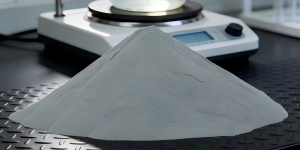
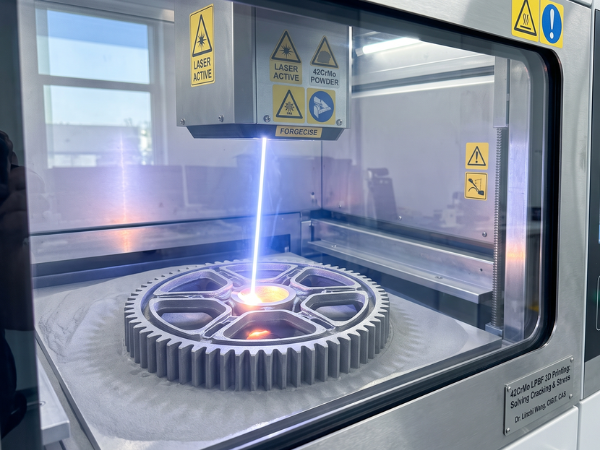
During LPBF, a laser melts thin layers of fine metal powder ($20–60\ \mu\text{m}$). Rapid heat transfer into the build plate creates cooling rates of $10^5 – 10^6\text{ K/s}$ and temperature gradients of $10^5 – 10^6\text{ K/m}$.
For medium-carbon steels, these extreme thermal cycles create three coupled physical problems that cause cracking.
       [ LPBF Laser Thermal Cycles ]
       Cooling Rate:     10⁵ – 10⁶ K/s
       Thermal Gradient: 10⁵ – 10⁶ K/m
                     │
                     ▼
  ┌─────────────────────────────────────────────────┐
  │  THREE COUPLED FAULT MECHANISMS                 │
  ├─────────────────────────────────────────────────┤
  │ 1. High-Carbon Martensite Embrittlement        │
  │    (Hard, untempered lath + twin, Elong < 5%)   │
  │                                                 │
  │ 2. Phase Expansion Stress                       │
  │    (CE ≈ 0.8–0.9%, ~4% γ→α volume growth)      │
  │                                                 │
  │ 3. Interlayer Heat Accumulation                 │
  │    (Cyclic reheating, local strain build-up)    │
  └─────────────────────────────────────────────────┘
                     │
                     ▼
         [ PART WARPING & COLD CRACKING ]
3.1 Problem 1: High-Carbon Martensite Embrittlement
Cooling rates of $10^5 – 10^6\text{ K/s}$ trap carbon inside the face-centered cubic ($\gamma$-austenite) lattice, forcing a shift into supersaturated body-centered tetragonal ($BCT$) martensite made of lath and twin structures.
- Result: As-printed metal reaches high hardness ($\gt 55 – 60\text{ HRC}$) but low ductility, with total elongation dropping under $5\%$. Internal thermal stress easily starts microcracks along grain boundaries.
3.2 Problem 2: Volume Growth During Phase Change
The carbon equivalent ($CE$) of 42CrMo measures around $0.8–0.9\%$:$$\text{CE} = \text{C} + \frac{\text{Mn}}{6} + \frac{\text{Cr} + \text{Mo} + \text{V}}{5} + \frac{\text{Ni} + \text{Cu}}{15}$$
- Result: As the melt pool passes the Martensite Start ($M_s$) temperature, the phase change from face-centered cubic ($\gamma$) to body-centered tetragonal ($\alpha’$) creates an isotropic volume expansion of about $4\%$. When this expansion presses against the shrinking cold matrix nearby, local tensile stress breaks the brittle martensite, causing cold cracks.
3.3 Problem 3: Heat Damage Between Deposited Layers
Layer-by-layer printing reheats previously solidified layers every time the laser passes above them.
- Result: The Heat-Affected Zone (HAZ) goes through repeating cycles of tempering and re-austenitization. This causes local strain accumulation, element segregation, and thermal fatigue, causing layers to split apart along the $Z$-axis.
3.4 Summary of Mechanical Failure
Failure in LPBF 42CrMo traces back to three combined factors:$$\text{LPBF Failure} = \text{Residual Stress Accumulation} \otimes \text{Martensite Embrittlement} \otimes \text{HAZ Thermal Fatigue}$$
Stopping cracks requires an alloy design that manages residual stress during printing while preserving high final strength after heat treatment.
4. Engineering Solutions Developed by CIGIT, CAS
To stop cracking, Dr. Linzhi Wang’s team at the Chongqing Institute of Green and Intelligent Technology, Chinese Academy of Sciences (CIGIT, CAS) designed an LPBF-specific 42CrMo powder composition and processing method.
+-----------------------------------------------------------------------------------+
|               CAS CIGIT LPBF 42CrMo Technical Strategy                            |
+-----------------------------------------------------------------------------------+
|  [1. Micro-Alloying (Mo/V Balance)]                                               |
|      └── Lowers Ms temperature ➔ Triggers TRIP Effect ➔ Cancels Tensile Stress     |
|                                                                                   |
|  [2. Tailored Post-Heat Treatment]                                                |
|      └── Tempered Lath Martensite ➔ UTS ≥ 1200 MPa, Elongation ≥ 15%, Charpy ≥ 86J |
|                                                                                   |
|  [3. Process & Geometry Adaptation]                                               |
|      └── Removes Local Stress Peaks ➔ Enables Crack-Free Complex Parts            |
+-----------------------------------------------------------------------------------+
4.1 Solution 1: Stress Balance via Micro-Alloying & TRIP Effect
Instead of using high bed preheating (which increases equipment cost and powder oxidation), the CAS team adjusted the underlying phase change physics of the metal.
- Micro-Alloying: By adjusting Molybdenum ($Mo$), Vanadium ($V$), and trace elements, the team lowered the Martensite Start ($M_s$) temperature into a controlled window.
- TRIP Effect Activation: Lowering the $M_s$ point forces the phase change ($\gamma \rightarrow \alpha’$) to happen at temperatures where Transformation-Induced Plasticity (TRIP) relaxes internal stress. The positive expansion of the phase change offsets the negative thermal contraction, lowering tensile stress and preventing cracks without sacrificing density.
4.2 Solution 2: Combined Strength and Toughness
Standard 3D-printed steel often trades strength for toughness. The CAS team established a post-printing heat treatment schedule (quenching and tempering parameters matched to LPBF structures).
Performance Data
| State / Metric | Yield Strength ($YS$) | Ultimate Tensile Strength ($UTS$) | Elongation ($\delta$) | Charpy U-Notch Impact ($A_k$) | Microstructure |
|---|---|---|---|---|---|
| Traditional Q&T 42CrMo Standard | $\ge 930\text{ MPa}$ | $\ge 1080\text{ MPa}$ | $\ge 12\%$ | $\ge 63\text{ J}$ | Tempered Sorbitite |
| Standard LPBF As-Printed 42CrMo | Unstable | $\approx 1100 – 1300\text{ MPa}$ | $< 5\%$ (Brittle) | $< 15\text{ J}$ | Brittle High-Carbon Martensite + Microcracks |
| CAS LPBF-Optimized 42CrMo (Post-HT) | $\ge 1050\text{ MPa}$ | $\ge 1200\text{ MPa}$ | $\ge 15\%$ | $\ge 86\text{ J}$ | Fine Tempered Lath Martensite + Dispersed Carbides |
Post-treated CAS 42CrMo exceeds traditional wrought steel standards in tensile strength, elongation, and impact energy at the same time.
4.3 Solution 3: Process Adaptability
By reducing internal stress, the modified alloy prints reliably across wide machine parameter windows. Complex parts print with fewer support structures, minimal deformation, and repeatable dimensions for volume production.
4.4 Supporting Alloy Research
Dr. Linzhi Wang’s group used several material design tools and alloy studies to build this solution:
                  [ High-Throughput Calculation Alloy Design (HTCM) ]
                                          │
        ┌─────────────────────────────────┼─────────────────────────────────┐
        ▼                                 ▼                                 ▼
[ High-Strength Steels ]       [ Superalloys & Light Alloys ]     [ Advanced Hardware ]
• 30CrMnSiA stress release      • GH3230 Carbide Shifts           • Dual-Wavelength Laser
  via Retained Austenite &        (M₂₃C₆ ➔ M₆C) for high-temp       Additive Manufacturing
  TRIP Effect                     strength                        • LPBF Parameter Optimization
  (Eng. Fail. Anal., 2026)        (Mat. Today Comm., 2025)          Framework
                                • Al-Mg-Sc-Zr Isotropic 480 MPa     (Virt. Phys. Prototyp., 2026)
                                  Alloy (J. Mat. Res. Tech., 2025)
- High-Strength Steel Stress Release (30CrMnSiA): Studied internal stress relief through retained austenite phase shifts (TRIP effect) to improve strength, ductility, and fatigue life (Engineering Failure Analysis, 2026).
- High-Temperature Superalloys (GH3230): Analyzed carbide shifts ($M_{23}C_6 \rightarrow M_6C$) to raise high-temperature creep performance (Materials Today Communications, 2025).
- Isotropic Lightweight Alloys (Al-Mg-Sc-Zr): Reached near-isotropic $480\text{ MPa}$ tensile strength in 3D-printed aluminum using grain refinement (Journal of Materials Research and Technology, 2025).
- Advanced AM Frameworks: Created Dual-Wavelength Laser Additive Manufacturing methods and the High-Throughput Calculation Alloy Design Framework (HTCM) to streamline alloy formulation (Virtual and Physical Prototyping, 2026).
5. Industrial Uses & Field Value
Printing defect-free 42CrMo steel opens practical uses across several heavy engineering markets.
                          [ LPBF 42CrMo Primary Uses ]
                                       │
         ┌─────────────────────────────┼─────────────────────────────┐
         ▼                             ▼                             ▼
  [ Oil & Gas ]                 [ Automotive ]                [ Tooling & Molds ]
  • High-Pressure Valves        • High-Torque Gears           • Conformal Cooling Molds
  • Downhole Drilling Tools     • Suspension Knuckles         • Die-Casting Inserts
  • NACE MR0175 Compliance      • Topology-Optimized Parts    • High-Wear Core Pins
5.1 Oil and Gas Sector
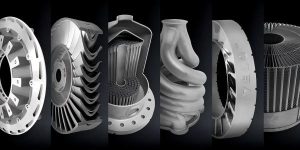
- High-Pressure Valve Bodies & Downhole Tools: LPBF prints single-piece valve bodies with internal 3D cooling and flow lines, eliminating casting shrinkage defects and fluid leaks from drilled cross-holes.
- Sour Gas Compliance: Tested to meet NACE MR0175/ISO 15156 standards for Hydrogen Sulfide ($H_2S$) Stress Corrosion Cracking (SCC) resistance in sour wells.
- On-Demand Production: Digital inventory files allow print-on-demand field parts, lowering lead times from months to days.
5.2 Automotive Engineering
- High-Torque Drive Gears & Suspension Knuckles: Enables hollow, topology-optimized structural parts that lower component weight while maintaining fatigue limits.
- Impact Safety: High impact resistance ($\ge 86\text{ J}$) protects structural chassis parts under sudden shock loads.
5.3 Molds and Tooling
- Conformal Cooling Molds: Drilled cooling lines leave hot spots in complex mold cores. LPBF 42CrMo molds feature fluid lines that follow the exact 3D curvature of the mold cavity.
- Production Savings: Cuts plastic injection cooling cycles by $20\% – 40\%$, lowers part warping, and extends tool wear life.
6. Researcher Profile: Dr. Linzhi Wang (CIGIT, CAS)
This alloy research was directed by Dr. Linzhi Wang and his research team at the Chongqing Institute of Green and Intelligent Technology, Chinese Academy of Sciences (CIGIT, CAS).
+-----------------------------------------------------------------------------------+
|                         RESEARCH PROFILE: DR. LINZHI WANG                         |
+-----------------------------------------------------------------------------------+
| • Ph.D., Associate Professor & Doctoral Supervisor at CIGIT, CAS                  |
| • Vice Director, Chongqing 3D Printing Application Eng. Tech. Research Center     |
| • Expert Committee Member, National AM Standardization Technical Committee        |
| • Youth Expert Member, China Additive Manufacturing Industry Alliance             |
| • Council Member, Chongqing Association of Young Scientists and Tech Workers      |
| • Adjunct Professor, Weiqiao GuoKe Institute of Advanced Technology               |
| • Member, Youth Innovation Promotion Association, Chinese Academy of Sciences     |
| • Visiting Scholar, Tsinghua University (2022–2023)                               |
| • Vice GM (Temp.), Equipment Mgmt Dept, Sinopec Material & Equipment Corp (2025)  |
| • Chongqing "Jinyun Elite" Innovative Young Talent & Govt Procurement Expert      |
+-----------------------------------------------------------------------------------+
6.1 Roles & Academic Appointments
- Academic Roles: Associate Professor and Doctoral Supervisor at CIGIT, CAS; Member of the CAS Youth Innovation Promotion Association; Visiting Scholar at Tsinghua University (2022–2023).
- Industry Appointment: Vice General Manager of the Equipment Management Department (Procurement Operation Department) at Sinopec Material & Equipment Corporation (2025 temporary appointment).
- Advisory & Standards Work: Member of the Expert Group of the National Additive Manufacturing Standardization Technical Committee; Youth Committee Member of the China Additive Manufacturing Industry Alliance; Technical Investigator at the Chongqing Intellectual Property Bureau; Major Equipment Localization Review Expert for Sinopec Group; Honorary Advisor for Singapore Sync Publishing; Senior Member of the Chinese Materials Research Society (C-MRS), Chinese Society for Metals (CSM), and Chinese Mechanical Engineering Society (CMES).
6.2 Key Academic Achievements
- Research Projects: Principal Investigator (PI) for 23 national and provincial projects, including National Natural Science Foundation of China (NSFC) grants, provincial R&D projects, and industrial technology transfers. Technical contributor to 15 major national key research projects.
- Publications & Books: Author of 52 peer-reviewed SCI papers in material journals (including multiple ESI Highly Cited articles). Lead editor of 3 academic books, including “Laser Additive Manufacturing of Hard-to-Weld Superalloys”.
- Patents: Filed 35 national invention patents, with 26 granted. Technologies are actively licensed across oilfield and manufacturing industries.
- Standards & Awards:
- Lead author of 1 National Standard for spherical metal powder testing in 3D printing.
- Contributor to 2 Sinopec Industry Standards.
- Winner of the Chongqing Science and Technology Progress Award.
- Developer of the “Turbine Blade Repair and Remanufacturing” project, selected for the MIIT (Ministry of Industry and Information Technology) First Batch of Typical Additive Manufacturing Application Scenarios.
- First Prize Winner at the 1st Chongqing Youth Science & Technology Talent Showcase (featured in Chongqing Science and Technology Daily).
7. Future Outlook and Industry Shift
The work by Dr. Linzhi Wang’s group moves 42CrMo additive manufacturing away from trial-and-error printing toward physics-based alloy engineering. Combining micro-alloying stress control, TRIP phase dynamics, and targeted heat treatment allows medium-carbon low-alloy steels to print without cracking while exceeding traditional wrought strength standards.
Combining Dual-Wavelength Laser AM, High-Throughput Calculation Alloy Design (HTCM), and specialized powder chemistry creates a unified manufacturing model: Forming–Property–Lifespan Integration (成形-成性-成寿一体化) for high-stress equipment used in demanding environments.
8. Frequently Asked Questions
Why does 42CrMo (AISI 4140) crack during laser 3D printing?
42CrMo cracks during LPBF because rapid cooling ($10^5 – 10^6\text{ K/s}$) forms hard, brittle high-carbon martensite. At the same time, the phase change from austenite to martensite causes a $\sim 4\%$ volume expansion ($CE \approx 0.8–0.9\%$) that combines with thermal contraction stress, tearing the un-tempered metal.
{
  "@context": "https://schema.org",
  "@type": "FAQPage",
  "mainEntity": [
    {
      "@type": "Question",
      "name": "Why is 42CrMo (AISI 4140) prone to cracking during laser 3D printing?",
      "acceptedAnswer": {
        "@type": "Answer",
        "text": "42CrMo steel cracks in LPBF due to rapid cooling rates (10^5 to 10^6 K/s) forming brittle high-carbon martensite combined with a ~4% phase transformation volume expansion (CE ≈ 0.8-0.9%) and accumulated thermal strain between layers."
      }
    },
    {
      "@type": "Question",
      "name": "How does micro-alloying prevent residual stress in LPBF 42CrMo?",
      "acceptedAnswer": {
        "@type": "Answer",
        "text": "Tuning elements like Molybdenum (Mo) and Vanadium (V) lowers the Martensite Start (Ms) temperature, triggering Transformation-Induced Plasticity (TRIP) to offset thermal contraction stress and stop cold cracks."
      }
    },
    {
      "@type": "Question",
      "name": "What mechanical properties can LPBF 42CrMo achieve after heat treatment?",
      "acceptedAnswer": {
        "@type": "Answer",
        "text": "After optimized post-heat treatment, LPBF 42CrMo achieves Ultimate Tensile Strength ≥ 1200 MPa, Elongation ≥ 15%, and Charpy U-notch Impact Energy ≥ 86 J."
      }
    },
    {
      "@type": "Question",
      "name": "How can industry partners contact the research team for technical collaboration?",
      "acceptedAnswer": {
        "@type": "Answer",
        "text": "Contact Dr. Linzhi Wang at the Chongqing Institute of Green and Intelligent Technology, Chinese Academy of Sciences (CIGIT, CAS) via Email: wlz@cigit.ac.cn or Phone: +86-023-65935573."
      }
    }
  ]
}
How does micro-alloying prevent residual stress in LPBF 42CrMo?
Tuning elements such as Molybdenum ($Mo$) and Vanadium ($V$) lowers the Martensite Start ($M_s$) temperature. This triggers Transformation-Induced Plasticity (TRIP), using the volume expansion of the phase change to offset thermal contraction stress and stop cold cracks from forming during solidification.
What mechanical properties does LPBF 42CrMo reach after heat treatment?
With CAS optimized heat treatment, 3D-printed 42CrMo reaches:
- Ultimate Tensile Strength ($UTS$): $\ge 1200\text{ MPa}$
- Yield Strength ($YS$): $\ge 1050\text{ MPa}$
- Elongation ($\delta$): $\ge 15\%$
- Charpy U-Notch Impact Energy ($A_k$): $\ge 86\text{ J}$