






- Author: Felix Lee
- Title: Chief Executive Officer at Forgecise
- Author Expertise: 15+ years in advanced additive manufacturing, aerospace structural engineering, and industrial metallurgy strategy.
- Published Date: July 24, 2026
Table of Contents
Executive Summary
What is driving the commercial space 3D printing revolution in 2026?
The global commercial space sector has reached a critical strategic inflection point: transitioning from technical validation (single-unit testing) to industrialized scale production. Additive manufacturing (3D printing) serves as the core technological engine, achieving massive cost reductions, unprecedented delivery compression, and radical structural innovations.
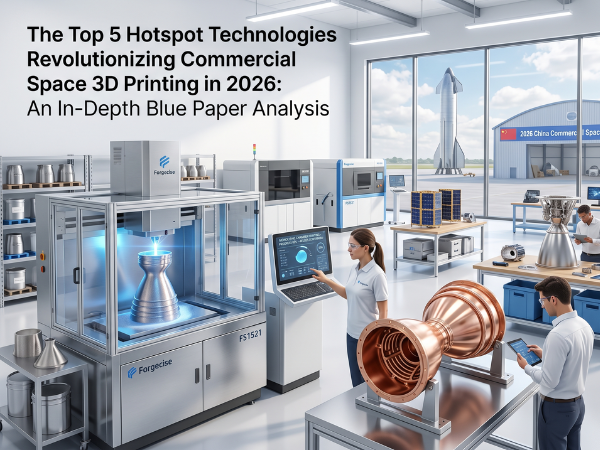
According to the 2026 Commercial Space 3D Printing Technology Development Blue Paper, the top 5 hotspot technologies transforming aerospace manufacturing are:
- SpaceX Raptor Monolithic Copper Thrust Chambers: Achieving$> 95\%$material yield,$70\%$cost reduction, and$> 50$proven reuses (targeting$100+$).
- Meter-Scale Rocket Engine Expansion Extensions: Eliminating brazing defects with single-piece 316L SLM printing ($1013\text{ mm} \times 1013\text{ mm} \times 902\text{ mm}$build volume) and cutting delivery lead times by$70\%$.
- Supportless Aerospike Engines (XRA-2E5): Overcoming internal support requirements ($\ge 95\%$supportless coverage), reducing post-processing costs by$50\%$, and enhancing cooling efficiency by$25\%$.
- Nano-Ceramic Aluminum (TaoAl) Satellite Flat Plates: Lowering structural density to$1.8\text{ g/cm}^3$($33\%$lighter than standard aluminum) with$> 400\text{ MPa}$yield strength for$3.8\text{ m}$LEO satellite structures.
- ISS On-Orbit Microgravity Metal Printing: ESA’s$\text{Ti-6Al-4V}$SLM facility on the ISS Columbus module compressing emergency part replacement cycles from$3 \text{ to } 6\text{ months}$to$< 24\text{ hours}$.
1. Introduction: The Strategic Pivot from Validation to Scale
The commercial space industry is undergoing an unprecedented paradigm shift. For decades, metal 3D printing was confined to low-volume prototype validation and specialized test articles. In 2026, driven by the commercial urgency of mega-constellation deployments (such as low-Earth orbit satellite networks) and multi-use heavy-lift launch vehicles, the industry has pivoted decisively toward industrialized mass production.
+-----------------------------------------------------------------------+
|                    THE 3D PRINTING PARADIGM SHIFT                     |
|                                                                       |
|   Legacy Manufacturing               2026 Additive Scale              |
|   --------------------               -------------------              |
|   - Multi-piece split welding        - Monolithic single-piece SLM    |
|   - 4 to 6 months lead time          - < 1.5 months delivery cycle    |
|   - < 30% material utilization       - > 90-95% material yield        |
|   - High weld-joint failure risk     - Zero-weld seamless integrity   |
+-----------------------------------------------------------------------+
As detailed in Chapter 4 of the 2026 China Commercial Space 3D Printing Technology Development Blue Paper—jointly authored by leading institutions including the MIIT Equipment Engineering Research Institute, Shanghai Additive Manufacturing Innovation Center, Huazhong University of Science and Technology (HUST), Falcontech Co., Ltd., Sichuan Additive Manufacturing Association, and Guangdong Additive Manufacturing Association—the integration of 3D printing is no longer optional. It is the primary technological lever for lowering launch cost thresholds, improving engine reliability, and expanding human orbital operations.
Below is an exhaustive breakdown of the five benchmark technology hotspots defining this transformation.
2. Hotspot 1: SpaceX Raptor Engine Monolithic Copper Thrust Chamber
Application Context & Industry Benchmark
The copper alloy thrust chamber of the SpaceX Raptor engine—a full-flow staged combustion liquid oxygen/methane propulsion system powering the Starship super-heavy launch vehicle—represents the global gold standard for reusable rocket engines. It marks the historical transition of space-grade metal additive manufacturing from “experimental validation pieces” to “industrialized mass-produced reusable flight components.”
Legacy Thrust Chamber vs. Monolithic SLM Thrust Chamber
+--------------------------------------+     +--------------------------------------+
|       Legacy Split-Weld Design       |     |     Monolithic 3D Printed Chamber    |
+--------------------------------------+     +--------------------------------------+
| - Copper inner wall + Nickel shell   |  VS | - Integrated copper alloy structure   |
| - Spliced cooling channels           |     | - Conformal cooling channels         |
| - Numerous weld seams (High stress)  |     | - Zero weld seams / Zero interfaces  |
| - R&D Cycle: 4-6 Months              |     | - R&D Cycle: < 1.5 Months            |
+--------------------------------------+     +--------------------------------------+
The Legacy Manufacturing Bottleneck
Traditional rocket engine thrust chambers rely on a split-welding approach, joining a high-thermal-conductivity copper alloy inner lining with a high-strength nickel-based alloy outer jacket. This legacy process suffers from three critical industry-wide pain points:
- Weld Seam Failure Under Thermal Stress: The presence of numerous weld joints creates severe residual stress concentration. Under repeated thermal-mechanical fatigue and extreme cyclic temperature gradients during launch and re-entry, these seams develop micro-cracks and fuel/oxidizer leakages, rendering multi-mission reuse impossible.
- Inconsistent Internal Cooling Performance: Complex regenerative cooling channels must be spliced together in segments. This results in poor channel dimensional consistency, reduced heat transfer efficiency, and an inability to withstand extreme combustion chamber pressures and temperatures.
- Prohibitive Cost and Lead Time: Traditional manufacturing involves tedious, multi-step sub-assembly, specialized tooling, and extensive non-destructive testing (NDT), resulting in $4 \text{ to } 6\text{ month}$ lead times and excessive unit costs that block high-frequency flight schedules.
Technical Breakthrough & Engineering Solution
SpaceX pioneered the single-piece Selective Laser Melting (SLM) monolithic manufacturing of copper alloy thrust chambers. By printing the inner lining, outer structural shell, and intricate conformal regenerative cooling channels simultaneously in a single build, SpaceX eliminated all assembly interfaces and structural weld seams. SpaceX remains the only commercial space enterprise globally to demonstrate over 50 successful reuses of a single thrust chamber.
Quantified Performance Metrics & Impact
Data compiled in the Blue Paper (Table 4-1) highlights the holistic operational gains achieved through monolithic 3D printing:
| Metric Criteria | Legacy Split-Welding Process | Monolithic SLM 3D Printing | Operational Net Gain |
|---|---|---|---|
| Material Utilization Yield | $30\%$ | $> 95\%$ | $+65\%$ Efficiency |
| Unit Manufacturing Cost | Baseline ($100\%$) | Reduced by $70\%$ | $-70\%$ Cost Overhead |
| R&D / Production Lead Time | $4 \text{ to } 6\text{ Months}$ | $< 1.5\text{ Months}$ | $75\%$ Time Compression |
| Monthly Production Output | Low Volume ($<10\text{ units}$) | $> 100\text{ Units / Month}$ | $10\times$ Scale Factor |
| Proven Structural Reusability | Single-use to limited reuse | $50+$ Flight Reuses | Targeting $100+$ Reuses |
Future Outlook
As printing parameter databases and high-thermal-conductivity copper powder alloys (e.g., GRCop-42/GRCop-84 equivalents) undergo further refinement, future iterations will focus on maximizing thermal fatigue life to surpass $100+$ reuses. Furthermore, the standardized process framework established by this application is highly scalable, serving as a blueprint for global aerospace suppliers in copper powder metallurgy, large-scale SLM hardware development, and closed-loop quality control systems.
3. Hotspot 2: Industrial Batch Production of Meter-Scale Rocket Engine Nozzle Extensions
Application Context & Industry Benchmark
In the domestic liquid rocket engine sector, the industrial batch manufacturing of meter-scale thrust chamber nozzle extensions (expansion sections) represents a major breakthrough in moving from “single-piece prototyping” to “stable multi-unit industrial output.”
This application is spearheaded by Falcontech Co., Ltd. providing full-stack technical solutions, utilizing the Farsoon Technologies FS1521 multi-laser metal 3D printing system. Utilizing 316L stainless steel powder, this project achieves single-piece monolithic fabrication of nozzle extensions exceeding one meter in diameter, directly serving Tianbing Technology’s THXX series liquid engines.
       Farsoon FS1521 Meter-Scale Monolithic Print Build Volume
       +--------------------------------------------------------+
       |                                                        |
       |                   1013 mm (X-Axis)                     |
       |            +------------------------------+            |
       |            |                              |            |
       |   1013 mm  |     Meter-Scale Nozzle       |   902 mm   |
       |   (Y-Axis) |          Extension           |  (Z-Axis)  |
       |            |  (316L Stainless Steel SLM)  |            |
       |            +------------------------------+            |
       |                                                        |
       +--------------------------------------------------------+
Technical Breakthroughs
- Build Envelope Dimensions: Maximum build dimensions reach $1013\text{ mm} \times 1013\text{ mm} \times 902\text{ mm}$.
- Integrated Conformal Channels: Complex internal regenerative cooling fluid channels are printed directly into the structure in a single pass, completely eliminating secondary brazing, external tube wrapping, or segmental welding.
- Flight & Testing Validation: The 3D-printed nozzle extensions have passed full-process metallurgical evaluations, ground hot-fire tests, and are actively deployed in commercial launch vehicles.
Five Dimensions of Operational Improvement
According to technical data (Table 4-2), monolithic additive manufacturing transforms nozzle extension production across five key pillars:
- Structural Reliability (Zero Leakage Risk): By eliminating brazing seams and joint intermetallics, root causes of thermal cracking and high-pressure fluid leaks are eradicated. Failure and leakage risks are reduced to zero.
- Thermal & Dynamic Performance: Conformal cooling channels are free from traditional machining constraints. Optimal flow geometry maximizes heat rejection, boosting overall engine thrust efficiency and operational thermal margins under extreme firing conditions.
- Delivery Efficiency: Eliminates the need for costly, long-lead stamping and brazing dies. Individual component development is compressed from several months to under $3\text{ weeks}$, with total delivery schedules shortened by $70\%$. Design modifications can be implemented instantly in CAD without scrap tool delays.
- Reusability & Duty Cycle: The nozzle extension successfully completed cumulative hot-fire testing exceeding $1000\text{ seconds}$ and $6$ consecutive engine ignition cycles. It reliably supports $50+$ flight reuses (with research targeting $100+$ reuses).
- Material Yield & Economic Gains: Raw material utilization increased from under $30\%$ (traditional forging and subtractive turning) to over $90\%$. Intermediate production steps—such as multi-stage tooling, brazing inspection, and manual alignment—are completely bypassed.
Future Roadmap
Technological developments are expanding this meter-scale SLM methodology beyond expansion nozzles to cover entire engine power assemblies, including main combustion chambers, injector heads, turbopump housings, and hot-gas ducts.
4. Hotspot 3: Supportless Monolithic Manufacturing of Aerospike Rocket Engines
Application Context & Engineering Architecture
The XRA-2E5 Aerospike Rocket Engine ($200\text{ kN}$ thrust class), co-developed by Hanbang Laser and LEAP71, represents a leap forward in advanced propulsion geometry. Built using the HBDE800 large-format industrial metal 3D printing platform, this design replaces traditional bell nozzles with an annular combustion chamber and a central plug body architecture.
       TRADITIONAL BELL NOZZLE          AEROSPIKE PLUG NOZZLE (XRA-2E5)

             /         \                        |   |     |   |
            / Combustion\                       | Chamber |   |
           /   Chamber   \                      |___|_____|___|
          (_______________)                        \  Plug /
           \             /                          \ Body/
            \  Diverging\                            \   /
             \   Bell   /                             \ /  (Altitude Compensating
              \________/                               V    Exhaust Expansion)
Overcoming the Internal Support Challenge
Historically, producing complex meter-scale aerospike engines via Powder Bed Fusion (PBF) required dense internal metal support structures within the enclosed fluid passages and annular walls. Removing these supports manually from complex internal channels is often impossible or cost-prohibitive.
Hanbang Laser and LEAP71 resolved this by implementing advanced computational design algorithms paired with supportless printing parameter controls, enabling structural overhangs and internal channels to be printed cleanly without internal scaffolding.
Key Metrics & Manufacturing Impacts
- Supportless Coverage Rate: $\ge 95\%$ of internal structures printed without support geometry.
- Post-Processing Cost Reduction: Support material consumption decreased by $> 90\%$, directly dropping post-processing labor and machining costs by $\sim 50\%$.
- Cooling Fluid Dynamics: Internal channel walls remain completely smooth and unmarred by support stubs, enhancing coolant flow dynamics and increasing heat dissipation efficiency by $\sim 25\%$.
- Manufacturing Lead Time: Total design-to-component fabrication time dropped by $\sim 40\%$, achieving the engineering objective of “Print-and-Go” propulsion hardware.
- Structural Integrity: Zero weld seams and zero mechanical fasteners remove all stress concentrations and joint leakage vectors.
               XRA-2E5 Supportless Aerospike Performance Metrics
               +-----------------------------------------------+
               | Metric Factor            | Quantified Result  |
               +--------------------------+--------------------+
               | Supportless Coverage     | >= 95%             |
               | Support Material Saved   | > 90%              |
               | Post-Processing Cost     | - 50%              |
               | Internal Channel Cooling | + 25% Efficiency   |
               | Overall Lead Time        | - 40% Compression  |
               | Target Engine Thrust     | 200 kN             |
               +-----------------------------------------------+
Strategic Industry Value
This application establishes a new manufacturing paradigm combining AI-driven algorithmic design with large-scale additive equipment. It provides a foundation for next-generation altitude-compensating nozzles, reusable propulsion systems, and integrated reaction control systems.
5. Hotspot 4: LEO Satellite Large-Scale Flat Plate Structures via Ceramic-Aluminum Composites
Application Context & Satellite Manufacturing Challenges
With the accelerated deployment of global Low Earth Orbit (LEO) mega-constellations, flat-panel satellites have emerged as the dominant platform for broadband communication and optical/radar remote sensing. These satellites require ultra-large structural flat plates ($3.8\text{-meter}$ class) and integrated bus cabins that meet strict requirements for high stiffness, minimal mass, high thermal conductivity, and rapid batch production.
    Traditional Aluminum vs. Nano-Ceramic Aluminum (TaoAl) Satellite Plates
    +-----------------------------------------+-----------------------------------------+
    | Traditional Machined/Welded Aluminum    | Nano-Ceramic Aluminum (TaoAl Composite) |
    +-----------------------------------------+-----------------------------------------+
    | - Material Density: 2.7 g/cm^3          | - Material Density: 1.8 g/cm^3 (-33%)   |
    | - Yield Strength: ~260 MPa (Cast Al)    | - Yield Strength: >400 MPa (+50%)       |
    | - High risk of thin-wall thermal warp   | - High thermal stability & low warp     |
    | - Multi-piece assembly (High thermal R) | - Integrated structural-thermal channels|
    | - Production lead time: Several months  | - Production lead time: ~25 Days        |
    +-----------------------------------------+-----------------------------------------+
Legacy manufacturing using machined aluminum plates joined by welding faces major limitations:
- Excessive structural mass (standard aluminum density $\sim 2.7\text{ g/cm}^3$ limits payload capacity).
- Thermal distortion and irreversible warping when welding thin-walled $3.8\text{ m}$ structures.
- High thermal contact resistance caused by attaching heat pipes, cable harness mounts, and payload brackets via fasteners.
Technical Solution: Nano-Ceramic Reinforced Aluminum (TaoAl)
To address these limitations, Hongqing Technology developed a complete manufacturing suite based on proprietary Nano-Ceramic Particle Reinforced Aluminum Matrix Composites (TaoAl / Ceramic Aluminum Matrix Composite). Combining structural-thermal topology optimization, segmented printing with precision joining, and automated quality control, Hongqing Technology successfully produced $3.8\text{-meter}$ large-scale satellite flat plates and integrated bus cabins.
Quantified Material & Structural Metrics
Data from the Blue Paper (Table 4-3) showcases the physical breakthroughs achieved with TaoAl additive manufacturing:
- Mass Reduction: Material density is lowered to $1.8\text{ g/cm}^3$—a $33\%$ weight reduction compared to standard aluminum alloy ($2.7\text{ g/cm}^3$), significantly expanding satellite payload capacity.
- Mechanical Strength: Room-temperature yield strength exceeds $400\text{ MPa}$, representing a $50\%$ increase over standard cast aluminum alloys.
- Production Acceleration: Manufacturing lead time for a $3.8\text{-meter}$ satellite plate dropped from several months to $\sim 25\text{ days}$.
- Integrated Heat Dissipation: Embedded cooling channels and structural brackets are printed directly into the panel, lowering contact thermal resistance and supporting high-power payloads.
Future Roadmap
Target milestones include scaling single-piece segmented fabrication to $4.5\text{-meter}+$ ultra-large structures while extending TaoAl materials into rocket grid fins, payload adapter rings, and satellite thermal management frames across LEO mega-constellation programs.
6. Hotspot 5: Space In-Situ Manufacturing – On-Orbit Metal 3D Printing on the ISS
The In-Space Resupply Bottleneck
As orbital stations expand operations and deep-space missions advance, relying exclusively on ground launches for spare parts introduces four major operational constraints:
- Long Supply Lead Times: Ground cargo flights operate on fixed schedules, requiring $3 \text{ to } 6\text{ months}$ to deliver replacement hardware.
- High Logistics Costs: Launching payload to Low Earth Orbit costs over $\$20,000\text{ per kilogram}$, with costs compounding for lunar or Martian vectors.
- Absence of Rapid Emergency Repair: On-orbit hardware failures currently require waiting for the next launch, posing risks to station safety and crew operations.
- Mass Constraints on Deep-Space Missions: Spacecraft cannot carry secondary redundant spares for every onboard component due to strict payload launch limits.
                  EARTH-TO-ORBIT RESUPPLY VS. IN-SITU AM

   GROUND RESUPPLY MODEL                    IN-SITU ON-ORBIT MODEL
   =====================                    ======================
   [Earth Depot]                            [Raw Metal Powder / Wire]
         |                                             |
   (3 - 6 Months Flight Lead)               (< 24 Hours Emergency Print)
         |                                             |
   [ISS Station Deployment]                 [Flight-Ready Titanium Part]
   Cost: > $20,000 / kg                     Cost: >80% Mass Savings
The Technological Breakthrough
To establish in-space manufacturing capabilities, the European Space Agency (ESA)—in collaboration with Airbus Defence and Space, MT Aerospace, and OHB System—developed the Metal 3D Printing Facility.
Launched and installed inside the International Space Station (ISS) Columbus Module, this system achieved the world’s first successful end-to-end engineering demonstration of metal laser powder bed fusion in a microgravity space environment. The facility successfully produced $\text{Ti-6Al-4V}$ titanium alloy calibration specimens, structural connectors, and emergency repair components.
Microgravity Engineering Challenges Overcome
The ISS facility overcame four fundamental physics hurdles:
- Powder Bed Management in Microgravity: Preventing loose metal powder from floating inside the pressurized cabin.
- Melt Pool Dynamics in Vacuum/Microgravity: Stabilizing surface tension and thermal dissipation in laser melt pools without gravity-driven convection.
- Supportless Overhang Forming: Printing complex geometry without auxiliary support structures in orbit.
- Closed-Loop QA: Implementing automated on-orbit optical monitoring to guarantee part density and defect control.
Quantified Performance Metrics & Impact
Data compiled in the Blue Paper (Table 4-4) details the operational specs of the ISS Metal 3D Printing Facility:
          ESA ISS On-Orbit Metal 3D Printing Quantified Performance
          +---------------------------------------------------------+
          | Operational Parameter       | Quantified Specification  |
          +-----------------------------+---------------------------+
          | Material Processed          | Ti-6Al-4V Titanium Alloy  |
          | Part Relative Density       | >= 99.9%                  |
          | Dimensional Accuracy        | +/- 0.1 mm                |
          | Emergency Lead Time         | < 24 Hours (vs 3-6 Mos)   |
          | Logistics Weight Savings    | > 80% Mass Reduction      |
          | Direct Launch Cost Savings  | > $10 Million / Mission   |
          +-----------------------------+---------------------------+
- Part Integrity: Achieved relative part density $\ge 99.9\%$ and dimensional accuracy of $\pm 0.1\text{ mm}$. Mechanical properties equaled ground-printed baselines, with certain fatigue resistance metrics exceeding ground controls.
- Emergency Response: Component replacement time dropped from $3\text{–}6\text{ months}$ to under $24\text{ hours}$.
- Economic Savings: Transporting raw powder feedstock instead of bulky finished spares reduces launch mass by $> 80\%$, yielding over $\$10\text{ million}$ in launch cost savings per LEO operational mission.
Exploration Timeline & Strategic Roadmap
- 2028 Target: Deployment of metal additive manufacturing systems in Lunar Orbit (Gateway/Orbital infrastructure).
- 2030 Target: Deployment of In-Situ Resource Utilization (ISRU) metal printing systems on the Lunar Surface to process lunar regolith and extracted metals for habitat construction and hardware maintenance.
7. Master Technology Comparison Matrix
To summarize the five hotspot technologies analyzed in the 2026 Blue Paper, the table below compares their materials, equipment providers, operational gains, and lifecycle reusability metrics:
| Hotspot Technology / Component | Primary Material | Hardware / Key Partners | Primary Value Proposition | Reusability / Duty Cycle |
|---|---|---|---|---|
| 1. SpaceX Raptor Thrust Chamber | Copper Alloy | Internal SpaceX SLM Process | $-70\%$ cost drop; $>95\%$ material yield; $>100\text{ units/mo}$ capacity | Proven $50+$ reuses (Targeting $100+$) |
| 2. Meter-Scale Expansion Extension | 316L Stainless Steel | Farsoon FS1521 / Falcontech / Tianbing THXX | $1013\times 1013\times 902\text{ mm}$ size; $70\%$ faster delivery; zero leaks | Passed $1000\text{s}$ hot-fire / $6$ ignitions; $50+$ reuses |
| 3. Aerospike Monolithic Engine (XRA-2E5) | High-Temp Alloy | Hanbang HBDE800 / LEAP71 | $\ge 95\%$ supportless coverage; $-50\%$ post-process cost; $+25\%$ cooling | $40\%$ shorter R&D cycle; $200\text{ kN}$ thrust class |
| 4. LEO Satellite Flat Structural Plate | Nano-Ceramic Al (TaoAl) | Hongqing Technology | Density $1.8\text{ g/cm}^3$ ($-33\%$); Yield strength $>400\text{ MPa}$ ($+50\%$) | $25\text{ days}$ lead time for $3.8\text{ m}$ size structure |
| 5. ISS On-Orbit Metal Facility | $\text{Ti-6Al-4V}$ Titanium | ESA / Airbus / MT Aerospace / OHB System | Emergency turnaround $<24\text{ hrs}$; $>80\%$ weight reduction | Density $\ge 99.9\%$; Precursor to 2028/2030 Lunar Base |
8. Frequently Asked Questions (FAQ) & Knowledge Graph Base
Q1: Why is 3D printing replacing traditional welding in reusable rocket thrust chambers?
A: Traditional thrust chambers rely on joining copper inner liners to nickel outer shells using hundreds of individual weld seams. Under the extreme thermal-mechanical cycles experienced during rocket launches, these weld seams suffer from residual stress concentration and thermal fatigue cracks, leading to propellant leaks. Monolithic 3D printing forms the inner wall, outer jacket, and cooling channels in a single pass, eliminating all weld seams and structural interfaces. This extends part life to $50\text{–}100+$ reuses while cutting manufacturing costs by $70\%$.
Q2: What is “TaoAl” (Nano-Ceramic Aluminum) and why is it important for LEO satellites?
A: TaoAl is a high-performance composite material developed by Hongqing Technology that incorporates nano-ceramic particles into an aluminum matrix. It achieves a density of just $1.8\text{ g/cm}^3$ ($33\%$ lighter than standard aluminum alloys at $2.7\text{ g/cm}^3$) while delivering a room-temperature yield strength above $400\text{ MPa}$ ($50\%$ higher than cast aluminum). This combination reduces structural satellite mass, increases payload capacity, and shortens structural build cycles to $25\text{ days}$.
Q3: How does metal 3D printing function in microgravity onboard the International Space Station?
A: Microgravity printing requires overcoming challenges related to powder containment and melt-pool behavior. ESA’s Metal 3D Printing Facility inside the ISS Columbus Module uses specialized atmospheric controls, enclosed powder management systems, and real-time optical monitoring. This setup allows for stable laser melting of $\text{Ti-6Al-4V}$ titanium alloy without gravity assistance, achieving part densities $\ge 99.9\%$ and enabling on-demand replacement parts in under $24\text{ hours}$.
Q4: What is the significance of supportless 3D printing in aerospike rocket engines?
A: Aerospike engines use intricate annular combustion chambers and internal cooling fluid channels where manual removal of traditional printing support scaffolding is impossible. Supportless printing—demonstrated on the $200\text{ kN}$ XRA-2E5 engine by Hanbang Laser and LEAP71—achieves $\ge 95\%$ supportless coverage. This reduces support material consumption by $>90\%$, cuts post-processing costs by $50\%$, improves internal surface smoothness, and increases cooling efficiency by $25\%$.
9. Conclusion & Industry Event Callout
Additive manufacturing has evolved from an experimental prototyping tool into the primary structural driver of the modern commercial space economy. By eliminating weld seams, enabling supportless geometries, utilizing nano-composite alloys like TaoAl, and deploying in-space microgravity printers, the aerospace industry is lowering the cost per kilogram to orbit while accelerating vehicle turnaround times.
For engineering teams, defense executives, and additive manufacturing specialists seeking to stay at the forefront of these developments:
Upcoming Industry Event Notice: Registration is now open for the Commercial Space & Low-Altitude Aviation 3D Printing Conference. Join key authors of the 2026 Blue Paper, chief engineers, and OEM executives to discuss next-generation powder metallurgy, multi-laser SLM architectures, and orbital manufacturing roadmaps.
For further technical consultation, additive design reviews, or industrial strategy inquiries, contact Felix Lee and the engineering advisory team at Forgecise.