







Author: Felix Lee (CEO at Forgecise)
Published Date: June 26, 2026
Read Time: 6 min read
Category: Aerospace & Manufacturing
Table of Contents
Key Takeaways (Quick Facts for Readers)
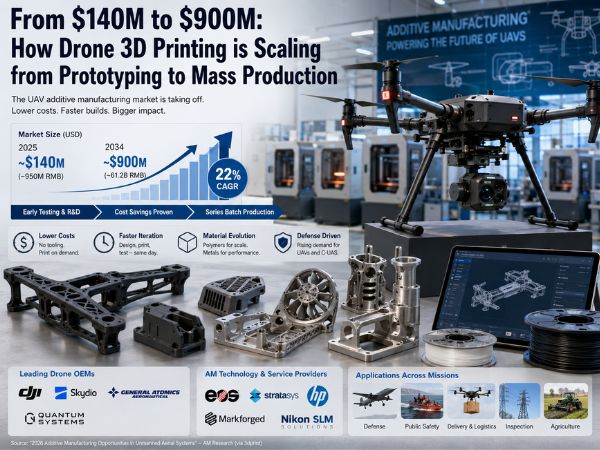
- Market Projection: The market for 3D printing in drone systems is growing from $140 million USD (~950 million RMB) in 2025 to nearly $900 million USD (~61.2 billion RMB) by 2034, with a Compound Annual Growth Rate (CAGR) of roughly 22%.
- Main Application Shift: Unmanned Aerial Vehicles (UAVs) are now the largest real-world application scene globally for budget-friendly 3D printers. Manufacturers have moved past initial visual testing into series batch factory production due to lower costs.
- Material Shift: Polymers still handle high volumes and cheap unit costs, but metal 3D printing is taking over larger drone builds, specifically for engine parts and high-load frame components.
- Primary Driver: Global defense spending on military UAVs and Counter-Unmanned Aerial Systems (C-UAS) is pushing manufacturers to build systems faster than ever.
- Supply Chain Players: Top drone OEMs using 3D printing include DJI, Skydio, General Atomics, and Quantum Systems. Primary hardware and service providers include EOS, Stratasys, HP, Markforged, and Nikon SLM Solutions.
1. The Growing UAV Additive Manufacturing Market
A industry report titled 2026 Additive Manufacturing Opportunities in Unmanned Aerial Systems: Market Analysis and Forecast from research firm AM Research shows that 3D printing in drone making has reached a real turning point.
| Metric | 2025 Estimate | 2034 Projection | Growth |
|---|---|---|---|
| Market Value (USD) | ~$140 Million USD | ~$900 Million USD | 22% CAGR |
| Market Value (RMB) | ~950 Million RMB | ~61.2 Billion RMB | Multi-fold Expansion |
| Primary Focus | Early Testing & R&D | Factory Mass Production | Shift to Scale |
Demand for drones across key commercial and government fields keeps rising year after year. These fields include:
- Defense Operations
- Public Safety
- Agriculture
- Logistics and Delivery
- Infrastructure Inspection
As drone output expands across these industries, 3D printing has changed from an early-stage modeling tool into a primary way to make actual flight hardware.
2. Moving Past Prototypes into Series Production
For years, aerospace engineers used 3D printers mainly for fast visual checks, spatial fitting, and low-volume R&D tests. That simple reality is gone.
The World’s Largest Production Scene for Low-Cost AM
The AM Research report points out that drones are now the largest production application anywhere in the world for low-cost 3D printers.
More commercial and military drone companies build end-use parts on 3D printers every day. They rely on additive machines for full production runs, not just visual models.
[Visual Prototypes & R&D] ──► [Cost Savings Proven] ──► [Series Batch Production]
Direct Drivers: Cost and Speed
The biggest reason for this change comes down to simple math: unit costs and operational speed. Old-school injection molding and multi-axis CNC machining demand huge initial spending on metal molds, long setup wait times, and high material waste.
For drone builders operating in fast-moving markets, additive manufacturing provides clear advantages:
- No Mold Expenses: You skip initial tooling costs for steel or aluminum molds.
- Fast Design Changes: Engineers alter CAD files and immediately print fixed components without stopping factory lines.
- On-Demand Local Runs: Factories print smaller batches as needed, avoiding heavy warehouse storage costs.
3. Materials Update: Polymers Meet Metal 3D Printing
Materials used in drone printing follow a clear pattern. Plastic polymers created the base market, but metal systems now build critical load-bearing parts.
Polymer Printing: Low Costs and Quick Delivery
Polymer 3D printing built the foundation of this industry. Plastic parts offer high production speed and very low single-piece costs. These traits match what drone makers need for fast delivery and cheap builds. Plastic components still make up most body covers, outer shells, landing gear, and simple internal brackets.
Metal Printing: Taking Over High-End Platforms
Polymer systems are now paired with Metal Additive Manufacturing. As noted in the AM Research report, metal 3D printing is entering larger, more complex drone setups.
Key areas using metal parts include:
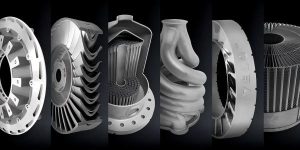
- Propulsion Systems: Engine manifolds, turbine nozzles, heat exchangers, and exhaust components that must resist extreme operational heat.
- High-Stress Parts: Wing spars, central body joints, motor mounts, and payload attachments that handle high physical forces.
Metal printing fills the exact needs of military UAV designs: complex shapes, light structures, and strong metallic materials.
4. Defense Growth as the Main Market Engine
Commercial delivery and crop monitoring keep growing, but the defense sector is the single largest growth engine for drone 3D printing today.
Spikes in Military Units and Counter-UAS
Governments worldwide are spending heavily on military drones and Counter-Unmanned Aerial Systems (C-UAS). Because of this spending, military drone production numbers have reached levels far higher than past years.
Need for Quick Production Cycles
Modern defense hardware changes fast. Military suppliers want manufacturing methods that let them build machines faster and update systems right away.
3D printing fulfills these military needs by offering:
- Local On-Site Printing: Field teams print spare parts right near operations.
- Rapid System Updates: Engineers adjust payload bays or electronic housing components in days based on active operational needs.
5. Ecosystem and Supply Chain Overview
The supply chain around drone additive manufacturing combines big aerospace brands, equipment makers, and small tech startups.
       ┌─────────────────────────────────────────────────────────────┐
       │                Drone AM Ecosystem Landscape                 │
       └──────────────────────────────┬──────────────────────────────┘
                                      │
           ┌──────────────────────────┴──────────────────────────┐
           ▼                                                     ▼
┌───────────────────────────────┐                     ┌───────────────────────────────┐
│     Drone OEMs & Tech Primes  │                     │  AM Hardware & Service Vendors│
├───────────────────────────────┤                     ├───────────────────────────────┤
│ • DJI (大疆)                  │                     │ • EOS                         │
│ • Skydio                      │                     │ • Stratasys                   │
│ • General Atomics             │                     │ • HP (惠普)                   │
│ • Quantum Systems             │                     │ • Markforged                  │
│                               │                     │ • Nikon SLM Solutions         │
└───────────────────────────────┘                     └───────────────────────────────┘
Leading Drone OEMs
Major drone builders using 3D printing in their regular production lines include:
- DJI (大疆): The largest commercial and industrial drone producer globally.
- Skydio: American autonomous drone builder expanding into defense and enterprise operations.
- General Atomics: Global defense contractor making long-range military UAVs.
- Quantum Systems: European defense tech firm creating eVTOL fixed-wing drone systems.
Hardware and Service Providers
Key 3D printing machine makers and service suppliers helping these drone builders include:
- EOS: Industrial 3D printing vendor focused on metal and plastic Laser Powder Bed Fusion.
- Stratasys: Longtime leader in high-strength plastic FDM and PolyJet systems.
- HP (惠普): Maker of Multi Jet Fusion (MJF) tech used for plastic parts at scale.
- Markforged: Producer of composite carbon-fiber and desktop-to-industrial metal printers.
- Nikon SLM Solutions: Maker of high-speed multi-laser metal 3D printing systems.
According to AM Research, this market blends established aerospace suppliers, dedicated manufacturing vendors, and agile startups designing new drone technology.
6. Frequently Asked Questions (FAQ)
Q1: Why are drone makers using metal 3D printing alongside polymers?
Short Answer: Metal handles high-stress and high-heat areas that plastic cannot survive.
Detailed Explanation: Polymers remain ideal for cheap, lightweight body shells and internal covers. However, larger drone platforms require metal 3D printing for motor mounts, structural wing joints, and propulsion parts that face extreme physical loads and high heat.
Q2: What is the projected 3D printing drone market size by 2034?
Short Answer: Near $900 million USD (around 61.2 billion RMB).
Detailed Explanation: AM Research estimates the market will grow from $140 million USD in 2025 to nearly $900 million USD by 2034, registering an annual compound growth rate of 22%.
Q3: How does 3D printing help defense drone production?
Short Answer: It cuts setup wait times and enables fast field updates.
Detailed Explanation: 3D printing removes the need for costly metal molds and long production setups. Defense teams can alter designs on computers, print replacement parts near bases, and adjust electronics bays in days to adapt to changing field requirements.
Final Thoughts
The shift in drone 3D printing from simple testing models to real factory batch production is changing how hardware gets built. Rising military spending, better metal 3D printers, and lower unit costs mean drone builders who use additive tools will move faster and build lighter systems over the next decade.
Author Bio
Felix Lee is the CEO at Forgecise, working on production strategies, hardware engineering, and advanced manufacturing setups for autonomous machines.
Data Source: “2026 Additive Manufacturing Opportunities in Unmanned Aerial Systems” report by AM Research (via 3dprint).