





Author: Felix Lee (CEO at Forgecise)
Published: June 24, 2026
Reviewed by: Forgecise Engineering Team
Reading Time: 7 Minutes
Executive Summary
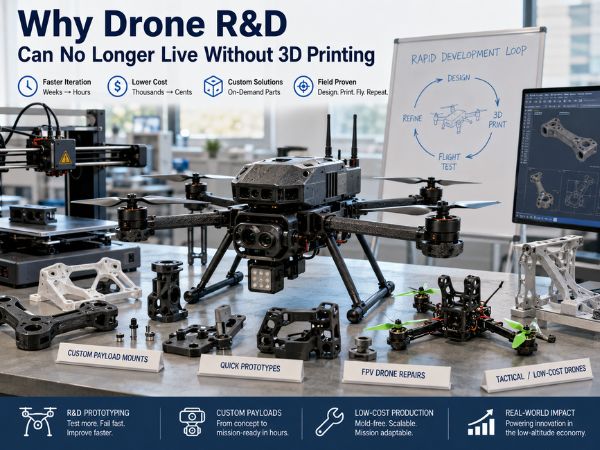
- Main Catalyst: As low-altitude flight tech grows, drone R&D needs fast updates. 3D printing has become a core build tool rather than an extra perk.
- Cost and Time Savings: Swapping metal molds for 3D prints cuts iteration times from weeks to hours and drops prototype costs to almost zero.
- Tailored Gear: It solves single-part build issues for enterprise payloads like thermal cameras, gas detectors, and speakers.
- Low-Cost Hardware: It allows mold-free builds for light frames, cheap FPV drone repairs, and disposable tactical aircraft used in conflict zones.
- Field Proof: Real R&D work—like our “Suiguang” 5G drone project—shows that engineers can design, print, flight-test, and tweak parts all on the same day.
Schema.org Markup
{
  "@context": "[https://schema.org](https://schema.org)",
  "@type": "TechArticle",
  "headline": "Why Drone R&D Can No Longer Live Without 3D Printing",
  "description": "An in-depth analysis on how additive manufacturing solves critical pain points in UAV research, prototyping, custom payloads, and ultra-low-cost drone production.",
  "author": {
    "@type": "Person",
    "name": "Felix Lee",
    "jobTitle": "CEO",
    "worksFor": {
      "@type": "Organization",
      "name": "Forgecise"
    }
  },
  "datePublished": "2026-06-24",
  "dateModified": "2026-06-24",
  "publisher": {
    "@type": "Organization",
    "name": "Forgecise"
  },
  "keywords": ["3D Printing in Drone R&D", "UAV Additive Manufacturing", "Low-Altitude Economy", "Suiguang 5G Drone", "Custom Payload Mounts"]
}
The Twin Engine of Low-Altitude Flight
Interest in low-altitude aviation is growing fast. Money, policy, and engineering talent continue to pour into this airspace. Yet behind the main headlines, another industry grows right alongside it: 3D printing.
If low-altitude tech is a soaring glider catching a strong breeze, 3D printing is the essential wing joint holding it together.
This is not hyperbole. As drone engineering shifts toward rapid testing and short production runs, 3D printing has moved from a handy bonus to a everyday build tool.
How did this shift happen? What exact engineering headaches does 3D printing solve in modern UAV labs? And how do teams use it day to day? Let’s look at the hardware side of things.
What Key R&D Pain Points Does 3D Printing Solve?
[Traditional Tooling vs 3D Printing]
Traditional: Design -> Machined Mold (Weeks / $1,000s) -> Flight Test -> Scrapped Mold
3D Printing: Design -> Print (Hours / Cents) -> Flight Test -> CAD Adjust (Same Day)
1. Cutting Down R&D Expenses and Lead Times
In early drone development, aerodynamic setups and physical frames need constant flight testing. Engineers must build and fly multiple prototype variations to find what works best.
Using traditional manufacturing causes clear headaches:
- Long Tooling Wait Times: Making a metal mold usually takes several weeks.
- High Upfront Costs: A single mold setup costs anywhere from a few thousand to tens of thousands of dollars.
- Wasted Cash on Redesigns: If an airframe fails a flight test or needs a small size tweak, that expensive mold turns into scrap metal.
The 3D Printing Fix: Additive machines change this process. Printing a structural joint takes just a few hours, and plastic filament or resin costs very little.
Development moves from weeks down to hours. Trial costs drop from thousands of dollars to small change. R&D teams can model, print, and fly test three or four variations in a single day. When failing a test costs almost nothing, teams can test bolder ideas and fix design flaws much faster.
2. Building Custom Mounts for Enterprise Drones
Commercial drones rarely use standard off-the-shelf builds. Different clients want different gear mounted on their aircraft:
- Thermal imagers for search and rescue operations
- High-definition zoom cameras for power grid inspections
- Loudspeakers for public safety warnings
- Gas sensors for environmental checks
                  ┌── Thermal Imager
                  ├── HD Zoom Camera
Enterprise Drone ─┼── Megaphone / Loudspeaker
                  └── Gas Detection Module
                           │
             (Needs Custom Mounted Bracket)
                           │
             [3D Printed On-Demand in Hours]
These jobs mean short production runs and custom parts. A contract might only call for two or three custom brackets or protective covers.
Traditional molding makes zero sense here. You cannot split a $10,000 mold cost across three plastic brackets. 3D printing needs no molds. Once the CAD file is ready, the printer starts. Making a single custom bracket costs about the same per unit as making a hundred, fitting small-batch orders perfectly.
In active drone workshops, engineers turn a client’s custom request into a working mount in a matter of hours: Design it, print it, mount it, fly it.
3. Meeting Demand for Ultra-Low-Cost Airframes
Some drone projects care far more about low costs than maximum frame strength. 3D printing allows teams to print full body frames without molds, pulling overall production costs way down.
DIY FPV Drones
This approach is standard among FPV drone builders. Pilots download open-source CAD files or draw their own frames, then print parts using basic home 3D printers. They add motors, flight boards, and propellers to build cheap aircraft. When a pilot crashes and snaps an arm or a guard, they print a new part at home for pennies. Repair costs stay tiny.
Disposable Tactical Drones
We see an even clearer example in conflict areas today. Operators fly large numbers of cheap FPV drones for scout work and strikes. Many of these military airframe parts are 3D printed—costing anywhere from a few dollars to a few dozen dollars each. 3D printing has turned these aircraft into low-cost expendable tools.
How R&D Labs Use 3D Printing on Live Projects
Here is a clear look at how engineering centers use 3D printing in their daily work.
[Lab Applications]
├── 1. "Suiguang" 5G Drone Prototyping (Same-Day Flight Loops)
├── 2. Custom Work Brackets (Release Hooks, Antenna Mounts, Banner Devices)
└── 3. Everyday Shop Tools (Soldering Jigs, Board Cases, Wire Clips)
Case 1: Fast Prototyping for the “Suiguang” 5G Light Drone
“Suiguang” (溯光) is a 5G light drone developed in-house by our lab team. During early work, the team had to test frame shapes, payload mounting points, and 5G antenna spots over and over again.
If every modification needed a machined mold:
- Wait Time: Every update would take at least two weeks.
- Expenses: Out-of-pocket costs would start at tens of thousands of dollars per round, slowing the project to a crawl.
The Engineering Choice: The team decided that all structural parts on prototype builds had to be 3D printed, saving factory molds for the final mass-production run.
Whenever an engineer tweaked a CAD file, the fresh plastic part came off the printer print bed a few hours later. The team handled assembly, flight checks, bug fixes, and CAD updates all within the same day.
This daily loop—Design, Print, Fly, Fix—helped the “Suiguang” drone go from early concept to first successful flight fast, while keeping the early budget tiny.
Case 2: Quick Turnaround on Task-Specific Accessories
Off-the-shelf drones rarely fit special mission needs right out of the box:
- Cargo Runs: Need custom release hooks and drop latches.
- Signal Checks: Need special antenna mounts angled for test tools.
- Banner Displays: Need custom mechanical arms to hold and roll out vertical banners.
Opening metal molds for these small, one-off orders is far too expensive. 3D printing is the only path that makes financial sense.
Engineers design the hook or bracket to match the job, print it in a few hours, bolt it to the drone, and start the flight. Getting parts done fast keeps client turnarounds quick.
Case 3: Printing Everyday Shop Tools and Micro-Parts
Beyond the aircraft itself, daily shop work requires dozens of small hand tools and mounting accessories:
- Exploded-view display stands for technical briefings
- Custom soldering jigs and assembly blocks
- Workbench tool holders
- Plastic cases for flight controller boards
- Cable management clips and wire guides
[Cost Comparison Example]
Commercial Off-The-Shelf Bracket: $20.00 + 3-Day Shipping (Often Loose Fit)
In-House 3D Printed Bracket:       $0.25  + 1.5 Hours Print Time (Exact Fit)
Buying these small items from suppliers costs good money, takes days to arrive, and rarely fits custom rigs quite right.
3D printing handles these small operational gaps with ease: Need a tool? Draw it. Finished drawing? Print it. Printed? Put it to work. A custom soldering jig uses a few cents worth of plastic, and a board case prints in under two hours. Over a full year, these small printed parts save labs hundreds of hours and thousands of dollars.
A Flexible Tool for Hardware Teams
From testing airframes to building custom payload brackets, cheap drone frames, and lab hand tools, 3D printing touches every step of modern drone R&D.
It doesn’t just answer “Can we build this part?” It answers the practical questions: “Can we build it faster? Can we build it cheaper? Can we adjust it easily when specs change?”
Our project work with the “Suiguang” 5G drone and field missions shows this every day: 3D printing shrinks the gap between a design drawing and a flyable part down to a few hours.
If drones are the wings of low-altitude flight, 3D printing is the flexible joint inside them. As low-altitude manufacturing grows, this build tool will only become more essential.
Frequently Asked Questions
Q1: Why is traditional injection molding bad for early drone R&D?
Short Answer: Injection molds cost thousands of dollars and take weeks to make, which wastes time and money when drone designs change often during early flight tests.
Full Explanation: Injection molding requires locked-in designs and heavy upfront cash. In early UAV development, engineers adjust frame shapes, weight points, and motor positions constantly. If you use hard molds, every tiny design change requires buying a brand-new mold or paying for costly tooling tweaks.
Q2: Which 3D printing materials work best for drone parts?
Short Answer: FDM printing with carbon-fiber nylon or PETG works great for strong structural arms, while SLA resin works best for smooth, detailed camera housings.
Full Explanation: Most drone labs use Fused Deposition Modeling (FDM) with tough materials like Carbon Fiber Reinforced Nylon (PA-CF), PETG, or Polycarbonate (PC) for high-strength motor arms and landing gear. For smooth camera mounts, light-sensor covers, and detailed wind-tunnel testing models, engineers turn to Stereolithography (SLA) or Selective Laser Sintering (SLS).
Q3: How does 3D printing cut drone repair costs?
Short Answer: Pilots can print individual broken parts like motor arms or landing clips at home for cents instead of buying expensive factory replacement kits.
Full Explanation: Instead of buying full assembly kits or waiting weeks for factory parts to ship, drone operators store 3D CAD files on a computer. When a arm or guard breaks during a crash, they send the file to a desktop printer and produce an exact replacement in an hour for pennies in plastic.
Q4: How is 3D printing used for tactical military drones?
Short Answer: It lets small field workshops print cheap airframes, release hooks, and motor mounts locally without relying on slow military supply chains.
Full Explanation: Additive manufacturing bypasses traditional factory setups. Operators in field bases can download digital blueprints and print full airframes, motor mounts, and payload drop hooks on-site. This makes it easy to mass-produce cheap scout and strike drones as simple disposable gear.
About the Author
Felix Lee is the Chief Executive Officer at Forgecise, a hardware company focused on rapid prototyping, digital manufacturing, and advanced engineering for aerospace and robotics teams. Felix writes about low-altitude aviation, digital production lines, and practical material choices for hardware labs.
- Website: www.forgecise.com
- LinkedIn: Felix Lee on LinkedIn
- Subscribe: Join our engineering newsletter for direct updates on low-altitude hardware trends.