




Author: Felix Lee, CEO at Forgecise
Published Date: August 10, 2026
Category: Metal Additive Manufacturing / Post-Processing
Table of Contents
What Is Metal 3D Printing Sandblasting?
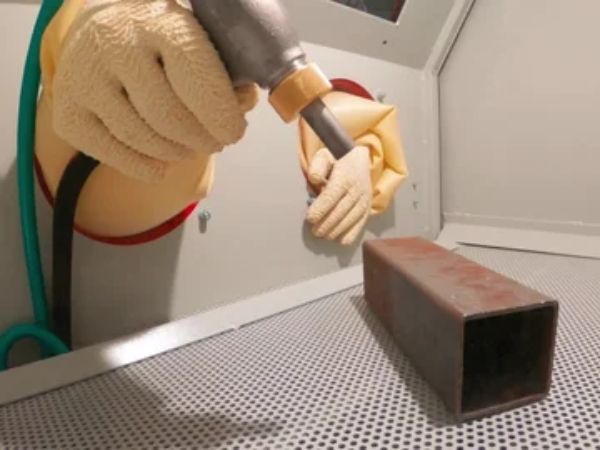
Metal 3D printing sandblasting is a post-processing method that uses compressed air to spray abrasive particles onto printed metal parts. It removes loose powder, oxides, and surface defects while improving surface texture, coating adhesion, and appearance. When controlled correctly, it can also create surface compressive stress that helps improve fatigue performance.
Metal additive manufacturing allows engineers to produce complex metal components with shapes that are difficult to make through traditional manufacturing. However, printed metal parts usually need additional surface treatment before final use.
After printing, surfaces may contain:
- Unmelted powder particles
- Layer marks
- Oxide layers
- Small burrs
- Uneven surface texture
This is where metal 3D printing sandblasting becomes an important manufacturing step.
Sandblasting is not only used to make parts look better. It helps prepare surfaces for coating, improve cleanliness, control roughness, and support later processes such as machining, inspection, and surface finishing.
How Does Sandblasting Work on Metal 3D Printed Parts?
Sandblasting, also called abrasive blasting, uses compressed air to accelerate abrasive materials at high speed toward a metal surface.
The impact between abrasive particles and the printed part creates two main effects:
- Cleaning effect
Removes unwanted materials from the surface. - Surface modification effect
Changes roughness, texture, and surface stress conditions.
Common abrasive materials include:
- Aluminum oxide
- Glass beads
- Silicon carbide
- Steel shot
- Ceramic beads
The final result depends on the material being treated, abrasive selection, pressure, distance, angle, and processing time.
Why Is Sandblasting Used in Metal 3D Printing?
Removing Powder, Oxides, and Surface Contamination
The first purpose of sandblasting is cleaning.
Metal 3D printed parts often contain attached powder that cannot be removed completely during normal powder recovery.
Sandblasting helps remove:
- Remaining metal powder
- Oxidation layers
- Small surface particles
- Minor burrs
- Manufacturing contamination
A clean surface is important before:
- Painting
- Coating
- Anodizing
- Adhesive bonding
- Quality inspection
Controlling Surface Roughness and Appearance
Sandblasting changes the surface profile by removing high points and creating a more even texture.
The final roughness depends on:
- Abrasive particle size
- Material hardness
- Air pressure
- Blasting time
Typical surface roughness after blasting can range around:
Ra 0.8–6.3 μm
Common blasting conditions include:
- Abrasive size: 80–240 mesh
- Pressure range: 0.2–0.8 MPa
For many engineering parts, the target surface roughness is around:
Ra 1–3 μm
Different abrasive sizes create different finishes:
- 80–120 mesh: stronger matte texture
- 120–180 mesh: balanced surface finish
- 200+ mesh: finer appearance
Improving Coating Adhesion
Sandblasting improves coating bonding by increasing surface area and creating small surface structures.
A controlled rough surface allows coatings to attach more effectively.
This is commonly used before:
- Paint coating
- Thermal spraying
- Protective coatings
- Medical surface treatments
For example, titanium alloy implants may use blasting before applying hydroxyapatite coatings.
However, excessive blasting can damage the surface, so the process must match the application requirement.
Creating Surface Compressive Stress
Abrasive impact can create plastic deformation in the surface layer of metal parts.
This may produce:
- Residual compressive stress
- Better resistance to crack growth
- Improved fatigue performance
This principle is related to shot peening, a process widely used for aerospace components.
The effect depends on:
- Material type
- Abrasive energy
- Processing temperature
- Surface condition
Sandblasting should not automatically be considered a strengthening process. The parameters must be tested and controlled.
How to Choose Abrasive Media for Metal 3D Printing Sandblasting?
Choosing the correct abrasive is important because different materials react differently.
Aluminum Oxide (Alumina)
Aluminum oxide is a hard abrasive with strong cutting ability.
It is suitable for:
- Steel parts
- Titanium parts
- Removing oxide layers
Advantages:
- Strong cleaning performance
- Good surface preparation ability
The higher cutting ability also means operators must control pressure carefully.
Glass Beads
Glass beads provide a softer blasting effect.
They are suitable for:
- Titanium alloys
- Aluminum alloys
- Parts requiring lower surface damage
Benefits include:
- Smooth matte appearance
- Reduced scratching risk
- Gentle surface treatment
Silicon Carbide
Silicon carbide has sharp edges and high hardness.
Advantages:
- Strong cutting ability
- Effective surface removal
Limitations:
- Can damage soft metals
- May create excessive roughness
It should be used carefully on aluminum components.
Steel Shot and Ceramic Beads
Steel shot and ceramic media are used when controlled impact behavior is needed.
For stainless steel parts, suitable media helps reduce unwanted contamination.
The abrasive should also be replaced or refreshed when wear becomes excessive. If abrasive performance decreases significantly, surface consistency may become difficult to maintain.
What Are the Key Sandblasting Parameters?
The main process parameters include:
- Abrasive size
- Air pressure
- Spray distance
- Impact angle
- Processing time
Pressure and Spray Distance
Common metal part settings are:
- Pressure: 0.4–0.6 MPa
- Spray distance: 15–25 cm
- Nozzle movement speed: about 5–10 cm/s
The spray gun should move evenly across the surface.
Keeping the nozzle in one position for too long can cause:
- Over-blasting
- Excessive roughness
- Dimensional changes
A test blast on a sample area or non-critical part should be completed before production.
Sandblasting Guidelines for Different Metal Materials
Different alloys require different process settings.
Titanium Alloy (TC4 / Ti-6Al-4V)
Titanium alloy is widely used in aerospace and medical applications.
Recommended methods:
- Glass beads or aluminum oxide
- Pressure below approximately 0.4 MPa for thin structures
After blasting, some medical applications require:
- Acid cleaning
- Ultrasonic cleaning
- Additional polishing
These steps help remove embedded abrasive particles and achieve required surface quality.
Aluminum Alloy (AlSi10Mg)
Aluminum is softer than many engineering metals, so aggressive blasting can damage the surface.
Recommended settings:
- White aluminum oxide or garnet
- 120–180 mesh
- Pressure around 0.3–0.5 MPa
After blasting, aluminum parts should receive anodizing or coating when required to reduce oxidation.
Stainless Steel (316L)
316L stainless steel is commonly used for medical and industrial components.
Recommended media:
- Stainless steel shot
- Ceramic beads
Important controls:
- Avoid contamination
- Check surface condition
- Use penetrant testing (PT) for critical parts when needed
Nickel-Based Superalloy (IN718)
IN718 is used in high-temperature aerospace applications.
Recommended abrasives:
- Aluminum oxide
- Silicon carbide
Typical settings:
- 80–120 mesh
- Pressure around 0.6–0.8 MPa
Operators must avoid surface damage that could affect high-temperature performance.
Standard Metal 3D Printing Sandblasting Workflow
A controlled workflow includes:
1. Part Preparation
Before blasting:
- Remove loose powder
- Clean oil and contamination
- Protect sensitive features
2. Abrasive Selection
Choose media based on:
- Material type
- Surface requirement
- Final application
3. Test Blasting
Before production:
- Test parameters
- Check surface condition
- Confirm no deformation
4. Production Blasting
Maintain:
- Stable pressure
- Correct distance
- Even movement
5. Cleaning and Inspection
After blasting:
- Remove remaining abrasive
- Perform ultrasonic cleaning if needed
- Measure roughness
- Check appearance
What Are the Risks of Sandblasting Metal 3D Printed Parts?
Thin Wall Damage
Thin structures below about 0.5 mm may deform under strong blasting force.
Possible problems:
- Bending
- Surface distortion
- Hole changes
Internal Channel Problems
Complex internal structures can be difficult to clean.
Small channels below approximately 2 mm may not allow abrasive access.
Additional methods may include:
- Chemical cleaning
- Ultrasonic cleaning
Precision Feature Damage
Over-blasting may affect:
- Threads
- Small holes
- Precision surfaces
- Micro structures
Protection or later machining may be required.
Abrasive Embedding
Soft metals may trap abrasive particles.
Possible effects:
- Surface contamination
- Reduced corrosion resistance
- Problems with medical applications
Proper cleaning is necessary.
How to Protect Parts During Sandblasting?
Sensitive areas should receive protection.
Examples:
- Thin walls
- Thread holes
- Small channels
- Positioning pins
- Precision locking areas
Protection methods include:
- Custom fixtures
- Silicone plugs
- High-temperature tape
- Protective covers
Testing the protection method before production helps prevent batch failures.
Sandblasting vs Shot Peening: What Is the Difference?
Sandblasting mainly focuses on:
- Cleaning
- Surface preparation
- Roughness control
Shot peening mainly focuses on:
- Surface strengthening
- Compressive stress control
- Fatigue improvement
High-temperature blasting processes have also been studied for strengthening effects. For some titanium-aluminum systems, treatment around 675°C has shown fatigue improvement under optimized conditions.
Some studies report high-cycle fatigue improvement of approximately 29–47%, but the result depends on material, process conditions, and testing methods.
How Is Sandblasting Quality Checked?
Quality evaluation usually includes four areas:
Surface Roughness
Check Ra values to confirm surface requirements.
Appearance
Inspect:
- Uniform texture
- Consistent color
- No visible defects
Cleanliness
Confirm:
- No loose particles
- No oil
- No remaining abrasive
Additional Testing
Critical parts may require:
- Adhesion testing
- Penetrant testing (PT)
- Dimensional inspection
Safety and Environmental Requirements
Sandblasting creates dust containing:
- Metal particles
- Broken abrasive materials
Safe operation requires:
- Enclosed blasting equipment
- Ventilation systems
- Dust protection
- Eye protection
- Hearing protection
- Equipment grounding
Waste abrasive should be collected and handled according to local requirements.
Frequently Asked Questions
What is metal 3D printing sandblasting?
Short answer: It is a surface treatment process that uses compressed air and abrasive particles to clean and modify printed metal parts.
It removes powder residue, improves surface texture, and prepares parts for coating or further processing.
Why do metal 3D printed parts need sandblasting?
Short answer: Sandblasting removes surface defects and creates a controlled finish.
It helps remove powder, oxides, and uneven textures while improving coating preparation.
Which abrasive is best for titanium 3D printed parts?
Short answer: Glass beads and aluminum oxide are common choices.
The correct abrasive depends on required roughness, surface protection needs, and final application.
Can sandblasting improve fatigue performance?
Short answer: Controlled blasting can create compressive stress that may improve fatigue resistance.
The result depends on material and process control.
What is the difference between sandblasting and shot peening?
Short answer: Sandblasting mainly cleans and finishes surfaces, while shot peening mainly strengthens surfaces.
Both use impact energy but have different goals.
Can sandblasting damage metal 3D printed parts?
Short answer: Yes, incorrect settings can damage parts.
High pressure, unsuitable abrasives, or excessive processing time can affect thin walls, precision areas, and soft metals.
Final Thoughts
Metal 3D printing sandblasting is an important post-processing step that improves surface quality, cleanliness, and coating preparation.
The best results come from controlling every part of the process:
- Selecting the correct abrasive
- Setting suitable pressure
- Protecting sensitive features
- Cleaning after blasting
- Inspecting final quality
When treated as a controlled manufacturing process, sandblasting helps transform printed metal parts into reliable components for aerospace, medical, and industrial applications.