




Written by: Felix Lee
CEO at Forgecise | Metal Additive Manufacturing & Industrial 3D Printing Solutions
Published: August 2026
Last Updated: August 2026
Table of Contents
Quick Answer
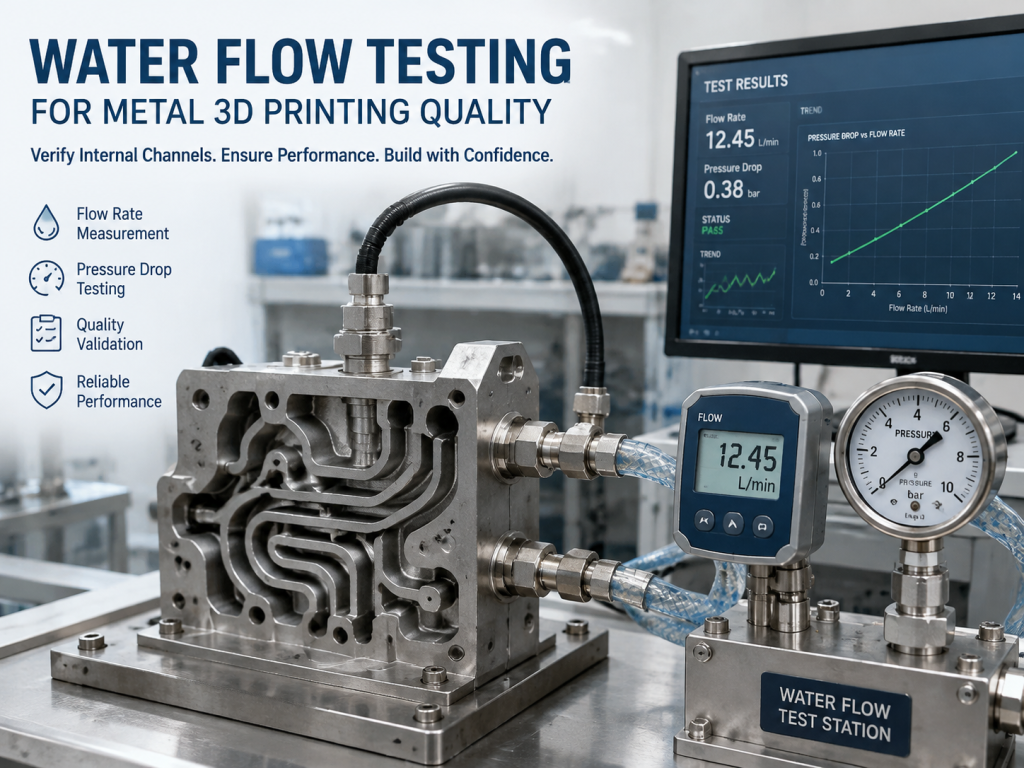
Water flow testing for metal 3D printing is a quality verification method that checks whether internal channels inside printed parts are open, clean, and built correctly. By measuring flow rate and pressure drop, engineers can detect blockages, powder residue, channel restrictions, and performance problems before parts are used in production systems.
TL;DR
- Metal 3D printing can create internal channels that traditional machining cannot manufacture.
- These hidden channels control cooling, fluid movement, and thermal performance.
- Water flow testing verifies channel quality through flow rate and pressure measurements.
- The test helps identify powder blockage, geometry changes, leakage risks, and uneven flow.
- Combining flow testing with CT scanning, endoscopy, and digital quality systems creates a complete inspection process.
A metal 3D printed part can look perfect on the outside and still fail inside.
This is one of the realities engineers face when working with additive manufacturing.
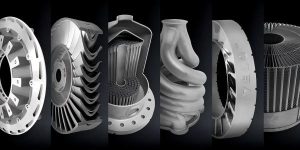
The advantage of metal 3D printing is the ability to create complex internal structures, such as conformal cooling channels, hydraulic manifolds, heat exchanger cores, and fuel nozzles. These designs can improve performance, reduce weight, and solve problems that traditional manufacturing cannot handle.
But the same internal complexity creates a new challenge.
How do you prove that the hidden channels are actually working?
The answer is water flow testing for metal 3D printing.
At Forgecise, we believe successful additive manufacturing is not only about producing complex shapes. It is about proving that those parts can perform reliably in real operating conditions.
What Is Water Flow Testing in Metal 3D Printing?
Water flow testing, also known as flow rate and pressure drop testing, measures how easily water moves through internal channels inside a metal 3D printed component.
The test checks:
- Flow rate through the channel
- Pressure loss across the part
- Channel consistency
- Possible blockages
- Internal manufacturing quality
The purpose is straightforward:
Does the printed channel perform the way the original design intended?
This question matters because the final printed channel may not perfectly match the CAD model.
During metal additive manufacturing, several factors can change internal geometry:
- Printing direction
- Layer-by-layer thermal effects
- Support structures
- Surface roughness
- Powder remaining inside passages
Water flow testing provides real performance data instead of relying only on digital design files.
Why Are Internal Channels Difficult to Validate After Metal 3D Printing?
Metal additive manufacturing allows engineers to create internal designs that were previously impossible.
Common applications include:
- Injection mold conformal cooling channels
- Hydraulic manifolds
- Heat exchanger cores
- Aerospace fuel nozzles
- Electric vehicle cooling plates
These components depend on controlled fluid movement.
A small internal defect can create large performance problems.
For example, a cooling channel may still allow water to pass through even when the passage is partially blocked. However, the reduced flow can create uneven temperatures, longer production cycles, and lower part quality.
The outside surface does not tell the complete story.
The real performance often comes from the hidden structure.
How Does Water Flow Testing Verify Powder Removal?
One of the biggest challenges in metal 3D printing is removing unused powder from internal passages.
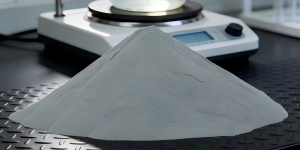
Complex channels can trap loose metal powder after printing.
If powder removal is incomplete:
- Flow resistance increases
- Pressure drop becomes higher
- Cooling performance decreases
- Internal passages may become blocked
The problem can become worse after thermal processing because remaining powder may harden and become difficult to remove.
A typical quality process includes:
Printing → Powder Removal → Heat Treatment → Machining → Water Flow Testing → Final Approval
Water flow testing acts as a release check.
If the measured flow does not match the expected value, engineers can investigate cleaning quality, printing conditions, or design problems.
How Does Flow Testing Confirm Internal Channel Geometry?
A printed internal channel is not always identical to the original CAD design.
The final geometry can change because of:
- Print orientation
- Thermal distortion
- Layer effects
- Support contact
- Local powder buildup
Water flow testing detects these differences through changes in flow behavior.
| Problem | Testing Result |
|---|---|
| Channel becomes smaller than designed | Higher pressure drop |
| Powder remains inside channel | Lower flow rate |
| Support material blocks passage | Uneven branch flow |
| Poor channel design | Higher resistance |
Flow results can also be compared with CFD simulation.
This creates a useful engineering feedback loop:
Design → CFD Prediction → Metal Printing → Flow Testing → Process Improvement
The test does not only find problems. It helps improve future designs.
What Are the Recommended Design Rules for Metal 3D Printed Channels?
Good internal channel design requires more than creating complex shapes.
Engineers must consider:
- Fluid movement
- Pressure loss
- Cleaning ability
- Manufacturing limits
For conformal cooling applications, common recommendations include:
Water Flow Velocity
Recommended range:
2–4 m/s
This provides a balance between cooling performance and pressure requirements.
Channel Diameter
Typical ranges:
- Standard channels: Ø6–12 mm
- Precision channels: Ø2–6 mm
Smaller channels require tighter control during printing and cleaning.
Important Design Guidelines
Engineers should:
- Avoid sharp corners
- Use smooth radius transitions
- Reduce sudden changes in channel size
- Limit unnecessary bends
- Add powder removal openings when possible
A channel that cannot be cleaned or tested creates unnecessary risk.
How Does Water Flow Testing Improve Conformal Cooling Performance?
Injection molding is one area where water flow testing has a direct production impact.
Cooling can represent around 80% of the molding cycle time.
Metal 3D printed conformal cooling channels can improve temperature control because they follow the shape of the mold.
However, the design only works when the water flow is correct.
Poor flow can cause:
- Hot spots
- Warping
- Shrinkage
- Cracking
- Lower production yield
Engineering Example
An automotive connector mold was improved using optimized conformal cooling channels.
Before improvement:
- Deep area temperature: 140°C
- Cycle time: 45 seconds
- Yield rate: 82%
After channel optimization and flow validation:
- Deep area temperature: below 95°C
- Cycle time: 28 seconds
- Yield rate: 99.5%
This example shows why flow testing is more than a final inspection.
It confirms whether the cooling design delivers real manufacturing improvement.
Why Is Flow Testing Important for Aerospace and Thermal Management Parts?
For aerospace and advanced thermal systems, internal flow performance can affect safety and reliability.
Applications include:
- Aerospace fuel nozzles
- Hydraulic control manifolds
- Spacecraft heat exchangers
- EV battery cooling plates
A flow result outside the expected range may indicate:
- Internal blockage
- Incorrect channel geometry
- Manufacturing variation
- Leakage risk
For critical parts, manufacturers often combine several tests:
- Water flow testing
- Pressure testing
- Thermal imaging
Together, these create a complete:
Flow–Thermal–Leakage Validation System
This approach helps engineers confirm that the part can handle real operating conditions.
What Equipment Is Used for Water Flow Testing?
A professional water flow testing system usually includes:
- Flow meters
- Pressure sensors
- Pumps
- Temperature-controlled water tanks
- Data acquisition systems
- Micro-flow measurement equipment
Common testing methods include:
| Test Method | Purpose |
|---|---|
| Flow meter testing | Measures water movement through channels |
| Pressure drop testing | Measures internal resistance |
| Leakage testing | Finds sealing problems |
| Thermal imaging | Measures temperature distribution |
For very small channels, high-precision micro-flow meters are needed.
How Does Flow Testing Work With CT and Endoscopy?
Water flow testing, CT inspection, and endoscopy provide different information.
They work best together.
| Technology | Purpose |
|---|---|
| Industrial CT | Shows internal structure and defects |
| Endoscopy | Allows direct visual inspection |
| Water flow testing | Confirms actual channel performance |
A simple way to understand the difference:
CT and endoscopy help find the cause.
Flow testing confirms the result.
For aerospace and other critical applications, flow results should be stored together with inspection records for full traceability.
How Can Manufacturers Prevent Flow Problems Before Printing?
The best way to improve flow performance is to consider testing during the design stage.
Design for Additive Manufacturing (DFAM) should include:
- Easy powder removal paths
- Suitable printing orientation
- Reduced trapped powder areas
- Proper support placement
- Testable channel designs
The goal is simple:
A good additive manufacturing design should be printable, cleanable, and verifiable.
What Causes Failed Water Flow Tests?
Most failed flow tests come from problems in cleaning, manufacturing, or design.
| Failure | Possible Cause | Solution |
|---|---|---|
| Low flow rate | Powder residue | Improve cleaning process |
| High pressure drop | Channel restriction | Adjust design or printing settings |
| Uneven branch flow | Poor inlet design | Improve flow distribution |
| Leakage | Surface or sealing defect | Repair affected area |
A failed test should provide information.
The result helps engineers improve:
- Design
- Printing parameters
- Cleaning methods
- Post-processing steps
How Should Companies Use Flow Test Data?
Water flow testing becomes more valuable when results are recorded and connected with manufacturing systems.
Important records include:
- Flow rate
- Pressure drop
- Water temperature
- Test pressure
- Acceptance result
- Part number
- Production batch
These results can connect with:
- MES (Manufacturing Execution System)
- PLM (Product Lifecycle Management)
- SPC (Statistical Process Control)
- Digital Twin systems
Instead of being a single inspection step, flow testing becomes a continuous quality signal.
Manufacturers can identify trends, detect problems earlier, and improve production control.
Final Thoughts: Water Flow Testing Makes Metal 3D Printing More Reliable
Metal 3D printing gives engineers the ability to create complex internal structures, but those structures need proper validation.
A part can look excellent externally while having problems inside the channel.
Water flow testing solves this challenge by turning hidden internal performance into measurable engineering data.
For manufacturers producing conformal cooling molds, hydraulic components, aerospace parts, heat exchangers, and thermal management systems, flow testing should be part of the normal quality process.
The future of additive manufacturing is not only creating complex parts.
It is proving that those parts work.
Frequently Asked Questions
What is water flow testing for metal 3D printing?
Short Answer:
Water flow testing checks whether internal channels inside metal 3D printed parts are open, clean, and working correctly by measuring water flow rate and pressure loss.
The test helps manufacturers detect blockages, powder residue, channel restrictions, and manufacturing problems before parts enter production.
Why is water flow testing important for conformal cooling channels?
Short Answer:
Water flow testing confirms that conformal cooling channels deliver consistent cooling performance. It helps prevent hot spots, longer cycle times, warping, and product defects caused by uneven water movement inside printed channels.
Can water flow testing detect powder blockage?
Short Answer:
Yes. Powder remaining inside metal 3D printed channels reduces flow and increases pressure drop. Water flow testing can identify these performance problems, while CT or endoscopy can help locate the exact cause.
What is the difference between CT inspection and water flow testing?
Short Answer:
CT inspection shows internal structures and defects, while water flow testing measures actual channel performance. CT explains what is inside the part; flow testing confirms whether the channel works properly.
Which industries use water flow testing for additive manufacturing?
Short Answer:
Industries using water flow testing include aerospace, automotive, injection molding, energy, and thermal management. Common applications include fuel nozzles, hydraulic manifolds, heat exchangers, conformal cooling molds, and EV cooling systems.
Author Bio
Felix Lee is the CEO at Forgecise, focusing on metal additive manufacturing solutions, industrial 3D printing applications, and manufacturing quality systems. His work involves helping engineers connect design, production, and validation methods to create reliable metal 3D printed components.
At Forgecise, the focus is simple: complex additive manufacturing parts need measurable proof, not only a successful print.