






Table of Contents
Quick Answer
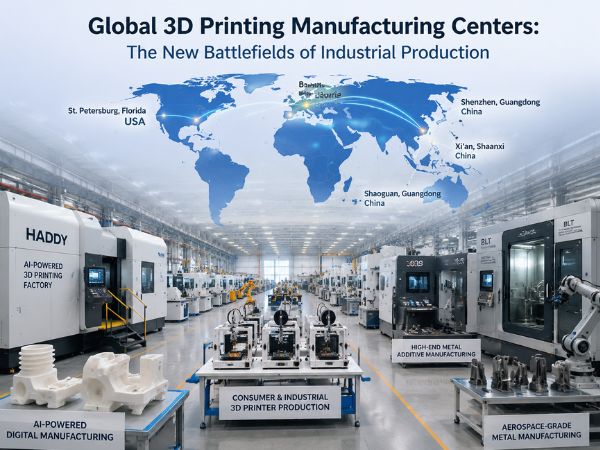
The world’s leading 3D printing manufacturing centers are located across the United States, China, and Germany. These facilities represent five different industrial models: AI-powered mass production, consumer 3D printer manufacturing, high-end metal additive manufacturing, contract production services, and aerospace-grade metal manufacturing.
TL;DR
- The global 3D printing industry is moving from prototyping toward industrial-scale production.
- The five leading manufacturing hubs include Haddy in the United States, Bambu Lab in Shenzhen, EOS in Germany, JLC3DP in Guangdong, and BLT in Xi’an.
- Each hub dominates a different segment of additive manufacturing.
- The biggest industry barriers remain cost, supply chain dependence, automation limitations, and lack of global production standards.
- The future of 3D printing will depend on combining AI, materials science, automation, and scalable manufacturing systems.
3D printing has spent decades being described as the “future of manufacturing.” That future is no longer limited to small prototypes sitting on engineering desks.
Today, the competition is moving toward something much bigger: industrial-scale 3D printing manufacturing centers.
The companies and regions building the largest additive manufacturing ecosystems are no longer competing only on printer technology. They are competing on factory capacity, automation, materials, supply chains, and the ability to deliver thousands of consistent parts.
The global race is creating a new manufacturing map.
The United States is pushing AI-driven local production. China is scaling consumer and industrial manufacturing. Germany continues to define premium metal printing standards. Meanwhile, aerospace-focused manufacturers are building complete metal additive manufacturing ecosystems.
Based on reported 2025–2026 industry data, the following five manufacturing centers represent some of the most influential 3D printing production hubs shaping the next generation of manufacturing.
The World’s Top 5 3D Printing Manufacturing Centers
| Rank | Manufacturing Center | Location | Main Manufacturing Focus |
|---|---|---|---|
| 1 | Haddy Automated 3D Printing Factory | St. Petersburg, Florida, USA | AI-powered large-scale digital manufacturing |
| 2 | Bambu Lab Manufacturing Headquarters | Shenzhen Guangming, China | Consumer desktop 3D printer production |
| 3 | EOS Metal Additive Manufacturing Center | Bavaria, Germany | High-end industrial metal printing |
| 4 | JLC3DP Super Factory | Shaoguan, Guangdong, China | Multi-process industrial 3D printing services |
| 5 | BLT Metal Additive Manufacturing Base | Xi’an, Shaanxi, China | Aerospace-grade metal manufacturing |
1. Haddy Automated 3D Printing Factory: America’s AI-Powered Manufacturing Model
Why is Haddy considered one of the largest 3D printing manufacturing facilities?
Haddy’s automated 3D printing factory in St. Petersburg, Florida represents a new generation of manufacturing: large-scale, localized, and heavily automated production.
The facility officially entered full production in the first quarter of 2026 and has been recognized by overseas industry media as one of the largest single-site integrated 3D manufacturing centers.
Unlike traditional factories built around fixed tooling and assembly lines, Haddy’s model focuses on flexible digital manufacturing.
The factory uses:
- Robotic production systems
- AI-based scheduling and production management
- Thousands of large-format fused deposition modeling (FDM) machines
- Digital manufacturing workflows
Its production scope covers:
- Construction components
- Military parts
- Large household products
The business model is built around localized manufacturing — producing products closer to customers instead of relying on long global supply chains.
Supported by demand from North American infrastructure and defense-related markets, the factory reportedly achieved strong order growth momentum during 2025–2026, with growth exceeding 70%.
What challenges does Haddy face?
Although Haddy represents the ambition of American industrial reshoring, it also highlights a major challenge facing many Western 3D printing factories: high operating costs.
Compared with similar production facilities in China’s manufacturing regions, production costs can be significantly higher due to:
- Labor expenses
- Factory construction costs
- Material costs
- Supply chain limitations
High-performance materials, including advanced metal powders and powerful laser systems, remain dependent on specialized suppliers.
Another challenge is equipment utilization.
Large-scale factories require enormous capital investment, and underused machines create significant depreciation pressure. Industry discussions continue around whether heavily invested “super factories” can achieve sustainable profitability.
2. Shenzhen Bambu Lab Manufacturing Base: The Global Consumer 3D Printer Powerhouse
Why has Shenzhen become the center of consumer 3D printing manufacturing?
China’s Shenzhen manufacturing ecosystem has become one of the most important global locations for consumer 3D printer production.
The Bambu Lab manufacturing headquarters in Shenzhen Guangming represents the scale advantage of China’s electronics and manufacturing supply chain.
The planned facility covers:
- Approximately 83,700 square meters of land
- Nearly 376,000 square meters of planned building area
The project is progressing through multiple construction and production phases, with planned annual production capacity exceeding 3 million desktop 3D printers.
The manufacturing ecosystem integrates:
- Core component development
- Material testing
- Automated assembly
- Hardware production
According to the provided industry report, Bambu Lab reached approximately 42.7% global market share in the consumer 3D printer segment in 2025.
The Shenzhen manufacturing cluster also represents a significant portion of global desktop 3D printer exports, benefiting from the city’s mature electronics supply chain.
What challenges does Shenzhen’s consumer 3D printing industry face?
The consumer 3D printer market demonstrates the power — and pressure — of scale manufacturing.
The main challenges include:
Price competition
Low entry barriers have created intense competition among manufacturers.
Rapid product cycles
Consumer devices require frequent upgrades, forcing factories to continuously modify production lines.
Inventory pressure
Fast technology changes create risks of excess inventory.
This has created an ongoing debate:
Can production scale alone offset shrinking margins?
Many smaller brands have struggled with insufficient production capacity and rising costs, leading some companies to exit the market.
3. EOS Bavaria Metal Printing Center: Europe’s High-End Industrial Additive Manufacturing Leader
Why is EOS important in industrial metal 3D printing?
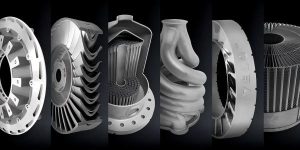
EOS’s metal additive manufacturing center in Bavaria, Germany represents Europe’s focus on precision engineering and high-value industrial applications.
The facility operates more than 650 industrial metal printing systems and plays a major role in Europe’s metal additive manufacturing ecosystem.
EOS focuses on applications including:
- Automotive powertrain components
- Precision tooling
- Aerospace structures
- Industrial metal parts
The company has supported major industrial customers, including:
- BMW
- Airbus
- Siemens
Germany’s advantage comes from engineering expertise, material development, and manufacturing standards.
EOS has helped advance processes involving:
- High-temperature alloys
- Tool steels
- Metal powder optimization
- Industrial qualification methods
What limits high-end metal 3D printing?
The biggest challenge is economics.
Industrial metal printing equipment requires significant investment, with individual systems often costing hundreds of thousands of dollars.
Large metal components may require printing times measured in dozens of hours.
For production volumes above thousands of units, traditional manufacturing methods often remain more cost-effective.
Another major expense is post-processing.
Operations such as:
- Support removal
- Surface finishing
- Inspection
- Final preparation
can represent approximately 35%–50% of total component costs.
As a result, many European metal printing facilities remain focused on high-value, low-volume applications rather than mass-market production.
4. JLC3DP Shaoguan Super Factory: China’s Large-Scale Industrial 3D Printing Service Platform
Why is JLC3DP important in industrial 3D printing manufacturing?
JLC3DP (Jialichuang 3D Printing) represents a different manufacturing model from equipment-focused companies. Instead of only selling machines, it operates as a large-scale industrial 3D printing service provider that helps companies access production capacity without building their own factories.
Located in Shaoguan, Guangdong, the JLC3DP super factory is one of China’s largest single-site industrial 3D printing service facilities.
The facility covers approximately:
- 14,000 square meters of factory space
- More than 1,200 industrial 3D printing machines
Its manufacturing capabilities cover:
- Plastic 3D printing
- Resin 3D printing
- Metal 3D printing
The factory supports:
- Seven major additive manufacturing processes
- More than 30 industrial materials
This creates a one-stop manufacturing ecosystem for customers needing rapid production, testing, and small-to-medium batch manufacturing.
Which industries use JLC3DP’s manufacturing services?
The facility primarily supports companies that need flexible production without investing heavily in their own equipment.
Major customer groups include:
- Hardware developers
- Automotive component suppliers
- Product designers
- Cultural and creative product manufacturers
For startups and small manufacturers, this model solves a major problem:
Building an internal industrial 3D printing facility requires large equipment investment, specialized operators, and process knowledge.
A professional manufacturing service provider allows companies to access advanced production capabilities faster.
According to the provided industry report, JLC3DP’s hardware development-related batch production orders increased by more than 55% in 2026.
What challenges does large-scale 3D printing outsourcing face?
The contract manufacturing model also creates industry challenges.
One common problem is the difference between companies that own production capacity and companies that only act as intermediaries.
Some lightweight service providers outsource orders to larger factories during peak demand periods, creating problems with:
- Production scheduling
- Delivery control
- Quality management
Urgent orders may require additional premiums.
Another challenge is quality consistency.
Because different technologies and machines may be combined within one production network, maintaining identical output quality across batches can be difficult.
Customers may experience:
- Delivery delays
- Dimensional tolerance variation
- Inconsistent quality levels
The industry still lacks unified standards for:
- Production scheduling
- Quality control
- Batch manufacturing requirements
5. BLT Xi’an Metal Additive Manufacturing Base: China’s Aerospace-Grade 3D Printing Ecosystem
Why is BLT considered a key aerospace 3D printing manufacturer?
Bright Laser Technologies (BLT) in Xi’an represents one of China’s most complete metal additive manufacturing ecosystems.
Unlike companies focusing on only equipment or only printing services, BLT integrates:
- Metal 3D printing equipment
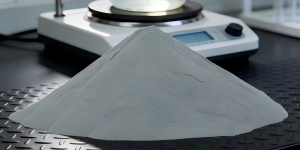
- Metal powder production
- Manufacturing services
- Process research and development
This creates a closed-loop industrial chain.
The facility includes metal powder production capabilities with reported annual capacity of:
3,000–4,000 tons of metal powder
BLT develops its own SLM (Selective Laser Melting) metal printing systems and supplies advanced manufacturing solutions for:
- Commercial aircraft programs
- Aerospace applications
- Space-related projects
According to the provided industry report, BLT holds more than 70% of China’s aerospace metal 3D printing component market and achieved aviation-related order revenue exceeding RMB 1.8 billion in 2025.
The company also operates under demanding aerospace quality systems, including:
- AS9100 certification
- Nadcap certification
What challenges does aerospace metal 3D printing face?
Aerospace manufacturing has some of the highest requirements in the world.
The biggest challenges are materials and certification.
Although common titanium alloy powders have achieved increasing domestic production capability, advanced aerospace materials such as:
- Low-oxygen high-temperature alloy powders
- Specialized metal powders
remain technically challenging.
Material costs can represent approximately half of total production costs.
Certification is another major barrier.
Aerospace components require:
- Long validation cycles
- Strict testing procedures
- Stable manufacturing processes
Certification can take years.
At the same time, commercial aerospace demand can fluctuate, affecting factory utilization.
As more companies expand metal additive manufacturing capacity, the industry is also beginning to discuss whether certain aerospace manufacturing segments could face future capacity competition.
What Are the Four Biggest Challenges Limiting Large-Scale 3D Printing Manufacturing?
1. High Production Costs
The biggest challenge facing industrial 3D printing is still cost.
Although additive manufacturing provides unique advantages in customization and complex geometries, it often struggles against traditional manufacturing methods in large-volume production.
Major cost factors include:
- Equipment depreciation
- Specialty materials
- Energy consumption
- Skilled labor
- Post-processing
3D printing is currently strongest when producing:
- Complex parts
- Customized products
- Low-volume high-value components
Traditional manufacturing often remains more competitive for millions of identical parts.
2. Supply Chain Dependence
Many advanced 3D printing ecosystems still rely on specialized global suppliers.
Critical dependencies include:
- High-performance metal powders
- Industrial lasers
- Advanced machine components
Supply chain disruptions can affect:
- Production schedules
- Manufacturing costs
- Factory profitability
Building local supply chains remains a strategic priority for major manufacturing regions.
3. Limited Automation Beyond Printing
Modern 3D printers are increasingly automated.
However, the complete manufacturing process is not fully automated.
Many factories still rely on human workers for:
- Powder handling
- Support removal
- Surface finishing
- Quality inspection
This creates bottlenecks between printing and final delivery.
The next stage of industrial 3D printing will likely depend on fully integrated automated workflows.
4. Lack of Global Manufacturing Standards
Standardization remains one of the industry’s biggest obstacles.
Manufacturers still face differences in:
- Quality control systems
- Certification requirements
- Production processes
- Batch consistency
For global companies ordering thousands of parts across different regions, predictable quality is essential.
Without stronger industry standards, scaling additive manufacturing globally will remain difficult.
Can 3D Printing Replace Traditional Manufacturing?
Direct Answer
3D printing is unlikely to completely replace traditional manufacturing. Instead, it will become a complementary production technology that excels in customized, complex, and high-value manufacturing applications while traditional methods continue dominating large-volume production.
3D Printing vs Traditional Manufacturing
| Manufacturing Method | Main Advantage | Best Application |
|---|---|---|
| Traditional Manufacturing | Lowest cost at high volume | Mass production |
| Industrial 3D Printing | Design flexibility and customization | Complex parts and small batches |
| Hybrid Manufacturing | Combines both advantages | Future smart factories |
The future will probably not be a competition between 3D printing and traditional manufacturing.
Instead, leading factories will combine:
- Digital design
- AI production management
- Automated manufacturing
- Traditional production methods
The Future of Global 3D Printing Manufacturing Centers
The five leading manufacturing centers demonstrate one important trend:
3D printing has moved beyond prototyping and entered the industrial production era.
However, the future winners will not simply be the companies owning the most machines.
The strongest manufacturing ecosystems will combine:
- Artificial intelligence
- Automated factories
- Advanced materials
- Digital supply chains
- Manufacturing expertise
The industry is moving toward intelligent production networks where factories can produce customized products at industrial scale.
From Haddy’s AI-driven manufacturing model in the United States to Shenzhen’s consumer hardware ecosystem, Germany’s precision metal printing expertise, JLC3DP’s flexible manufacturing services, and BLT’s aerospace-grade capabilities, each manufacturing center represents a different path toward the future.
The biggest question for the next decade is not whether 3D printing can manufacture products at scale.
It already can.
The real question is:
Can the industry make large-scale additive manufacturing affordable, standardized, and globally competitive?
Frequently Asked Questions (AEO Optimized)
What are the largest 3D printing manufacturing centers in the world?
The largest and most influential 3D printing manufacturing centers include Haddy in Florida, Bambu Lab in Shenzhen, EOS in Germany, JLC3DP in Guangdong, and BLT in Xi’an. These facilities represent different areas of additive manufacturing, including AI production, consumer printers, industrial metal printing, contract manufacturing, and aerospace components.
Which country has the strongest 3D printing manufacturing industry?
China currently demonstrates significant manufacturing scale because of its electronics supply chain, industrial production capacity, and large 3D printing ecosystems in cities such as Shenzhen, Guangdong, and Xi’an. Germany remains highly influential in industrial metal printing, while the United States focuses heavily on automated digital manufacturing models.
Why is industrial 3D printing still expensive?
Industrial 3D printing remains expensive because of equipment investment, specialized materials, labor-intensive post-processing, and certification requirements. While it is highly competitive for complex and customized parts, traditional manufacturing often remains cheaper for extremely high-volume production.
Can 3D printing achieve mass production?
Yes, 3D printing can achieve mass production in specific applications. However, widespread replacement of traditional manufacturing depends on reducing costs, improving automation, strengthening supply chains, and developing consistent global production standards.
What is the future of additive manufacturing?
The future of additive manufacturing will likely combine AI-powered factories, advanced materials, automated workflows, and digital supply chains. The most successful companies will build complete manufacturing ecosystems rather than focusing only on individual printers.
Author Note
This article was prepared by Felix Lee, CEO at Forgecise, based on analysis of global additive manufacturing trends, industrial production models, and reported 2025–2026 3D printing manufacturing developments.
The goal is to provide industry professionals, manufacturers, investors, and technology leaders with a practical overview of how global 3D printing production capacity is evolving.