





Release Date: 2026-04-10
Paul Li
CTO | Author18 years experience in the Research and Development of 3D printing equipment and additive manufacturing processes, empowering the efficient intelligent manufacturing of complex parts.
3D printing technology emerged in the mid-1990s. Using a computer-generated 3D design model as its blueprint, it employs software to slice the model into discrete layers and utilizes a CNC forming system to build physical objects layer by layer. Specialized materials—such as ceramic powder, metal powder, plastics, or even biological tissues—are selectively fused or bonded using laser beams, heated nozzles, or other energy sources. The fundamental working principle is similar to that of an ordinary printer: instead of traditional ink and paper, the “printing material” consists of processed powders or liquids like ceramics, metals, or polymers.
In the mold industry, 3D printing enables the fabrication of mold components with complex internal structures—particularly conformal cooling channels—that are difficult or impossible to achieve through conventional manufacturing methods. The integration of conformal cooling systems significantly enhances cooling efficiency, promotes uniform temperature distribution, and thereby improves both product quality and production throughput.
Application of 3D Printing in Mold Product Design
Product design continues to evolve alongside advancements in technology, culture, and aesthetics. With the rise of 3D printing, designers are no longer constrained by traditional manufacturing limitations. This freedom allows them to focus more on creative form exploration and functional innovation.
Modern product development increasingly emphasizes concurrent (parallel) engineering. By integrating considerations across the entire product lifecycle early in the design phase, potential issues from downstream stages—such as manufacturability, assembly, or maintenance—can be identified and resolved upfront. This approach minimizes design iterations and shortens overall development time.
Under this concurrent design paradigm, different phases and teams work simultaneously and collaboratively. Here, 3D printing plays a pivotal role: it allows design teams to rapidly transform conceptual models into accurate physical prototypes during the early design stage, facilitating effective communication and evaluation.
Unlike traditional workflows that rely solely on abstract sketches or 2D drawings for visualization—often hindering clear communication among team members—3D printing enables every stakeholder, including end users, to directly see and touch functional prototypes. This tangible interaction allows for straightforward comparison of structural, aesthetic, and functional differences between design alternatives, helping to quickly identify flaws and refine the concept through iterative cycles until the final design is optimized.
Application of 3D Printing in Mold Manufacturing
Today, many manufacturers across industries have adopted 3D printing, with mold makers being among the most active adopters. Traditionally, 3D printing has been widely used to produce prototypes for verifying a product’s structure, appearance, and functionality before committing to full-scale mold production.
In recent years, with continuous advancements and maturation of metal 3D printing technologies, an increasing number of mold enterprises are exploring direct applications of 3D printing in mold fabrication itself. Leveraging its unique advantages, this technology helps significantly reduce mold lead times and lower production costs.
Metal 3D printing is primarily used to fabricate mold inserts—especially cores, cavities, and complex sliders equipped with conformal cooling channels. Compared to conventional machining, direct 3D printing of these components offers substantially higher efficiency and flexibility, unconstrained by internal geometries or external complexity.
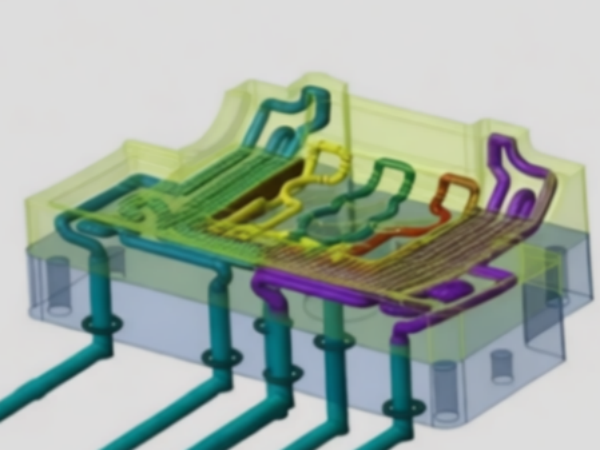
Traditionally, cooling channels are created by drilling straight cylindrical holes, which must navigate around structural features and assembled components—severely limiting design freedom. In contrast, 3D printing enables the creation of conformal cooling channels that precisely follow the contour of the mold surface. This not only achieves more uniform mold temperatures but also enables faster, more efficient cooling. As a result, demolding speed and cycle times are reduced without introducing residual stresses, warpage, or other defects commonly associated with rushed cooling—offering cooling performance far superior to conventional methods.
In traditional designs, cooling channels must avoid inserts and structural elements, preventing optimal placement. For example, as shown in the image above, the cooling channel in a core insert cannot uniformly follow its complex shape, leading to uneven cooling and a high risk of part deformation.
This limitation stems directly from conventional manufacturing processes, which rely solely on drilling or insert assembly—methods inherently incapable of producing curved or topology-optimized channels.
With the advancement and adoption of metal 3D printing in the mold industry, designers now have an innovative platform to create truly conformal cooling systems. Freed from traditional process constraints, they can strategically embed cooling channels that uniformly trace the geometry of mold inserts, enabling rapid and homogeneous cooling.
Advantages of 3D Conformal Cooling Systems over Traditional Systems:
- Reduced Cooling Time: Shortens injection molding or die-casting cycle times by 30–70%, significantly boosting production efficiency, output, and yield quality.
- Improved Part Quality: Eliminates warpage, cracking, flash, porosity, and other defects caused by uneven cooling or residual stress, enhancing final product consistency and reliability.
- Extended Mold Life & Lower Cost: More uniform thermal management reduces thermal fatigue, prolonging mold service life and lowering per-unit production costs.
Overall, while domestic adoption of 3D-printed molds in China still lags behind international standards, the transformative impact of this technology on mold manufacturing is undeniable. Integrating 3D printing into mold design and production is a clear industry trend. Currently, few Chinese companies are actively researching this application—but as 3D printing becomes more industrialized and commercialized, mold manufacturing represents a highly promising direction, especially for the vast base of small and medium-sized mold enterprises.
Mold Insert Case Study
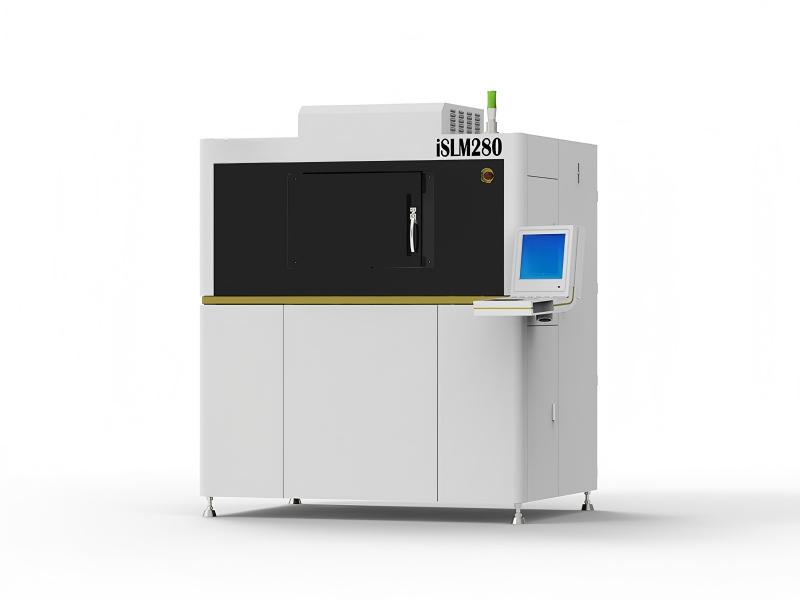
- Process: SLM (Selective Laser Melting)
- Material: Tool Steel (18Ni300)
- Layer Thickness: 0.035 mm
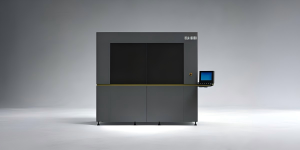
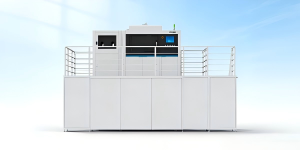
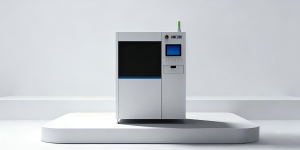
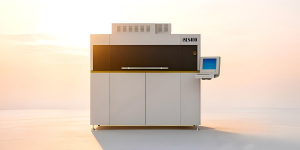
- Equipment: Forgecise iSLM280 Metal 3D Printer
- Build Time: 2 hours 15 minutes
- Post-Processing: Milling
- Application: Mold Manufacturing
From a broader perspective, while aerospace and defense sectors demand high technical specifications, and medical applications face strict regulatory and limited customization barriers, the mold industry—supported by a dense ecosystem of specialized enterprises and industrial clusters—is exceptionally well-positioned for the widespread adoption and scaling of 3D printing technology.
About Forgecise
Forgecise is an innovator in additive manufacturing technology, dedicated to providing high-performance metal 3D printing materials, equipment, and process solutions for the mold manufacturing, energy power, and other industrial sectors.