
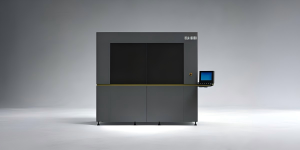
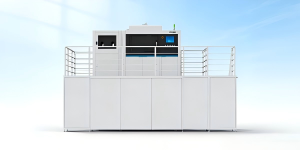
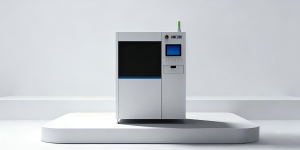
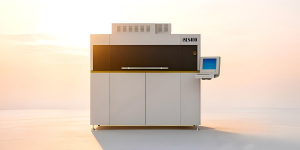



In the world of metal 3D printing, although both methods can eventually produce hard parts, the underlying principles are vastly different. Currently, the two most discussed technologies on the market are Laser Powder Bed Fusion (SLM), which is based on “melting,” and Binder Jetting or Metal FDM, which are based on “sintering/bonding.”
To help everyone better understand the differences between these two technologies, we have selected the most common 316L and 17-4PH stainless steels as samples to conduct an in-depth comparison across four aspects: material performance, microstructure, hardness, and precision.
Core Principle: Melting vs. Bonding
First, we need to clarify one point: although both are called 3D printing, the principles of home printers and industrial printers are completely different.
- SLM (Laser Melting): It is like “welding.” It uses high-energy lasers to completely melt metal powder, which then solidifies, stacking layer by layer.
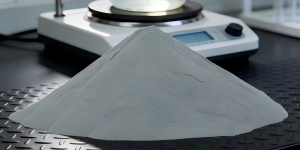
- Binder Jetting/FDM (Sintering): It is like “gluing” or “pottery.” First, a binder is used to stick the powder together to form a “green part,” or it is extruded like toothpaste. Finally, it needs to be placed in a high-temperature furnace to burn off the binder and fuse the metal particles (sintering).
Performance Showdown: Who is Stronger?
① Density (Are there internal voids?)
Density directly determines the strength and durability of a part.
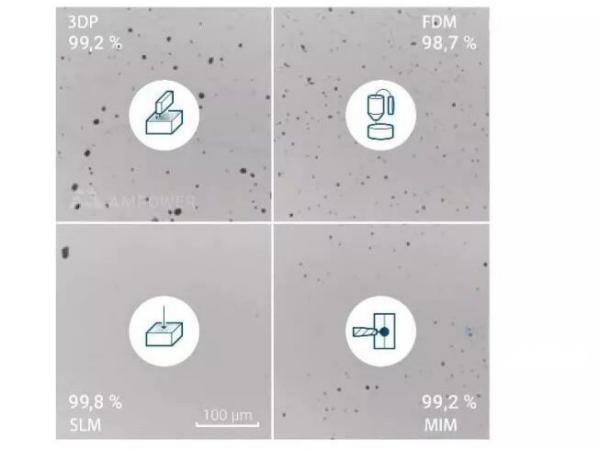
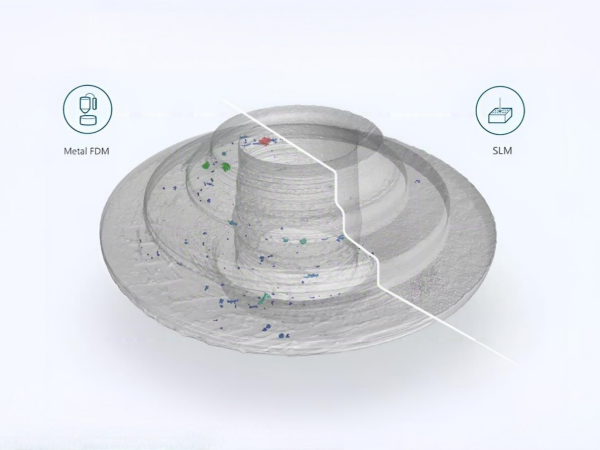
- SLM Technology: Excellent performance. It typically achieves a density of 99.8% or higher, with almost no internal voids, and performance close to traditionally forged metals.
- Binder Jetting/FDM: Since it relies on high-temperature sintering for fusion, microscopic pores are inevitable internally. Although high-quality processes can achieve over 99%, typically (especially in MIM processes) the density is between 95%-97%. This means SLM technology has a slight edge in pore control.
② Tensile Strength and Hardness (Who is harder?)
- Strength: Whether using SLM or Binder Jetting technology, the tensile strength of printed 316L and 17-4PH stainless steel can meet international standards (such as ASTM A276) and is higher than traditional cast parts.
- Difference: Parts printed by SLM usually have extremely high yield strength due to rapid cooling rates and fine grains. While Binder Jetting parts meet strength standards, their hardness is often slightly lower than required standards, which is related to solution treatment during the sintering process and residual porosity.
- Microstructure: SLM-printed 316L presents a typical twinned austenitic structure; whereas 17-4PH presents a martensitic structure.
Precision and Surface: Who is More Delicate?
For precision parts, whether they can be used directly after printing depends on surface finish and dimensional accuracy.
Surface Roughness:
- SLM: Surface quality is usually superior to castings but not as good as high-precision machined surfaces. Subsequent sandblasting or polishing is usually required.
- Binder Jetting/FDM: Surface roughness is greatly affected by the build direction, and deformation is prone to occur during the sintering process, resulting in a surface that is not as flat as SLM.
Dimensional Accuracy:
- SLM: Extremely high precision with minimal deformation, suitable for manufacturing parts with strict tolerance requirements.
- Binder Jetting/FDM: During the sintering process, parts are prone to shrinkage and deformation (e.g., deformation around the outer ring). If high precision is desired, milling is usually required before sintering, or subsequent machining must be accepted.
Material Breadth: Who Has More Choices?
- Binder Jetting: Theoretically has strong compatibility; any material suitable for MIM (Metal Injection Molding) can be attempted. Common materials on the market currently include 316L, 17-4PH, pure copper, aluminum alloys, etc.
- SLM: Currently offers a greater variety of formable materials, covering aluminum, titanium, nickel-based superalloys, precious metals, and even magnesium. In principle, every weldable metal material can be used for Laser Powder Bed Fusion.
Summary Comparison Table
To help you understand more intuitively, we have organized the following comparison table:
| Comparison Dimension | SLM (Laser Melting) | Binder Jetting / FDM (Sintering) |
|---|---|---|
| Internal Density | Extremely High (99.8%+), close to forged metal | Relatively High (95-99%), slightly lower than SLM, contains micro-pores |
| Mechanical Properties | High yield strength, excellent performance | Meets standards, but hardness and ductility are slightly inferior |
| Dimensional Accuracy | High, minimal deformation, suitable for precision parts | Medium, prone to deformation during sintering, requires auxiliary processing |
| Material Selection | Extremely Broad (Titanium, Aluminum, Steel, Superalloys, etc.) | Relatively Broad (Mainly Stainless Steel, Copper, Aluminum, etc. MIM materials) |
| Main Advantage | Good performance, dense, no complex post-processing | Suitable for complex shapes, theoretically suitable for mass production |
Conclusion
There is no “best” technology, only the application that is most suitable.
If you value cost control, complex internal cavity structures, or mass production more, and the requirements for density are not extremely critical, Binder Jetting or Metal FDM are highly potential alternative solutions.
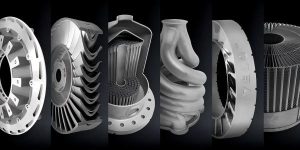
If you pursue ultimate performance, high strength, and high precision (such as aerospace parts, medical implants), SLM technology is currently the preferred choice because it can print almost defect-free dense metal.
About Forgecise
Forgecise is an innovator in additive manufacturing technology, dedicated to providing high-performance metal 3D printing materials, equipment, and process solutions for the mold manufacturing, energy power, and other industrial sectors.
Paul Li
CTO | Author18 years experience in the Research and Development of 3D printing equipment and additive manufacturing processes, empowering the efficient intelligent manufacturing of complex parts.