



Last updated: August 7, 2026
Written by Felix Lee, CEO at Forgecise
Metal 3D printing powder removal, also called depowdering, removes loose and trapped powder from SLM and LPBF parts before heat treatment, machining, pressure testing, or final use. The main methods include tapping, vibration, gas blowing, vacuum extraction, abrasive flow machining, ultrasonic cleaning, and automated cleaning systems.
Table of Contents
TL;DR
- Remove powder before heat treatment and machining.
- Vibration works best on surfaces and shallow cavities.
- Pulsed gas, vacuum, and custom fixtures help clean internal channels.
- Titanium, aluminum, and magnesium powders need strict fire and oxygen controls.
- Critical parts need flow tests, borescope checks, X-ray, CT, weighing, or sample cutting.
A printed metal part can look clean while still holding a serious problem inside.
Picture a heat exchanger with many curved internal passages. The outside looks fine. Both channel openings seem clear. But loose powder remains packed behind a bend. During heat treatment, that powder can fuse into a hard blockage.
The print may be good. The part still fails.
That is why depowdering is not a simple cleanup job. It connects printing with heat treatment, machining, inspection, and final approval.
Why Must Powder Be Removed From Metal 3D Printed Parts?
Powder must be removed because unfused metal often remains on the surface and inside hidden features. If it stays there, it can block flow paths, damage tools, pollute equipment, change test results, expose workers, and raise fire or explosion risk.
Residual powder often becomes trapped inside:
- Closed or partly closed cavities
- Conformal cooling channels
- Lattice structures
- Sandwich panels and cellular cores
- Deep grooves
- Blind holes
- Long curved passages
- Areas where channel size changes
The problem can become worse later.
During heat treatment, loose powder may sinter into a hard lump. During machining, powder may fall out and scratch the tool or finished surface. It may also pollute cutting fluid.
During pressure or flow testing, trapped powder can block a channel and cause a false result. A good part may appear defective. A real blockage may also go unnoticed until the part is in service.
Fine metal powder brings another risk. Its small particle size gives it a large surface area. Aluminum, titanium, magnesium, and some other metal powders may burn or explode when dust, oxygen, and an ignition source meet.
Depowdering is both a quality step and a safety step.
What Methods Remove Powder From Metal 3D Printed Parts?
The main methods are tapping, vibration, gas blowing, vacuum extraction, rotary tumbling, abrasive flow machining, ultrasonic cleaning, and wet cleaning. Most complex parts need several methods used in sequence.
How Do Tapping and Mechanical Vibration Work?
Manual tapping and vibration use movement to release loose powder.
An operator may tap the part lightly with a rubber mallet. The part may also sit on a vibration table so powder falls from open areas and shallow cavities.
Industrial vibration systems may use:
- Frequencies from tens to hundreds of hertz
- Adjustable vibration force
- Timed cleaning cycles
- Multi-angle tilting
- Part rotation
This method is low-cost and useful for outer surfaces, open pockets, and simple cavities. It is often the first cleaning step.
It has clear limits.
Powder may stay trapped in blind holes, narrow bends, lattice nodes, and internal dead zones. Thin-wall parts also need low-force settings because strong vibration can bend or damage them.
How Do Gas Blowing and Vacuum Extraction Work?
Gas blowing sends clean, dry, oil-free gas through a nozzle and into a cavity or channel. A vacuum nozzle collects the powder as it comes out.
For deep blind holes, the operator may switch between blowing and suction. For long conformal channels, a custom fixture can connect to the channel opening and send pulsed gas through the full path.
Pulsed gas can loosen powder packed at:
- Tight bends
- Narrow sections
- Channel intersections
- Sudden size changes
- Blind ends
Common setups include:
- Steady gas flow with vacuum collection
- Blow-and-suction cycles
- Pulsed gas flow
- Part rotation during cleaning
- Custom channel adapters
- Cleaning inside a negative-pressure chamber
Compressed air may be used in some approved processes, but it must be dry and oil-free.
Reactive powders need more care. Titanium, aluminum, and magnesium powder may need argon or another inert gas to reduce oxygen exposure and ignition risk.
The gas should match the alloy, powder condition, machine setup, and site safety plan. Reactive powder should not be blown with ordinary shop air without a proper review.
When Are Rotary Tumbling and Abrasive Flow Machining Used?
Rotary drums can clean many small parts at the same time. As the drum turns, parts move, change position, and release loose powder.
Ceramic or other approved media may be added to help carry powder away. The process must be controlled because parts can hit one another, damage edges, become tangled, or pick up media residue.
Abrasive flow machining, or AFM, works in a different way.
AFM pushes a thick abrasive medium through an internal passage. The medium can pull out trapped powder and smooth the channel wall at the same time.
AFM works well for:
- Conformal cooling inserts
- Long curved channels
- Small internal passages
- Parts that need internal surface smoothing
The main concern is leftover abrasive material. The part must be flushed, cleaned, and checked after AFM. Leaving abrasive inside a channel only replaces one type of residue with another.
Can Ultrasonic and Wet Cleaning Remove Powder?
Ultrasonic cleaning uses small bubbles in a liquid to loosen powder from fine details and inner surfaces. It may work well for small, precise, or high-value parts that can be placed in liquid.
The cleaning liquid depends on the metal.
Water may work for some materials. Metals that oxidize easily may need an approved solvent, anhydrous ethanol, or another non-water cleaning medium.
Wet cleaning adds another risk: trapped liquid.
The part must be dried fully, often in a vacuum dryer. Liquid left inside a blind cavity may cause corrosion, affect heat treatment, or create quality problems later.
Titanium parts need extra review because some wet processes may cause hydrogen uptake. Under some conditions, this can raise the risk of hydrogen damage.
Ultrasonic cleaning should be treated as a tested material process, not as a general wash step.
Why Are Internal Channels Hard to Clean?
Internal channels are hard to clean because they may be only 2–6 mm wide, several hundred millimeters long, sharply curved, or partly closed. Powder often gets stuck at bends, blind ends, lattice nodes, intersections, and sudden channel changes.
The best fix starts during design.
How Can Part Design Make Powder Removal Easier?
Designers can make depowdering easier by:
- Adding temporary drain or vent holes
- Placing holes where they can later be plugged, welded, or machined away
- Avoiding sudden channel size changes
- Reducing blind ends
- Giving powder a clear path out
- Pointing openings downward where possible
- Using gravity when choosing print direction
- Checking cleaning access before printing
A small drain hole may add one extra step. It may also save an expensive part from rejection.
This matters for heat exchangers, aerospace fuel nozzles, turbine parts, lattice structures, and conformal cooling inserts. Once a narrow channel is printed without a good exit path, cleaning choices become limited.
How Are Long or Curved Flow Paths Cleaned?
Long internal paths often need a custom fixture that seals around the channel opening. The system can then send pulsed gas through the passage while a vacuum collects powder from the outlet.
The part may also be rotated through several angles.
An industrial borescope can inspect visible sections. It cannot always see around every bend, so critical parts may also need flow-rate or pressure-drop testing.
A channel may look open from both ends while still holding a powder pocket in the middle. A flow test can find the problem even when the camera cannot.
What Equipment Is Used in a Depowdering Workstation?
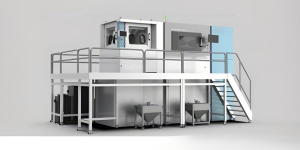
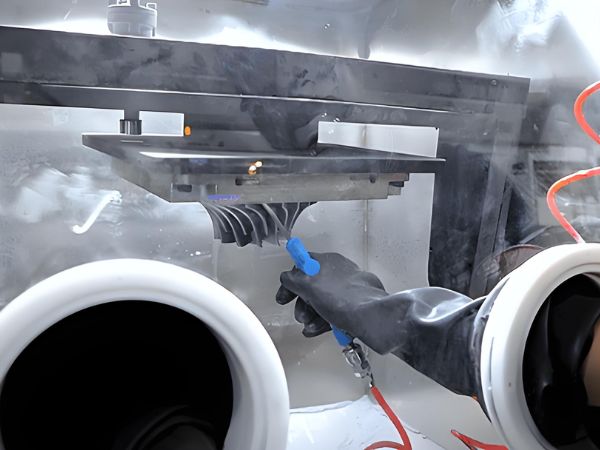
A depowdering workstation combines cleaning, dust control, filtration, powder collection, and worker protection. Its job is to remove powder without letting it spread through the room.
A modern station may include:
- A sealed glovebox or negative-pressure enclosure
- Tapping and vibration tools
- Multi-axis part rotation
- Gas nozzles
- Vacuum extraction
- Sealed powder pipes
- Grounded powder containers
- HEPA and ULPA filters
- Spark detection
- Static grounding and bonding
- Oxygen monitoring
- Inert-gas protection
- Explosion-rated electrical parts
Equipment may also need to meet ATEX or other local dust-explosion rules.
Dry or wet blasting can remove surface powder and lightly stuck particles. It is a surface treatment. It does not clean deep or closed channels in a reliable way.
How Should Recovered Metal Powder Be Handled?
Recovered powder should be sorted, screened, tested, labeled, and tracked before reuse. It should not go straight back into the printer just because it looks clean.
Powder may be grouped as:
- New powder
- Recovered powder
- Approved mixed powder
- Dirty or rejected powder
Recovered powder may be screened to remove clumps and foreign matter. It may also need tests for:
- Particle size
- Oxygen level
- Flowability
- Moisture
- Foreign material
- Changes caused by repeated heating
Some company rules may allow recovered powder to be mixed with new powder. A limit such as 30% old powder may appear in a process rule.
That number is only an example. It is not a rule for every alloy, printer, or factory.
Each company must set its own limit through testing and process approval.
Powder that no longer meets printing limits may be used for less demanding work where allowed. Otherwise, it should enter the waste process.
Every powder batch should link to screening records, test results, mix ratios, printer builds, and part records.
What Safety Controls Are Needed During Powder Removal?
Metal powder can create inhalation, skin, static, fire, and explosion hazards. Safety controls must match the alloy, particle size, equipment, room, and work method.
A safe setup should include:
- Enclosed powder handling
- Local exhaust
- Negative-pressure cleaning
- Grounded and bonded equipment
- No open flames
- No unsafe electrical tools
- Oxygen control for reactive powders
- Sealed powder collection
- Approved cleaning methods
- Written emergency steps
Dust levels should stay below local worker exposure limits and well below the powder’s explosion limit.
There is no single dust number that is safe for every metal powder. The result depends on alloy type, particle shape, particle size, air movement, and testing method.
Worker protection may include:
- A suitable dust respirator
- N95, KN95, P3, or another approved filter
- Safety goggles
- Protective gloves
- Antistatic clothing
- Antistatic footwear
The correct respirator depends on the SDS and site risk review. A mask used for one nickel or titanium process may not be right for another.
The workplace should keep safety data sheets easy to reach. Workers should receive training and take part in emergency drills.
Metal powder fires need an approved dry agent or a planned inert-gas system. Water should not be used on reactive metal fires unless the material safety plan clearly allows it.
How Is Powder Removal Checked?
A part should not pass inspection based on sight alone. Hidden passages need a written cleaning standard and a test method that can find powder in places the operator cannot see.
Common checks include:
- Flow-rate testing
- Pressure-drop testing
- Industrial borescope inspection
- X-ray inspection
- CT scanning
- Weight checks before and after cleaning
- Cutting open sample parts
Flow and pressure results can be compared with design values or an approved sample part.
Borescopes help with visible cavities. X-ray and CT can find hidden powder, but the result depends on wall thickness, metal type, part shape, scan quality, and powder amount.
Weight checks can support process control, but weight alone may not prove that every channel is clear. A small powder plug can block an important passage without changing the total weight very much.
Critical aerospace parts may need sample cutting to prove that the cleaning process works.
The process rule should state:
- Which test to use
- The pass and fail limits
- How often to test
- Which parts need more checks
- When retesting is required
- Who can release the part
- Which records must be saved
“Looks clean” is not the same as “passed the cleaning standard.”
When Should Depowdering Happen?
Depowdering should normally happen before heat treatment and machining. The part should not move to the next step until the cleaning record and test result have passed.
Powder left inside a part can:
- Fuse into hard lumps during heat treatment
- Fall onto tools during machining
- Scratch cutting edges
- Pollute coolant
- Block pressure lines
- Block cooling channels
- Cause false test results
The handover record should include:
- Part number
- Alloy
- Powder batch
- Cleaning method
- Cleaning equipment
- Main settings
- Operator or machine ID
- Test result
- Release status
A clear process gate should be used:
Powder removal passed → cleanliness checked → part released.
How Is Automation Changing Depowdering?
Aerospace and medical factories are moving from manual cleaning to automated cleaning cells. Robots can hold and turn the part while several stations apply vibration, gas, vacuum, and inspection.
An automated system may include:
- Robot handling
- Multi-position vibration
- Programmed gas cycles
- Vacuum extraction
- Multi-axis rotation
- Camera inspection
- Saved part recipes
- Powder recovery records
- Cleaning test results
- MES tracking
- Part-level history
Conformal cooling mold shops may use their own flow-through and AFM stations.
For factories that make many different parts in small numbers, a full robot cell may not be needed. Flexible fixtures, written work steps, tested settings, and repeatable checks may be the better choice.
The goal is not automation by itself. The goal is repeatable cleaning with records.
How Should Waste Powder and Cleaning Liquid Be Disposed Of?
Dirty powder, old powder, sieve waste, used filters, blasting media, cleaning liquid, and solvent must enter a controlled waste process. They should not go into normal trash or drains.
Titanium and aluminum powder may need wetting, stabilization, or inerting before transport. This step must follow an approved method because some metals may react with water and release hydrogen.
Nickel-based and other heavy-metal powders may count as hazardous waste or controlled industrial waste, based on local law and material content.
Waste records should include:
- Metal or alloy type
- Powder amount
- Reason for rejection
- Treatment method
- Storage method
- Waste class
- Disposal company
- Transfer records
This final step closes the metal additive manufacturing process. It also supports safety, environmental records, and part traceability.
What Is the Recommended Depowdering Workflow?
A controlled workflow starts with part review and ends with a signed release.
- Review the alloy, shape, channels, cavities, lattices, and thin walls.
- Choose the enclosure, gas, ventilation, grounding, PPE, and collection system.
- Remove loose outer powder with gravity, tapping, vibration, and rotation.
- Clean internal areas with gas, vacuum, custom fixtures, and blow-suction cycles.
- Use tumbling, AFM, ultrasonic cleaning, wet cleaning, or blasting where approved.
- Collect, sort, screen, test, and label recovered powder.
- Check the part with flow, pressure, borescope, X-ray, CT, weighing, or sample cutting.
- Dry the part and remove any liquid or abrasive residue.
- Save the cleaning settings and test result.
- Release the part for heat treatment, machining, or testing.
- Send waste powder and liquid through the approved disposal process.
Frequently Asked Questions About Metal 3D Printing Powder Removal
Metal 3D printing powder removal depends on part shape, alloy type, channel size, safety risk, and final cleanliness needs. Simple parts may only need vibration and vacuum cleaning. Parts with long channels, lattices, or sealed areas often need custom fixtures, pulsed gas, special cleaning, and several inspection methods.
What is depowdering in metal additive manufacturing?
Depowdering is the removal of unfused metal powder from the surface, cavities, lattices, and internal channels of a printed part. It usually happens before heat treatment and machining. The process may use vibration, gas flow, vacuum, rotation, AFM, ultrasonic cleaning, or wet cleaning.
Can compressed air clean every metal 3D printed part?
No. Compressed air may work for approved materials and setups, but it must be dry and oil-free. Titanium, aluminum, and magnesium powders may need inert gas and oxygen control. The gas choice should follow the powder SDS and the factory safety plan.
Can sandblasting clean internal channels?
Sandblasting can clean outer surfaces and remove lightly stuck powder. It does not work well in deep, curved, narrow, or closed channels. These features usually need gas flow, vacuum, AFM, ultrasonic cleaning, rotation, or custom flow fixtures.
Can recovered metal powder be reused?
Yes, but only after screening, testing, approval, and full tracking. The powder may need checks for size, oxygen, flow, moisture, and dirt. Any mix of new and recovered powder must follow a tested company rule for that alloy and printer.
How can a factory prove that a channel is clean?
A factory may use flow tests, pressure-drop tests, borescopes, X-ray, CT scans, weight checks, or sample cutting. Critical parts often need more than one method. The correct test and pass limit should be written into the process rule before production.
Metal Powder Removal Must Be Treated as a Manufacturing Step
A part is not ready just because printing has finished.
It is ready when powder has been removed, the waste has been handled, the channel condition has been checked, and the results have been recorded.
A simple part may only need vibration and vacuum cleaning. A fuel nozzle, medical part, heat exchanger, or conformal cooling insert may need pulsed inert gas, a custom fixture, CT scanning, flow testing, and MES records.
The cleaning method changes with the part.
The basic rule stays the same:
Clean it. Check it. Record it. Then move it to the next step.
About the Author
Felix Lee is the CEO of Forgecise. He writes about metal additive manufacturing, powder handling, post-processing, internal channel cleaning, and production quality.
Author: Felix Lee
Role: CEO at Forgecise
Published: August 7, 2026
Last updated: August 7, 2026
Technical reviewer: Not yet assigned
Safety notice: This article gives general education only. Metal powder risks change by alloy, particle size, machine, gas, room, and local law. Follow the powder SDS, workplace rules, fire plan, environmental rules, and site risk review.
Sources
- Occupational Safety and Health Administration, “Combustible Dust: An Explosion Hazard.” Accessed August 7, 2026.
- Occupational Safety and Health Administration, “Hazard Communication Guidance for Combustible Dusts.” Accessed August 7, 2026.
- National Institute for Occupational Safety and Health, “3D Printing—Additive Manufacturing.” Accessed August 7, 2026.
- National Institute for Occupational Safety and Health, “Evaluation of Metals Exposure in a Metal Powder Additive Manufacturing Facility.” Accessed August 7, 2026.