





Back to 3D Printing in Aerospace
Table of Contents
Article Information
Written by:
Felix Lee
CEO at Forgecise
Last Updated: August 18, 2026
Technical Review:
Advanced Manufacturing Engineering Review Team
About the Author
Felix Lee is the CEO at Forgecise, focusing on advanced manufacturing technologies, digital engineering workflows, and industrial production innovation. His work covers how new manufacturing methods, computational design, and digital production systems are changing the way industries create complex components.
Through research and industry collaboration, Felix studies how additive manufacturing can improve material efficiency, production flexibility, and future manufacturing systems.
Aerospace Additive Manufacturing: How Titanium 3D Printing Is Creating Lighter Aircraft Structures
Quick Answer
Aerospace additive manufacturing uses metal 3D printing, topology optimization, and advanced lattice structures to create aircraft components that are lighter and more efficient than traditional machined parts. By using titanium alloys such as Ti-6Al-4V and placing material only where loads require it, manufacturers can reduce waste, improve design freedom, and create complex structures that traditional manufacturing cannot produce.
Key Takeaways
- Aerospace additive manufacturing changes aircraft production from material removal to controlled material placement.
- Topology optimization uses computer simulations to remove unnecessary weight while maintaining strength.
- Bionic lattice structures improve performance by creating lightweight internal architectures.
- Titanium additive manufacturing requires strict processes such as HIP and CNC finishing before flight certification.
- Airbus, Safran, Howmet Aerospace, and defense organizations are applying these technologies to real aerospace components.
The aerospace industry has always faced the same engineering challenge:
How can aircraft become lighter without reducing safety?
For decades, manufacturers solved this problem by starting with large titanium blocks and removing material through machining.
The method worked, but it created a major limitation.
A large amount of expensive aerospace-grade titanium was removed and recycled before the final part reached the aircraft.
Today, aerospace manufacturers are changing this approach.
Instead of cutting away unnecessary material, engineers are using software algorithms to determine where material is actually needed.
This new approach combines:
- Topology optimization
- Bionic lattice structures
- Titanium additive manufacturing
- Advanced metal processing
Together, these technologies are changing how critical aircraft structures are designed and produced.
Why Is Aerospace Manufacturing Moving From Titanium Forging to Additive Manufacturing?
Traditional aerospace manufacturing relies heavily on titanium forging and CNC machining because aircraft structures require high strength, fatigue resistance, and long service life.
Titanium alloy Ti-6Al-4V remains one of the most widely used aerospace materials because it provides:
- High strength-to-weight performance
- Corrosion resistance
- Temperature resistance
- Compatibility with carbon fiber reinforced polymer (CFRP) structures
Aircraft manufacturers use titanium in areas such as:
- Engine pylon fittings
- Landing gear assemblies
- Structural bulkheads
- Wing connectors
However, titanium creates a serious manufacturing challenge.
It is expensive and difficult to machine.
What Is the Buy-to-Fly Problem in Aerospace Manufacturing?
The buy-to-fly ratio describes the relationship between:
The weight of raw material purchased and the final weight of the installed aircraft component.
Traditional titanium machining can create extremely high ratios.
For complex aerospace brackets, the ratio may reach approximately:
33:1
This means manufacturers may need:
- 33 pounds of titanium material
- To produce only 1 pound of finished aircraft hardware
The remaining material becomes waste.
This creates several problems:
- High material costs
- Long machining cycles
- Increased energy use
- Expensive recycling processes
For aerospace companies producing thousands of components, this becomes a major manufacturing expense.
Why Does Traditional Manufacturing Limit Aerospace Design?
Traditional machining depends on physical cutting tools.
Tools need access to the material.
This creates design restrictions.
Engineers may want to remove internal material or create complex curved structures, but the cutting tool may not reach those areas.
As a result, traditional parts often contain extra material simply because manufacturing limitations prevent further optimization.
The manufacturing process controls the design.
Additive manufacturing changes this relationship.
How Does Aerospace Additive Manufacturing Reduce Material Waste?
Aerospace additive manufacturing builds components layer by layer using controlled energy sources.
Depending on the process, manufacturers use:
- Metal powder
- Titanium wire
- Laser energy
- Electron beams
Material is added only where it contributes to structural performance.
This creates several advantages:
- Lower material waste
- More complex geometries
- Reduced dependence on large forging tools
- Faster design changes
- Improved production flexibility
Instead of designing a part around machining limitations, engineers can design around structural requirements.
How Does Topology Optimization Improve Aerospace Components?
Topology optimization is one of the main technologies behind modern aerospace additive manufacturing.
It uses mathematical algorithms to determine the most efficient way to distribute material inside a component.
The goal is:
Remove unnecessary material while maintaining strength and stiffness.
What Is Topology Optimization in Aerospace Engineering?
Topology optimization starts with a digital design space.
Engineers define:
- Maximum component dimensions
- Material properties
- Load conditions
- Manufacturing limitations
- Weight targets
The software then analyzes how forces move through the structure.
Instead of asking:
“Where can engineers cut material?”
The algorithm asks:
“Where does the structure actually need material?”
How Does the SIMP Algorithm Work?
One of the most common topology optimization methods in aerospace engineering is:
Solid Isotropic Material with Penalization (SIMP).
The process uses several steps:
1. Digital Structure Creation
The design area is divided into thousands or millions of finite elements.
2. Stress Simulation
Finite Element Analysis (FEA) calculates:
- Stress distribution
- Load paths
- Structural response
3. Material Evaluation
The algorithm identifies areas that contribute little to structural performance.
4. Material Removal
Low-value areas are reduced or removed.
5. Optimized Geometry Generation
The final structure follows the main load paths.
The result is often a lightweight organic structure that looks very different from traditional aerospace brackets.
What Is the Difference Between Topology Optimization and Generative Design?
Topology optimization and generative design are often discussed together, but they serve different purposes.
| Technology | Purpose |
|---|---|
| Topology Optimization | Removes unnecessary material from a defined design space |
| Generative Design | Creates multiple possible designs based on engineering requirements |
Topology optimization usually focuses on refining a specific structure.
Generative design explores different solutions.
In many aerospace workflows, engineers use both:
- Generative design helps explore possible concepts.
- Topology optimization improves the final structural solution.
This combination allows engineers to create parts that traditional machining cannot produce.
How Do Bionic Lattice Structures Make Aerospace Parts Lighter?
Additive manufacturing allows engineers to create internal structures that were impossible with traditional machining.
One of the most important examples is:
Bionic lattice design.
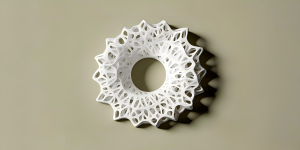
A lattice structure replaces solid material with a carefully designed internal network.
These structures can provide:
- High strength-to-weight ratio
- Better energy absorption
- Improved load distribution
- Reduced material usage
The idea comes from nature.
Natural structures such as bone and antlers achieve strength while using very little material.
What Are Variable-Density Lattice Structures?
Traditional lattice designs use the same structure throughout the entire component.
For example:
- Same cell size
- Same strut thickness
- Same density
However, aircraft parts experience different loads in different areas.
Variable-density lattice structures solve this by connecting the internal design with stress data from simulations.
In high-load areas, engineers can:
- Increase material density
- Thicken structural elements
- Strengthen internal regions
In low-load areas, the structure becomes lighter.
The result is a component that places material only where it is needed.
What Are TPMS Lattice Structures in Aerospace Manufacturing?
Triply Periodic Minimal Surface (TPMS) structures are a more advanced type of lattice architecture used in aerospace additive manufacturing.
Unlike traditional lattice designs made from separate struts, TPMS structures use continuous curved surfaces.
Common examples include:
- Gyroid structures
- Diamond structures
These designs provide several benefits:
- Smooth force transfer
- Lower stress concentration
- High energy absorption
- Better structural efficiency
For metal powder bed fusion processes, TPMS structures are especially useful because their continuous geometry can reduce the need for additional support structures during printing.
How Does Implicit Modeling Create Complex Aerospace Lattices?
Creating advanced lattice structures requires more than traditional CAD methods.
Many aerospace companies use implicit modeling software such as nTop to generate complex internal structures.
Traditional CAD systems describe parts using boundary surfaces.
Implicit modeling uses mathematical equations to define geometry.
This approach helps engineers create:
- Large variable-density lattice structures
- Smooth transitions between different densities
- Smaller digital files
- Faster design optimization
For aerospace applications, this is important because highly complex lattice structures can become difficult to manage with conventional CAD systems.
Are Bionic Aerospace Structures Better Than Traditional Designs?
Bionic structures are not only about appearance.
Their shape comes from mechanical principles found in nature.
Natural structures such as bone and deer antlers have evolved to handle complex loads while using limited material.
Aerospace engineers study these structures because they provide useful lessons:
- How forces move through materials
- How energy is absorbed
- How weight can be reduced
Example: Deer Antler-Inspired Aerospace Lattice Structures
Researchers have tested lattice designs inspired by deer antler bone structures for aircraft engine mount applications.
The goal was to improve:
- Load distribution
- Structural strength
- Damage resistance
Testing showed that the antler-inspired design achieved:
- Maximum yield force of approximately 30.7 kN
- Nearly 45% higher performance compared with standard lattice structures
This shows why bionic structures are becoming an important area in aerospace engineering.
The organic appearance is not a visual choice.
It comes from optimized structural behavior.
What Problems Must Engineers Solve Before Titanium AM Parts Can Fly?
Printing a titanium aerospace component is only one step.
The harder challenge is proving that the part can survive years of flight cycles.
Aircraft structures such as:
- Landing gear mounts
- Engine fittings
- Wing connectors
experience repeated loading thousands or millions of times during service.
The main challenges include:
- Surface roughness
- Internal porosity
- Fatigue performance
- Certification requirements
How Does Surface Roughness Affect Titanium Additive Manufacturing?
One major challenge in Laser Powder Bed Fusion (LPBF) is the rough surface created during printing.
During the process:
- Metal powder particles partially melt
- Some particles remain attached to the surface
- Each printed layer creates small surface variations
These create:
- Micro-notches
- Surface valleys
- Stress concentration areas
During repeated aircraft loading, these areas can become locations where fatigue cracks begin.
This means an as-built titanium additive manufactured part may not have the same fatigue performance as a smooth machined forging.
Why Is CNC Machining Still Used After Metal 3D Printing?
A common misunderstanding is that additive manufacturing completely replaces machining.
In aerospace production, the two processes often work together.
Additive manufacturing creates:
- Complex geometry
- Internal lightweight structures
- Optimized material placement
CNC machining creates:
- Accurate connection surfaces
- Finished holes
- Smooth fatigue-critical areas
Critical locations such as:
- Pin holes
- Mounting surfaces
- Load transfer areas
usually require precision machining.
This hybrid approach keeps the weight savings from additive manufacturing while meeting aerospace quality requirements.
How Does Internal Porosity Affect Aerospace Metal AM Parts?
Another challenge is internal defects.
During metal additive manufacturing, rapid melting and cooling can create:
- Gas pockets
- Lack-of-fusion defects
- Small internal voids
These defects can become internal stress points.
Under repeated loading, they may reduce fatigue life.
For this reason, aerospace manufacturers use advanced post-processing methods.
Why Is Hot Isostatic Pressing (HIP) Important for Titanium Aerospace Parts?
Hot Isostatic Pressing, known as HIP, is a major process used to improve titanium additive manufactured components.
HIP combines:
- High temperature
- High pressure
- Controlled gas atmosphere
A typical aerospace Ti-6Al-4V HIP process uses approximately:
- 1650°F (898°C) temperature
- 15,000 psi argon gas pressure
- Several hours of processing
During HIP:
- Internal pores collapse.
- Material bonds together through diffusion.
- Internal defects are reduced.
- Density improves.
The final structure becomes close to fully dense titanium material suitable for demanding aerospace applications.
What Is the Howmet Ampliforge Hybrid Manufacturing Process?
Some aerospace applications require even higher material performance.
This has led to hybrid manufacturing methods that combine additive manufacturing with traditional forging.
One example is:
Howmet Aerospace Ampliforge™
The process combines:
- Additive manufacturing for complex shapes.
- Forging for improved material properties.
The printed component becomes a near-net-shape preform.
A later forging process improves:
- Grain structure
- Toughness
- Fatigue resistance
The result combines the design freedom of additive manufacturing with the mechanical advantages of forged titanium.
How Are Aerospace Companies Using Additive Manufacturing Today?
Aerospace additive manufacturing has moved beyond research laboratories.
Companies are now applying the technology to real aircraft structures.
Important applications include:
- Engine pylon fittings
- Landing gear components
- Wing rib connectors
How Are Engine Pylon Fittings Made With Additive Manufacturing?
Engine pylon fittings connect the aircraft engine to the wing structure.
These parts experience complex forces:
- Engine weight
- Thrust loads
- Aerodynamic forces
- Vibration
- Maneuver stress
Because of their importance, they require very high reliability.
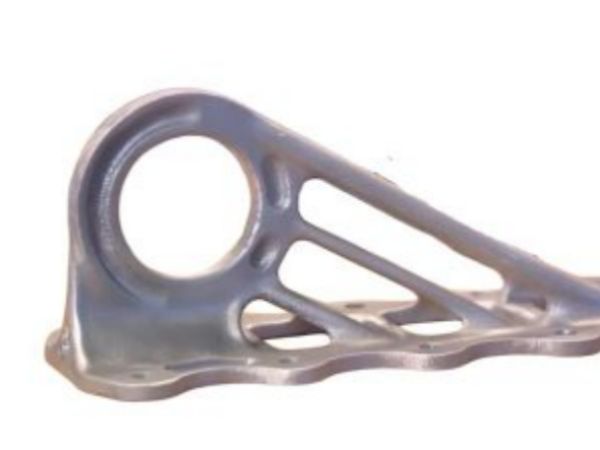
Airbus A350 Titanium Pylon Bracket Example
Airbus successfully installed a titanium additive manufactured engine pylon bracket on an A350 XWB aircraft.
The component was produced using:
- Titanium alloy
- Laser powder bed manufacturing
- Advanced design optimization
The project showed that topology-optimized titanium structures could move from development environments into commercial aviation.
It also demonstrated that additive manufacturing could meet strict aerospace qualification requirements.
How Are Landing Gear Components Being Redesigned?
Landing gear is one of the most demanding areas in aerospace engineering.
Landing gear components must handle:
- Hard landing impacts
- Vertical forces
- Side loads
- Repeated cycles
These parts often follow safe-life design principles.
Engineers must prove that cracks will not develop during the expected service period.
Safran and SLM Solutions Landing Gear Example
Safran Landing Systems worked with SLM Solutions to redesign a titanium nose landing gear component.
The project used:
- Topology optimization
- SLM®800 additive manufacturing system
- Quad-laser technology
The results included:
- Approximately 15% weight reduction
- Faster prototype production
- Shorter development cycles
Traditional forged prototypes can require months.
Additive manufacturing allowed engineers to produce test parts much faster.
How Did KARI Solve Additive Manufacturing Lattice Challenges?
The Korea Aerospace Research Institute (KARI) worked on topology-optimized landing gear structures with internal lattice designs.
The team faced a difficult manufacturing problem.
Complex lattice structures need support materials during printing.
However, removing those supports after printing could damage the delicate internal lattice.
The solution was a DfAM approach.
Engineers created a thin solid protective layer on downward-facing surfaces.
This layer:
- Prevented support structures from bonding with the lattice
- Protected the internal geometry
- Allowed easier post-processing
This example shows an important lesson:
A good additive manufacturing design must consider the printing process from the beginning.
Which Metal Additive Manufacturing Technologies Are Used for Large Aerospace Parts?
Different aerospace applications require different additive manufacturing methods.
The main technologies include:
- Laser Powder Bed Fusion (LPBF)
- Electron Beam Melting (EBM)
- Wire Directed Energy Deposition (w-DED)
How Does Laser Powder Bed Fusion Work?
LPBF is widely used for complex aerospace components.
The process uses:
- Thin layers of metal powder.
- Laser energy to melt selected areas.
- Repeated layer building.
Advantages:
- High accuracy
- Complex geometry
- Fine features
Common applications:
- Titanium brackets
- Engine fittings
- Lightweight structures
Challenges:
- Residual stress
- Surface roughness
- Thermal distortion
Why Is Electron Beam Melting Used for Titanium Aerospace Parts?
Electron Beam Melting (EBM) operates inside a vacuum environment.
The electron beam melts titanium powder while keeping the surrounding material at high temperatures.
For titanium parts, the powder bed can reach around:
700°C
This reduces:
- Thermal gradients
- Warping
- Residual stress
EBM is useful for titanium components where dimensional stability is important.
What Is Wire Directed Energy Deposition (w-DED)?
For very large aerospace structures, powder bed systems have size limitations.
Wire Directed Energy Deposition uses:
- Titanium wire
- Energy sources such as plasma arc or electron beam
- Robotic movement
The process can build much larger structures at higher deposition speeds.
Applications include:
- Wing structures
- Large titanium frames
- Aircraft structural blanks
How Is Airbus Using Large-Scale Titanium Additive Manufacturing?
Airbus has explored wire-based additive manufacturing for large titanium structures.
The technology can produce components up to approximately:
7 meters (over 23 feet)
The workflow is:
Digital design → Additive manufacturing → CNC finishing → Aircraft integration
This approach allows manufacturers to create large components while reducing material waste.
How Is Additive Manufacturing Changing Aerospace Supply Chains?
The impact of additive manufacturing goes beyond the factory floor.
Traditional aerospace supply chains often depend on:
- Large forging suppliers
- Specialized tooling
- Long transportation routes
Additive manufacturing creates a different model.
Companies can maintain digital production files and manufacture parts closer to where they are needed.
Benefits include:
- Faster replacement production
- Reduced inventory requirements
- More flexible supply networks
How Did the US Navy Use Additive Manufacturing for Aircraft Readiness?
Fleet Readiness Center East (FRCE) used metal additive manufacturing to address supply challenges.
Applications included:
- AH-1Z Viper weapons pylon fitting
- V-22 Osprey landing gear repair fitting
The important achievement was creating a digital manufacturing process that connected:
Design → Manufacturing → Qualification → Installation
This reduced dependence on long traditional supply chains.
How Is Taiwan Building an Aerospace Additive Manufacturing Ecosystem?
Taiwan has developed an advanced aerospace manufacturing network involving:
- Aerospace Industrial Development Corporation (AIDC)
- Industrial Technology Research Institute (ITRI)
ITRI developed capabilities in:
- Metal additive manufacturing research
- Aerospace titanium powders
- Large-format printing systems
One large powder bed fusion system features:
- 500 × 500 × 500 mm build volume
- Four synchronized lasers
How Do Taiwanese Machine Tool Companies Support AM Production?
Additive manufacturing parts still require precision finishing.
Asia Pacific Elite Corp (APEC) developed advanced machining solutions for hybrid aerospace manufacturing.
The GM2540 system supports:
- 5-axis machining
- Titanium AM finishing
- Aerospace precision requirements
The workflow becomes:
Digital design → Printing → Machining → Final aerospace component
What Does the Future of Aerospace Additive Manufacturing Look Like?
Aerospace additive manufacturing will continue developing through the combination of:
- Better simulation tools
- Artificial intelligence design
- Larger printing systems
- Improved materials
- Digital supply chains
The future aircraft factory will not start with a large block of metal.
It will start with engineering data.
Frequently Asked Questions
What is aerospace additive manufacturing?
Short answer:
Aerospace additive manufacturing uses metal 3D printing technologies to create aircraft components with less waste and more design freedom.
The technology combines titanium materials, digital engineering, and advanced manufacturing processes to produce lightweight structures for aircraft applications.
Why is titanium used in aerospace additive manufacturing?
Short answer:
Titanium is used because it provides high strength, low weight, corrosion resistance, and strong performance in demanding aircraft environments.
Ti-6Al-4V titanium alloy is widely used for structural aerospace components because it works well with both metal additive manufacturing and composite aircraft structures.
How does topology optimization reduce aircraft weight?
Short answer:
Topology optimization uses computer simulations to remove material that does not contribute significantly to structural performance.
By analyzing stress patterns through FEA, engineers create lighter components while maintaining required strength.
Are 3D printed aerospace parts safe for flight?
Short answer:
Yes, when they complete required aerospace qualification processes.
Flight-ready additive manufactured parts require controlled production, inspection, HIP treatment, machining, fatigue testing, and certification.
Which companies use aerospace additive manufacturing?
Short answer:
Companies including Airbus, Safran Landing Systems, Howmet Aerospace, and SLM Solutions are developing aerospace additive manufacturing applications.
Their work includes titanium brackets, landing gear components, and structural aircraft parts.