










By Felix Lee, CEO at Forgecise
Published: July 2026 | Reading Time: 6 mins | Reviewed for Accuracy: Advanced Additive Manufacturing Series
Table of Contents
Quick Summary
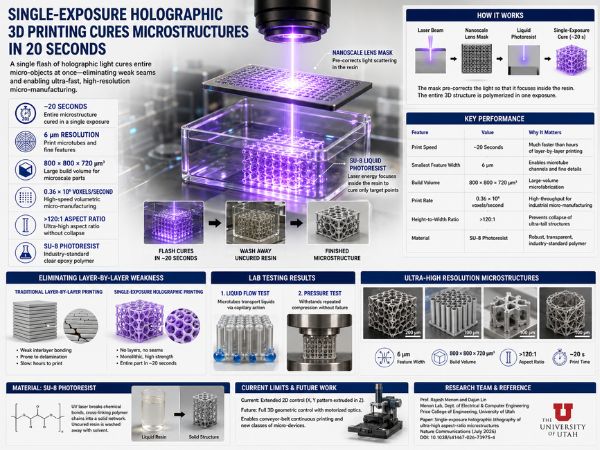
Researchers at the University of Utah have built a new 3D printing technique called single-exposure holographic lithography. Instead of building microstructures layer by layer over several hours, this tool uses laser light passing through a nanoscale mask to harden an entire shape inside polymer liquid in roughly 20 seconds. Because it cures the entire object at once, it completely removes the weak seams and layer peeling found in normal 3D printing.
Quick Performance Numbers
| Feature | Value | Why It Matters |
|---|---|---|
| Print Speed | ~20 Seconds | Much faster than standard laser printing that takes hours |
| Smallest Feature Width | $6\ \mu\text{m}$ | Can print tiny microtube channels |
| Build Volume | $800 \times 800 \times 720\ \mu\text{m}^3$ | Prints large amounts of microscopic shapes at once |
| Print Rate | $0.36 \times 10^6\text{ voxels/second}$ | Fast speed for factory micro-manufacturing |
| Height-to-Width Ratio | Over $120:1$ | Keeps super thin structures from falling over |
| Liquid Material | SU-8 Photoresist | Industry-standard clear plastic polymer |
1. The Problem with Layer-by-Layer Micro 3D Printing
Standard 3D printers build items by stacking thin slices on top of each other. While this works great for plastic toys or large prototypes, it causes two big problems when making micro-scale parts:
- Weak Seams and Layer Peeling: The lines where two layers meet act like cracks waiting to happen. Under heavy pressure, these layers pull apart.
- Very Slow Speeds: Printing microscopic parts point by point or slice by slice takes hours.
In July 2026, researchers at the University of Utah shared a new method that skips layer stacking entirely. Prof. Rajesh Menon and researcher Dajun Lin from the Department of Electrical & Computer Engineering (Price College of Engineering) created a way to print full microstructures in a single light flash lasting about 20 seconds.
2. How Single-Exposure Holographic Lithography Works
Traditional 2D chip manufacturing uses flat stencils (called masks) to block light. This creates flat electronic circuits on silicon wafers. However, flat masks cannot build 3D shapes inside a block of material without repeating hundreds of slicing steps.
+-----------------------------------------------------------------------+
|                 HOLOGRAPHIC LITHOGRAPHY PROCESS                      |
+-----------------------------------------------------------------------+
|  [Laser Beam]                                                        |
|        │                                                              |
|        ▼                                                              |
|  [Nanoscale Lens Mask]                                                |
|        │  (Fixes light bending & spreading before laser hits liquid)  |
|        ▼                                                              |
|  [SU-8 Liquid Polymer Tank]                                           |
|        │  (Laser energy focuses at target points inside liquid)       |
|        ▼                                                              |
|  [Flash Cures in ~20s] ➔ [Wash Away Soft Liquid] ➔ [Finished Object] |
+-----------------------------------------------------------------------+
Fixing Light Bending Inside Liquid Polymer
Shining laser light deep into semi-clear polymer liquid is tricky. The liquid naturally bends and scatters the light, which makes the final image blurry.
The Utah team solved this by creating a special nanoscale lens mask placed right in front of the laser:
- Pre-Correcting Light Rays: The microscopic patterns on the mask change the light rays beforehand so they cancel out the scattering inside the liquid.
- Targeted Energy Focus: As laser light passes through the mask, it hits exact target points inside the liquid, causing the plastic to harden only where needed.
The Cookie Cutter Analogy
Prof. Rajesh Menon explained the process using a simple baking comparison:
“The nanoscale mask acts like a cookie cutter that defines the intricate 2D shape over a thick sheet of dough, while the laser simultaneously acts as internal heat that bakes and solidifies the polymer resin from within.”
3. The Polymer Material and Test Results
How SU-8 Photoresist Hardens
The printer uses SU-8 photoresist, a tough epoxy liquid standard in tiny mechanical devices:
- Chemical Linkage: High-power laser light breaks chemical bonds inside the liquid, causing polymer chains to lock together into a solid shape.
- Washing Unused Resin: Soft liquid that did not receive laser light stays unhardened. Liquid solvents wash it away, leaving clean, hollow 3D parts behind.
Measured Performance
- Speed: Solidifies whole micro-objects in ~20 seconds.
- Print Volume: Measures up to $800 \times 800 \times 720\ \mu\text{m}^3$.
- Voxel Rate: Reaches $0.36 \times 10^6\text{ voxels/second}$.
- Feature Resolution: Microtubes can have inner and outer widths down to $6\ \mu\text{m}$.
- Height-to-Width Ratio (Aspect Ratio): Exceeds $120:1$ without bending or breaking.
4. Real-World Lab Testing
To prove their printed parts work in real life, the Utah team made microtube grid arrays in several complex layouts.
+-----------------------------------------------------------------------+
|                       LAB EXPERIMENT RESULTS                          |
+-----------------------------------------------------------------------+
| 1. Liquid Flow Test:                                                  |
|    • Microtubes pull liquids through channels without leaking         |
|                                                                       |
| 2. Pressure Test:                                                     |
|    • Parts handle repeated squeezing without layer cracking           |
+-----------------------------------------------------------------------+
- Fluid Movement: Tests confirmed that the hollow microtubes pulled liquids through their inner channels using natural capillary action. The channels remained open and unblocked.
- Squeezing Strength: In repeated compression tests, the solid micro-objects held up under heavy loads. Because they were cured in one flash without layer boundaries, they did not split or peel.
5. Current Limits and What Comes Next
Prof. Menon points out that while the printer is fast, it has one main limit right now:
- Current Stage (“Extended 2D”): The tool gives full control over X and Y dimensions while pulling that shape straight down the Z axis. While the part has 3D length, width, and height, it cannot yet make totally random 3D shapes that change in all directions at once.
- Future Work: The team is building motorized optical parts to achieve full 3D geometric control. The 20-second print time could also allow continuous assembly line printing on moving conveyor belts.
6. Frequently Asked Questions
Q1: What is single-exposure holographic 3D printing?
Answer: It is a technique that solidifies a whole micro-object in about 20 seconds using a single laser flash passed through a patterned optical mask. Instead of drawing lines or stacking layers, the laser energy hardens the liquid photopolymer all at once.
Q2: Why does holographic printing stop layer cracking?
Answer: It removes layer cracking because it cures the entire object during one single light exposure without stacking separate slices. This forms a single solid piece with no internal seams or weak boundaries.
Q3: What polymer material does this printer use?
Answer: The printer uses SU-8 photoresist, an epoxy-based liquid polymer. When hit by laser light, its long polymer chains cross-link into a solid structure while unused liquid washes away in solvent.
Q4: How small are the shapes made by this printer?
Answer: The printer can make microtube features as small as 6 micrometers wide, with height-to-width ratios over 120 to 1 inside an 800 x 800 x 720 cubic micrometer build space.
7. Journal Reference
- Paper Title: Single-exposure holographic lithography of ultra-high aspect-ratio microstructures
- Journal: Nature Communications (Published July 2026)
- Lead Authors: Prof. Rajesh Menon and Dajun Lin (Menon Lab)
- University: Department of Electrical & Computer Engineering, Price College of Engineering, University of Utah
- DOI Link: 10.1038/s41467-026-73975-4
About the Author
Felix Lee is the Chief Executive Officer at Forgecise, an advanced manufacturing firm focused on precision additive manufacturing, photopolymer curing, and production scale-up strategies.
- Editorial Note: This report was written independently. All technical metrics were checked directly against the published research paper in Nature Communications (DOI: 10.1038/s41467-026-73975-4).