






By Felix Lee | CEO at Forgecise
Published: August 2026 | Reading Time: 7 min
Categories: Additive Manufacturing, Physical Metallurgy, Medium-Entropy Alloys, Advanced Materials
Table of Contents
Executive Summary & Direct Answer
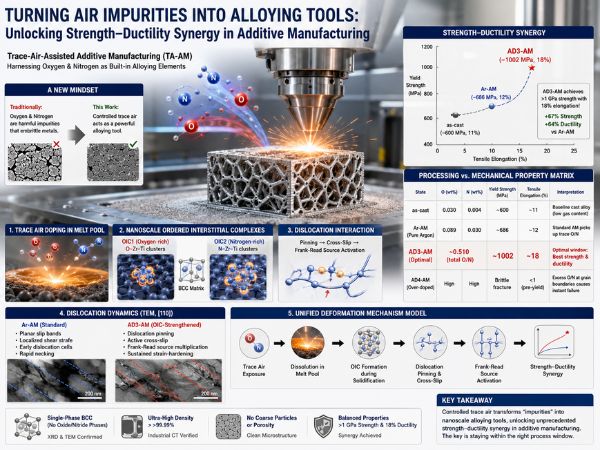
In metal 3D printing, engineers usually treat oxygen and nitrogen ($\text{O/N}$) as harmful impurities that make metal brittle. A 2026 study published in Nature Communications by Li et al. flips this idea on its head. It shows that controlled trace air can work as a built-in alloying tool.
- Main Method: Using trace-air-assisted additive manufacturing (TA-AM) to add small amounts of oxygen and nitrogen into a $\text{Ti}_{56}\text{Zr}_{30}\text{Nb}_{14}$ medium-entropy alloy (MEA).
- Key Mechanical Result: The best sample, called AD3-AM, reaches a yield strength of 1002 MPa ($>1\text{ GPa}$) and a tensile ductility of 18%. Compared to standard argon 3D printing (Ar-AM), this is a 67% increase in yield strength and a 64% increase in stretchability.
- Microstructure Mechanism: Instead of forming large brittle oxide or nitride chunks, oxygen and nitrogen form tiny nanoscale units called Ordered Interstitial Complexes (OIC1 and OIC2). These complexes pin dislocation lines, force dislocations to cross-slip, and start new Frank-Read dislocation sources while keeping a clean single-phase BCC matrix.
- Process Boundary: The air amount must stay inside a strict window. Adding too much air (AD4-AM) causes impurities to group at grain boundaries, leading to sudden brittle failure before the metal even yields.
Article Metadata & Reference Card
| Field | Details |
|---|---|
| Article Title | Strength-ductility synergy in medium-entropy alloys via harnessing trace air in additive manufacturing |
| Journal / Year | Nature Communications (2026) |
| Target Material | $\text{Ti}_{56}\text{Zr}_{30}\text{Nb}_{14}$ Medium-Entropy Alloy (MEA) |
| Key Authors | Li et al. |
| DOI | 10.1038/s41467-026-72511-8 |
| Primary Process | Trace-air-assisted additive manufacturing (Controlled atmospheric O/N doping) |
| Core Finding | $\text{AD3-AM}$: Yield strength $\sim 1002\text{ MPa}$, Tensile elongation $\sim 18\%$ |
⏱ 1-Minute Snapshot
- A New Mindset: Metallurgists usually use expensive argon gas or high vacuums to clear out air. This study shows that inside a controlled process window, small amounts of air act as intentional alloying elements.
- The Test Metal: Tests were run on a $\text{Ti}_{56}\text{Zr}_{30}\text{Nb}_{14}$ medium-entropy alloy, comparing cast metal, standard pure argon 3D printing (Ar-AM), and different air doping levels.
- Double Boost: The best air-doped setting ($\text{AD3-AM}$) pushes strength over $1\text{ GPa}$ while keeping an $18\%$ stretch rate. This solves the classic trade-off where strengthening a metal makes it brittle.
- How It Works: Tiny oxygen-rich $\text{OIC1}$ ($\text{O-Zr-Ti}$) and nitrogen-rich $\text{OIC2}$ ($\text{N-Zr-Ti}$) clusters drive the performance jump. Too much air ($\text{AD4-AM}$) ruins the metal and breaks it instantly.
Abstract Breakdown: Rethinking Air Impurities
Standard metal 3D printing uses ultra-pure argon or vacuums to keep reactive metals like titanium and zirconium from taking in gas. When these metals absorb raw gas from the room, they usually become brittle and snap easily.
This research tests a reverse approach: gas atoms from air do not have to be bad impurities. When added through a careful recipe during printing, oxygen and nitrogen work as fine-tuning elements inside the metal lattice.
The researchers used a single-phase Body-Centered Cubic (BCC) $\text{Ti}_{56}\text{Zr}_{30}\text{Nb}_{14}$ medium-entropy alloy. Their process boosted strength and stretchability at the same time. Atom Probe Tomography (APT) combined with Machine Learning (ML) and iDPC-STEM electron imaging revealed two nanoscale ordered interstitial complexes:
- OIC1 (Oxygen-rich): Tiny $\text{O-Zr-Ti}$ chemical clusters.
- OIC2 (Nitrogen-rich): Tiny $\text{N-Zr-Ti}$ chemical clusters.
These units are not brittle macroscopic oxide or nitride rocks. They are also not random loose gas atoms in the metal lattice. Instead, they form sub-nanometer coherent zones inside the BCC matrix. During mechanical pulling, these zones interact with moving dislocations. They hold dislocation lines in place, push them to switch slip planes through cross-slip, and trigger Frank-Read sources to keep the alloy hardening as it bends.
Process Route: How Trace Air Becomes an Alloying Variable
The authors tested four material states to track how air absorption affects performance and microstructures:
Processing vs. Mechanical Property Matrix
| State | Gas Content (O/N) | Yield Strength (YS) | Tensile Elongation | Metallurgical Interpretation |
|---|---|---|---|---|
| as-cast | $\text{O} \approx 0.030\text{ wt\%}$, $\text{N} \approx 0.004\text{ wt\%}$ | $\sim 600\text{ MPa}$ | $\sim 11\%$ | Baseline: Standard cast metal with low gas content. |
| Ar-AM | $\text{O} \approx 0.089\text{ wt\%}$, $\text{N} \approx 0.030\text{ wt\%}$ | $\sim 686\text{ MPa}$ | $\sim 12\%$ | Standard Pure AM: Picks up tiny amounts of extra gas during standard argon printing. |
| AD3-AM | Total $\text{O/N} \approx 0.510\text{ wt\%}$ | $\sim 1002\text{ MPa}$ | $\sim 18\%$ | Optimal Window: Air doping yields $+67\%$ strength and $+64\%$ stretchability vs Ar-AM. |
| AD4-AM | Over-doped $\text{O/N}$ concentration | Brittle fracture | $<1\%$ (Fails pre-yield) | Too Much Air: Excess gas pools at grain boundaries and causes instant snapping. |
Process Physics and Material Checks
During printing, the liquid melt pool absorbs trace oxygen and nitrogen from the chamber air. Rapid cooling and reheating cycles spread these atoms through the metal.
The team ran three structural checks to prove the gains in $\text{AD3-AM}$ came from lattice changes rather than basic density differences:
- Single-Phase BCC Structure: X-ray diffraction (XRD) and electron microscopy (TEM) showed the metal stayed a pure single-phase BCC structure with no oxide or nitride crystal peaks.
- High Material Density: Industrial Computed Tomography (CT) scans showed a relative density above $99.99\%$ with zero cracks.
- No Coarse Particles: The extra strength did not come from large second-phase particles or filled holes, proving that atomic interstitial clusters did the work.
Detailed Figure Breakdown & Physical Mechanisms
Figure 1: Strength-Ductility Performance
                  STRENGTH-DUCTILITY SYNERGY
    1200 |
         |                                   ★ AD3-AM (1002 MPa, 18%)
    1000 |                                  /
YS       |                   [Ar-AM]       /
(MPa) 800 |                  (686 MPa, 12%)
         |   [as-cast]      /
     600 |  (600 MPa, 11%) /
         |____________________________________
           0               10             20
                        Elongation (%)
- Stress-Strain Behavior: Engineering stress-strain tests show a big jump from
as-castandAr-AMtoAD3-AM. The $\text{AD3-AM}$ sample crosses $1\text{ GPa}$ in yield strength while reaching $18\%$ total stretch. - Comparing to Other AM Alloys: When plotted against other 3D-printed alloys containing oxygen, nitrogen, or carbon, $\text{AD3-AM}$ lands in the top-right corner—a spot showing gains in both strength and ductility.
- Sustained Work-Hardening: Most gas-strengthened metals snap early after reaching peak load. $\text{AD3-AM}$ keeps hardening while stretching, delaying necking and thin spot formation.
- The Over-Doping Danger ($\text{AD4-AM}$): Adding air is not a “more is better” trick. Going past $0.510\text{ wt\%}$ total gas ($\text{AD4-AM}$) causes premature brittle failure due to grain boundary buildup.
Figure 2 & Figure 3: Nanoscale Interstitial Complexes & ML-APT Analysis
To see where oxygen and nitrogen sit inside the crystal lattice, researchers combined iDPC-STEM imaging with Machine Learning Atom Probe Tomography (ML-APT):
[Trace O/N Air Doping] ──► [Solid Solution in Melt Pool]
                                    │
                                    ▼
                 [Nanoscale Chemical Partitioning]
                                    │
           ┌────────────────────────┴────────────────────────┐
           ▼                                                 ▼
   [OIC1 Complexes]                                  [OIC2 Complexes]
   • Oxygen-Rich                                     • Nitrogen-Rich
   • O-Zr-Ti Short-Range Clusters                    • N-Zr-Ti Short-Range Clusters
           │                                                 │
           └────────────────────────┬────────────────────────┘
                                    ▼
                    [Interaction with Dislocations]
- Matrix Coherency (Fig. 2): SAED diffraction pattern checks confirm that $\text{AD3-AM}$ maintains its single-phase BCC layout. Atomic iDPC-STEM pictures show oxygen and nitrogen pairing up near titanium and zirconium atoms.
- Machine Learning Atom Probe Tomography (Fig. 3): ML algorithms sorted 3D atom positions into two distinct interstitial units:
- OIC1 ($\text{O-Zr-Ti}$): Sub-nanometer clusters rich in oxygen, zirconium, and titanium.
- OIC2 ($\text{N-Zr-Ti}$): Sub-nanometer clusters rich in nitrogen, zirconium, and titanium.
- Core Metallurgical Finding: Oxygen and nitrogen atoms do not sit as lonely, random gas impurities. Instead, they organize into short-range ordered units that locally tune lattice friction and shear resistance.
Figure 4 & Figure 5: Dislocation Dynamics and Deformation Mechanisms
TEM imaging along the $[110]$ direction of stretched samples reveals how $\text{OICs}$ change plastic deformation:
Ar-AM (Standard)                AD3-AM (OIC-Strengthened)
----------------                -------------------------
• Planar Slip Bands             • Dislocation Pinning
• Localized Shear Strafe        • Active Cross-Slip
• Early Dislocation Cell Voids  • Frank-Read Source Multiplication
• Rapid Necking                 • Sustained Strain-Hardening
- Deformation in Ar-AM (Fig. 4): Standard argon-printed samples deform along straight, flat slip lines. Dislocation lines stack up in narrow bands, creating early weak spots and lower total stretch.
- Deformation in AD3-AM (Fig. 4 & 5):
- Dislocation Pinning: As dislocations try to move through the BCC lattice, nanoscale $\text{OICs}$ block them temporarily like speed bumps.
- Dynamic Cross-Slip: To bypass pinned $\text{OIC}$ spots, dislocation lines bend and jump onto nearby secondary slip planes.
- Frank-Read Source Activation: These jumps activate double cross-slip Frank-Read sources, multiplying dislocation lines. This creates uniform deformation across the whole piece and keeps the alloy hardening.
- Unified Model (Fig. 5): The process connects trace air exposure to liquid absorption, thermal ordering, dislocation pinning, cross-slip activation, and ultimate strength-ductility gains.
Direct Takeaways for Metallurgists and AM Engineers
1. From “Impurity Control” to “Impurity Engineering”
For reactive alloys made with titanium, zirconium, hafnium, or vanadium, total gas removal is not the only option. Setting a strict air doping window turns gas atoms into functional alloying elements.
2. Multi-Scale Proof is Required
Proving interstitial ordering requires a full chain of evidence: tensile tests $\rightarrow$ phase diffraction (XRD/TEM) $\rightarrow$ atomic imaging (iDPC-STEM) $\rightarrow$ 3D chemical mapping (ML-APT) $\rightarrow$ dislocation motion checks.
3. Focus on Process Windows
The sharp drop from $\text{AD3-AM}$ ($1002\text{ MPa}$, $18\%$ stretch) to $\text{AD4-AM}$ (brittle snapping) shows that trace-air metallurgy needs tight process controls. Production use will depend on real-time gas monitoring and repeatable melt pool thermal cycles.
Frequently Asked Questions
What causes the strength-ductility boost in AD3-AM alloys?
Short Answer: Nanoscale ordered interstitial complexes ($\text{OICs}$) pin dislocation lines and force dynamic cross-slip.
Details: Oxygen and nitrogen combine with titanium and zirconium to form $\text{OIC1}$ and $\text{OIC2}$ complexes. These sub-nanometer clusters stop dislocations from sliding along single flat planes. Instead, they force dislocations to jump planes, triggering Frank-Read sources that keep the alloy hardening as it bends.
Does trace air 3D printing form brittle oxide particles?
Short Answer: No, the metal stays a clean single-phase BCC alloy.
Details: High-resolution electron microscopy and XRD show no coarse oxide or nitride diffraction peaks in the $\text{AD3-AM}$ window. The gas atoms remain inside sub-nanometer coherent clusters rather than forming large brittle particles.
What happens if too much air enters the printing chamber?
Short Answer: Excess gas pools at grain boundaries, causing the metal to break instantly.
Details: Over-doping ($\text{AD4-AM}$) forces extra oxygen and nitrogen to collect at grain boundaries. This boundary weakness causes brittle cracking under low stress before plastic yield occurs.
Attribution & Source Notice
- Original Paper: Strength-ductility synergy in medium-entropy alloys via harnessing trace air in additive manufacturing, Nature Communications (2026). DOI: 10.1038/s41467-026-72511-8.
- Authors: Li et al.
- Notice: This article is an analytical review prepared for technical exchange and scientific reading.