



Commercial metal prints require far more than standard picture hooks. In high-traffic corporate, hospitality, and gallery spaces, successful installations depend on engineered mounting systems, wall substrate compatibility, adhesive shear calculations, security integration, and glare management. The right hanging methodology protects both the artwork and the building itself while maintaining a clean architectural presentation.
- TL;DR
- System 1: Sub-frame and French Cleat Systems (The Industry Standard)
- System 2: Standoff Mounting Systems (The Architectural Aesthetic)
- System 3: Gallery Track and Cable Hanging Systems (For Dynamic Spaces)
- Lower-Tier Systems (Used Selectively)
- Step 1: Degrease the Surface
- Step 2: Apply Pressure Correctly
- Step 3: Respect the Temperature Window
- Step 4: Allow Full Cure Time
- Matte or Satin Finishes
- Bonded Dibond Composite Systems
- How can flatbed UV printers prevent magnetic drift on thin metal sheets?
- Why do adhesive-only mounting systems fail over time?
- How do high-volume print labs align mounting hangers consistently?
- How should glare and color shifting be managed in bright interiors?
- How can installers stop heavy metal prints from tipping forward on cable systems?
- About the Author
TL;DR
- French cleat systems remain the commercial industry standard for heavy metal prints.
- Adhesive-only mounting systems frequently fail without proper shear calculations and curing protocols.
- Masonry, plaster, drywall, and cable-track installations all require different engineering approaches.
- Matte and satin finishes dramatically reduce glare in bright commercial interiors.
- Commercial-grade installations should include security screws, maintenance protocols, and periodic inspections.
A few years ago, I walked into a hotel lobby installation where three oversized aluminum prints had slowly tilted forward over the course of six months.
Nobody noticed it at first.
Then one panel finally detached overnight and slammed into the marble floor.
The issue wasn’t the artwork. The print quality was exceptional. The problem was the installation method. A residential adhesive hanger had been used on a commercial-grade aluminum panel weighing nearly 18 pounds.
That’s where most B2B installations go wrong.
People treat metal prints like framed posters. They’re not.
They’re rigid architectural panels. And once you start treating them like engineered building elements instead of decorative accessories, the installation strategy changes completely.
Why Commercial Spaces Are Shifting to Metal Prints
Traditional wall décor systems create operational headaches in commercial environments.
Canvas absorbs moisture. Paper fades under UV exposure. Framed glass breaks during maintenance. Cleaning crews accidentally damage edges during routine service.
Facilities teams end up replacing artwork far more often than they budgeted for.
Metal prints solve many of those problems.
Today’s commercial-grade metal artwork is typically produced using one of two fabrication methods:
- Dye-sublimation onto coated aluminum
- Direct-to-substrate UV printing onto aluminum composite panels like Dibond
The result is a rigid, frameless display system that feels modern, minimal, and architectural.
But here’s the part many procurement teams underestimate:
Rigid aluminum panels introduce structural installation challenges that traditional framed art never had.
Weight distribution matters. Shear strength matters. Thermal expansion matters. Seismic movement matters.
And in busy commercial environments, security matters too.
Comparative Engineering of Commercial Mounting Systems
Standard picture hooks fail in commercial installations because they create concentrated point-load stress.
Commercial mounting systems distribute force differently.
That distinction matters a lot once you start hanging large-format aluminum panels in public environments.
System 1: Sub-frame and French Cleat Systems (The Industry Standard)
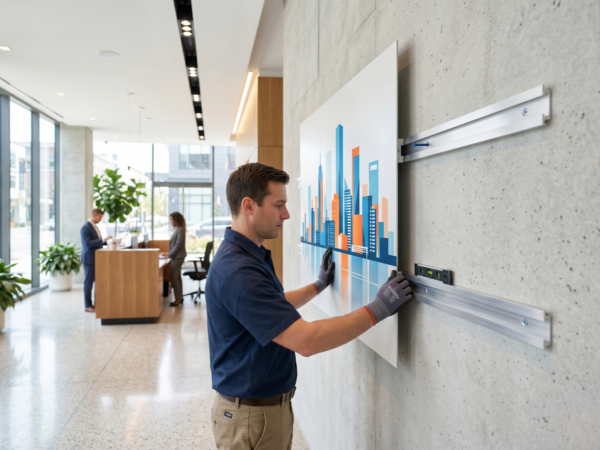
French cleats — commonly called Z-bars in commercial fabrication — remain the gold standard for mid- and large-format metal prints.
The mechanism is deceptively simple.
Two interlocking aluminum rails are cut at matching bevels, usually at:45∘
or90∘
One rail mounts to the wall. The other mounts to the back of the print.
Once engaged, gravity locks the system together.
Here’s why this system dominates commercial installations:
Instead of concentrating force at a single hook point, French cleats distribute the load horizontally across the entire rail length.
That dramatically reduces substrate shear stress.
I’ve seen older drywall installations survive surprisingly heavy lobby artwork simply because the cleat distributed force properly across multiple anchors.
That’s the engineering advantage.
Key Benefits
- Superior weight distribution
- Self-leveling alignment
- Hidden hardware presentation
- Reduced vibration movement
- High theft resistance with T-screw integration
- Excellent compatibility with drywall, masonry, and concrete
Typical Commercial Applications
- Corporate lobby statement pieces
- Hospital installations
- Educational facilities
- Large-format branding walls
- Hospitality corridors
System 2: Standoff Mounting Systems (The Architectural Aesthetic)
If French cleats are about structural efficiency, standoff systems are about visual drama.
These systems use pre-drilled holes — typically:3/8″
in diameter — positioned at panel corners.
Each assembly includes:
- Wall-mounted barrel
- Threaded stud
- Decorative cap
The print physically floats away from the wall, creating a gap usually between:1/4″ to 2″
That shadow line creates dimensionality that architects love in minimalist interiors.
This surprises people every time:
The visual effect isn’t the main benefit.
Mechanical stability is.
In busy commercial spaces, standoffs are extremely difficult to accidentally dislodge. That matters in hotel corridors, universities, and public-facing offices where artwork gets bumped constantly.
Best Use Cases
- Luxury hospitality
- Wayfinding systems
- Executive boardrooms
- Corporate branding walls
- Modern industrial interiors
System 3: Gallery Track and Cable Hanging Systems (For Dynamic Spaces)
Gallery track systems like STAS and Artiteq dominate environments where displays rotate frequently.
These systems mount an aluminum track at the wall-ceiling junction.
From that track hang:
- Steel cables
- Perlon cords
- Adjustable locking hooks
The operational advantage is enormous.
Facilities teams can completely reconfigure exhibitions without drilling new holes or patching drywall every month.
Museums figured this out years ago. Corporate campuses are finally catching up.
The Forward-Tipping Problem
Large frameless metal prints often tilt forward when suspended from cable systems.
Why?
Center of gravity.
Thin aluminum panels lack rear structural depth, so the hanging point creates forward leverage.
Professional installers solve this with:
- Full-height structural subframes
- Cable attachments within 1–2 inches of the top edge
- Bottom felt spacers
- Rear balancing systems
Without those adjustments, even expensive installations end up looking crooked.
Lower-Tier Systems (Used Selectively)
Adhesive Hangers / Command Strips
Useful only for:
- Temporary marketing
- Pop-up exhibitions
- Lightweight seasonal displays
Commercial installers generally avoid these beyond:10 lbs
because adhesive creep becomes a serious long-term risk.
Direct Magnet / Keyhole Plates
These systems work in highly dynamic spaces where displays change constantly.
However, they depend heavily on:
- Magnetic pull force
- Steel compatibility
- Ferromagnetic alignment
They’re rarely used for permanent large-format installations.
The Science of Shear Strength and Adhesives
This is where installations either succeed quietly for 10 years…
or fail spectacularly.
When drilling through the face of a metal print isn’t possible, installers rely on structural adhesive systems to bond hanging frames to the rear surface.
That introduces a pure engineering problem:
Shear force.
The governing equation is:
τ=AV
Where:
- V = vertical load
- A = adhesive contact area
Commercial systems must also maintain a minimum safety factor:
FoS=τappliedτultimate≥2.5
That 2.5x factor-of-safety requirement is non-negotiable in professional environments.
ChromaLuxe 4-Way French Cleat System Case Study
The ChromaLuxe 4-Way Cleat System uses engineered PVC combined with commercial-grade rubber-based PSA adhesive technology.
This is not ordinary double-sided tape.
Rubber-based PSAs chemically bond more aggressively to aluminum than standard acrylic tapes.
That difference becomes massive at scale.
For example:
A:40″×60″
aluminum panel with:164.0 in2
of adhesive area can support:885.6 lbs
at a 2.5x FoS.
The exact same footprint on acrylic drops to:524.8 lbs
because acrylic surfaces provide weaker chemical adhesion.
That’s a huge engineering distinction.
Why Adhesive-Only Mounts Fail Over Time
Here’s the trap nobody talks about:
Most adhesive systems don’t fail immediately.
They fail slowly.
Heat cycles, humidity fluctuations, and constant gravitational load cause polymer creep inside the adhesive layer.
Eventually, microscopic separation forms.
Then comes delamination.
Then the air gap grows.
Then the panel falls.
I’ve seen this happen in corporate corridors where cheap foam tape was used instead of structural PSA systems.
The correct solution is a hybrid methodology:
- Structural epoxy
- Rigid rear subframe
- Commercial-grade PSA
- Mechanical hanging integration
Not one or the other.
Both.
Critical Adhesive Installation Rules
Professional installers follow strict preparation protocols.
Skipping these steps is where projects get burned.
Step 1: Degrease the Surface
Use:99%
isopropyl alcohol.
Any oils, dust, residue, or processing contamination reduce bonding surface area.
Step 2: Apply Pressure Correctly
Use a rubber hand roller across the full adhesive perimeter to activate polymer wet-out.
That pressure matters more than most installers realize.
Step 3: Respect the Temperature Window
Application temperature must remain above:50∘F
or:10∘C
Below that threshold, polymer flow becomes unreliable.
Step 4: Allow Full Cure Time
Minimum cure period:24 hours
before hanging.
No shortcuts.
Adapting to Commercial Wall Substrates
The wall matters just as much as the artwork.
Different substrates require completely different anchoring strategies.
Masonry and Cinder Block Installations
Modern offices, warehouses, universities, and mixed-use developments often use concrete masonry walls.
Standard drill bits fail quickly here.
Commercial installers instead use:
- Carbide-tipped masonry bits
- Tapcon anchors
- High-tensile masonry fasteners
This is where inexperienced crews usually get into trouble.
They underestimate anchor pull-out forces.
That mistake gets expensive fast.
Historic Plaster and Lath Walls
Older buildings create a different challenge.
Plaster cracks easily under concentrated load pressure.
Professional installers solve this by mounting a painted:1×4
wood backer board directly into studs first.
The hanging system then attaches to the backer board.
The weight distributes evenly across the wall structure instead of crushing localized plaster zones.
Simple idea.
Huge difference.
Real-World Logistics and B2B Operational Challenges
Commercial fabrication problems rarely show up in manufacturer brochures.
They show up at 2 AM during installation week.
The Delamination Warning
High-tack transfer tape can destroy mounted panels during production.
This happens constantly in high-volume print shops.
Technicians apply alignment tape to painted MDF or faux-wood backings…
then peel the finish straight off during removal.
The fix is straightforward:
- Use low-tack masking for temporary guides
- Apply permanent adhesive only to raw aluminum or uncontaminated polymer cores
Small detail.
Massive operational impact.
High-Volume Shipping and Packaging Engineering
Large-format metal prints are surprisingly vulnerable during transit.
Bent corners and micro-surface scratches ruin expensive installations.
High-end labs like White House Custom Colour have developed sophisticated crate systems to prevent this.
One panorama installation used:
- Custom suspended wooden frame
- Foam isolation inserts
- Internal floating structure
- 16 heavy-duty wood screws
The print literally floated inside the crate to eliminate transit movement.
That’s commercial logistics engineering — not standard packaging.
Replacement Policies Matter More Than People Think
This catches facilities teams off guard.
Top-tier print labs often immediately replace damaged commercial panels to keep installation schedules alive.
For example:
If a:40″×50″
panel arrives with damaged pre-installed hangers, premium labs may overnight a replacement while allowing the client to retain the original.
That policy alone can save hotel openings or corporate launch deadlines.
Strategic Guidelines for Long-Term Commercial Curation
A successful installation isn’t finished after mounting.
Long-term operational planning matters just as much.
1. Professional Adhesive Curing Protocols
Every adhesive-mounted subframe should follow:
- 99% isopropyl degreasing
- Full perimeter roller pressure
- 24-hour cure period
- Temperature above 50°F
Skipping curing windows is one of the biggest hidden failure causes in commercial installs.
2. Standardize Security Hardware
High-traffic environments require theft-resistant systems.
Professional installers typically specify:
- Interlocking aluminum French cleats
- Bottom-mounted T-head security screws
This combination prevents accidental lift-off while keeping hardware visually hidden.
3. Conduct Lighting and Reflection Audits
Gloss metal prints behave like mirrors under direct light.
That creates intense specular reflection in:
- Corporate boardrooms
- Window-heavy lobbies
- Hospitality interiors
The solution is usually one of two approaches:
Matte or Satin Finishes
These diffuse incoming light and reduce glare dramatically.
Bonded Dibond Composite Systems
Instead of dye-sublimation, high-resolution photographic prints mount directly onto:3mm
Dibond panels with satin non-glare laminate.
This also minimizes microscopic color shifting sometimes associated with heat sublimation.
4. Establish Maintenance Protocols
Commercial cleaning crews accidentally damage artwork more often than theft or impact.
Metal prints should only be cleaned using:
- Dry microfiber cloths
- Non-abrasive streak-free glass cleaner
Never:
- Paper towels
- Abrasive pads
- Harsh chemical solvents
Facilities teams should also perform:
- Semi-annual alignment inspections
- Anchor checks
- Security screw verification
That maintenance schedule dramatically extends installation lifespan.
Expert FAQ: How to Hang Metal Prints
How can flatbed UV printers prevent magnetic drift on thin metal sheets?
Some UV flatbed systems use internal electromagnets beneath the print bed. Thin ferromagnetic panels can shift during printing as magnetic forces pull the material. Commercial print labs avoid this by specifying non-ferromagnetic aluminum alloys like 3003 or 5052 grade aluminum. When magnetic substrates are required, edge clamps and vacuum bed systems stabilize the sheet mechanically.
Why do adhesive-only mounting systems fail over time?
Adhesive creep occurs when constant gravitational force slowly deforms the polymer layer. Heat and humidity accelerate this process, eventually causing delamination and air gaps. Commercial installers solve this by combining structural PSA adhesives with rigid subframes and mechanical hanging systems instead of relying on foam tape alone.
How do high-volume print labs align mounting hangers consistently?
Professional fabrication facilities use custom-machined acrylic or aluminum alignment jigs. These hold panels square while centering the mounting frame precisely, typically 2–4 inches below the top edge. This prevents crooked installations and improves repeatability during high-volume production runs.
How should glare and color shifting be managed in bright interiors?
Bright commercial environments amplify specular reflection on gloss aluminum prints. Matte White and Satin Clear finishes diffuse light and reduce glare significantly. For high-detail photography, many designers instead specify bonded Dibond composite panels with non-glare satin laminates to preserve sharpness and minimize sublimation-related color drift.
How can installers stop heavy metal prints from tipping forward on cable systems?
Forward tipping occurs when the hanging point sits too far below the panel’s center of gravity. Installers solve this using full-height structural subframes, cable attachments within 1–2 inches of the top edge, and bottom felt spacers that keep the artwork parallel to the wall.
Final Thoughts: Commercial Metal Prints Are Architectural Systems
Here’s the truth.
The moment metal artwork enters a commercial environment, it stops being “decor.”
It becomes part of the built environment.
That means installation decisions affect:
- Safety
- Maintenance costs
- Visual consistency
- Long-term durability
- Liability exposure
- Operational efficiency
The companies getting this right treat mounting hardware with the same seriousness they treat lighting plans or millwork specifications.
And honestly… they should.
A properly engineered metal print installation can look flawless for a decade.
A poorly engineered one may fail before the warranty paperwork is even filed.
Request a Commercial Installation Consultation
If you’re planning:
- Corporate lobby installations
- Hospitality art programs
- Healthcare wayfinding systems
- Educational gallery walls
- Large-format architectural metal print deployments
work with installers and fabrication partners who understand both aesthetics and structural engineering.
Because in commercial environments, the hanging system is just as important as the artwork itself.
About the Author
Felix Lee
CEO at Forgecise
Felix Lee specializes in commercial visual systems, architectural display engineering, and B2B installation strategy for modern built environments. His work focuses on the intersection of durable materials, operational efficiency, and design-forward commercial presentation systems.
Last Updated: May 18, 2026
External Sources
- Google Search Central AI Features Documentation
- ChromaLuxe Official Technical Resources
- Artiteq Hanging Systems
- STAS Picture Hanging Systems
Accessed: May 18, 2026