









Author: Felix Lee, CEO at Forgecise
Date: May 15, 2026
Category: Industrial Additive Manufacturing / Material Science
The Industrialization of Additive Manufacturing
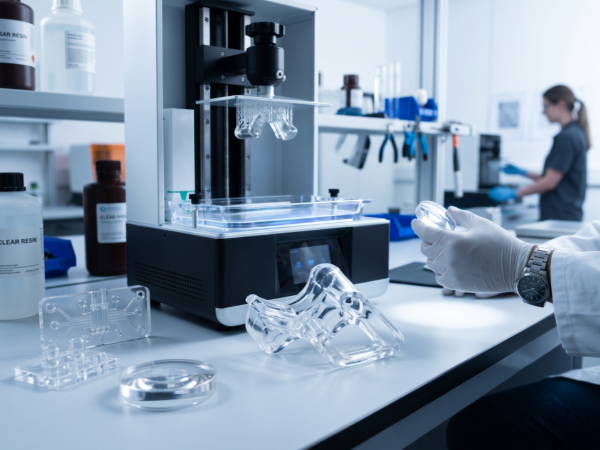
Additive manufacturing (AM) is transitioning from a prototyping tool to a method for scalable industrial production. Clear resin—used in high-resolution vat photopolymerization processes—has become a necessary material for B2B sectors, including medical diagnostics, precision optics, and fluidics.
The global 3D printing market now exceeds a $29 billion valuation. This growth drives new polymer chemistry. Manufacturers are synthesizing reactive urethane photopolymers that avoid historical brittleness and yellowing. This shift allows B2B supply chains to operate with greater flexibility and speed.
1. Printing Technologies for Transparent Media
Hardware platforms dictate clear resin performance. In 2026, the market divides into four distinct technologies:
| Technology | Mechanism | Layer Precision | Primary B2B Advantage |
| SLA | UV laser tracing | 25–100 μm | Superior surface finish for lenses. |
| DLP | UV projector | 35–100 μm | High throughput for small batches. |
| MSLA (LCD) | LED array | 10–50 μm | Cost-effective scaling. |
| PµSL | Micro-projection | 2–25 μm | Critical for microfluidics. |
Industrial-grade SLA systems hitting 0.1 mm feature sizes are now standard for precision industries. Newer hardware ecosystems, like the Formlabs Form 4, have tripled print speeds, lowering the barrier to entry for high-volume B2B production.
2. Engineering-Grade Clear Resins
Modern clear resins match the mechanical performance of traditional plastics like Polycarbonate (PC) and Acrylonitrile Butadiene Styrene (ABS). They withstand physical stress, thermal shifts, and chemical exposure while maintaining UV stability.
Comparative Mechanical Performance (2026 Benchmarks)
| Mechanical Property | Formlabs Clear V5 | BASF Ultracur3D ST 45 | Liqcreate Clear Impact |
| Tensile Strength | 40.4–53.0 MPa | 60.0 MPa | 47.0 MPa |
| Flexural Modulus | 1,701–2,710 MPa | 2,400 MPa | 1,700 MPa |
| Elongation at Break | 9% – 79% | 25% | 15% – 25% |
| Izod Impact | 27–42 J/m | No Measurement | 28 J/m |
| Heat Deflection | 66–76 °C | 116 °C (RG series) | 51 °C |
| Light Transmission | 85% (@ 2mm) | High | Perfectly Transparent |
Materials like BASF ST 45 handle high stress for functional prototypes like automotive connectors. Formlabs Tough 1500 Resin V2 provides stiffness and ductility, allowing engineers to print compliant mechanisms—such as snap-fit enclosures—without the parts shattering.
3. Medical and Healthcare Applications
The medical 3D printing sector will reach $3.65 billion by late 2026. Clear resins give surgeons unobstructed visibility. During chest wall reconstructions, 3D-printed guides made from BioMed Clear Resin let surgeons execute osteotomies based on patient-specific CT or MRI data.
| Application | Material Requirement | Technology | Outcome |
| Surgical Guides | Autoclavable, Class I/IIa | SLA | Reduced OR time. |
| Anatomical Models | Multi-material | PolyJet / SLA | Better surgical planning. |
| Fluidic Devices | Transparent micro-channels | PµSL / SLA | Precision drug testing. |
| Dental Aligners | High detail | MSLA / DLP | Scalable customization. |
Medical-grade clear resins must meet ISO 10993 standards and survive steam sterilization at 121°C for 30 minutes. B2B buyers must avoid the “Broker Trap”—online networks that route medical components through the same machines used for industrial oil pumps. Secure your supply chain by requiring direct-to-factory, ISO 13485-compliant manufacturing.
4. Post-Processing for Optical Clarity
Parts emerge from the printer looking hazy due to layer boundaries. Glass-like transparency requires a specific finishing workflow.
| Finishing Level | Process | Visual Clarity | Application |
| Standard | Support removal + wash | Hazy | Geometric assessment |
| Sandblasted | Light glass bead blasting | Frosted | Light diffusion |
| Lacquered | Acrylic/Urethane spray | High clarity | Complex prototypes |
| Polished | Sanding + polishing + coat | Optically Clear | Lenses / light pipes |
Professionals use 3M Headlight Restoration Kits and automotive-grade acrylic urethane clearcoats to level the surface. Resin dipping is another method. Dipping a cleaned part into fresh clear resin and using Nitrogen UV-curing prevents the oxygen inhibition layer, creating a hard, smooth surface.
5. 3D Printing vs. Injection Molding Economics
The breakeven point strongly favors AM for low-to-medium volumes.
| Metric | 3D Printing (Resin) | Injection Molding |
| Upfront Capital | $0 (No tooling) | $5,000 – $50,000+ |
| Lead Time | Hours / Days | 2 – 12 Weeks |
| Cost (100 units) | $15.00 | $52.00 (Amortized) |
| Cost (1,000 units) | $15.00 (Constant) | $7.00 (Amortized) |
| Design Flexibility | Unlimited | Expensive mold rework |
The B2B decision zone typically sits between 200 and 1,000 units. High-speed printers like the Form 4L push this breakeven point to 13,000 units. Many companies also use clear vacuum casting—creating a silicone mold from a 3D-printed master model—to produce bubble-free polyurethane parts that mimic Polycarbonate.
6. Case Study: Fiber Optic Polishing
Engineers recently used SLA clear resin to build transparent internal components for fiber optic polishing machines. Visual validation of the fiber alignment reduced prototyping cycles by 40%, moving the project to production in weeks.
7. Future Trends: 2026–2030
- Multi-Material Printing: Engineers can now print clear light pipes and opaque structural housings in a single job.
- AI Quality Control: Smart printers use integrated cameras and machine learning to check transparency and layer quality in real time.
- Sustainable Feedstocks: Chemical recycling now transforms automotive shredder residues into high-quality circular raw materials for new resins.
8. B2B Industry FAQ: 3D Printer Clear Resin
Q1: How do you manage internal voids and micro-bubbles in optical lenses?
A: Adjust your infill density and print timing. Use 100% infill and a 1–2 second “light-off delay” to let the resin settle completely before the next layer cures. Vacuum degassing the resin before printing also removes trapped air.
Q2: What are the VOC mitigation and PPE requirements in high-volume sites?
A: Standard filters fall short for continuous B2B production. While US OV/P100 or European A2/P3 filters work for short exposure, high-volume sites must install active charcoal filtration and dedicated HVAC systems to meet 2026 safety standards.
Q3: Can clear resins be mixed with flexible additives for industrial gaskets?
A: Yes, mixing is common for impact resistance. B2B operators often use a 70/30 ratio of clear resin to a flexible additive. Keep in mind that this mixture alters the material’s refractive index and shrinkage rates, requiring you to recalibrate the print files.
Q4: How do you ensure dimensional stability in large, thin-walled clear housings?
A: Print orientation and mechanical lift speeds control sagging. Print the parts vertically with a minimal angle and use slow lift speeds (1–3 mm/s) to reduce the suction forces against the FEP film.
Q5: What is the most effective way to recover “cloudy” resin and extend vat life?
A: Automated mechanical filtering prevents resin degradation. Filter the resin through a 190-micron mesh after every print job. This removes the microscopic “gel” particles that cause clouding and extends the standard 24-month shelf life.