







Author: Felix, CEO at Forgecise
Date: May 13, 2026
Category: Industrial Safety / Additive Manufacturing
- The Chemical Architecture: Why the Resin is Toxic
- Toxicological Pathways: Skin, Breath, and Long-Term Damage
- The Marketing Deception: "Green" Resins Are Not Safe
- Occupational Health and Safety: 2026 ISO, OSHA, and NIOSH Rules
- B2B Case Studies: Real Safety Successes and Failures
- The 2026 Industrial Safety Checklist
- FAQ: Frequently Asked Questions About Resin Toxicity
- The Bottom Line for B2B Managers
Disclaimer: This article provides general information. For medical advice or occupational regulatory compliance, consult a certified professional.
Additive manufacturing, specifically vat photopolymerization (SLA, DLP, MSLA), has moved straight from prototyping labs to the industrial production floor. This shift relies heavily on photopolymer resin. But as businesses scale their print farms, procurement officers and facility managers face a serious question: is 3D printer resin toxic?
Yes. In its liquid and partially cured states, 3D printer resin is a highly reactive and hazardous chemical.
Below, we break down the exact molecular risks, clear up marketing myths about “safe” eco-resins, and outline the 2026 occupational health protocols your facility must follow.
The Chemical Architecture: Why the Resin is Toxic
To understand the danger, we have to look at how the resin works. Resins rely on a light-triggered radical polymerization process. When UV light (usually 385–405 nm) hits the resin, photoinitiators break down into free radicals. This starts a chain reaction:
$PI + h\nu \rightarrow R^\bullet$
(Here, $PI$ is the photoinitiator and $R^\bullet$ is the reactive radical species).
These radicals attack carbon-carbon double bonds in acrylate monomers, creating a solid plastic. However, this process is never perfect. In a typical industrial print, 20% to 30% of the resin stays unpolymerized inside the printed object. This raw liquid remains highly hazardous.
Here is what makes up the chemical mix:
- Acrylate Monomers (Reactive Base): These molecules have a low molecular weight. They can easily pass through the human skin’s lipid bilayer, causing severe irritation and eye damage.
- Methacrylates (Cross-linking Agent): Very common in dental and medical resins. They cause allergic contact dermatitis and mucosal irritation.
- Photoinitiators (e.g., TPO, BAPO): Curing catalysts that carry risks for targeted organ toxicity and suspected reproductive harm.
- Reactive Diluents (e.g., Styrene): Used to control how the liquid flows. They release high levels of Volatile Organic Compounds (VOCs) and carry suspected cancer risks.
- ACMO (4-Acryloylmorpholine): Added to make prints print faster and stronger. It is a severe skin sensitizer strictly regulated by the EPA Significant New Use Rule (SNUR).
- Nanofillers / Pigments: Found in heavy-duty engineering resins. They create Ultrafine Particles (UFPs) that operators can easily inhale.
Toxicological Pathways: Skin, Breath, and Long-Term Damage
Dermal Exposure and Permanent Sensitization
The worst risk of handling resin is sensitization. Standard irritants cause a temporary rash. Acrylates, however, trigger Type IV hypersensitivity. If you get small amounts of resin on your skin repeatedly, your immune system eventually learns to treat the chemical as a foreign disease. This creates a permanent, lifelong allergy.
Take a documented case from 2024: A dental technician handled methacrylate resins for months with minimal safety gear. The allergy hit suddenly. They developed such severe contact dermatitis that they could no longer work near any standard dental materials. Once a worker hits this threshold, even a tiny drop of resin triggers a major chemical burn.
Inhaling VOCs and Ultrafine Particles (UFPs)
Printers generate heat and UV energy, which releases heavy vapors. Studies from 2024 and 2025 show that emissions spike right when the build plate lifts out of the liquid, exposing a huge surface area of wet resin.
In rooms with poor airflow, Total VOC (TVOC) levels can hit 128,000 $\mu g/m^3$. Workers breathe in formaldehyde, styrene, and isobornyl acrylate, which causes long-term lung damage.
At the same time, the process creates UFPs—particles smaller than 100 nanometers. These are small enough to enter the deep alveolar region of the lungs, cross the blood-brain barrier, and trigger chronic conditions like COPD or pulmonary fibrosis.
The Marketing Deception: “Green” Resins Are Not Safe
Many buyers purchase “water-washable” or “plant-based” resins thinking they are safe for a normal office. Chemical tests prove this is false. Manufacturers admit they cannot build a functional 3D printing resin without hazardous chemicals.
- Water-Washable Resins: These resins use surfactants so you can wash them with water instead of alcohol (IPA). But the chemicals inside (like ACMO) are just as toxic. Environmentally, they are a disaster. It takes up to 5 million liters of water to dilute a single liter of resin to safe levels. Never pour resin wash water down a drain.
- Bio-Based / Plant-Based Resins: These use natural sources like soybean oil. While better for carbon emissions, the final liquid still relies on epoxidized soybean oil (a known skin irritant) and toxic photoinitiators. They are not biodegradable while in liquid form.
- Biocompatible (Medical) Resins: Yes, Formlabs BioMed resins are built in ISO Class 8 cleanrooms. But they are only safe after strict washing and high-heat UV curing. When liquid, biocompatible resin burns the skin just like standard resin.
Occupational Health and Safety: 2026 ISO, OSHA, and NIOSH Rules
Regulatory bodies now treat 3D printing labs as heavy industrial sites.
- ISO/ASTM Standards: Sites must follow ISO/ASTM 52920:2023 to ensure environmental, health, and safety (EHS) compliance, including strict climate control. Teams should use terms defined in ISO/ASTM 52900 and test machine emissions using ANSI/CAN/UL 2904.
- OSHA 2026 Rules: OSHA aggressively checks the Hazard Communication standard (29 CFR 1910.1200). Managers must keep Safety Data Sheets (SDS) ready and accurately label all secondary containers. Facilities must track respiratory sensitization injuries on the OSHA 300 Log. A new heat injury rule also forces managers to watch for machine heat, which makes VOC off-gassing worse.
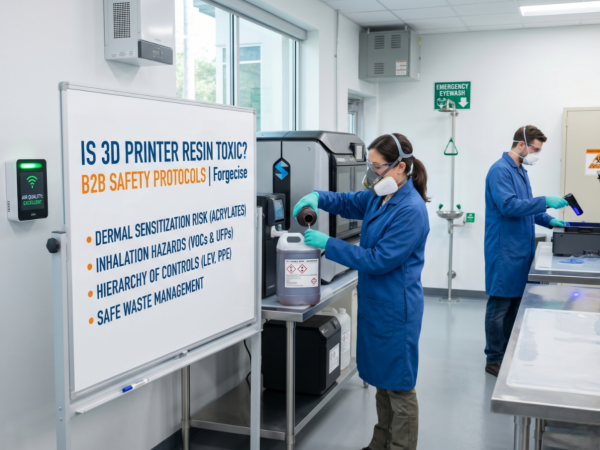
- NIOSH “Hierarchy of Controls”: Wearing a mask is the last line of defense. NIOSH demands engineering fixes first. Rooms need 6 to 10 Air Changes per Hour (ACH), negative air pressure, and Local Exhaust Ventilation (LEV) built directly over the printers.
B2B Case Studies: Real Safety Successes and Failures
Dental Lab Success: Prime Dental Lab grew safely by dropping open-vat machines and buying enclosed, auto-dispensing systems like the Stratasys J5 DentaJet. By cutting out manual pouring, they reduced biological risks for their staff while improving print accuracy.
Medical Liability: Hospital labs printing surgical guides report serious issues when staff rush the washing process. If the resin is not cleaned with IPA and cured in a high-intensity oven, “leachable” monomers remain on the print. This causes tissue inflammation in patients and opens the hospital to massive lawsuits.
Frontline Reports (May 2026):
- Eye Damage: A worker on Reddit reported permanent cornea burns. A resin support snapped, splashing liquid into their eye, and the lab did not have a plumbed eyewash station nearby.
- Business Closure: A printing business owner developed such a severe acrylate allergy that they could not walk into their own shop, forcing them to sell the company.
- Carpet Risks: Liquid resin dropped on a carpet will never cure without direct UV light. It stays toxic and off-gases into the office air for months.
The 2026 Industrial Safety Checklist
To run a safe print farm, put this exact framework in place:
Workspace Engineering
- Floors: Install hard, non-porous floors like epoxy or vinyl. No carpets. Never sweep with a dry broom, as it kicks up toxic UFPs.
- Spill Control: Put silicone mats or stainless trays under all machines. Keep a spill kit ready with absorbents, IPA, and hazardous waste bags.
- Eyewash: Install plumbed eyewash stations within a 10-second walk (roughly 55 feet) of the resin handling zone. Test them every week.
Personal Protective Equipment (PPE)
- Hands: Wear two layers of Nitrile or Neoprene gloves ($\ge$ 6-mil thick). Throw them away after a single use.
- Breath: Wear a half-mask respirator with P100/OV cartridges whenever opening a printer lid.
- Eyes & Body: Wear indirect-vent chemical goggles over your normal glasses. Wear disposable lab coats to stop resin from getting into your car or home.
Air and Waste Management
- Airflow: Run active VOC sensors. Use Heat-Recovery Ventilators (HRVs) to bring in fresh outside air without changing the room temperature.
- Liquid Waste: Treat all liquid—even water-washable run-off—as hazardous chemical waste. Store it in HDPE or glass jugs. High-volume labs should buy a solvent distiller to recycle dirty IPA.
- Solid Waste: A 2024 study showed resin microparticles destroy the health of soil insects. You must put all dirty paper towels, gloves, and broken supports inside a UV chamber. Cure them until they are “bone dry” before throwing them in the trash.
FAQ: Frequently Asked Questions About Resin Toxicity
Q1: Is an enclosed printer safe to use in a standard office with central HVAC?
No. Standard office air systems (2-4 ACH) cannot clear out persistent VOCs and UFPs. Worse, the central HVAC will push those toxic vapors into other rooms. Yale and Stanford EHS guidelines state you must use a dedicated lab with 6+ ACH and exhaust that vents directly outside.
Q2: Can “bio-based” resin be disposed of in standard municipal trash?
No. Liquid bio-based resin is chemical waste that kills aquatic life. You can only put fully cured, rock-solid resin in the regular trash. You must hire a licensed waste company to remove any liquid residue.
Q3: What is the actual breakthrough time for nitrile gloves with 3D resins?
As fast as 3 to 9 minutes. Studies (like Lönnroth et al.) show small monomers like HEMA burn right through standard nitrile gloves in minutes. You need industrial gloves at least 6-mil thick, and you must change them every 15 minutes while working.
Q4: How effective are HEPA/Carbon filters for resin odors vs. toxic VOCs?
Not effective enough. Small carbon filters might hide the smell, but toxic VOCs are often completely odorless. These filters fill up and stop working in just a few weeks. You must use them only as a backup to real, outdoor-vented exhaust.
Q5: What are the long-term liability risks for B2B businesses ignoring PPE?
Massive legal and financial ruin. Sensitization allergies are permanent. If you fail to protect your staff, you face private lawsuits and huge insurance hikes. Under 2026 OSHA rules, fines for “Willful” safety violations can easily pass $150,000 per incident.
The Bottom Line for B2B Managers
Treat 3D printer resin exactly like a heavily regulated industrial chemical. Audit your air quality, maintain your SDS binder (29 CFR 1910.1200), train your staff on the permanent dangers of sensitization, and buy enclosed, automated hardware. Spending money on ventilation and proper PPE is far cheaper than losing your best workers to an allergy or paying a six-figure OSHA fine.