




By Felix, CEO at Forgecise
Published: May 14, 2026
Vat photopolymerization (VPP) has moved from a simple prototyping tool to a core industrial manufacturing method. This shift means we need to look closely at every step in the 3D printing process. People often focus on exposure settings and hardware precision. But the post-processing phase is just as vital and frequently misunderstood.
For B2B operators, knowing exactly how long to wash resin prints goes beyond surface looks. It guarantees accurate dimensions, stable materials, and safe products.
The Science of Resin Removal
The goal of washing is simple: remove all liquid, uncured resin from the printed part. A solvent must dissolve the resin without hurting the cured plastic underneath. Different resins need different solvents, making this a careful balancing act.
Solvent Options and Saturation Limits
Isopropyl Alcohol (IPA) at 90% or higher is the industry standard because it dissolves many resin types quickly. However, safety and facility rules often push B2B labs toward alternatives. Tripropylene Glycol Monomethyl Ether (TPM) and Propylene Glycol Diacetate (PGDA) offer safer, less-flammable options that still protect the material.
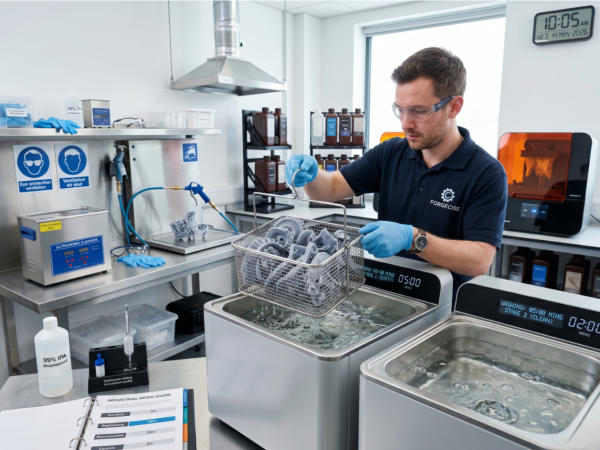
The mechanical action matters, too. Automated systems like the Form Wash use impellers to create a turbulent flow. This pushes the solvent deep into tiny channels.
You also need to watch your solvent quality. When resin makes up more than 5% to 10% of the bath, the solvent stops cleaning well. Parts washed in dirty solvent turn sticky and cloudy, meaning it is time to replace the liquid or switch to a two-stage wash.
Managing VOCs and Safety
Washing creates high levels of Total Volatile Organic Compounds (TVOCs). The printing process might only release 0.1 mg/m³ of TVOCs, but the IPA washing stage can spike concentrations to 36.8 mg/m³. Industrial post-processing labs require strong HVAC systems to handle this air exchange and meet occupational safety standards.
How Long to Wash Specific Resin Materials
You must balance your timing. Wash for too short a time, and you leave a sticky resin film. Wash for too long, and the solvent absorbs into the part, causing it to swell and crack.
Based on technical data from companies like Formlabs and Anycubic, here are the professional material-specific washing times:
| Resin Category | Material Type | Recommended IPA Wash Time | Strategic Notes |
| Standard | Clear V5, Grey V5, White V5 | 5 Minutes | Built for speed; low risk of damage. |
| High Precision | Model Resin, Draft Resin | 10 Minutes | Needs more time to clear tight tolerances. |
| Engineering | Durable Resin V2/V2.1 | 20 Minutes | High risk of swelling if you exceed this limit. |
| Engineering | Rigid 10K Resin | 10 + 10 Minutes | Two-stage wash to remove glass particles. |
| Elastic/Flexible | Elastic 50A, Flexible 80A | 10 + 10 Minutes | Highly absorbent; needs fresh solvent in stage two. |
| High Temp | High Temp Resin | 5 Minutes | Structural damage happens if left past 6 minutes. |
| Casting/Wax | Castable Wax 40 | 10 Minutes | 5 mins primary, then rinse in fresh solvent. |
| Biocompatible | BioMed Clear/Amber | Check Manual | Follow strict FDA/ISO guidelines for times. |
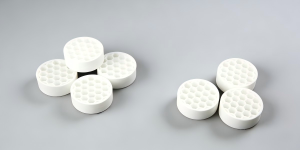
| Ceramic | Alumina 4N Resin | 2 Minutes | IPA Prohibited. Use Ceramic Wash Solution only. |
Key Takeaway: Engineering-grade materials demand careful timing. If you leave Durable Resin or Elastic 50A in the wash past the 20-minute mark, the part will swell and never return to its correct dimensions.
Size-Based Rules for Service Bureaus
Service bureaus dealing with many different part sizes can scale their washing times based on volume and surface area.
| Part Classification | Max Dimensions (mm) | IPA Wash Time | Water-Washable Resin Wash Time |
| Small Component | ≤ 64 x 40 x 80 | ≤ 2 Minutes | 10 Minutes |
| Medium Prototype | 96 x 60 x 122 | 2 Minutes | 10–12 Minutes |
| Large Industrial Part | 192 x 120 x 245 | 2–4 Minutes | 10–12 Minutes |
The Water-Washable Trade-Off
Water-washable resins seem safer, but they take five to six times longer to wash than standard resins. Water also evaporates slowly. If you cure a water-washable part while it is still damp, it will crack internally and turn chalky.
Workflow Integration & Best Practices
Automation fixes the post-processing bottleneck. Companies like Genera and Supernova build closed-loop systems that combine printing, washing, and curing. This removes human error. The Supernova VLM platform uses specific cleaning agents and heat to wash thick resins, keeping the process capability index (CpK) above 1.0. Platforms like Xometry rely on this consistency to lower the cost per part.
The “Dirty vs. Clean” 2-Stage Wash
Many professionals use a two-stage wash to save thousands of dollars on solvent:
- Stage 1 (Dirty Wash): Agitate the part in used IPA to strip away 80-90% of the liquid resin.
- Stage 2 (Clean Wash): Move the part to fresh, clean IPA for a final 2-minute rinse.
Support Removal: Before or After Washing?
Remove your supports after the first wash but before the UV cure.
Drop the washed, uncured part into warm water (60°C) for 30 seconds. The heat softens the material, letting you peel the supports off easily. If you wait until after the final UV cure, the plastic becomes brittle, and the supports will shatter and leave deep craters.
FAQ: Expert Troubleshooting
1. How long can resin safely remain in the printer vat?
Short Answer: A few days to weeks, as long as you block all UV light and dust.
If you use engineering resins with ceramic or glass fillers, the heavy particles will settle at the bottom. You must use an automated stirrer or manually mix the resin before starting a new print to keep the fillers even.
2. How can “white spots” or “blooming” be eliminated from the part surface?
Short Answer: Make sure parts are completely dry and use clean IPA.
Blooming happens when you cure a part that is still wet, or if your IPA contains more than 10% dissolved resin. Use compressed air to dry the part completely and keep your final rinse stage perfectly clean.
3. What are the specific safety requirements for an industrial washing station?
Short Answer: You need HVAC ventilation, PPE, and fire suppression.
IPA flashes at just 12°C. You must ground your washing stations to stop static sparks and keep them in a dedicated wet lab. Many B2B operators switch to non-flammable TPM solvents to meet insurance rules.
4. Is it better to use a dedicated washing station or an ultrasonic cleaner?
Short Answer: Use a dedicated turbine-driven washing station.
Ultrasonic cleaners create high-frequency vibrations that generate heat and sparks. Using them with flammable solvents like IPA creates a massive fire hazard.
5. How should resin-saturated solvent be managed to minimize environmental impact?
Short Answer: Use UV light to cure the dissolved resin into a solid sludge, then filter it.
This process, combined with distillation, lets you dispose of the sludge as solid plastic waste. You can then reuse the remaining solvent for your “dirty” wash stage.
ISO/ASTM 52900 and Final Thoughts for B2B Setup
Medical and aerospace sectors demand strict adherence to ISO/ASTM 52900. You must log wash times and solvent types exactly as the manufacturer states to validate biocompatibility. Automated machines record these wash reports via WiFi to meet ISO 9001 standards.
To run a professional VPP workflow, set up an automated two-stage wash, stick strictly to the manufacturer’s washing times, and focus on facility safety. Treat your washing stage as a precise science, and your parts will hit the highest standards of durability and accuracy.