







Motorsport budgets are decided per race weekend, not per year. That changes which parts make sense to print. A component that saves two kilograms and three weeks of lead time pays back even at a high unit price; a cheap bracket that behaves exactly like the machined version does not.
Table of contents
Why motorsport adopted AM first
Additive manufacturing reached race teams before it reached road cars for three structural reasons, none of them about the technology being new.
First, volumes are tiny and classes are loose. Many categories have no homologation requirement for a given component, so a team can change a part between events without a type-approval process. Second, geometry is usually the binding constraint — a manifold has to route through a space that no casting or welded assembly will fit into. Third, the iteration loop is measured in days. A design change that costs nothing in CAD but everything in tooling is exactly the case where printing wins.
Part families that pay back first
| Part family | Process | Why it pays back | Watch point |
|---|---|---|---|
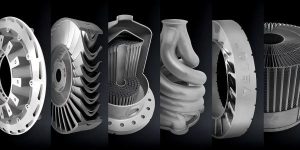
| Intake and exhaust manifolds | LPBF, Inconel 718 or Ti-6Al-4V | Runner geometry that cannot be cast or welded in the available space; a length change is a CAD edit, not a new tool | Wall thickness in internal bends, and support removal from inside the runners |
| Cooling ducts and heat exchangers | LPBF, AlSi10Mg or CuCrZr | Conformal channels and lattice cores raise heat rejection in the same envelope | Channel cleanout and a pressure test that proves it |
| Brackets and mounts | LPBF, Ti-6Al-4V or AlSi10Mg | Topology optimisation plus part consolidation: one printed bracket replaces several machined pieces and fasteners | Fatigue at load introduction points, not static strength |
| Aero and ducting | SLS, PA12 | Iteration between events without tooling; complex internal geometry is free | Surface finish affects flow, so budget a finishing step |
| Jigs, fixtures, cockpit mock-up | SLS or SLA | Hours instead of weeks, and cheap to revise when the layout changes | Dimensional stability, especially for anything used as a datum |
The cost model is per race weekend
Comparing printed parts on unit price alone will always favour the machined alternative, and it will be the wrong answer. The number that decides is cost per event, and it has four components that a unit price hides:
- Lead time converted into options. A part in three days instead of six weeks is a design decision you can still make after the last test.
- Spares carried. Printed spares can be held as files rather than as inventory, and re-run when needed. That is floor space and cash released.
- Part count removed. Consolidation removes assembly labour and joint failures, which is where race retirements actually come from.
- Mass. Every kilogram removed is worth lap time, and lap time is the only currency the team is judged on.
Where printing loses is equally clear: a simple bracket in a stable design, made in quantity, with no mass or packaging pressure, is cheaper machined. Be honest about which column a part falls into before committing to a process.
Materials that survive a season
- Ti-6Al-4V — the default for structural brackets and suspension-adjacent hardware. High specific strength, good fatigue behaviour after stress relief and, where required, hot isostatic pressing.
- Inconel 718 — exhaust and hot-side hardware. Needs full heat treatment to develop its properties, which is a step in the process, not an optional extra.
- AlSi10Mg — ducts, plenums and non-structural housings. Light and quick to print, with a clear temperature ceiling.
- 316L — cheap, corrosion-resistant brackets and non-critical hardware where mass is not the driver.
- PA12 and PA11 — aero parts, ducting, fixtures and mock-up components where dimensional accuracy matters more than strength.
What to send for a race part quote
Race timelines do not leave room for a second round of questions. Send all of this in the first message:
- The model or drawing, plus the envelope it has to fit into if that is the real constraint
- Alloy, and the service temperature it will actually see
- Quantity including spares, and the date the part has to be at the track
- Load path and the failure mode you care about — static strength, fatigue, or stiffness
- Post-processing you need done: support removal, heat treatment, machining allowance, surface finish
- Whether the part will be inspected and to what standard, so the documentation package is agreed up front
Our industry page sets out where additive manufacturing fits in automotive and motorsport programmes. For process selection across alloys, see metal 3D printing services, and finished race parts can be quoted through parts manufacturing.
Updated: November 23, 2026. By Felix Lee.