
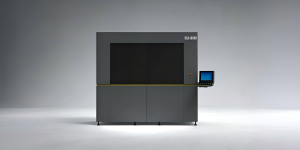
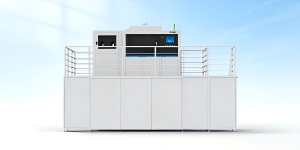
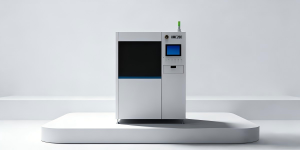
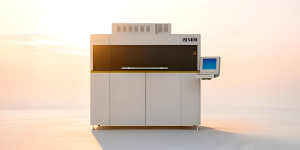











An industrial SLA printer is quoted as a configured system, not a catalogue item. Two machines with the same build envelope can differ by a factor of two once the light engine, automation and service agreement are included. This article sets out what actually moves the number, so a quote can be read instead of compared on headline price alone.
Table of contents
Why industrial SLA has no list price
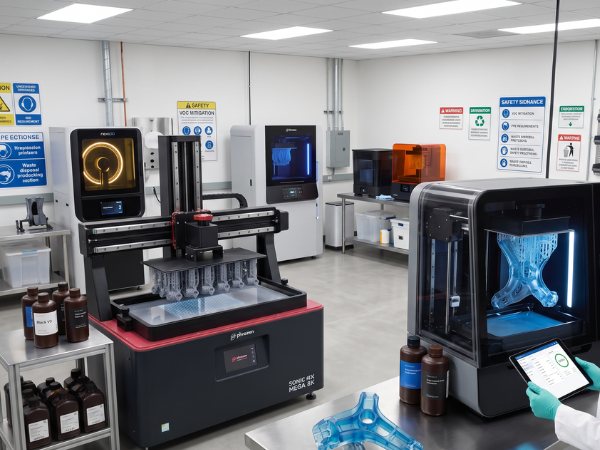
Desktop resin printers carry a published price because the configuration is fixed: one vat, one light engine, one material family, no installation. Industrial systems are built to order. Build envelope, optical resolution, resin handling, wash-and-cure integration and service level are selected separately, and each one changes both the bill of materials and the support contract that follows it.
A supplier who publishes a single number is usually quoting a base configuration you will not actually run, or making up the difference in consumables and service. Ask for the configured price against your part, not the entry price of the range.
The five factors that move the price
| Factor | What it changes | What to ask for |
|---|---|---|
| Build envelope | The dominant driver. A larger vat needs a larger light engine, a stiffer frame and more resin per fill. | The usable envelope and the tolerance at the edges of the bed, not the centre. |
| Light engine and resolution | Optical resolution raises cost steeply, because the imaging path has to be built and calibrated to a tighter spec. | The pixel size at the build plane in microns, not a marketing “XY resolution” figure. |
| Throughput features | Second light engine, automated resin feed and integrated wash/cure multiply machine price but cut labour per part. | Parts per hour on your geometry, including load, wash, cure and inspection. |
| Material platform | Open platforms cost more up front and less over five years; closed platforms invert that. | Which third-party resins are validated, and what the supplier charges to qualify a new one. |
| Service level | On-site response time and locally held spares are a real line item, frequently a five-figure annual cost on mid-size systems. | Contract length, response time in hours, and which parts are held in your region. |
Market bands by machine class
The bands below are order-of-magnitude figures for planning a budget. They are not a quote, and they move with configuration, currency and region.
- Small industrial systems, roughly 300 mm envelope. Tens of thousands. Adequate for prototypes and short series, with the trade-off appearing in tolerance consistency and uptime rather than in price.
- Mid-size single-engine systems. Typically low-to-mid six figures once resin handling and wash/cure are included. This is where most production work sits.
- Large-format or dual-engine production cells. Six figures and upward, with installation, extraction, floor preparation and operator training usually quoted as separate scope.
The more useful question is not what the machine costs but what an accepted part costs at your volume. A cheaper system that rejects five percent of parts is more expensive than a dearer one that rejects one percent, and the gap widens as part value rises.
What the five-year cost actually contains
Machine price is typically a minority of the total. The recurring lines are where quotes diverge:
- Resin. The largest recurring cost on most systems. Price per kilogram is misleading on its own; cost per accepted part is what matters, and it depends on reject rate and how much resin is lost to the vat.
- Wash and cure consumables. Solvent, tanks and filters. Easy to underestimate because they scale with throughput, not with machine count.
- Service and spares. Light engine ageing is the constraint. Ask what the expected replacement interval is and what that part costs.
- Extraction and floor space. Resin systems need ventilation, temperature stability and a footprint that includes post-processing.
- Operator time. Loading, support removal, washing, curing and inspection. Automation features exist precisely because this line is large.
How to compare two quotes
Normalise both quotes to the same unit: cost per accepted part at your monthly volume, over the contract period. That means asking each supplier for the same three inputs on the same geometry — build time, resin consumption per build, and expected reject rate — and then adding the service and consumable costs you would actually incur.
Two questions separate serious suppliers from catalogue sellers. First, what is the tolerance on a feature at the far corner of the build plane, not the centre. Second, what happens to throughput when the light engine reaches end of life, and how the service contract covers it. Neither answer appears on a price list.
What to send for a price range
A ten-minute email gets a useful range; a request for “your price list” gets a brochure. Send:
- The part or a representative part, with the tolerance that actually matters
- Monthly or annual quantity, and whether it varies seasonally
- The material family and any regulatory or biocompatibility requirement
- Required surface finish and whether you need support removal and post-cure done by the supplier
- Existing process and current cost per part, so the comparison is real
- Site constraints: power, ceiling height, extraction route, floor loading
Current specifications for our resin systems are on the resin 3D printer (SLA) page. If the part is better served by a service bureau than by an in-house machine, the comparison between buying and outsourcing is set out on our metal 3D printing services page, and finished parts can be quoted through parts manufacturing.
Updated: November 23, 2026. By Felix Lee.