




Robotic support removal is worth a trial when the same part families return often, tools can reach the supports and fixtures locate the parts reliably. The investment decision should use measured cost per accepted part. A fast removal demonstration leaves programming, loading and inspection costs unresolved.
Table of contents
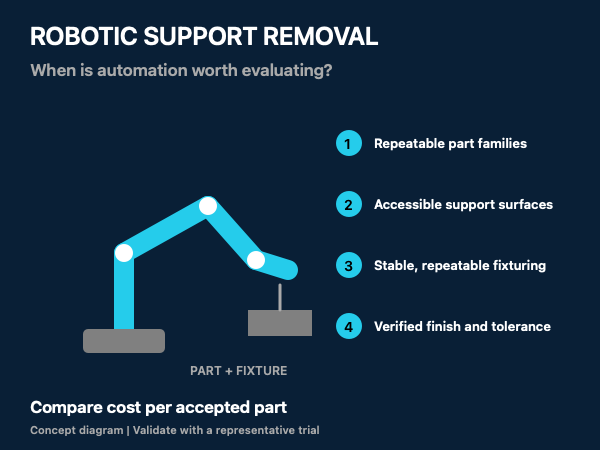
Start with the parts that repeat
List the part families that consume the most support-removal hours. Record material, support layout, annual quantity and the frequency of design changes. Repeated geometry gives you more opportunities to reuse a program and fixture. A changing mix of prototypes may spend much of its available time in setup.
Check access and fixturing before estimating savings
Mark every support contact that must be removed. Check tool approach, collision clearance and access around thin walls. A robot cannot make an inaccessible support reachable without a change to the part, support design or removal route. Baseplate separation and fine finishing may remain separate operations.
Choose locating features and clamping points that remain usable in the incoming condition. Build distortion and support variation can affect alignment. Test representative variation, including difficult parts from the intended process, before agreeing the production scope.
Compare manual and robotic routes on the same basis
| Measurement | Manual route | Robotic route |
|---|---|---|
| Preparation | Operator instructions and tool setup | Programming, alignment strategy and fixture development |
| Per-batch work | Sorting and workstation setup | Program loading, fixture change and first-piece check |
| Per-part attendance | Handling and active removal | Loading, supervision, unloading and intervention |
| Equipment time | Workstation and tool occupancy | Full cell cycle including scanning and tool changes |
| Quality | Rework, scrap and inspection time | The same acceptance criteria, rework and inspection time |
Measure operator attendance separately from equipment occupancy. A cell may run while an operator does other work, but that time only becomes a saving when the staffing plan can use it. Track tool wear and interruptions as well as the uninterrupted removal cycle.
Calculate savings and payback from trial results
For each route, divide the batch cost by the accepted output. Include labor, consumables, equipment allocation, programming amortization and any rework. Add the recurring service and maintenance costs expected for the cell. Keep cost allocation consistent between the two routes.
Illustrative arithmetic only: suppose a validated comparison gives a $20 saving per accepted part and demand supports 4,000 accepted parts per year. That is $80,000 in annual savings before any additional recurring costs. If those costs are $20,000 per year, the net annual benefit is $60,000. An assumed installed investment of $180,000 gives a simple payback of 3 years. These inputs are invented, not a Forgecise quotation or performance claim. Financing, tax and the time value of money require a fuller model.
Recalculate with lower demand, longer setup and the measured rejection rate. If the net benefit becomes zero or negative, a finite simple payback cannot be calculated. Report that result instead of substituting optimistic utilization.
Write the trial acceptance plan
Agree the remaining support allowance, critical dimensions and surface condition before the trial. Define which features require inspection and which require later machining. Record complete cycle times, operator minutes and accepted output for a representative batch. Include reloads and tool replacement in the test where they affect production.
The trial report should identify the CAD revision, material, incoming condition, fixture, program revision and inspection method. Compare the result with the current manual route using the same delivered condition. A successful trial on one geometry does not establish capability for every metal part.
When a manual or mixed route may fit better
Manual removal may remain economical for occasional prototypes, frequent geometry changes or small workloads. A mixed route may use a robot for accessible repeated surfaces and manual work for the remaining contacts. Evaluate each operation separately when the full sequence cannot be automated economically.
Prepare a part-specific evaluation
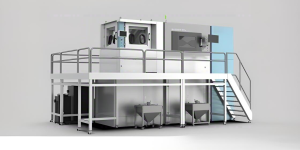
Send the CAD and drawing, alloy, support condition, expected batch size and annual demand. Add photographs of the incoming part and current cycle records where available. Review metal support removal methods and the Forgecise robotic AM support removal system. Request an evaluation using your representative parts and acceptance criteria.
For cost-model background, see NIST’s additive manufacturing cost report. Use current supplier quotations and your trial data for an investment decision.
Include finishing and inspection in the cost per accepted metal printed part when comparing removal routes.
Updated: November 13, 2026. By Felix Lee.