







By Felix Lee | CEO at Forgecise Published July 25, 2026
Table of Contents
Search Summary
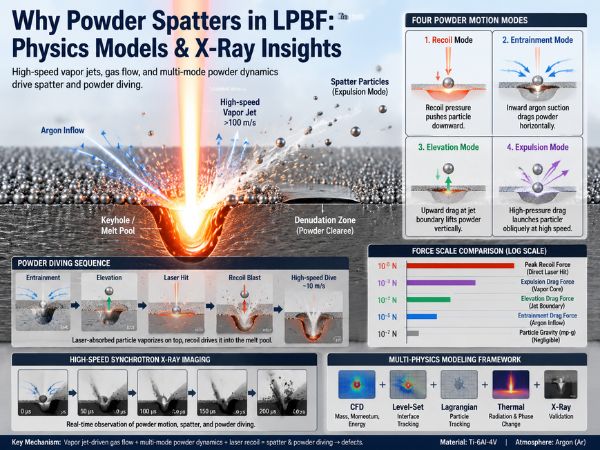
Why does metal powder spatter in Laser Powder Bed Fusion (LPBF)? Metal powder spatters because high-power lasers vaporize metal, blasting out a fast vapor jet ($>100\text{ m/s}$). This jet pulls in surrounding Argon shielding gas, creating suction and pressure drags that drag, lift, or launch loose particles. Depending on where particles rest and what forces hit them, powder moves in four ways: Recoil Mode, Entrainment Mode, Elevation Mode, and Expulsion Mode. When airborne particles get hit by laser light, vapor recoil blasts them downward into the liquid melt pool at$\sim 10\text{ m/s}$—a dangerous event known as Powder Diving.
1. Practical Context & Author Perspective
At Forgecise, our team works daily to eliminate defects in printed metal components. Void formation, lack of fusion, and rough surface finishes usually trace back to one chaos-maker: powder spatter and denudation.
To fix spatter, you must look at microsecond ($\mu\text{s}$) and micrometer ($\mu\text{m}$) events. The powder bed is a fast-moving physical system where fluid flow, phase changes, and thermal radiation meet.
This breakdown examines a foundational paper published in Additive Manufacturing (Vol. 35, 101362, 2020) by Xuxiao Li, Cang Zhao, Tao Sun, and Wenda Tan (University of Utah & Argonne National Laboratory), titled:
“Revealing transient powder-gas interaction in laser powder bed fusion process through multi-physics modeling and high-speed synchrotron x-ray imaging.”
Combining high-speed synchrotron X-ray imaging with a 2D multi-physics model, this work shows why metal powder moves, lifts, spatters, or plunges straight into the melt pool.
2. Research Metadata & Major Findings
Here is the exact reference data for this study:
| Attribute | Details |
|---|---|
| Title | Revealing transient powder-gas interaction in laser powder bed fusion process through multi-physics modeling and high-speed synchrotron x-ray imaging |
| Authors | Xuxiao Li, Cang Zhao, Tao Sun, Wenda Tan |
| Institutions | Department of Mechanical Engineering, University of Utah; Advanced Photon Source, Argonne National Laboratory |
| Journal / Year | Additive Manufacturing, Volume 35, Article 101362 (2020) |
| Material System | Ti-6Al-4V Grade Powder Bed under Argon (Ar) Atmosphere |
| Primary Methods | Unified CFD + Level-Set Interface Tracking + Lagrangian Particle Tracking + High-Speed Synchrotron X-Ray Imaging |
| Key Terminology | LPBF, Powder Spatter, Powder-Gas Interaction, Vapor Jet, Argon Entrainment, Recoil Pressure, Powder Diving Motion |
Primary Discoveries:
- Gas Drag Drives Motion: Gas drag caused by Argon suction—driven by fast metal vapor jets—causes powder movement, not direct laser photon pressure.
- Four Motion Modes: Powder motion fits four distinct categories based on dominant forces: Recoil, Entrainment, Elevation, and Expulsion.
- Powder Diving: Flying particles hit by laser light vaporize on top, generating downward recoil that drives them into the melt pool at $\sim 10\text{ m/s}$.
3. The Sequence: How Laser Exposure Causes Spatter
You can trace powder spatter through a step-by-step physical chain:
[High-Power Laser Hit]
         │
         ▼
[Rapid Local Heating & Melting (Ti-6Al-4V)]
         │
         ▼
[Boiling Point Surpassed]
         │
         ▼
[Vapor Jet Ejection + Recoil Pressure]
         │
         ▼
[Depression Zone / Keyhole Forms]
         │
         ▼
[Pressure Drops & Sucks In Shielding Gas]
         │
         ▼
[Aerodynamic Drag Pulls Loose Powder]
         │
         ▼
[4 Powder Modes: Recoil, Entrainment, Elevation, Expulsion]
         │
         ▼
[Spatter Lands / Powder Dives → Defects Form]
When a laser shines on a $20\text{–}60\,\mu\text{m}$ powder layer, localized energy rapidly vaporizes metal. Vapor shoots upward at hundreds of meters per second. This fast stream creates a low-pressure zone that draws in surrounding Argon gas. Inward Argon flow acts like a vacuum cleaner, dragging nearby loose powder straight toward the melt zone.
4. Full Mathematical Formulation
Li et al. created a complete framework covering solid substrate, loose powder, liquid melt pool, gas, and individual moving grains. Here are the 10 core mathematical formulations from their model.
4.1 Mass, Momentum, and Energy Flow
The model handles low-speed liquid metal and high-speed gas inside one unified CFD system.
1. Mass Conservation (Continuity):
$$\frac{\partial \rho}{\partial t} + \nabla \cdot (\rho \mathbf{u}) = 0$$
Where $\rho$ is fluid density and $\mathbf{u}$ is velocity.
2. Momentum Conservation (Navier-Stokes):
$$\frac{\partial (\rho \mathbf{u})}{\partial t} + \nabla \cdot (\rho \mathbf{u} \mathbf{u}) = -\nabla p + \nabla \cdot \boldsymbol{\tau} + \rho \mathbf{g}$$
Where $p$ is static pressure, $\boldsymbol{\tau}$ is viscous stress, and $\mathbf{g}$ is gravity.
3. Energy Conservation:
$$\frac{\partial (\rho E)}{\partial t} + \nabla \cdot (\mathbf{u} (\rho E + p)) = \nabla \cdot (k \nabla T)$$
Where $E$ is total energy (internal plus kinetic), $k$ is thermal conductivity, and $T$ is temperature.
4.2 Solid Motion Stopping: Darcy Drag Force
To stop solid regions from flowing like liquid, the team added a Darcy drag force ($\mathbf{F}_D$) to the momentum equation:
4. Darcy Drag Equation:
$$\mathbf{F}_D = -\mu \cdot C(T) \cdot (\mathbf{u} – \mathbf{u}_s)$$
Where $\mu$ is dynamic viscosity of liquid metal, $C(T)$ is a temperature-dependent coefficient (high in solids, zero in liquids), and $\mathbf{u}_s$ is solid velocity ($\mathbf{u}_s = \mathbf{v}_p$ inside powder, $\mathbf{u}_s = 0$ in solid substrate).
4.3 Boundary Tracking: Level-Set Method
Moving boundaries between metal and gas change every microsecond.
5. Level-Set Tracking Equation:
$$\frac{\partial \phi}{\partial t} + \mathbf{u} \cdot \nabla \phi = 0$$
Where $\phi$ is the distance function ($\phi > 0$ inside metal, $\phi < 0$ in gas, $\phi = 0$ at the boundary).
4.4 Particle Motion (Lagrangian Tracking)
Every loose powder grain is tracked as a rigid body acted on by drag, gravity, and hits from other grains.
6. Particle Translation:
$$m_p \frac{d\mathbf{v}_p}{dt} = \mathbf{F}_{gas} + m_p \mathbf{g} + \mathbf{F}_c$$
Where $m_p$ is particle mass, $\mathbf{v}_p$ is velocity, $\mathbf{F}_{gas}$ is gas drag over surface $S_p$, and $\mathbf{F}_c$ is contact force from collisions.
7. Particle Rotation:
$$I_p \frac{d\boldsymbol{\omega}_p}{dt} = \int_{S_p} \mathbf{r} \times d\mathbf{F}_{gas}$$
Where $I_p$ is moment of inertia, $\boldsymbol{\omega}_p$ is angular velocity, and $\mathbf{r}$ is distance from center of mass.
8. Drag Separation:
$$\mathbf{F}_{gas} = \mathbf{F}_p + \mathbf{F}_\tau = \int_{S_p} (-p \mathbf{n} + \boldsymbol{\tau} \cdot \mathbf{n}) dA$$
Where $\mathbf{F}_p$ is pressure drag and $\mathbf{F}_\tau$ is friction drag along particle skin.
4.5 Gas State & Flow Behavior
Temperatures range from $298\text{ K}$ to above $3000\text{ K}$. Assuming constant gas values creates massive calculation errors.
9. Argon Density & Viscosity Equations:
$$\rho_g = \frac{p}{R_{Ar} T}$$$$\mu_g = \mu_0 \left(\frac{T}{T_0}\right)^{3/2} \frac{T_0 + S}{T + S}$$
Where $R_{Ar}$ is gas constant for Argon, $\mu_0$ is dynamic viscosity at reference temperature $T_0$, and $S$ is Sutherland constant.
Particle Reynolds Number ($Re_p$):
$$Re_p = \frac{\rho_g |\mathbf{u}_g – \mathbf{v}_p| d_p}{\mu_g}$$
- Calculated Value: Hot gas near the jet lowers density $\rho_g$ and raises viscosity $\mu_g$. This yields $Re_p \approx 10$. This proves gas flow around powder stays in a laminar intermediate boundary state, rather than full turbulence or simple Stokes flow.
4.6 Thermal Energy Comparison
10. Convective Heating vs. Direct Laser Power
The model checks Nusselt numbers ($Nu$) to see if gas heats powder during flight:$$Nu = 2 + C \cdot Re_p^m \cdot Pr^n \quad \implies \quad h_{conv} = \frac{Nu \cdot k_g}{d_p}$$$$q_{conv} = h_{conv} (T_\infty – T_p) \approx 10^6 \text{ W/m}^2$$
Direct laser light delivers much higher energy density: $$q_{laser} \approx 10^9 \text{ W/m}^2$$
- Finding: Laser energy density ($10^9\text{ W/m}^2$) is 1,000 times higher than hot gas convective heat ($10^6\text{ W/m}^2$). Hot gas convection plays almost no role in melting powder. Laser light absorption drives surface melting and boiling.
Energy to Melt a Powder Grain ($Q_{melt}$):
$$Q_{melt} = \frac{1}{6} \pi d_p^3 \rho_s \left[ c_s (T_L – T_0) + \Delta H_f \right]$$
Where $\rho_s$ is solid density, $c_s$ is specific heat capacity, $T_L$ is liquidus point, and $\Delta H_f$ is heat of fusion. Direct laser absorption melts a particle in tens of microseconds.
5. Four Powder Motion Modes
Li et al. split powder motion into four basic modes based on local forces:
                            [Laser Beam]
                                 │
                                 ▼
                 ┌───────────────┴───────────────┐
                 │   High-Speed Vapor Jet Core   │
                 └───────────────┬───────────────┘
                                 │
       ┌─────────────────────────┼─────────────────────────┐
       ▼                         ▼                         ▼
[RECOIL MODE]            [EXPULSION MODE]          [ELEVATION MODE]
(Direct Beam)           (Vapor Jet Core)          (Jet Boundary)
• Recoil Pressure       • High Pressure Drag      • Upward Pressure Drag
• Pushes Downward       • High Friction Drag      • Vertical Lift
• Rapid In-Pool Melt    • Fast Oblique Launch     • Low Angle Ejection
       ▲                         ▲                         ▲
       └─────────────────────────┼─────────────────────────┘
                                 │
                         [ENTRAINMENT MODE]
                         (Outer Inflow Area)
                         • Low Pressure Sink
                         • Inward Argon Suction
Motion Mode Comparison Table
| Mode | Main Force Source | Gas Flow Pattern | Trajectory & Speed | Quality Effect |
|---|---|---|---|---|
| 1. Recoil Mode | Vapor Recoil Pressure ($p_{recoil}$) | Direct laser beam hits top of particle | Pushed downward into pool within tens of $\mu\text{s}$ | Fast melting or surface disturbance |
| 2. Entrainment Mode | Inward Pressure Drag ($\mathbf{F}_p$) + Friction ($\mathbf{F}_\tau$) | Vapor jet sucks in surrounding Argon | Pulled horizontally toward laser ($1\text{–}3\text{ m/s}$) | Clears powder bed around track |
| 3. Elevation Mode | Vertical Friction + Pressure Gradient | Outer shear layer at edge of vapor jet | Lifted vertically upward at steep angles | Setup state for spatter or diving |
| 4. Expulsion Mode | High Pressure Drag + Friction Drag | Core of fast vapor jet ($>100\text{ m/s}$) | Shot obliquely at high speed ($\sim 10\text{ m/s}$) | Creates cold spatter deposits & voids |
Detailed Breakdowns for Each Mode
Mode 1: Recoil Mode
- Mechanics: Happens when laser light hits loose powder directly. Top surface evaporation fires vapor upward, generating a strong reactive recoil force downward.
- Force Scale: Recoil force scales from $10^{-3}\text{ N}$ to several Newtons, easily overriding gas drag ($10^{-5}\text{–}10^{-3}\text{ N}$).
- Result: Particle plunges down into the melt pool and dissolves in $20\text{–}50\,\mu\text{s}$.
Mode 2: Entrainment Mode
- Mechanics: Fast vapor jets shoot up and pull nearby Argon inward.
- Force Scale: Combined drag is roughly $10^{-5}\text{ N}$.
- Result: Loose powder around the laser track slides inward toward the pool. This forms bare zones (denudation zones) alongside printed paths.
Mode 3: Elevation Mode
- Mechanics: An entrained particle reaches the edge of the vapor jet where gas moves faster on one side than the other.
- Force Scale: Upward drag measures around $10^{-4}\text{ N}$.
- Result: The particle lifts gently straight up into the air above the powder layer.
Mode 4: Expulsion Mode
- Mechanics: A particle enters the center of the vapor plume, blocking fast gas. Pressure builds up on the front face while low pressure forms behind it. Skin friction accelerates the grain further.
- Force Scale: Total drag reaches $10^{-3}\text{ N}$.
- Result: The particle blasts away at high speed ($\sim 10\text{ m/s}$) across long distances, landing on cold powder as spatter.
6. Multi-Mode Sequences and Powder Diving
Powder grains switch between modes during flight.
Path 1: Standard Spatter Sequence
$$\text{Entrainment Mode (Horizontal Slide)} \longrightarrow \text{Elevation Mode (Vertical Lift)} \longrightarrow \text{Expulsion Mode (Fast Launch)}$$
Path 2: The Powder Diving Sequence
$$\text{Entrainment Mode} \longrightarrow \text{Elevation Mode} \longrightarrow \text{Laser Light Hit} \longrightarrow \text{Vapor Recoil Blast} \longrightarrow \text{High-Speed Dive}$$
   [Laser Beam] ──┐
                  │ (Direct or Reflected Light)
                  ▼
         ● Floating Powder Grain (Elevated)
         │
         ├── Top Surface Evaporates Instantly
         │
         ▼ [Massive Downward Recoil Force]
         │
         │  (Velocity ~10 m/s Downward)
         ▼
~~~~~~~~~🌊~~~~~~~~~~~~~~~~~~~~~~~~~~~~~~~~~~~~~~
   [Melt Pool Surface Waves & Turbulence]
~~~~~~~~~🌊~~~~~~~~~~~~~~~~~~~~~~~~~~~~~~~~~~~~~~
Powder Diving Mechanics:
- An entrained particle lifts into the laser beam or catches strong light reflected off keyhole walls.
- The top surface absorbs radiation ($q_{laser} \approx 10^9\text{ W/m}^2$) and boils instantly.
- Rapid top evaporation shoots vapor up, hammering the particle downward.
- The grain flips direction and drives into the melt pool at speeds near $\sim 10\text{ m/s}$.
- Quality Impact: Hitting the pool at $10\text{ m/s}$ kicks up surface waves, disrupts keyhole balance, and traps unmelted, oxide-coated inclusions deep inside solid metal.
7. Force Scale Comparison
Here is how forces rank on moving powder grains in LPBF:
Force Magnitude (Log Scale)
  ▲
  │  10^0 N  ├─────────────────────────────── Peak Recoil Force (Direct Laser Hit)
  │          │
  │  10^-3 N ├─────────────────────────────── Expulsion Drag Force (Vapor Core)
  │          │
  │  10^-4 N ├─────────────────────────────── Elevation Drag Force (Jet Boundary)
  │          │
  │  10^-5 N ├─────────────────────────────── Entrainment Drag Force (Argon Inflow)
  │          │
  │  10^-7 N ├─────────────────────────────── Particle Gravity (mp * g) [Negligible]
  └──┴───────┴───────────────────────────────► Physical States