











By Felix Lee, CEO at Forgecise
Published: May 15, 2026
- 2026 Market Analysis: Breaking Down the Tiers
- Technological Convergence and Mechanical Upgrades
- Operational Excellence and Calculating Total Cost of Ownership (TCO)
- B2B Procurement Policies and Wholesale Ecosystems
- Case Study Analysis in High-Stakes Environments
- Strategic Implementation Guidelines for B2B Customers
- FAQ: B2B Questions Answered
- Looking Ahead to 2027
Executive Summary (TL;DR): The definition of the “cheapest resin 3D printer” changed fundamentally in 2026. The price floor for a high-resolution, professional-grade 10K system dropped to $169. For B2B buyers, budget machines equipped with tilt-vat mechanics and smart failure checks now offer a highly profitable alternative to traditional $3,000 industrial units—as long as you carefully manage the Total Cost of Ownership (TCO) and post-processing labor.
Additive manufacturing hit a major turning point in 2026. High-resolution resin printing technology dropped in price, breaking the wall between cheap hobbyist gear and high-end industrial tools. Global supply chains now lean heavily toward local, on-demand production. Because of this shift, budget resin 3D printers became a core part of professional B2B workflows.
Looking at current market data, the global 3D printing market for prototyping reached an estimated $13.47 billion. Analysts project a 15.44% compound annual growth rate (CAGR) through 2031. Right now, the “price floor” for a reliable, high-resolution resin printer sits around $169. For that price, you get models like the Anycubic Photon Mono 4 with 10K resolution—a specification people paid a huge premium for just two years ago. This guide breaks down the cheapest credible resin 3D printing solutions available in mid-2026. We will look at TCO, mechanical reliability, and how professionals actually integrate these machines into their daily work.
2026 Market Analysis: Breaking Down the Tiers
We categorize the market not just by price, but by the level of built-in automation and hardware reliability. Here is the primary segmentation for B2B buyers:
| Segment | Representative Models | Price Range | Key Technological Drivers |
| Entry-Level (Ultra-Budget) | Anycubic Photon Mono 4, Elegoo Mars 5 | $169 – $190 | 10K resolution, manual leveling, compact footprint. |
| Mid-Range Value | Elegoo Saturn 3 Ultra, Anycubic Photon Mono M7 | $299 – $399 | Larger build volumes, 12K-14K screens, basic sensor arrays. |
| Advanced Prosumer | Elegoo Saturn 4 Ultra 16K, Anycubic Photon Mono M7 Pro | $450 – $600 | Tilt-vat mechanisms, smart failure detection, resin heating. |
| Professional Desktop | Formlabs Form 4, HeyGears Reflex RS Combo | $1,800 – $3,500 | Walled-garden ecosystems, 99.9% reliability, automated post-processing. |
Technological Convergence and Mechanical Upgrades
Cheap resin printers work for professionals today mostly because they borrow mechanical designs from expensive, older machines.
The Tilt-Vat Release Mechanism
Historically, the “peel force” needed to separate a fresh layer from the vat bottom caused delicate parts to snap. In 2026, the tilt-vat mechanism—standard in models like the Elegoo Saturn 4 Ultra and Mars 5 Ultra—tilts the tank to release the layer.
- Faster Vertical Speed: Machines hit vertical build speeds of 100mm/hour to 170mm/hour.
- Thinner Supports: Lower peel forces mean you can use thinner support structures, saving material.
- Longer Lasting Parts: Less mechanical stress extends the life of the monochrome LCD and FEP/ACF release films.
Smart Integration and Sensor-Based Failure Checks
Downtime costs businesses money. Models like the Anycubic Photon Mono M7 Pro and Elegoo Saturn 4 Ultra pack smart cameras and sensors. They actively monitor for:
- Residue Detection: Spots failed prints left in the vat to stop the LCD from crushing itself on the next layer.
- Resin Level Monitoring: Alerts you before the machine runs dry mid-print.
- Thermal Management: Built-in vat heaters keep resin flowing properly in unheated workshops or garages.
Resolution and Pixel Pitch in 2026
Companies heavily market 16K resolution, but professionals care more about XY pixel pitch. A 16K screen on a mid-sized printer delivers a pixel pitch of roughly 17-19 microns. You absolutely need this tight tolerance (±0.02mm) for dentistry, jewelry casting, and micro-fluidics.
Operational Excellence and Calculating Total Cost of Ownership (TCO)
For a business, the cheapest 3D printer isn’t the one with the lowest sticker price. Over three years, the initial hardware purchase accounts for only 20% to 30% of what you spend. You define the TCO for a fleet of budget resin printers with this formula:
$$TCO_{3yr} = CapEx + (OpEx_{resin} \times V_{annual}) + (Labor \times H_{post-proc}) + Cost_{maintenance} – ResaleValue$$
2026 Budget Estimates (Per Machine/Year):
- Resin ($500 – $1,500): Material waste eats up the biggest chunk of your variable costs.
- Labor ($2,000 – $5,000): Manual washing and curing labor drives up the cost-per-part more than anything else.
- Maintenance ($150 – $400): You must swap consumable screens every 500-1,000 hours. You also need to lubricate the Z-axis with white lithium grease every 200-300 hours to stop “Z-banding.” Plus, you must check build plate alignment (ball joint torque) every single month, even on auto-leveling systems.
- Safety & Compliance ($200 – $600): Good ventilation and PPE are mandatory for industrial safety.
B2B Procurement Policies and Wholesale Ecosystems
Major manufacturers upgraded their B2B support structures in 2026 to better serve companies:
- Creality: Offers a “Wholesale Discount” program giving verified institutions an extra 5% stackable discount. They feature instant online checkout, a 12-month warranty, and 24/7 technical assistance for print farm operators.
- Anycubic: Runs an enterprise “Reseller Program” with tiered pricing across over 100 countries. They offer a “Worry-Free Purchase” protection plan covering logistics damage. They also route all technical support through the “Anycubic Wiki” to help managers run large fleets.
- Elegoo: Relies on a strong network of authorized resellers (like SK本舗 in Japan and 3D Prima in Europe) to handle local warranty support. Their policy includes free shipping for bulk material orders over $50 in most major markets.
Case Study Analysis in High-Stakes Environments
Automotive and Consumer Goods (Unilever & Ford):
Internal reports show these brands use budget 12K and 16K resin printers to make “Cosmetic Mock-ups.” The smooth finish and tight tolerances let them test complex snap-fits that FDM printers cannot produce, speeding up approvals before mass production begins.
Healthcare and Dentistry:
Growing at a 19.76% CAGR, dental labs heavily deploy machines like the Anycubic Photon Mono M7 Pro. Producing patient-specific orthodontic models and surgical guides using FDA-cleared, biocompatible resins on budget machines allows smaller practices to finally bring manufacturing in-house.
Strategic Implementation Guidelines for B2B Customers
To run a profitable budget resin strategy, businesses must build on these rules:
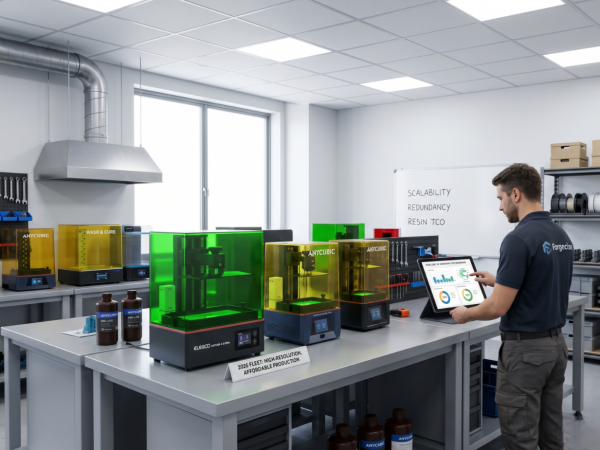
- Redundancy Over Scale: Buy multiple mid-sized units (like the Saturn 4 Ultra) instead of one massive printer. If one stops, your production keeps moving.
- Standardization of Materials: Pick a few high-quality resins (such as Anycubic ABS-Like Pro 2 or Elegoo Standard 2.0) and use the exact same exposure profiles across your whole fleet.
- Automated Post-Processing: Labor costs drain your budget fast. Integrated wash-and-cure stations are an absolute requirement to stay profitable.
- Safety and Compliance Documentation: Record all resin handling and waste disposal steps to follow local environmental laws strictly.
FAQ: B2B Questions Answered
Q1: Should a design studio invest in one $3,500 Formlabs Form 4 or a fleet of six $550 Elegoo Saturn 4 Ultras?
Answer: It depends on your failure tolerance. Get the industrial unit if you need “lights-out” production with zero human interaction. Get the budget fleet if you need high volume and redundancy; if one $550 machine fails, the other five keep printing.
Q2: Is the built-in carbon filtration in machines like the Saturn 4 sufficient for an office environment?
Answer: No. Built-in filters only catch odors. They miss the volatile organic compounds (VOCs) and ultrafine particles these machines produce. A professional setup requires an external ventilation system with negative pressure, like a vented grow tent.
Q3: Can budget machines handle engineering-grade resins for functional parts?
Answer: Yes. Most 2026 budget printers use open systems that handle ABS-like, tough, and high-temperature resins. Just dial in the exposure settings using calibration tools. Keep in mind that thick engineering resins might need the vat heaters found on “Pro” models to flow correctly.
Q4: Are the new auto-leveling systems reliable, or should we stick to manual leveling for professional consistency?
Answer: They are reliable, but verify them. The 2026 auto-leveling systems work well but react to resin thickness and room temperature. Run the “self-check” feature before big print jobs so the load sensors find the true zero-point accurately.
Q5: What is the most efficient way to manage post-processing for 10+ printers?
Answer: Automate the washing. Use large stations like the Anycubic Wash & Cure 3 Max. Set up a “Two-Stage” IPA wash to make your solvent last much longer, then use a dedicated UV station to cure contaminated waste before throwing it away.
Looking Ahead to 2027
The “cheapest resin 3D printer” of 2026 is no longer a compromise; it represents a smart business choice. Putting 16K screens, tilt-vats, and smart failure checks into a sub-$500 package created the “High-Efficiency Low-Cost” (HELC) manufacturing category.
As 2027 approaches, the industry shifts away from simply pushing higher resolutions. The new focus is “Closed-Loop” automation, where printers talk directly to wash stations to cut human labor further. Right now, B2B buyers have a clear path to scale high-precision production with minimal capital risk, as long as they manage the labor and maintenance costs built into vat polymerization technology.