









Release Date: 2026-04-10
Paul Li
CTO | Author18 years experience in the Ru0026amp;D of 3D printing equipment and additive manufacturing processes, empowering the efficient intelligent manufacturing of complex parts.
In the world of metal additive manufacturing (AM), a common mantra is “maximize density.” After all, a part full of pores is a weak part. But what if your part is already nearly perfect—over 99.5% dense? Does that mean you’ve unlocked its best possible performance?
A fascinating new study on 316L austenitic stainless steel, a workhorse material in industries from aerospace to medical devices, reveals a counterintuitive truth: within the high-density regime, using more laser energy can actually make your part weaker and more brittle.
This blog post dives into the paper “Microstructural and Mechanical Property Variations in 316L Stainless Steel Fabricated by Laser Powder Bed Fusion Under High-Density Processing Conditions” to explore why simply chasing density isn’t enough and how the microscopic world dictates macroscopic performance.
The Setup: Two Paths to (Almost) Perfect Density
The researchers started by mapping out the “process window” for 316L—a range of laser power, speed, and spacing settings that produce high-density parts. They found a very wide window, which is typical for this forgiving alloy.
From this window, they selected two extreme but valid parameter sets:
- Sample S1: Low Volumetric Energy Density (VED = 81.0 J/mm³)
- Sample S2: High Volumetric Energy Density (VED = 156.3 J/mm³)
Both samples were highly dense (S1 at 99.68%, S2 at a near-perfect 99.99%). If density were the only factor, S2 should be the superior part. But the tensile tests told a different story.
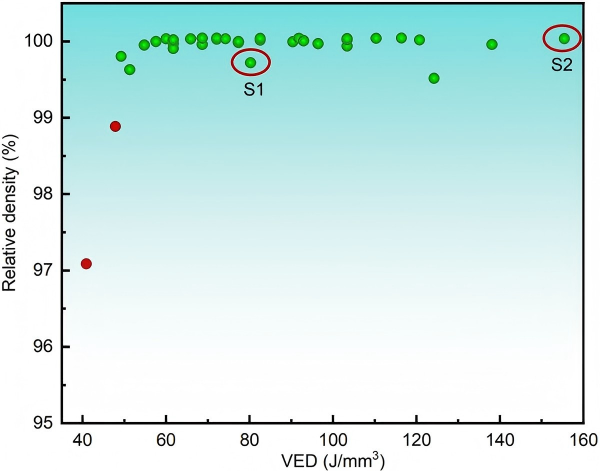
Figure 1 from the paper shows the relationship between VED and relative density. It highlights the broad “plateau” where density remains above 99.5%, even as energy input varies significantly.
The Surprise: Higher Density, Lower Performance
The mechanical test results were striking. Despite its higher density, Sample S2 was consistently outperformed by Sample S1:
| Property | S1 (Low VED) | S2 (High VED) | Change |
|---|---|---|---|
| Yield Strength (YS) | 566 MPa | 525 MPa | ↓ 7.3% |
| Ultimate Tensile Strength (UTS) | 665 MPa | 623 MPa | ↓ 6.3% |
| Elongation (Ductility) | 46.2% | 37.3% | ↓ 19.2% |
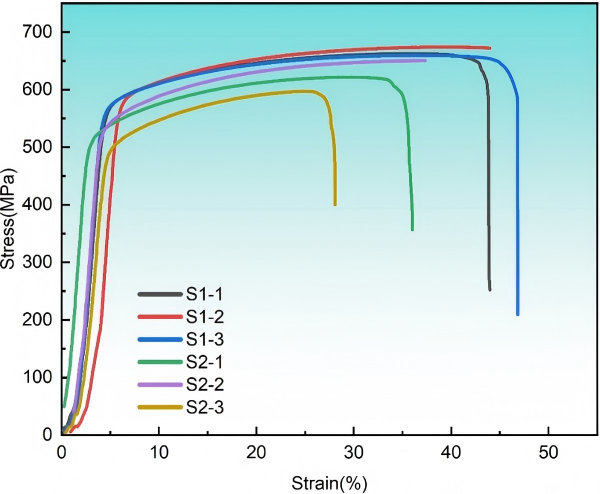
Figure 2 from the paper shows the stress-strain curves. The curve for S1 (blue) is not only higher (stronger) but also extends further to the right (more ductile) than S2 (orange).
The fracture surfaces told the same tale. S1’s surface was covered in large, deep dimples—a classic sign of a ductile, energy-absorbing failure. S2’s dimples were smaller and shallower, with hints of brittle features, confirming its reduced toughness.
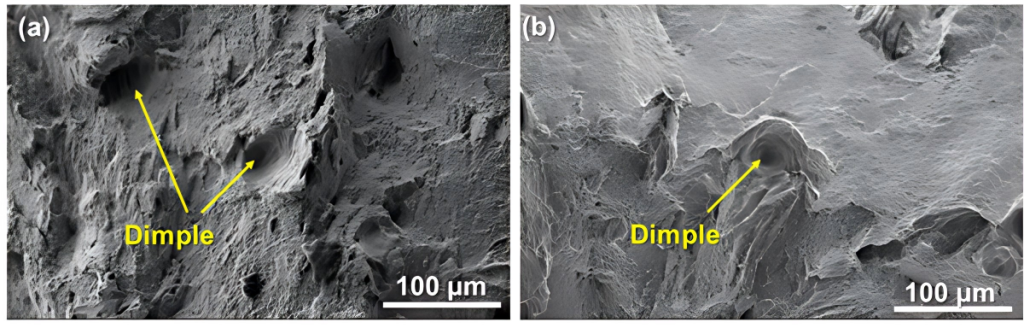
Figure 3 shows the fracture morphology under a scanning electron microscope (SEM). The left image (S1) shows large, deep dimples, while the right (S2) shows smaller, shallower ones.
The Microscopic Explanation: It’s All About the Grains
So why does more energy lead to worse performance? The answer lies in the microstructure, revealed through Electron Backscatter Diffraction (EBSD).
1. Grain Size Matters (Hall-Petch Effect):
Higher energy input (S2) led to significantly coarser grains. The average grain size grew from 10.87 µm in S1 to 16.68 µm in S2. According to the fundamental Hall-Petch relationship, larger grains mean lower strength. The high energy allows grains more time and thermal drive to grow before the next layer solidifies.
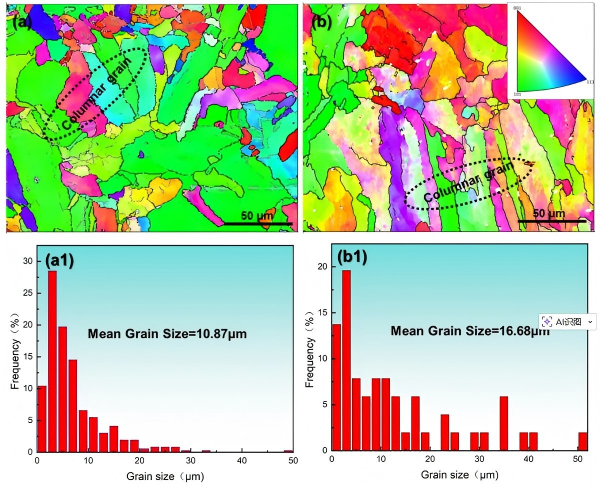
Figure 4 presents Inverse Pole Figure (IPF) maps and grain size distributions. It’s clear that S2 (right) has much larger grains than S1 (left).
2. A Tale of Two Strengthening Mechanisms:
The paper breaks down the sources of strength:
- S1 (Low VED): Its strength comes primarily from grain boundary strengthening (230.8 MPa). Fine grains create many boundaries that block dislocation movement—the ideal scenario.
- S2 (High VED): With its coarse grains, grain boundary strengthening drops (186.3 MPa). To compensate, it relies more on dislocation strengthening (202.4 MPa vs. 160.8 MPa for S1). This means its internal stress and defect density are higher.
While the total calculated strength is similar, the quality of that strength is different. A fine-grained structure (S1) offers a better balance of strength and ductility than a highly stressed, dislocation-tangled structure (S2).
3. Loss of Crystallographic Order:
S1 exhibited a strong crystallographic texture (a preferred grain orientation), which can be beneficial for consistent properties. S2, bombarded with more energy, lost this order, resulting in a chaotic, random grain orientation that contributes to its inferior and less predictable performance.
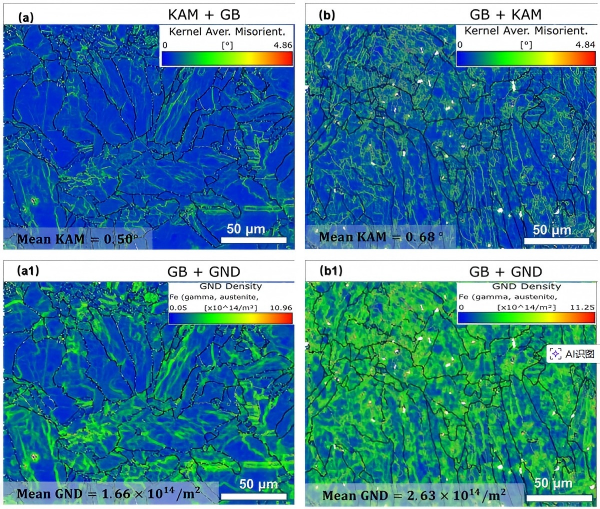
Figure 5 visualizes the Kernel Average Misorientation (KAM), a proxy for local stress and dislocation density. The map for S2 (right) is noticeably “hotter” than S1 (left), indicating higher internal stress.
Key Takeaway for Engineers
This research delivers a crucial message for anyone working with metal AM: Don’t stop optimizing once you hit 99.5% density.
For alloys like 316L that have a broad high-density processing window, there’s a secondary optimization layer focused on microstructural control. By carefully tuning parameters to use the minimum necessary energy to achieve full density, you can promote a fine-grained, low-stress microstructure that delivers the best combination of strength and ductility.
In essence, the most efficient process isn’t always the one that melts the most; sometimes, it’s the one that melts just enough. This principle of “precise regulation within the dense parameter range” is key to unlocking the true potential of additively manufactured metals.
About Forgecise
Forgecise is an innovator in additive manufacturing, focusing on high-performance metal 3D printing equipment, materials, and software solutions for industrial manufacturing.