










Release Date: 2026-04-10
Paul Li
CTO | Author18 years experience in the Ru0026amp;D of 3D printing equipment and additive manufacturing processes, empowering the efficient intelligent manufacturing of complex parts.
Selective Laser Melting (SLM), as a high-precision metal additive manufacturing technology, is gradually expanding from titanium alloys and superalloys to a wider range of engineering alloys. A recent study published in Chinese Journal of Lasers systematically investigated the effects of SLM process parameters on the microstructure and mechanical properties of 24CrNiMo alloy steel (a critical material commonly used for high-speed train brake discs), providing important technical foundations for its engineering applications.
1. Unique Microstructure of SLM-Formed 24CrNiMo
The study revealed that SLM-formed 24CrNiMo alloy steel exhibits a typical dual-phase composite microstructure:
- Tempered Martensite: Serving as the matrix phase, its lath structure is extremely fine, with an average width of only 50 nm. This is a direct result of the ultra-high cooling rates (10²~10⁶ K/s) inherent to the SLM process.
- Retained Austenite: Present in small amounts as island-like morphologies within the Heat-Affected Zone (HAZ). Its formation mechanism is as follows: the heat from newly deposited layers reheats the underlying solidified layers to temperatures above the austenitization temperature, and upon rapid cooling, this austenite is retained.
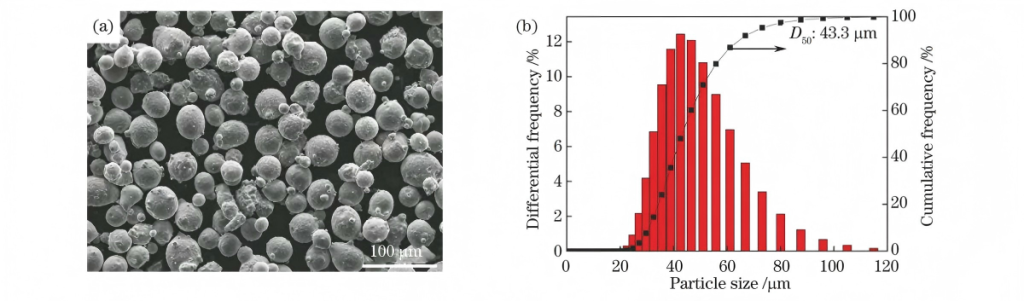
This microstructure, strengthened by both fine-grain and phase-transformation mechanisms, forms the foundation of its excellent mechanical properties.
2. The Critical Role of Process Parameters: The Trade-off Between Density and Hardness
Laser power (P) and scanning speed (v) are two key variables that determine the final part quality. They influence the microstructure and properties through the regulation of energy input density, producing distinctly different effects.
- Effect on Density: Increasing laser power or decreasing scanning speed enlarges the melt pool volume and improves melt fluidity, thereby effectively reducing “lack-of-fusion” pores. Experiments showed that at parameters of 320 W / 750 mm/s, the density reached a peak value of 99.93%.
- Effect on Microhardness and Strength: However, excessive energy input is a double-edged sword. It reduces the cooling rate and subjects previously formed layers to stronger thermal cycling effects, leading to:
- Coarsening of tempered martensite laths (from 50 nm to 200 nm).
- Widening of the Heat-Affected Zone.
These two factors work together to cause the hardness and strength of the material to decrease with increasing energy input.
3. Optimization of Mechanical Properties and Fracture Behavior Analysis
The research team tested tensile properties under different process parameters and compared them with traditional cast alloy steel:
- Optimal Comprehensive Performance: Under the parameter of 320 W / 950 mm/s, the specimen achieved the best strength-ductility combination:
- Tensile strength: 1362 MPa
- Yield strength: 1252 MPa
- Elongation: 16.2%
- Comparison with Cast Material: For reference, the cast 24CrNiMo exhibited a tensile strength of 1157 MPa, yield strength of 1034 MPa, and elongation of 15.4%. This clearly demonstrates that within the appropriate SLM process window, the formed parts exhibit comprehensive mechanical properties significantly superior to cast materials.
- Fracture Mechanism: Fracture surface analysis revealed the source of its excellent ductility. During tensile testing, microcracks initiated in the high-strength but brittle tempered martensite are hindered when propagating into the HAZ rich in retained austenite. This is because the FCC-structured austenite possesses more slip systems, effectively absorbing energy and delaying crack propagation, thereby ensuring good ductility.
Conclusion
This study not only successfully achieved high-quality SLM forming of 24CrNiMo alloy steel but, more importantly, established a clear “process-microstructure-property” relationship chain. By precisely controlling laser energy input, an ideal microstructure composed of ultra-fine tempered martensite and an appropriate amount of retained austenite can be obtained while ensuring high density, ultimately achieving comprehensive mechanical performance that surpasses traditional casting processes. This has significant guiding implications for promoting the application of SLM technology in manufacturing complex, high-performance steel components in fields such as rail transit and energy equipment.
About Forgecise
Forgecise is an innovator in additive manufacturing, focusing on high-performance metal 3D printing equipment, materials, and software solutions for industrial manufacturing.