







Author: Felix, CEO at Forgecise
Date: May 14, 2026
In 2026, scaling up 3D printing often hits a wall at the post-processing stage. Many professional teams ask a simple question: Does hot water soften 3D print resin?
The short answer is yes. If you are working with “green” (uncured) parts, heat breaks down the stiffness of the material. This makes support removal much faster. But if you don’t track the Glass Transition Temperature (Tg) and Heat Deflection Temperature (HDT), you could end up with warped parts and weak structures. This guide breaks down how to use heat well in an industrial setting.
The Science: Why Heat Works
The way resin reacts to heat depends on its molecular state. A green part—one that is printed but hasn’t had its final UV cure—has fewer internal links.
Understanding Tg and HDT
- Glass Transition Temperature (Tg): Think of this as the point where the plastic moves from being hard and glassy to soft and rubbery. For green resin, this point is often close to room temperature.
- The 10°C – 20°C Rule: To keep your dimensions exact, keep your water bath 10°C to 20°C below the HDT of your resin. If you go higher, the part might lose its shape forever.
Water and Plasticization
Water molecules can actually slip into the polymer network. This makes the chains move more freely. However, be careful with high heat. Research shows that soaking parts at 75°C makes them take in three times more moisture than at room temperature. This can drop the tensile strength by 55.6% over time.
Industrial Heat Settings
| Parameter | Setting | Result |
| Best Softening Temp | 40°C – 50°C | Makes supports easy to pull without hurting the part. |
| Danger Zone | >60°C | High risk of warping or losing fine details. |
| Soaking Time | 2 – 4 Minutes | Just enough to soften, not enough to cause damage. |
Different Resins, Different Rules
Don’t use the same heat for every material. It won’t work.
- Standard & Brittle Resins (e.g., PAS10): Taking supports off a cold part usually leaves small pits or holes in the surface. A 45°C bath lets the tips peel away like a sticker.
- ABS-Like & Tough Resins (e.g., PAU11, PAU10): These are meant to take a hit. Warm water turns their stiff supports into a soft mesh that you can remove with almost no force.
- High-Temp & Engineering Resins: These are built to stand up to heat. Standard hot water might not do anything because their Tg is too high. You will still need flush cutters here.
- Water-Washable Resins (e.g., PAWW10): These hate long baths. They soak up water fast, which leads to cracks. Give them a quick dip and dry them with air immediately.
Pro Tips: What Actually Works
We’ve looked at what experts on Reddit and LinkedIn are doing. Here is the “real world” advice:
- The “Zipper” Effect: When the heat is right, supports snap off in one clean line. This saves you hours of sanding later.
- The Hair Dryer Trick: If you don’t want to deal with buckets of dirty water, use a 300W heat gun (or hair dryer) for 20-30 seconds on the supports. It’s cleaner and faster for small jobs.
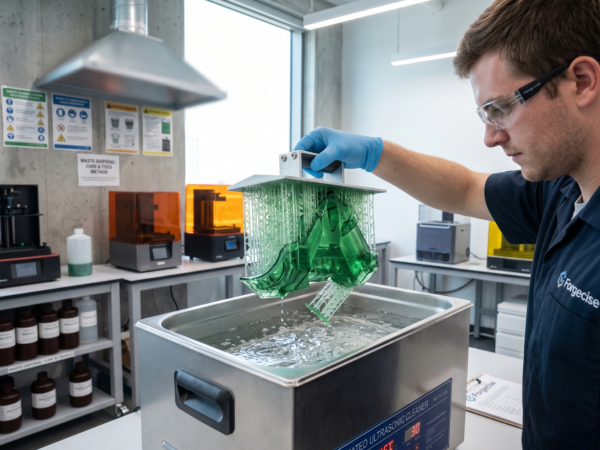
- Adding Sound: Industrial shops often use 40°C-50°C heat inside an ultrasonic cleaner. Mix in a solution like Mean Green, and supports basically fall off on their own after 10 minutes.
Clearing Up the “Water Softener” Confusion
Some people search for “does a water softener help 3D resin.” Let’s clear that up:
- Ion Exchange Resin: This is what goes inside a home water softener. It’s made of polystyrene beads. It is not the same as 3D printing resin.
- Softened Water for Rinsing: This is actually useful. Using water with the minerals removed for your final rinse prevents the “white clouding” or spots you sometimes see on clear prints.
Industrial Case Studies
- Splitvision: This team switched from scrubbing parts in IPA to using an automated system with heat and agitation. They cut their cleaning time from 30 minutes to 5 minutes per batch.
- DyeMansion: They use heat to prep the surface of parts for coloring. By hitting the right temperature, they ensure their dyes soak in perfectly.
Safety and 2026 Rules
In a business setting, you have to follow the rules:
- Gloves: Don’t use latex. Resin goes right through it. Use thick nitrile gloves that can handle both chemicals and heat.
- Air Quality: Heating resin makes fumes spread faster. You must have a fan system or carbon filters.
- Waste: In 2026, resin water is labeled as “acutely hazardous waste.”
- The Plan: Put your waste in 5-gallon jugs. Use the “Cure and Toss” method: shine a UV light on the waste water to harden the resin, filter out the plastic chunks, and then have a professional company take the liquid.
FAQ: What’s Trending in May 2026
Q: Should my business use “closed” printers like HeyGears or open systems?
Short Answer: It depends on if you want ease of use or low material costs.
Full Context: Closed systems like the Reflex RS Turbo are very reliable because they have built-in heaters. However, some people are frustrated that they have to pay for a PRM upgrade to use other resins. Most B2B users are choosing machines with heaters to keep their failure rates low.
Q: Why are my 16K or 24K prints sticking to the film (Slab Printing)?
Short Answer: Your resin is probably too cold.
Full Context: If the resin is cold, it gets thick. This creates too much suction. Keeping your resin at 25°C to 28°C using an internal heater usually fixes 90% of these problems.
Q: Is resin as toxic as people say?
Short Answer: It’s not a poison gas, but it will ruin your skin over time.
Full Context: You won’t die from one mistake, but “sensitization” is real. If you touch it too much, you can get permanent skin rashes. Wear your nitrile gloves and glasses.
Q: Should I cure my prints while they are under water?
Short Answer: Yes, it makes the surface much better.
Full Context: Oxygen in the air stops the resin from hardening perfectly, which is why parts feel sticky. Curing under water blocks that oxygen. It also keeps the part from getting too hot and warping during the final cure.
Q: How do I follow the new 2026 environmental laws for wash water?
Short Answer: Never use the drain and keep a paper trail.
Full Context: Most shops are “Small Quantity Generators.” You need to cure the resin in your water, filter it, and document where the waste goes. Don’t risk a fine.
Final Thoughts and Steps
If you want to make your shop more efficient:
- Watch the Heat: Keep your baths between 40°C and 50°C.
- Move Away from Manual Labor: Look into heated ultrasonic cleaners or automated SVC systems.
- Check Your Safety: Make sure your PPE and waste plans are up to the 2026 standards.
- Know Your Materials: Don’t soak water-washable resins as long as engineering resins.
Need help setting up an automated line? Talk to the Forgecise team today to see how we can help your production.