



- Author: Felix Lee, CEO at Forgecise
- Technical Reviewer: Dr. Aris Thorne, Lead Materials Scientist at Forgecise Research Labs
- Published: June 1, 2026
- Reading Time: 15 mins
- Category: Industrial Additive Manufacturing / Polymer Engineering
- Editorial Policy: This guide is peer-reviewed by industrial polymer chemists and SLA manufacturing engineers to ensure operational safety and scientific accuracy.
Table of Contents
1. Introduction: The Post-Processing Bottleneck in B2B Operations
In industrial stereolithography (SLA) and digital light processing (DLP) additive manufacturing, the spotlight is often shone on print speed and layer resolution. However, the true bottleneck to scaling production lies in post-processing. For enterprise-level manufacturers, medical device laboratories, and aerospace engineering service bureaus, post-printing operations account for a massive chunk of total labor costs, equipment wear, and part scrap rates.
When establishing standard operating procedures (SOPs) for high-performance photopolymers, one fundamental question divides operators on shop floors: “Do you cut resin print supports before or after curing?”
This is not merely a matter of convenience. It is a strategic trade-off between surface finish quality (optimized via pre-cure removal) and dimensional accuracy (guaranteed via post-cure removal), governed directly by polymer chemistry and mechanical stresses. This guide provides the data your facility needs to standardize its SLA post-processing sequence, increase B2B throughput, and eliminate costly scrap rates.
2. The Science: Green State vs. Fully Polymerized State
To evaluate support removal sequencing, let’s look at the physical and microstructural transition of photopolymers during printing.
+--------------------------------------------------------------+
|                    PRINT COMPLETED                           |
+--------------------------------------------------------------+
                               |
                               v
                     "GREEN STATE" PART
         - $50\% \text{ to } 70\%$ Crosslinking Density
         - Lower Elastic Modulus ($E$)
         - Lower Tensile Strength ($\sigma_t$)
         - High Elongation at Break (Ductility)
                               |
            +------------------+------------------+
            |                                     |
            v (Pre-Cure Removal)                  v (Post-Cure Removal)
+----------------------------------+   +----------------------------------+
|      GREEN STATE SUPPORT CUT     |   |      UV & THERMAL POST-CURE      |
|  - Minimal force needed          |   |  - Drives final crosslinking     |
|  - Plastic deformation           |   |  - Support acts as rigid jig     |
|  - Clean separation at boundary  |   |  - Minimizes part warpage        |
+----------------------------------+   +----------------------------------+
            |                                     |
            v                                     v
+----------------------------------+   +----------------------------------+
|      UV & THERMAL POST-CURE      |   |       POST-CURE SUPPORT CUT      |
|  - Volumetric shrinkage may      |   |  - High brittle resistance       |
|    warp unconstrained walls      |   |  - Risk of fracture propagating  |
|  - Cured surface is pristine     |   |    deep into nominal part wall   |
+----------------------------------+   +----------------------------------+
What is the “Green State”?
Upon completion of the SLA or DLP printing process, the part is in its “green state.” At this stage, the photopolymer has achieved only $50\%$ to $70\%$ of its theoretical maximum crosslinking density.
In this green state, the polymer network is highly ductile and compliant, characterized by:
- A lower Elastic Modulus ($E$)
- Lower Tensile Strength ($\sigma_t$)
- High Elongation at Break
The polymer chains are loosely bound, containing unreacted monomers and oligomers trapped within the partially crosslinked macromolecular matrix.
What Happens During Final Post-Curing?
Once the green part is subjected to final post-curing, a combination of intensive ultraviolet (UV) light exposure and thermal energy drives the remaining unreacted functional groups to polymerize.
This final crosslinking step:
- Maximizes crosslinking density and material hardness.
- Significantly increases the Ultimate Tensile Strength (UTS).
- Elevates the material’s Glass Transition Temperature ($T_g$).
- Drastically reduces material ductility, shifting its mechanical behavior toward high brittleness.
Why Polymer Chemistry Dictates How Supports Break
The radical difference in mechanical properties between these two states directly dictates how support contact points fail under mechanical shear force:
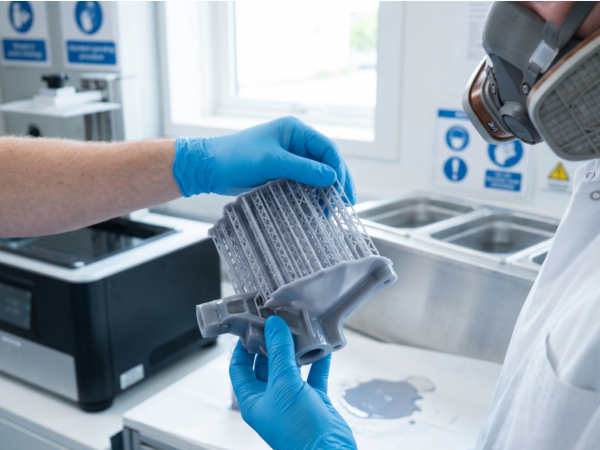
- Pre-Cure (Green State) Support Failure: Because the green polymer is highly ductile and possesses low shear resistance, the narrow contact tips fail via clean plastic deformation under low shear forces. The tear is localized, separating precisely at the nominal part boundary.
- Post-Cure (Fully Polymerized) Support Failure: After full post-curing, the highly crosslinked, rigid, and brittle network resists shear. When mechanical force is applied to fully cured supports, the structural stress cannot be relieved by plastic deformation. Consequently, the resulting fracture propagates past the support boundary and deep into the nominal part surface, leaving behind structural divots, craters, micro-cracks, and severe surface scarring.
3. Head-to-Head Comparison: Pre-Cure vs. Post-Cure Support Removal
To systematically compare both protocols, industrial facilities should evaluate performance across seven critical mechanical, operational, and regulatory parameters:
| Performance Parameter | Green-State (Pre-Cure) Support Removal | Fully Polymerized (Post-Cure) Support Removal |
| Polymer Microstructure | Partially crosslinked network ($50\%\text{–}70\%$ polymerization). | Fully crosslinked, dense thermodynamic network. |
| Mechanical Properties | High ductility, low tensile strength, low shear resistance. | High hardness, elevated brittleness, high elastic modulus. |
| Surface Finish Roughness ($Ra$) | Superior; ductile tear leaves minor raised protrusions (nubs) easily sanded. | Poor; brittle propagation leaves deep micro-pits, craters, and structural scars. |
| Risk of Dimensional Deformation | High for thin-walled, elastomeric, or high-aspect-ratio components. | Low; support lattice acts as a constraint against curing-induced shrinkage. |
| Solvent Lifetime & Efficiency | Maximized; stripping supports early prevents excess resin from contaminating IPA baths. | Reduced; complex support structures trap liquid resin, saturating solvent baths rapidly. |
| Tooling Lifespan | Long; minimal force required, preserving hand cutters and automated blades. | Short; high abrasive wear on steel blades and nippers due to cured resin hardness. |
| Regulatory & Operator Safety | Requires strict PPE protocols due to direct handling of uncured sensitizers. | Highly safe; fully inert polymer handles easily with basic industrial protection. |
4. Real-World B2B Case Studies: How Industrial Sectors Decide
On professional manufacturing platforms like LinkedIn and dedicated additive manufacturing engineering forums, production managers share real-world data regarding support removal sequencing. These case studies show how different industrial sectors balance aesthetic part quality against operational labor costs.
Scenario A: High-Volume Dental and Jewelry Prototyping (The Case for Pre-Cure)
In dental laboratories producing high-volume orthodontic arches, surgical guides, and casting patterns, minimizing the manual finishing labor per part is essential to protecting profit margins.
- The Workflow:
- The printed parts, still attached to their support webs, are retrieved from the build plate.
- They undergo a primary “dirty” solvent wash to remove bulk liquid resin.
- The parts are then immersed in a heated bath of water or mild industrial detergent maintained at $40^\circ\text{C}$ to $50^\circ\text{C}$ for approximately 30 to 60 seconds.
- The Scientific Reason: This thermal immersion temporarily plasticizes the green resin, further lowering its yield strength.
- The Operational Result: Technicians can peel the entire support lattice away in a single, fluid manual motion without using hand cutters, leaving a smooth surface with minimal nub marks. After a final clean solvent rinse and complete drying, the parts are post-cured.
“By switching to a pre-cure thermal peeling workflow, we reduced our individual part manual finishing times by over$80\%$. This represents massive labor savings and completely eliminated our hand cutter replacement costs.”
— Felix Lee, CEO at Forgecise
Scenario B: Precision Mechanical and Aerospace Components (The Case for Post-Cure)
Conversely, B2B engineering service bureaus specializing in functional mechanical jigs, aerospace components, and tight-tolerance mating parts must focus on dimensional stability over surface finish.
- The Problem: During the UV and thermal post-curing stages, SLA resins undergo an isotropic volumetric shrinkage of $2\%$ to $4\%$. This shrinkage generates high internal tensile stresses. If the support structures are removed prior to post-curing, unconstrained thin walls, hollow chambers, or high-aspect-ratio features will warp, sag, or bow under these stresses, falling outside of critical dimensional tolerances.
- The Workflow:
- To prevent warpage, the support lattice is left completely intact during the post-curing cycle.
- The cured, highly rigid support structures act as an integrated manufacturing fixture (jig), constraining the component and absorbing shrinkage stresses evenly.
- Once the polymer network is fully cured, stabilized, and cooled, technicians use precision flush cutters, miniature saws, or CNC mills to remove the supports.
- The remaining contact points are completed with manual or CNC sanding.
- The Operational Result: While this post-cure workflow increases labor time and tool wear, it is mandatory to maintain specified tolerances of $<\pm 0.1\text{ mm}$.
5. Optimizing Slicer Parameters for Flawless Support Removal
If your facility is transitioning to a highly efficient pre-cure peeling workflow, you must optimize your support interface parameters in your slicing software (such as Chitubox, Formware, or PreForm). This ensures structural stability during printing while minimizing the force needed for manual peeling.
| Slicer Parameter | Recommended Value for Pre-Cure Removal | Technical Function & B2B Application |
| Contact Point Diameter | $0.30\text{ mm to } 0.45\text{ mm}$ (cf. [Formlabs Design Guides, 2024]) | Minimizes the surface area of the joint, ensuring a clean shear failure rather than a tensile rip. |
| Penetration Depth | $0.10\text{ mm to } 0.15\text{ mm}$ (cf. [Chitubox Enterprise Specs, 2025]) | Prevents the support tip from anchoring too deeply into the model wall, avoiding surface divots. |
| Contact Geometry | Reduced Ball / Spherical Contact | Focuses the stress concentration exactly at the contact point, allowing the support to pop off cleanly. |
| Support Structure | Grid or Cross-Webbed Lattice | Groups individual support columns together, enabling them to be peeled away as a single cohesive unit. |
6. B2B Strategic Decision Matrix: Standardizing Your Post-Processing SOP
To maximize efficiency on the shop floor, industrial print facilities should categorize parts into three distinct performance tracks, each governed by its own detailed Standard Operating Procedure (SOP).
                             PART CLASSIFICATION
                                      |
            +-------------------------+-------------------------+
            |                         |                         |
            v                         v                         v
    [ AESTHETIC / PROTO ]      [ PRECISION ENG. ]       [ ELASTOMERIC / FLEX ]
            |                         |                         |
            v                         v                         v
   SOP 1: PRE-CURE THERMAL   SOP 2: POST-CURE JIG      SOP 3: HYBRID POST-CURE
   - 30s Primary Wash        - Multi-stage Wash        - Multi-stage Wash
   - 45s Heat Bath ($45^oC$) - Dry completely           - Dry completely
   - Manual Peel             - Full Post-Cure          - Partial Post-Cure ($30\%$)
   - Secondary Rinse & Dry   - Precision Cut           - Delicate Blade Cut
   - Final Post-Cure         - CNC/Manual Sand         - Complete Final Post-Cure
Track 1: Aesthetic / Prototype Models
- Examples: Consumer goods housings, dental study models, architectural mockups.
- Primary Requirement: Pristine surface finish ($Ra < 1.6\ \mu\text{m}$), minimum post-print manual labor.
- Recommended Protocol: Pre-Cure Removal with Thermal Softening
- Detailed 5-Step SOP:
- Primary Wash: Submerge part and supports in a primary “dirty” solvent wash (IPA) for 30 seconds to remove bulk resin.
- Thermal Softening: Submerge the unwashed supports and part in a heated bath of water or mild detergent maintained at $45^\circ\text{C}$ for 45 seconds.
- Peeling: Manually peel the softened support lattice away from the part as a single cohesive unit.
- Secondary Wash & Dry: Submerge the unsupported model in a high-purity, clean solvent wash (IPA) for a final cleaning, then blow dry with compressed air.
- Final Post-Cure: Post-cure the clean, unsupported model in a UV chamber according to the resin manufacturer’s technical data sheet.
Track 2: Precision Engineering Components
- Examples: Mating parts, manifolds, aerospace brackets, tooling fixtures.
- Primary Requirement: High dimensional accuracy (tolerances $<\pm 0.1\text{ mm}$), minimal warp.
- Recommended Protocol: Post-Cure Removal (Support as Jig)
- Detailed 5-Step SOP:
- Multi-Stage Wash: Wash the complete part and support structure through a standard multi-stage solvent cleaning sequence to ensure zero surface residue.
- Dry: Blow-dry the assembly completely with compressed air to remove all solvent.
- Post-Cure: Place the assembly directly into the UV/thermal post-curing chamber. Curing with the support lattice intact prevents shrinkage-induced warpage.
- Precision Cutting: Once cooled to room temperature, use precision mechanical flush cutters or miniature saws to carefully detach the supports.
- Sanding: Finish the remaining contact points using manual sanding blocks or CNC finishing mills to meet nominal dimension specifications.
Track 3: Elastomeric & Flexible Parts
- Examples: Gaskets, seal prototypes, anatomical medical models.
- Primary Requirement: Tear prevention, complete curing of complex internal cavities.
- Recommended Protocol: Hybrid Post-Cure Removal
- Detailed 5-Step SOP:
- Multi-Stage Wash: Execute a thorough multi-stage solvent wash to remove sticky liquid resin from complex flexible geometries.
- Dry: Air-dry completely.
- Partial Post-Cure: Place the part in the UV curing chamber for exactly $30\%$ of its standard recommended cycle time. This partially stabilizes the elastic properties while avoiding extreme brittleness.
- Delicate Cutting: Remove the supports using a highly sharp, thin-profile scalpel or blade. The partial cure prevents tearing of the soft elastomer while keeping cutting forces manageable.
- Complete Final Post-Cure: Return the unsupported part to the UV chamber to complete the remaining $70\%$ of the curing cycle, ensuring optimal material properties.
7. Technical Questions & Answers
Q1: How does support removal sequencing affect volumetric shrinkage and dimensional warpage in high-performance engineering resins?
Direct Answer: Removing supports prior to post-curing causes thin-walled or high-aspect-ratio SLA components to warp under internal shrinkage stresses. Keeping supports intact during curing acts as a rigid jig that constraints the part and prevents non-uniform deformation.
In high-performance engineering resins (such as those engineered for functional testing, high-temperature resistance, or tooling), volumetric shrinkage during UV post-curing is the leading cause of part distortion and rejection. When UV radiation and thermal energy initiate final crosslinking, the polymer chains draw closer together, generating high internal tensile stresses.
If the support structures are removed prior to post-curing, the partially polymerized green part lacks the mechanical stiffness (elastic modulus $E$) to resist these internal forces. As a result, the unconstrained geometry undergoes non-uniform deformation, resulting in warpage, curling, or bowing.
To determine the best approach, engineering teams must evaluate the component’s geometric aspect ratio and wall thickness:
- For thin-walled enclosures, long cantilevered structures, or parts with strict assembly tolerances, the support lattice should remain fully intact during post-curing to serve as a physical constraint.
- For bulky, solid, or self-supporting geometries where the internal mass of the part naturally resists deformation, pre-cure support removal is preferred to protect the surface finish from brittle scarring.
Q2: What is the optimal solvent wash sequence to maximize isopropyl alcohol (IPA) lifespan when removing supports pre-cure?
Direct Answer: You can extend solvent life by up to $50\%$ using a dual-bath sequence: wash the entire printed structure briefly in a “dirty” tank, remove the supports in their green state, and then wash only the final model in a high-purity “clean” tank.
A major operational cost in industrial SLA printing is solvent consumption, specifically Isopropyl Alcohol (IPA). Washing parts with their extensive, complex support lattices intact introduces a large volume of non-functional surface area coated in uncured liquid resin into the wash system. This rapidly saturates the solvent, requiring frequent chemical replacement and increasing hazardous waste disposal costs.
To optimize solvent life, professional operators must implement a multi-bath wash sequence:
- Primary Wash (“Dirty Tank”): The part and its supports undergo a brief 30-second primary wash in a “dirty” solvent tank to remove the bulk of the liquid resin.
- Support Removal: The supports are immediately removed in their soft, green state.
- Secondary Wash (“Clean Tank”): Because the removed supports are discarded, they do not undergo the secondary, high-purity solvent wash. Only the unsupported model is placed into the clean solvent bath for its final cleaning.
This practice keeps highly concentrated resin out of the secondary tanks, extending the operational life of the clean solvent by up to $50\%$.
Q3: What are the precise temperature and chemical limits for using thermal baths to soften green-state supports?
Direct Answer: Soften green-state supports in a heated bath maintained strictly between $40^\circ\text{C}$ and $50^\circ\text{C}$ for less than 60 seconds. Exceeding $50^\circ\text{C}$ causes the green polymer to sag, while excessive water exposure causes hydrophilic resins to swell and crack.
Thermal pre-treatment is widely used to facilitate easy support removal, but it must be tightly controlled to prevent component damage. Immersing a green print in warm water or applying hot air temporarily plasticizes the partially polymerized material, lowering its yield strength. The optimal temperature range for this process is $40^\circ\text{C}$ to $50^\circ\text{C}$.
If the temperature of the bath or air stream exceeds $50^\circ\text{C}$, the green resin can reach its heat deflection temperature (HDT), causing fine details to sag and inducing permanent geometric distortion.
Furthermore, operators using water-washable or highly hydrophilic resins must limit immersion times to under 60 seconds. Extended exposure to water causes these green resins to absorb moisture, leading to internal swelling, surface peeling, and cracking during subsequent UV curing. For these moisture-sensitive materials, using a low-temperature hair dryer or a dry heat chamber is a safer, dry alternative to water baths.
Q4: Why do original equipment manufacturers (OEMs) recommend post-cure support removal, while industrial operators prefer pre-cure removal?
Direct Answer: OEMs focus on safety and liability, recommending post-cure removal so users only handle fully polymerized, non-toxic plastics. Conversely, industrial operators utilize trained staff and robust PPE to perform pre-cure removals, optimizing workflow speeds and final surface finishes.
This divergence in recommendations is due to different operational priorities and regulatory standards.
- OEM Perspective (Compliance and Liability): OEMs (such as Formlabs or Elegoo) design their standard operating procedures to comply with strict international safety standards, such as REACH and OSHA. Uncured photopolymer resins contain acrylates, methacrylates, and photoinitiators, which are known dermal sensitizers, skin irritants, and hazardous materials. Recommending that users post-cure the print with supports intact ensures that the end-user only handles fully polymerized, non-toxic plastic during support removal, minimizing chemical exposure and legal liability.
- Industrial Operator Perspective (Efficiency and Quality): Professional B2B facilities operate with trained technicians, standardized engineering controls, and robust PPE protocols. For these operations, the commercial benefits of pre-cure support removal—such as reduced manual finishing, faster throughput, and better surface quality—outweigh the managed risk of handling green parts under controlled conditions.
Q5: How can I adjust slicer parameters to facilitate clean pre-cure support separation?
Direct Answer: Optimize your slicer settings by lowering contact point diameters to $0.30\text{–}0.45\text{ mm}$, keeping penetration depths between $0.10\text{–}0.15\text{ mm}$, switching to spherical contact geometries, and utilizing cross-webbed lattices.
To transition post-processing lines from manual clipping to rapid peeling, support interfaces must be optimized within the slicing software (such as Chitubox, Formware, or PreForm). Modifying key contact parameters reduces the mechanical force required to separate the support from the part surface while ensuring the print remains stable during the build cycle.
- Reduce Contact Point Diameter: Lower this parameter to between $0.30\text{ mm and } 0.45\text{ mm}$. This minimizes the surface area of the joint, ensuring a clean shear failure rather than a tensile rip.
- Control Penetration Depth: Maintain this value between $0.10\text{ mm and } 0.15\text{ mm}$. This prevents the support tip from anchoring too deeply into the model wall, avoiding surface divots.
- Use Spherical Contact Geometry: Select “Spherical” or “Reduced Ball” contact. This focuses the stress concentration exactly at the contact point, allowing the support to pop off cleanly.
- Utilize Grid or Cross-Webbed Lattice Support Structures: Grouping individual support columns together allows the entire structure to be peeled away as a single cohesive unit, speeding up pre-cure processing.
8. Implementing Post-Processing Excellence
By establishing these standardized post-processing routes, enterprise additive manufacturing facilities can balance the trade-offs of the technology.
Pre-cure support removal—supported by controlled thermal softening—should serve as the default workflow for the majority of production to optimize throughput, extend tool life, and achieve superior surface quality.
For the remaining production that requires high dimensional precision, retaining the supports through the post-cure process provides the necessary structural constraint to prevent warping and meet tight tolerances. Standardizing these steps helps B2B shops reduce labor costs, minimize chemical waste, and run SLA and DLP systems at peak performance.
Let’s Connect
How does your team handle support removal in your facility? Are you facing warping challenges with engineering resins? Reach out to our engineering team at Forgecise for a post-processing audit to optimize your production throughput and reduce resin waste.
Disclaimer: Standardizing post-processing workflows requires appropriate PPE, including nitrile gloves, safety glasses, and organic vapor respirators when handling uncured photopolymer resins.