



- Author: Felix Lee (CEO, Forgecise)
- Published: May 20, 2026
- Read Time: 15 Minutes
- Target Audience: Design Engineers, Hardware Sourcing Managers, AM Operators, and Procurement Officers
- Key Topics: Industrial Vat Photopolymerization, SLA vs FDM, Mechanical Taxonomy, Case Studies, E-E-A-T Additive Manufacturing Guidelines
Author’s Note (Felix Lee, CEO at Forgecise):
“In industrial manufacturing, the question ‘What is the strongest resin for 3D printing?’ is one of the most common—and most frequently misunderstood—inquiries we receive. True mechanical performance is never defined by a single number on a datasheet. It is the result of matching specific chemical networks with physical stress profiles, thermal limits, and environmental realities. This guide compiles the fundamental chemistry, real-world data, and case studies to help engineering teams source and execute high-strength photopolymerization programs at scale.”
Table of Contents
1. Introduction: The Misconception of “Strength” in Additive Manufacturing
In the search for the strongest resin for 3d printing, engineers often make the mistake of looking at a single datasheet value, such as tensile strength, and assuming it correlates directly to part longevity. In real-world applications, choosing a material based solely on a high ultimate tensile strength ($\text{UTS}$) frequently leads to catastrophic part failure.
To find a truly reliable high-strength photopolymer, we must move past marketing buzzwords and examine the distinct mechanical behaviors governed by polymer cross-linking density, monomer structures, and polymer backbone stiffness.
Why Vat Photopolymerization?
Modern industrial 3D printing relies on vat photopolymerization technologies—including Stereolithography (SLA), Digital Light Processing (DLP), and Digital Light Synthesis (DLS)—to convert liquid monomers into high-performance thermoset plastics. Unlike thermal-extrusion methods, the chemical formulation of the photopolymer determines the mechanical capabilities of the final part. Understanding how these chemical structures perform under different mechanical stresses is key to selecting the right material.
2. The Mechanical Taxonomy of “Strength” in Photopolymer Chemistry
To select the correct material for functional prototypes or end-use parts, design engineers must categorize “strength” into three distinct mechanical profiles based on polymer chemistry.
                     ┌────────────────────────────────────────┐
                     │  Photopolymer Mechanical Profiles      │
                     └───────────────────┬────────────────────┘
                                         │
         ┌───────────────────────────────┼──────────────────────────────┐
         ▼                               ▼                              ▼
┌──────────────────┐           ┌──────────────────┐           ┌──────────────────┐
│  High-Strength   │           │ Tough (Impact)   │           │ Hardness (Wear)  │
│  (Rigid) Resins  │           │  Resins          │           │  Resins          │
└────────┬─────────┘           └────────┬─────────┘           └────────┬─────────┘
         │                              │                              │
         ├─ High static load            ├─ Energy absorption           ├─ Surface durability
         ├─ High Tensile/Flex           ├─ Aliphatic chains            ├─ Scratch resistant
         └─ Brittle trade-off           └─ Elongation > 70%            └─ Low impact strength
A. High-Strength (Rigid) Resins
- Primary Application: Carrying heavy static loads.
- Chemical Structure: These formulations feature highly cross-linked polymer matrices. This dense network exhibits high tensile strength, high flexural strength, and a high Young’s modulus (elastic modulus).
- Performance Profile: Under static mechanical stress, rigid resins experience minimal deflection, making them exceptional for maintaining high dimensional accuracy in structural brackets, mounting jigs, and robotic frames.
- The Critical Trade-Off: The dense molecular cross-linking that provides stiffness also results in a low elongation at break, typically below $10\%$. This makes the material brittle, making it prone to sudden cracking or shattering when subjected to dynamic impacts, shock loads, or stress concentrations at sharp corners.
B. Tough (Impact-Resistant) Resins
- Primary Application: Energy absorption and cyclic physical stress.
- Chemical Structure: Tough formulations lower the cross-linking density by incorporating long-chain monomers, aliphatic segments, or flexible polyurethane oligomers into the polymer backbone.
- Performance Profile: While tough resins have a lower absolute tensile strength compared to rigid resins, they excel at resisting impact and stopping crack propagation. Under strain, the cured polymer undergoes plastic deformation (bending and stretching) rather than sudden brittle fracture.
- Best For: Snap-fit assemblies, protective enclosures, hand-held devices, and functional components prone to dropping.
C. High-Hardness (Wear-Resistant) Resins
- Primary Application: Surface durability and abrasion resistance.
- Chemical Structure: Highly dense, tightly cross-linked networks designed to resist localized indentation.
- Performance Profile: These materials resist scratching, surface wear, and localized forces. However, surface hardness is mechanically distinct from bulk toughness; hard resins are typically brittle and have low resistance to impact.
Isotropic Advantages over FDM Thermoplastics
A primary reason industrial engineering teams transition to vat photopolymerization is the mechanical isotropy of the printed parts. Extrusion-based technologies like Fused Deposition Modeling (FDM) suffer from poor inter-layer adhesion along the vertical ($Z$-axis), creating built-in failure lines under load.
By contrast, SLA, DLP, and DLS parts achieve continuous chemical bonding across layers. This ensures that tensile, flexural, and compressive properties remain highly uniform in all print directions across the $X$, $Y$, and $Z$ axes.
3. Quantitative Mechanical Analysis: Benchmarking Leading B2B Resins
Selecting the strongest resin for 3d printing requires comparing standard mechanical properties verified via ASTM testing methods. The table below lists the mechanical specifications of certified, B2B-grade engineering resins, categorized by their primary thermoplastic target profiles.
Comparative Materials Analysis Table
| Material Brand & Grade | Tensile Strength (MPa) | Tensile Modulus (MPa) | Elongation at Break (%) | Flexural Modulus (MPa) | Notched Izod Impact (J/m) | HDT @ 0.45 MPa (∘C) | Primary Target Thermoplastic |
| BASF Ultracur3D RG 1100 B | $70 – 111$ | $2900 – 3080$ | $5$ | $2695 – 2880$ | $16$ | $114 – 116$ | Glass-Filled Nylon / PBT |
| Carbon EPX 82 (Epoxy) | $82 – 84$ | $2800$ | $5.9 – 8$ | $3000$ | $44$ | $104 – 130$ | Glass-Filled PBT / Nylon |
| Formlabs Tough 2000 V2 | $40.4$ | $1800$ | $79$ | N/A | $79$ | $70$ | Acrylonitrile Butadiene Styrene (ABS) |
| Loctite 3D 3172 (Grey) | $37 – 41$ | $1476 – 1550$ | $91 – 119$ | $1053 – 1365$ | $67 – 79$ | $50 – 52$ | Polypropylene (PP) |
| Loctite IND405 (Clear) | $45$ | $1434$ | $101$ | $1383$ | N/A | $52.8$ | Unfilled Polypropylene (PP) |
Detailed Analysis by Material Category
The Rigid Champions: BASF RG 1100 B & Carbon EPX 82
For structural rigidity and static load support, BASF Ultracur3D RG 1100 B and Carbon EPX 82 represent the performance standard for rigid photopolymers.
- Stiffness: With flexural moduli reaching up to $3000\text{ MPa}$, these resins undergo minimal deflection under stress. This makes them ideal for manufacturing structural enclosures, heavy-duty brackets, and electrical connectors.
- Secondary Operations: Unlike standard brittle resins, these high-stiffness industrial formulations can be machined, tapped, and drilled to accept threaded brass inserts, enabling secure secondary assembly operations.
The Ductile/Impact Performers: Loctite 3172, Loctite IND405, & Formlabs Tough 2000 V2
When parts are subjected to dynamic impact or continuous cyclic stress, ductile engineering resins are required to prevent structural cracking.
- Formlabs Tough 2000 V2: This formulation mimics the performance of ABS, showing an elongation at break of $79\%$ and an unnotched Izod impact strength of $208\text{ J/m}$. These properties allow the part to absorb sudden energy without fracturing.
- Loctite 3D 3172 & IND405: Mimicking Polypropylene ($\text{PP}$), these resins offer superior elasticity. Loctite 3D 3172 achieves an elongation at break of over $100\%$ and maintains its mechanical integrity after $800\text{ hours}$ of accelerated outdoor weathering, making it suitable for automotive under-the-hood components, gaskets, and industrial assembly aids.
4. B2B Case Studies: Scaling High-Strength Resins to End-Use Production
The transition of vat photopolymerization from rapid prototyping to validated end-use production is demonstrated across several documented B2B case studies.
Case Study 1: Digital Inventories & On-Demand Production (IMS Verbindungstechnik)
- The Challenge: IMS Verbindungstechnik, a supplier of industrial fastening systems, struggled with high manufacturing costs and long lead times when delivering low-volume custom runs or replacement parts for the automotive aftermarket. Physically stocking these components was inefficient, and traditional injection molding was cost-prohibitive due to steel tooling expenses.
- The Solution: IMS partnered with Henkel’s Loctite 3D team to develop a proprietary, high-performance SLA resin capable of replacing approximately $90\%$ of their plastic components. This single, multipurpose material eliminated the need to purchase and stock multiple different liquid products.
- The Result: By May 2025, IMS converted its physical inventory of over $100$ low-volume SKUs into a digital catalog of validated print “recipes.” Working with the Würth Additive Group, IMS licenses these print recipes directly to customers. This digital inventory allows clients with compatible SLA hardware to manufacture approved clips in-house on demand, eliminating shipping delays, lowering warehousing costs, and reducing carbon emissions.
Case Study 2: Lightweighting & Extreme Durability in Defense (U.S. Air Force)
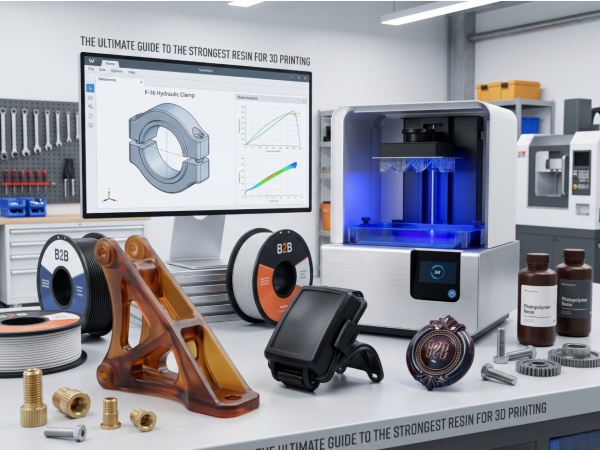
- The Challenge: The U.S. Air Force faces persistent supply chain bottlenecks when sourcing replacement parts for aging aircraft. In F-16 fighter jets, thousands of C3175-series hydraulic line clamps—originally machined from phenolic materials that off-gassed toxic formaldehyde—frequently fail due to environmental chemicals, thermal cycling, and high landing gear vibrations.
- The Solution: nTopology and Stress Engineering Services collaborated with Stratasys to redesign the clamp for production on the Origin One DLP printer. They selected Loctite 3D 3955 FST, a halogen-free, flame-retardant photopolymer with a high heat deflection temperature and UL 94 V-0 certification.
- The Dual-Material Strategy: The redesigned clamp features a rigid structure made of Loctite 3D 3955 for structural support, integrated with a flexible elastomer tether printed from Loctite IND402 to simplify installation within crowded landing gear cavities.
  +-----------------------------------------------------------------+
  |                  Optimized F-16 Hydraulic Clamp                 |
  |                                                                 |
  |  +--------------------+                   +--------------------+  |
  |  |  Rigid Clamp Half  |===================|  Rigid Clamp Half  |  |
  |  | (Loctite 3D 3955)  |  Flexible Tether  | (Loctite 3D 3955)  |  |
  |  +--------------------+  (Loctite IND402) +--------------------+  |
  +-----------------------------------------------------------------+
- The Result: The optimized, 3D-printed assembly doubled the strength of the original legacy clamp while reducing its weight. Production throughput on a single Stratasys Origin One reached $54$ clamp halves in $24\text{ minutes}$, translating to an on-demand manufacturing capacity of $1,296$ parts per day.
Case Study 3: Chemical Resistance & Luxury Aesthetics (Albéa & Erpro Group)
- The Challenge: Luxury cosmetics packaging must combine premium surface finishes with high chemical durability. Cosmetics manufacturer Albéa needed to produce a detailed decorative badge for its luxury “Sis” perfume bottles. The component had to withstand continuous chemical exposure from the perfume’s essential oils and solvents, while resisting scratching or cracking if dropped.
- The Solution: Albéa partnered with the Erpro Group, utilizing Carbon’s DLS platform and EPX 82 epoxy resin. EPX 82 was selected for its long-term chemical resistance, surface durability, and functional toughness.
- The Result: By utilizing Carbon’s digital light synthesis platform, Albéa developed and produced five design iterations in two weeks, bypassing the expensive steel tooling phase. Production scaled rapidly to manufacture $12,000$ end-use badges, demonstrating that high-performance resins can meet both aesthetic and functional demands.
Case Study 4: Overcoming the Post-Processing Bottleneck (PostProcess Technologies & Empire Group)
- The Challenge: Vat photopolymerization parts emerge from the printer covered in sticky, uncured liquid monomer. Manual hand-washing in Isopropyl Alcohol (IPA) is slow, presents safety hazards, and risk damaging delicate, thin-walled structures.
- The Solution: PostProcess Technologies deployed automated resin removal solutions (such as the DEMI 4100, DEMI 830, and specialized PLM-403-SUB chemistry) for service providers like the Empire Group.
- The Result: This software-driven post-print method reduced average SLA resin removal times by over $50\%$ while protecting fine-featured geometries, ensuring consistent surface finishes, and maintaining dimensional stability across production batches.
5. Engineering Best Practices: Designing and Sourcing for High-Strength Printing
Integrating high-strength photopolymers into an industrial workflow requires adhering to specific engineering rules across hardware selection, post-curing, part design, and workplace safety.
1. Sourcing and Printing High-Viscosity Resins
Many high-strength and tough engineering photopolymers (such as Loctite 3D 3172 and IND405) have high liquid viscosities, ranging from $1750\text{ cP}$ to over $2400\text{ cP}$ at $25^\circ\text{C}$. High viscosity slows down the flow of resin back under the build platform between layers, which can cause suction failures, delamination, and print voids.
- Hardware Requirement: To print these materials reliably, B2B users must utilize printers with active vat heating capable of maintaining temperatures between $30^\circ\text{C}$ and $60^\circ\text{C}$. Active heating lowers the resin’s viscosity, increases flowability, and ensures consistent layer adhesion and fine feature reproduction.
2. Calibrating UV and Thermal Post-Curing Cycles
SLA, DLP, and DLS parts emerge from the print chamber in a “green state,” with incomplete polymer cross-linking and up to $30\% – 40\%$ unreacted chemical groups. To reach the mechanical properties specified on their technical datasheets, parts must undergo a validated post-cure cycle.
- Risk of Imprecision: Under-cured parts remain soft and experience high creep under load, while over-curing degrades the polymer chains, making parts brittle.
- Actionable Best Practice: Post-curing units must be calibrated to the specific wavelengths (typically $385\text{ nm}$ or $405\text{ nm}$) and temperatures recommended by the resin manufacturer.
3. Mechanical Design Adaptation for Resins (Stress Mitigation)
Standard injection molding rules must be adapted when designing parts for photopolymerization:
- Apply Radiused Fillets: Avoid sharp internal corners. Rigid engineering resins are notch-sensitive, and sharp corners act as concentration points for stress. Maintain an internal radius of at least $1.5\text{ mm}$ to distribute forces evenly across the assembly.
- Incorporate Threaded Inserts: While engineering resins like EPX 82 can be tapped directly, high-stress assemblies should use brass threaded inserts. These inserts should be heat-set or pressed into molded receiving holes rather than being driven directly, which helps prevent hoop-stress cracking.
- Orient for Peel Force Mitigation: Position large flat surfaces at an angle (typically $30^\circ – 45^\circ$) relative to the build plate. This reduces the surface area of each layer, minimizing the peel forces exerted on the part during layer release and preventing layer separation.
4. EHS & Regulatory Compliance in Industrial Workspaces
Industrial-scale resin printing requires strict adherence to environmental, health, and safety (EHS) guidelines:
- Negative-Pressure Ventilation: Liquid resins and solvent washes release volatile organic compounds (VOCs) that can cause sensory irritation and chemical sensitization. Workspaces must be equipped with dedicated, externally vented extraction systems or negative-pressure hoods.
- Isolate Workstations: Use automated wash and cure systems to isolate operators from direct solvent and chemical contact.
- Hazardous Waste Management: Solvents like IPA containing uncured resin must be treated as hazardous waste. They should never be poured down municipal drains. Solvents must be collected and disposed of through licensed waste management channels, or cured under UV light to solidify the suspended photopolymer before disposal in a sanitary landfill.
6. FAQ: Debunking Technical Myths on the Strongest Resins for 3D Printing
Q1: Tensile Modulus vs. Elastic Elongation — What Constitutes True Operational “Strength”?
Short Answer: True mechanical strength depends entirely on how stress is applied: static loads need a high tensile modulus (rigidity), while parts facing dynamic shock or vibration require high elastic elongation (toughness).
Many operators select high-strength resins based solely on high tensile strength numbers (e.g., $\ge 80\text{ MPa}$), only to experience catastrophic failures when parts are put into service. While rigid resins (like Carbon EPX 82 or BASF RG 1100 B) are excellent for static loads, they perform poorly under dynamic impact. For parts that undergo repeated handling, drop risks, or vibration, a tough resin with lower tensile strength but higher elongation (such as Loctite 3172 or Formlabs Tough 1500 V2) is often the more durable choice in practice.
Q2: Can Budget ABS-Like Formulations Match Certified B2B Polymers?
Short Answer: No, budget ABS-like resins lack the standardized ASTM testing, chemical resistance, and long-term mechanical stability required to match certified B2B engineering polymers.
While consumer-grade ABS-like resins (such as Sunlu ABS-Like or Anycubic ABS-Like Pro 2) offer high print reliability and low cost for visual prototyping, they are not suitable for certified end-use parts. Budget formulations lack the standardized testing datasheets, long-term UV weathering data, ISO biocompatibility certifications, and chemical resistance profiles provided by certified resins like Formlabs Tough 2000 V2 or Henkel Loctite 3172. Under sustained loads, budget resins also experience significant creep, which can lead to dimensional warping and part failure over time.
Q3: How Do I Prevent Brittle Fracture and Cracking During Mechanical Assembly?
Short Answer: Prevent assembly cracking by designing generous internal radii ($\ge 1.5\text{ mm}$), strictly following manufacturer post-curing schedules, or adding a small percentage of a compatible elastomeric resin to the mix.
To prevent assembly cracking during operations like press-fitting bearings or driving self-tapping screws, implement three strategies:
- Implement Generous Fillets: Ensure internal radii of at least $1.5\text{ mm}$ to reduce notch-sensitivity.
- Prevent Overcuring: Strictly follow manufacturer exposure times and temperatures to avoid degrading the polymer chain.
- Use Tough Elastomeric Blends: In open systems, mixing $10\% – 20\%$ of an elastomeric resin (such as Siraya Tech Tenacious or AmeraLabs TGM-7) into rigid or ABS-like resins provides a cost-effective way to increase elongation at break, making parts resilient enough to withstand assembly stress.
Q4: Are Water-Washable Resins Suitable for Functional Parts?
Short Answer: No, water-washable resins are highly vulnerable to absorbing ambient moisture, which degrades their mechanical properties and causes severe warping over time.
Water-washable photopolymers are unsuitable for functional mechanical parts. To make these resins soluble or dispersible in water, manufacturers must integrate hydrophilic glycol segments or ionic groups into the polymer matrix. These hydrophilic zones remain in the cured part, causing it to absorb ambient moisture from the air over time. This water absorption acts as a plasticizer, swelling part dimensions, causing severe warping, and rapidly reducing tensile strength and hardness. For B2B engineering applications, solvent-washed photopolymers are required to ensure long-term mechanical stability.
Q5: Closed Proprietary vs. Open Hardware Systems: Which is Better for Industrial Strength?
Short Answer: Closed systems offer turnkey reliability and pre-tuned material settings, while open systems provide the freedom to source advanced, cost-effective engineering photopolymers from third-party manufacturers.
Closed proprietary platforms (such as the Formlabs Form 4 or HeyGears Reflex RS Turbo) utilize validated print parameters and integrated temperature controls (e.g., active vat heating), which minimize print failures and eliminate manual calibration. However, they lock users into expensive proprietary resins. Open hardware platforms allow users to source high-performance, cost-effective industrial resins from third parties like Henkel Loctite or BASF, but they require extensive calibration and testing to dial in exposure settings and avoid print failures. The introduction of platforms like the HeyGears Reflex 2 Max at RAPID + TCT 2026 highlights a shift in the market, as manufacturers seek larger build volumes while trying to balance closed-system reliability with open-material flexibility.
7. Conclusion: Engineering the Perfect Mechanical Fit
Selecting the strongest resin for 3d printing is not a matter of finding the highest number on a datasheet; it is about matching the physical stress profile of your application with the correct photopolymer chemistry. Rigid resins like Carbon EPX 82 and BASF RG 1100 B provide the stiffness needed for high static loads, while ductile formulations like Loctite 3172 and Formlabs Tough 2000 V2 absorb impact and resist dynamic fatigue.
By applying design optimization rules—such as generous internal fillets, active vat heating for high-viscosity resins, and validated post-curing cycles—engineering teams can successfully transition vat photopolymerization from rapid prototyping to robust, end-use production.
Let’s Collaborate on Your Next Project
Are you currently evaluating high-strength resins for an industrial project, or trying to solve cracking issues during assembly? Leave a comment below with your design challenges, or reach out to our editorial team at Forgecise for a detailed engineering design review.