





- Author: Felix Lee, CEO at Forgecise
- Published: June 4, 2026
- Category: Industrial Hygiene, Additive Manufacturing, Workplace Safety
- Read Time: 12 mins
- Target Audience: B2B Stakeholders, Lab Managers, 3D Printing Operators, Dental/Medical Professionals, and Hardware Engineers
Executive Summary & Key Takeaways
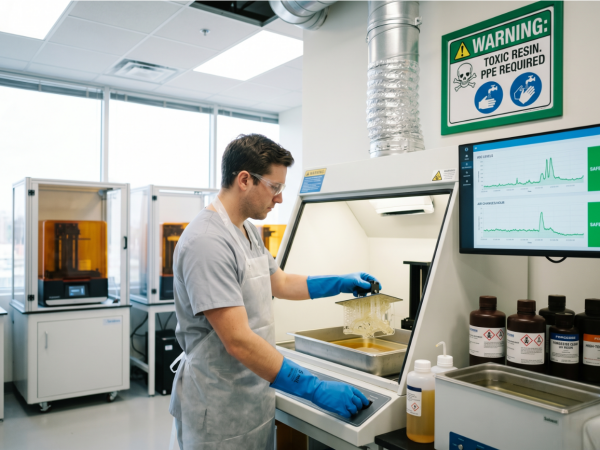
Is 3D printer resin toxic? Yes. In its liquid, unpolymerized state, photopolymer resin is highly toxic. It poses severe acute and chronic occupational risks, including cumulative skin sensitization (contact dermatitis), respiratory hazards from Volatile Organic Compounds (VOCs) and Ultrafine Particles (UFPs), and severe chemical burns. To mitigate these liabilities, commercial facilities utilizing SLA, DLP, or MSLA technologies must implement a strict multi-layered hazard control framework. This includes establishing negative-pressure local exhaust ventilation (LEV), maintaining$5\text{ to }10$Air Changes per Hour (ACH), enforcing the use of thick chemical-resistant nitrile gloves ($\ge 5\text{ mil}$), and strictly managing all liquid and contaminated wastes through federal hazardous waste (RCRA/EPA) channels.
1. Introduction: The Unseen Liabilities of High-Resolution 3D Printing
The use of vat photopolymerization technologies—including Stereolithography (SLA), Digital Light Processing (DLP), and Masked Stereolithography (MSLA)—has expanded rapidly within dental clinics, medical laboratories, engineering design offices, and industrial manufacturing spaces. These additive manufacturing processes utilize liquid photopolymer resins to construct high-resolution parts with exceptional surface quality.
However, a critical question frequently arises among operations managers, safety officers, and purchasing departments: is 3d printer resin toxic?
The definitive answer is yes. While the final, fully cured, post-processed plastic parts are generally stable, the raw, unpolymerized materials utilized in these systems pose severe toxicological risks, operational hazards, and long-term regulatory and legal liabilities for businesses.
As B2B stakeholders, failing to recognize and proactively manage these chemical risks can result in permanent occupational injuries, reduced productivity, high employee turnover, and severe financial penalties from regulatory bodies. This guide provides an exhaustive analysis of the chemical composition, occupational exposure pathways, real-world case studies, and regulatory compliance frameworks necessary to protect your personnel and secure your operations.
2. Chemical Composition: Why Liquid Photopolymer Resin is Highly Toxic
To understand why 3D printer resin is toxic, we must examine its chemical composition. Liquid photopolymer resins are complex, unreacted chemical mixtures comprising reactive monomers, oligomers, photoinitiators, and functional additives.
+--------------------------------------------------------------------------+
|                     LIQUID PHOTOPOLYMER RESIN COMPOSITION                |
+-------------------+--------------------+-----------------+---------------+
| Reactive Monomers | Reactive Oligomers | Photoinitiators | Additives     |
| (Acrylates/Meth-  | (Polyurethane/     | (Phosphine      | (Colorants,   |
|  acrylates)       |  Epoxy Backbones)  |  Oxides, etc.)  |  Stabilizers) |
+-------------------+--------------------+-----------------+---------------+
                                     │
                        UV / Visible Light Exposure
                       (Typically λ < 405 nm)
                                     │
                                     ▼
                      SOLID CROSS-LINKED POLYMER GRID
Under normal operating conditions, these liquids undergo a photochemically driven cross-linking reaction when exposed to ultraviolet (UV) or visible light sources, typically at wavelengths of $\lambda < 405\text{ nm}$. Until this chemical cross-linking is fully completed through post-printing curing, the unreacted components remain highly bioavailable, volatile, and toxic.
The primary hazardous components in these resins are acrylate and methacrylate monomers. These chemicals are highly reactive electrophilic compounds. Because they are designed to cross-link rapidly under UV light, they readily react with biological tissues on contact. Furthermore, liquid resin exists as a clear, non-volatile, oily film. It does not evaporate quickly from surfaces, meaning invisible spills can persist on tools, keyboards, and workbenches for days or weeks, acting as a silent source of secondary cross-contamination.
3. Inhalation Hazards: The Invisible Threat of VOCs and Ultrafine Particles (UFPs)
The hazards of 3D printer resin are not confined to direct skin contact. During the printing, post-processing washing, and thermal curing phases, these unreacted components release Volatile Organic Compounds (VOCs) and Ultrafine Particles (UFPs) measuring $1\text{ to }100\text{ nm}$.
These nanoscale particles present a unique occupational health risk:
- Deep Pulmonary Penetration: Due to their minuscule size, UFPs bypass the human respiratory tract’s natural filtration systems and pulmonary clearance mechanisms.
- Systemic Translocation: Once deep inside the alveoli of the lungs, UFPs can translocate directly into the bloodstream or systemic circulation, potentially damaging internal organs over time.
Quantitative emission studies indicate that SLA printing processes yield total volatile organic compound (TVOC) emission rates of over $4\text{ mg/h}$, which are approximately three to six times higher than typical rates observed in thermoplastic-based Fused Deposition Modeling (FDM). In poorly ventilated areas, TVOC concentrations can exceed $128,000\ \mu\text{g/m}^3$, representing extreme, hazardous exposure conditions.
Materials Exposure Comparison Matrix
To assist industrial hygienists and facility managers, the table below contrasts the emissions and hazardous classifications of vat photopolymerization against common thermoplastic-based Fused Deposition Modeling (FDM) materials:
| Printing Technology / Material Type | Primary Hazardous Emissions (VOCs & Particulates) | Primary Toxicological Classification | Key Source Identifiers |
|---|---|---|---|
| Vat Photopolymerization (SLA/DLP Resin) | 2-Hydroxypropyl methacrylate, 3-hydroxypropyl methacrylate, 2-hydroxyethyl methacrylate, isobornyl acrylate, methyl acrylate, formaldehyde, acetone, butanol, BHT | Skin Sensitizer (Cat. 1), Skin/Eye Irritant (Cat. 2), Carcinogen (Formaldehyde), Organ Toxicant, Aquatic Hazard (Cat. 3) | Liquid Resins, Post-processing wash baths, UV Curing ovens |
| Acrylonitrile Butadiene Styrene (ABS Filament) | Styrene, benzene, toluene, ethylbenzene, ultrafine particles ($1\text{–}100\text{ nm}$) | Carcinogen (Benzene, Styrene), Respiratory Irritant, Neurotoxicant | Extruder nozzles, heated build plates |
| Poly-lactic Acid (PLA Filament) | Formaldehyde, acetaldehyde, lactic acid vapors, ultrafine particles ($1\text{–}100\text{ nm}$) | Respiratory Irritant, Mild Sensitizer | Low-temp extruders |
| Polyethylene Terephthalate Glycol (PETG) | Caprolactam, ultrafine particles ($1\text{–}100\text{ nm}$) | Respiratory Irritant | Mid-temp extruders |
4. Real-World Cautionary Tales: Documented Field Cases
A review of real-world operational logs and incident reports posted on professional networks such as LinkedIn and specialized forums like Reddit reveals that chemical injuries and systemic exposure are widespread when institutional safety controls are bypassed. These peer-reported incidents serve as critical case studies highlighting the real-world consequences of inadequate industrial hygiene.
Case 1: The USB Drive Cross-Contamination Incident
An incident reported on professional 3D printing forums involved a commercial laboratory operator who experienced severe facial swelling and blistering. An industrial hygiene investigation revealed that the operator had handled a USB flash drive with resin-contaminated gloves.
The unpolymerized resin, which exists as a clear, non-volatile, oily film that does not easily wash off surfaces, was transferred from the USB drive to the operator’s computer mouse and keyboard, and subsequently to their face during routine physical contact. Within days, the operator suffered localized tissue inflammation, redness, and epidermal peeling, requiring emergency clinical treatment and a prolonged absence from the workspace.
- Key Takeaway: This case demonstrates the high risk of secondary cross-contamination, showing how unpolymerized resin can easily migrate from dedicated chemical work zones to clean office environments on common physical media like USB drives.
Case 2: The Exothermic UV Chemical Burn
A severe dermal injury case shared on community safety forums involved an operator who accidentally spilled liquid photopolymer resin onto their clothing. Rather than immediately removing the garment and washing the affected skin, the operator continued working and subsequently stepped outdoors into direct sunlight.
The UV radiation in the sunlight initiated a rapid, highly exothermic polymerization reaction within the resin-soaked fabric directly against the skin. The combined effect of chemical irritation and the rapid release of reaction heat generated severe second-degree chemical burns. The injury required surgical debridement and the application of cadaver skin grafts to promote healing.
- Key Takeaway: This case highlights the dangerous intersection of chemical toxicity and the photopolymerization process when unreacted material is left on the skin and exposed to ambient ultraviolet light.
Case 3: The Sensitized Laboratory Chemist
On professional platforms, a laboratory chemist shared their experience of becoming permanently sensitized to reactive acrylate monomers. Despite having formal training in chemical safety and handling similar compounds, the chemist developed hyper-sensitivity over several months of routine operation.
Eventually, the chemist’s physiological threshold dropped to a level where entering a room containing closed, active resin printers—without touching any liquid—triggered immediate respiratory distress and systemic contact dermatitis. The individual was ultimately forced to abandon all direct contact with photopolymerization technologies.
- Key Takeaway: This professional case study underscores the cumulative, irreversible nature of chemical sensitization and demonstrates that basic administrative precautions are insufficient without robust engineering controls.
5. B2B Multi-Layered Hazard Mitigation Matrix
To ensure safety and regulatory compliance, B2B organizations must establish a rigorous multi-layered barrier system integrating engineering controls, administrative protocols, and personal protective equipment (PPE).
         [ HIGH SAFETY ]
                │
                ▼   1. ENGINEERING CONTROLS (LEV, High ACH, Plumbed Eyewashes)
                │
                ▼   2. ADMINISTRATIVE CONTROLS (Hot/Cold Zoning, Segregated Tools)
                │
                ▼   3. PERSONAL PROTECTIVE EQUIPMENT (Thick Nitrile, OV/P100 Respirators)
                │
         [ LOW RISK ]
Operational Safety and Exposure Control Matrix
| Control Classification | Specific Operational Control | Technical Specification & Protocol |
|---|---|---|
| Engineering Controls | Local Exhaust Ventilation (LEV) | Enclose all printers, wash stations, and post-cure units in negative-pressure enclosures connected to inline extraction fans exhausting directly outdoors. |
| High Room Exchange Rates | Maintain $5\text{ to }10$ fresh Air Changes per Hour (ACH) in dedicated printer rooms to prevent VOC and UFP accumulation. | |
| Plumbed Emergency Eyewash | Install an ANSI-compliant, plumbed eyewash station and safety shower within $10\text{ seconds}$ of travel time from any resin handling area. | |
| Negative Pressure Ducting | Place exhaust fans at the terminal end of the ventilation system (at the window or wall exit) to ensure any system leaks pull clean indoor air inward rather than pushing VOCs into the room. | |
| Administrative Controls | Dedicated Hot/Cold Zoning | Divide the facility into a restricted, dedicated “hot” zone (chemical handling) and a “cold” zone (offices, computers). Prohibit eating, drinking, or storing personal items in hot zones. |
| Equipment Segregation | Label and color-code all tools, spatulas, and USB drives used in the hot zone. Never transfer these contaminated items to cold zones. | |
| Hazard Communication (HazCom) | Maintain accessible Safety Data Sheets (SDSs) for all resins and provide documented chemical safety training for all operators. | |
| Personal Protective Equipment (PPE) | Chemical-Resistant Gloves | Wear industrial-grade nitrile gloves of minimum $5\text{ mil } (0.15\text{ mm})$ thickness. Never use latex gloves, as acrylates permeate them in minutes. Change gloves immediately upon contact with liquid resin or every $5\text{ to }10\text{ minutes}$ during active handling. |
| Respiratory Protection | Wear a half-mask respirator fitted with Organic Vapor (OV) and $\text{P100}$ particulate cartridges (e.g., 3M 6200 series) during all printing, washing, and curing operations. | |
| Face and Eye Shielding | Wear UV-rated, chemical splash-resistant safety goggles or a full-face shield to protect against accidental resin splashes or UV light exposure. | |
| Protective Clothing | Wear long sleeves, full-length pants, closed-toe shoes, and a disposable lab coat or chemical-resistant apron to prevent garment contamination. |
6. Frequently Asked Questions (FAQ)
FAQ 1: Are bio-based (soy-based) and water-washable resins inherently safer or exempt from safety protocols?
Direct Answer: No. “Eco-friendly,” “soy-based,” or “water-washable” resins do not eliminate chemical toxicity, and they are not exempt from standard safety protocols.
Technical Explanation:
- Bio-based resins rely on the exact same hazardous acrylate and methacrylate chemistries to achieve UV curing; the term refers strictly to the agricultural origin of the raw material carbon sources, not the toxicity of the resulting monomers. They remain potent skin sensitizers and respiratory irritants.
- Water-washable resins present a significant chemical safety and environmental liability. Instead of using isopropyl alcohol (IPA), these resins allow unreacted monomers to be washed off using water. However, the resulting wash water is highly toxic to aquatic life and cannot legally be discharged into municipal sewers or public waterways under Environmental Protection Agency (EPA) regulations. Organizations must collect, chemically treat, and dispose of this wash effluent strictly as hazardous waste, using the same protocols applied to contaminated solvent baths.
FAQ 2: Do internal carbon and HEPA filters eliminate the need for active exhaust ventilation?
Direct Answer: No. Built-in active carbon filters or desktop air purifiers are designed strictly for odor reduction and do not provide reliable occupational safety.
Technical Explanation:
- Rapid Saturation: Activated carbon beds saturate rapidly when exposed to the continuous, high-volume VOC emissions generated during active printing, losing their absorption capacity within a short operational window.
- Non-Airtight Systems: Standard printer hoods are not airtight. VOCs and ultrafine particles continuously escape from the printer chassis during operation, and opening the hood at the end of a cycle releases a concentrated plume of accumulated vapors directly into the operator’s breathing zone. Consequently, facilities must deploy dedicated local exhaust ventilation (LEV)—such as negative-pressure enclosures or fume hoods vented directly outdoors—as the primary engineering control, utilizing carbon filtration strictly as a secondary measure.
FAQ 3: Which workflow stages present the highest quantitative VOC exposure hazards?
Direct Answer: The washing (post-processing) phase represents the absolute peak exposure event, significantly exceeding the hazards of the active printing phase.
Technical Explanation: Quantitative gas chromatography-mass spectrometry (GC-MS) analysis demonstrates that while active printing releases a steady stream of VOCs, the manual handling of parts in solvents is the most hazardous phase.
Research by the National Institute for Occupational Safety and Health (NIOSH) measured TVOC concentrations during part washing with volatile solvents like isopropyl alcohol (IPA) or acetone. The study found that TVOC levels reached up to $36.8\text{ mg/m}^3$ during manual rinsing, soaking, and drying tasks. This concentration represents one of the highest exposure peaks across the entire workflow, far exceeding standard indoor air quality and occupational exposure guidelines.
Additionally, post-processing cannot be ignored: cured parts continue to release measurable VOC emissions into the environment for months, indicating that post-curing completeness is critical to preventing long-term exposure in end-use applications.
FAQ 4: What are the immunological mechanisms of acrylate sensitization and its permanent consequences?
Direct Answer: Acrylate sensitization is an irreversible, immune-mediated allergic reaction. Once sensitized, an individual will react to even trace, sub-part-per-million levels of acrylates for the rest of their life.
Technical Explanation: The difference between a mild local reaction and permanent sensitization lies in the biochemical process of chemical sensitization:
- Hapten Formation: Acrylate monomers contain electrophilic double bonds (terminal olefins) that bind covalently to skin proteins upon contact. These bound molecules are called haptens.
- Immune System Priming: The body’s immune system recognizes these hapten-protein complexes as foreign antigens, triggering the proliferation of specific T-lymphocytes. This initial priming phase occurs without any visible symptoms or discomfort, giving operators a false sense of security.
- Hyper-Inflammatory Response: Once the T-cell population is sensitized, the individual’s physiological tolerance threshold is permanently lowered. Any subsequent dermal or inhalation contact—even at sub-part-per-million concentrations—elicits an immediate, hyper-inflammatory response. This response can manifest as chronic eczema, severe hives, occupational asthma, or systemic anaphylaxis, often forcing professionals to completely abandon their careers in additive manufacturing.
FAQ 5: What are the strict federal compliance protocols for post-processing waste disposal?
Direct Answer: Under the Resource Conservation and Recovery Act (RCRA) and EPA guidelines, all unpolymerized liquid photopolymers, contaminated washing solvents, and contaminated consumables are classified as characteristic hazardous wastes due to their flammability, toxicity, and potential to contaminate ecosystems.
Technical Explanation: Businesses are legally prohibited from disposing of these materials in standard commercial trash, pouring them down municipal drains, or mixing them with bio-medical “red bag” waste streams. The mandatory federal compliance protocol requires:
- Segregated Accumulation: All liquid wastes, contaminated solvents (e.g., spent IPA or water), and soiled consumables (such as gloves, wipes, and spent filters) must be collected in sealed, Department of Transportation (DOT)-approved containers.
- Proper Labeling & Manifesting: These containers must be kept closed, clearly labeled as “Hazardous Waste,” and tracked using official hazardous waste manifests.
- Certified Transportation & Disposal: The waste must be transported by licensed hazardous waste haulers to authorized Treatment, Storage, and Disposal Facilities (TSDFs). Failure to document and execute this process properly exposes B2B entities to severe federal and state EPA environmental audits and massive fines.
7. Conclusions and Summary of Best Practices
Commercial photopolymer resins present severe toxicological, cutaneous, and respiratory risks that can lead to irreversible chemical sensitization and chronic occupational injuries. However, when managed within a structured, chemically controlled environment, vat photopolymerization can be integrated safely and productively into B2B workflows.
To protect personnel and maintain regulatory compliance, organizations must move away from domestic-grade desktop setups and implement robust industrial hygiene standards. This requires rejecting marketing claims regarding the absolute safety of “bio-based” or “water-washable” formulations, as every resin formulation requires identical physical, inhalation, and environmental protection measures.
By establishing negative-pressure containment enclosures venting directly outdoors, maintaining ventilation rates of $5\text{ to }10\text{ ACH}$, implementing strict zoned hygiene practices to eliminate secondary cross-contamination, enforcing the use of thick nitrile gloves ($\ge 5\text{ mil}$) with frequent replacements, and managing all workflow waste streams through licensed hazardous waste TSDF pathways, organizations can maintain absolute regulatory compliance and ensure the long-term occupational health of their workforce.
For further technical consultation on integrating safe SLA/DLP workflows within your engineering offices or laboratories, contact our B2B compliance team at Forgecise Support.