








| Category | Property | Value / Range | Unit |
|---|---|---|---|
| Chemical Composition (wt.%) | Ti | Balance | — |
| Fe | ≤0.25 | wt.% | |
| C | ≤0.1 | wt.% | |
| O | ≤0.15 | wt.% | |
| N | ≤0.03 | wt.% | |
| H | ≤0.015 | wt.% | |
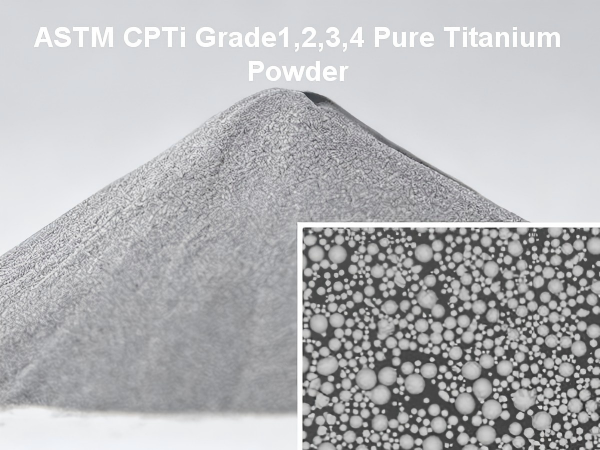
| Physical Properties | Particle Size (D₁₀/D₅₀/D₉₀) | ≥15 / 30–40 / ≤63 | μm |
| Sphericity | ≥0.9 | — | |
| Apparent Density | ≥2.4 | g/cm³ | |
| Tap Density | ≥2.8 | g/cm³ | |
| Flowability | ≤35 | s/50g | |
| Mechanical Properties (Heat-Treated) | Test Temp. | Tensile Strength | Yield Strength |
| Room Temperature | ≥350 | ≥250 | |
| Units | MPa | MPa |
> Please note: Specifications are subject to change without notice. Contact a Forgecise representative for the most current technical data.
2. Comprehensive Overview of CPTi
CPTi stands for Commercially Pure Titanium. It is not a single specific grade but a general classification for unalloyed titanium that contains small, controlled amounts of interstitial elements like oxygen, iron, carbon, and nitrogen. The properties of CPTi are primarily determined by its oxygen content: higher oxygen content leads to higher strength but lower ductility.
The most common international standard is the ASTM system, which defines four main grades of CPTi (Grade 1, 2, 3, and 4). Grade 2 is the most widely used, offering an excellent balance of strength, ductility, and weldability. In China, the equivalent grades are typically designated as TA1, TA2, TA3, and TA4, corresponding to the ASTM grades. CPTi is renowned for its outstanding corrosion resistance, especially in oxidizing and chloride-containing environments, making it a cornerstone material for the chemical processing, marine, and medical implant industries.
| ASTM Grade | Chinese Grade (GB) | Max Oxygen (O) | Max Iron (Fe) | Max Carbon (C) | Max Nitrogen (N) | Max Hydrogen (H) | Titanium (Ti) | Key Characteristics & Applications |
|---|---|---|---|---|---|---|---|---|
| Grade 1 | TA1 | ≤ 0.18% | ≤ 0.20% | ≤ 0.08% | ≤ 0.03% | ≤ 0.015% | ≥ 99.5% | Highest purity, maximum ductility and corrosion resistance. Ideal for deep drawing and extreme corrosive environments. |
| Grade 2 | TA2 | ≤ 0.25% | ≤ 0.30% | ≤ 0.08% | ≤ 0.03% | ≤ 0.015% | ≥ 99.2% | Best overall balance of strength, weldability, and formability. The most widely used grade for general industrial applications. |
| Grade 3 | TA3 | ≤ 0.35% | ≤ 0.30% | ≤ 0.08% | ≤ 0.03% | ≤ 0.015% | ≥ 98.8% | Higher strength than Grade 2 with slightly reduced formability. Suitable for structural parts requiring higher strength. |
| Grade 4 | TA4 | ≤ 0.40% | ≤ 0.50% | ≤ 0.08% | ≤ 0.03% | ≤ 0.015% | ≥ 98.5% | Highest strength among commercial pure titanium grades, with lower ductility. Used for high-strength structural components. |
Supplementary Notes:
- Composition Differences: The primary distinction among these grades lies in the controlled amounts of interstitial elements, particularly Oxygen (O) and Iron (Fe). As the oxygen content increases from Grade 1 to Grade 4, the tensile strength increases, but ductility and formability decrease.
- Direct Equivalents: ASTM Grades 1-4 are internationally recognized as the direct equivalents to the Chinese GB standard grades TA1-TA4 in terms of both chemical composition and mechanical properties.
- Medical Grade (ELI): For reference, there are also Extra Low Interstitial (ELI) grades, such as ASTM Grade 1 ELI, which have even stricter limits on oxygen (≤0.13%) and iron to ensure superior fracture toughness and biocompatibility for surgical implants.
3. Advantages of This CPTi Powder
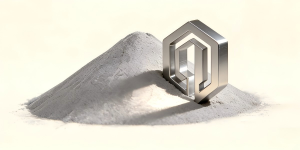
This CPTi powder is engineered for high-performance additive manufacturing, offering several key advantages:
- Excellent Formability and Ductility: With an elongation of ≥30.0%, the material is highly ductile, making it ideal for manufacturing complex, non-load-bearing parts that may require some degree of post-processing or deformation without fracturing.
- Superior Corrosion Resistance: As a commercially pure titanium, it inherits the exceptional corrosion resistance of the base element, suitable for parts used in harsh chemical or marine environments.
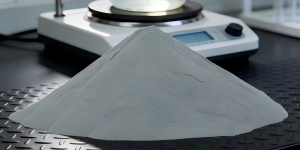
- Optimized for Powder Bed Fusion: The powder exhibits high sphericity (≥0.9), excellent flowability (≤35 s/50g), and a controlled particle size distribution (15-63 µm). These physical properties ensure smooth and consistent powder spreading in SLM and EBM machines, which is critical for achieving high-density, defect-free final parts.
- Good Strength-to-Weight Ratio: While not as strong as alpha-beta or beta titanium alloys, it offers a tensile strength of ≥350 MPa combined with a very low density, providing a favorable strength-to-weight ratio for lightweight structural components.
4. Application in Additive Manufacturing
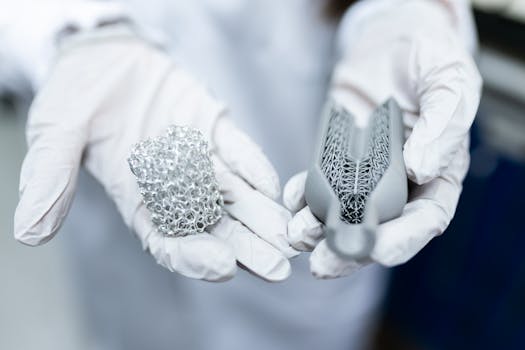
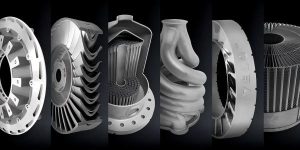
This high-quality CPTi powder is specifically designed for powder bed fusion technologies, including Selective Laser Melting (SLM) and Electron Beam Melting (EBM). Its excellent flowability and high sphericity ensure a uniform powder layer during the recoating process, which is fundamental to building parts with high dimensional accuracy and surface quality. As indicated by its typical applications, this powder is perfectly suited for manufacturing various non-load-bearing structural parts. These components leverage the material’s key benefits of light weight, superior corrosion resistance, and biocompatibility, finding use in sectors such as chemical processing equipment, marine hardware, and non-critical aerospace components.
5. Forgecise Custom Powder Services
At Forgecise, we understand that every application is unique. That’s why we offer comprehensive customization services for titanium and titanium alloy powders. Whether you require a specific CPTi grade (e.g., Grade 1, 2, or 4), a specialized particle size distribution for a particular AM machine, or a completely custom alloy composition, our advanced gas atomization technology and expert team can deliver a tailored powder solution to meet your precise requirements and help you innovate.