











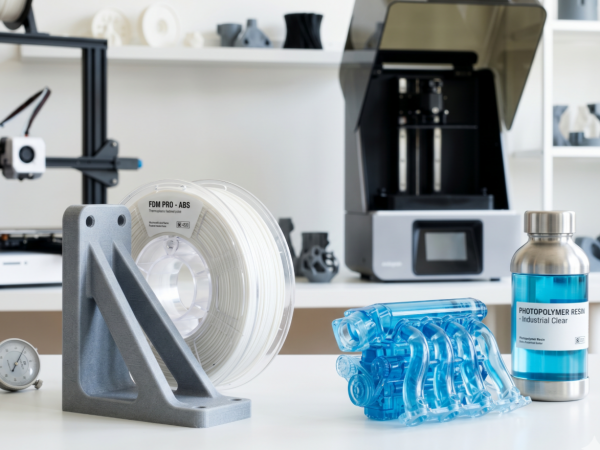
Choose resin or filament printing from the part requirements and complete production workflow. Resin systems selectively cure a photopolymer; filament systems deposit extruded thermoplastic. Neither process is universally stronger, cheaper or more accurate. Compare the exact material, machine, orientation and post-processing route.
Surface detail and dimensions
Resin printing is often considered for fine visual detail and intricate surfaces. Filament printing can be useful for larger fixtures and prototypes. Nominal pixel size, nozzle size and layer height are not finished-part accuracy specifications. Test critical holes, fits and surfaces on representative geometry.
Strength, toughness and temperature
Compare tensile strength, elongation, impact behavior, stiffness, creep and temperature performance using compatible test methods. Build orientation and processing can affect both technologies. A resin part does not automatically have identical properties in all directions, and a filament label alone does not predict interlayer performance.
Post-processing and handling
Resin parts generally require controlled cleaning and may require post-curing. Filament parts can require supports, trimming, drying of feedstock or other finishing. Compare operator time and waste as well as print time. Use the material instructions and an appropriate assessment of emissions and handling tasks for either workflow.
Functional and contact applications
For a fixture, define load, contact surfaces, temperature and expected service life. For a casting pattern, select a qualified casting material. For medical, food or skin-contact applications, use the specific material and validated workflow; a process category does not establish suitability.
Compare cost per accepted part
Include machine time, consumables, supports, cleaning or finishing equipment, labor, maintenance, inspection and rejects. Use the same part and acceptance criteria for the comparison. A low material price per kilogram does not by itself produce a lower delivered-part cost.
Run a small qualification build
Print representative features in the intended orientations. Complete the full finishing process and measure them. Repeat the build when consistency matters, and retain the settings and material batch information. Select the route that meets the requirements at a sustainable throughput.
Related selection guides
Read how resin printing works and compare polymer printing options. Share a drawing and acceptance requirements for a process discussion.