












How thin a 3D printer can print depends on the process, material, geometry and definition of “thin.” Layer height, optical pixel size, minimum wall thickness and dimensional accuracy describe different things. A small layer or voxel does not establish the thickness of a stable, usable wall.
Define the feature before comparing machines
Specify whether the requirement concerns a supported wall, a free-standing wall, a wire, a gap, a hole or an embossed detail. Record height, span, orientation and the surrounding geometry. A short supported feature can behave differently from a tall isolated wall at the same nominal thickness.
Resolution is not a guaranteed finished dimension
A printer’s nominal layer height describes vertical slicing. Pixel or laser-spot dimensions describe part of the exposure or energy-delivery system. Material response, exposure, heat flow and processing affect the final feature. Compare measured parts rather than equating a marketing resolution with a production tolerance.
Start with material-specific design guidance
Use design guidelines for the exact machine generation, material and settings. For example, Formlabs Form 4 generation design specifications distinguishes feature types and describes its test conditions. Its dimensions are not universal limits for other printers or resins.
Account for supports and post-processing
Thin sections must survive removal, washing, support cutting, curing and any later finishing. Metal parts also need evaluation for powder removal, thermal distortion and machining access. A feature visible immediately after printing may not survive the complete manufacturing route.
Micro-scale processes need their own evidence
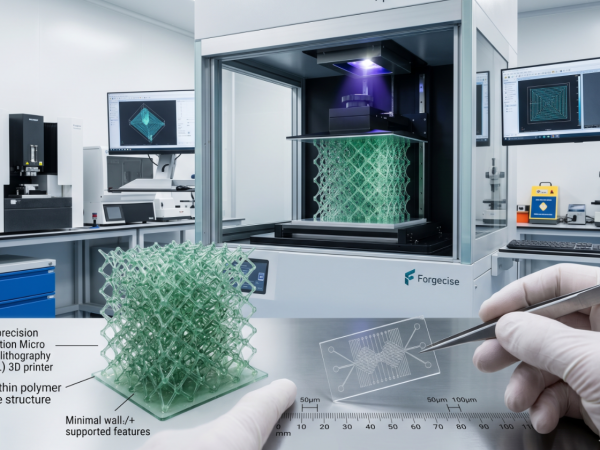
Specialized micro-fabrication can produce features beyond conventional production printers, but a reported laboratory feature size is not a general wall-thickness specification. Compare material, build volume, aspect ratio, inspection method and repeatability. Do not promise nanoscale free-standing walls from an unrelated resolution claim.
Validate a representative coupon
Create a thickness series that includes the actual height, support conditions and orientation. Process it through the full workflow. Measure the result, inspect defects and repeat it across relevant build locations. Set the production design allowance from usable, repeatable parts and the application loads.
Request a feasibility review
Provide a drawing with critical wall dimensions, tolerances, material, expected loads and quantity. Identify whether appearance, flexibility, sealing or strength controls acceptance. Contact Forgecise for a process review, or compare polymer printing options.