










- Author: Felix Lee, CEO at Forgecise
- Published Date: July 10, 2026
- Reading Time: ~15 Minutes
- Category: Additive Manufacturing, B2B Procurement Strategy, Industrial Automation
- Executive Summary: A data-driven analysis of how enterprise players scale serial production in 2026 using large-format vat photopolymerization. Features a technological breakdown (SLA, MSLA, LFD, LSPc), real-world B2B case studies (NASA, Texas A&M, Prototek), financial TCO models, and authoritative workplace safety protocols.
1. Introduction: The Additive Realignment of 2026
The global additive manufacturing sector is undergoing a fundamental realignment. We are shifting rapidly from design-phase rapid prototyping to functional, low-to-medium-volume serial production. This structural shift drives substantial capital investment across major economic corridors. Governments and enterprise players are investing heavily in research and localization.
- The United States remains one of the largest and most promising markets for additive solutions. It is accelerating capital deployment across aerospace, defense, and medical devices.
- China actively funds additive research and manufacturing processes to defend and expand its massive domestic production base.
- European economies, particularly Germany, leverage Industry $4.0$ frameworks to establish competitive, localized domestic manufacturing networks that mitigate global supply chain vulnerabilities.
Within this macro environment, buying a high-performance large format resin 3D printer is no longer just an expensive R&D novelty. It has become an indispensable cornerstone of industrial resilience.
               [ Traditional Subtractive Tooling ]
                               │
                               ▼ (High material waste, long lead times)
              [ Strategic Additive Manufacturing ]
                               │
        ┌──────────────────────┴──────────────────────┐
        ▼                                             ▼
[ Large-Scale SLA / MSLA ]                   [ Ultra-Fast LSPc Systems ]
(Isotropic functional parts,                 (Continuous throughput,
high surface fidelity)                       modular production lines)
Market trackers highlight a highly robust growth trajectory for this technology. The global 3D printing market size was estimated at USD $29.29\text{ billion}$ in 2025 and is projected to expand to USD $34.85\text{ billion}$ in 2026. By 2035, the global market is forecasted to reach approximately USD $152.72\text{ billion}$, representing a compound annual growth rate (CAGR) of $17.96\%$.
This rapid expansion is underpinned by a turning point in 2026. Historical bottlenecks across hardware engineering, software automation, and advanced polymer chemistry are being solved concurrently. Historically, industrial adoption was constrained by high machine acquisition costs, slow volumetric throughput, elevated print failure rates, and labor-intensive manual post-processing.
In 2026, these limitations are being actively solved through the integration of multi-laser systems, automated build preparation, localized manufacturing networks, and closed-loop process monitoring. As a result, large-format resin 3D printing has become an economically viable alternative to conventional subtractive manufacturing, such as CNC machining, for high-complexity geometries, custom medical devices, lightweight structural aerospace components, and rapid tooling.
2. Technical Spectrum of Industrial Light Engines
To achieve mechanical reliability and dimensional accuracy at scale, B2B procurement teams must evaluate the underlying light engine architectures that govern large-format vat photopolymerization. These technologies dictate the build speed, surface cosmetics, and edge-to-edge optical consistency across expansive build volumes.
Stereolithography (SLA)
SLA utilizes solid-state lasers directed by high-precision galvanometer scanners to cure resin point-by-point. Standard industrial platforms, such as the Stratasys Neo line (including the Neo450 and Neo800), leverage SLA to deliver isotropic mechanical properties, exceptional geometric accuracy, and highly polished surface finishes directly off the build plate. While point-by-point laser exposure ensures superior resolution, it scales poorly in terms of volumetric throughput when printing dense or solid geometries across large surfaces.
Masked Stereolithography (MSLA)
MSLA replaces the point-based laser with an LED array light source and a Liquid Crystal Display (LCD) photomask to cure entire layers simultaneously. This architecture makes sure that print speed remains independent of layer density. This makes it highly useful for batch manufacturing and large-volume visual models. However, entry-level MSLA printers often suffer from light diffusion and collimation issues. This leads to dimensional inaccuracy and soft, blurred details near the outer edges of the large LCD mask.
Low Force Display (LFD)
Formlabs’ proprietary LFD technology represents an advanced evolution of MSLA, combining a high-intensity Backlight Unit with a custom plano-convex lens array to achieve exceptional light collimation. LFD integrates an array of $145$ uniform-wavelength LEDs delivering an optical power intensity of $16\text{ mW/cm}^2$ to the cure plane, combined with pre-tuned anti-aliasing software to achieve sub-pixel resolution. By utilizing a flexible resin tank membrane, LFD minimizes the peel forces generated during layer separation. This allows for light-touch supports, pristine surface finishes, and high dimensional tolerances ($\pm 0.15\%$ in XY) at vertical build speeds up to $80\text{ mm/h}$.
Lubricant Sublayer Photo-curing (LSPc)
Nexa3D’s LSPc process resolves the delamination forces inherent in inverted vat polymerization by employing a patented, self-lubricating, non-degenerative membrane. This mechanism completely prevents the cured resin from sticking to the vat window. This enables vertical build speeds of up to $240\text{ mm/h}$ ($24\text{ cm/h}$). LSPc delivers a uniform, distortion-free optical path across the entire build plate. This ensures part-to-part consistency and renders the technology highly scalable for continuous, production-grade manufacturing.
Large-Format Resin 3D Printer: Technical Comparison Table (2026)
The following table provides a broad comparative technical analysis of the leading professional and prosumer large-format resin printing systems currently in the market:
| Manufacturer & Model | Light Engine Technology | Build Volume ($W \times D \times H$ in $\text{mm}$) | XY Resolution | Max Vertical Speed | Primary B2B Applications | Starting Price Range (USD) |
|---|---|---|---|---|---|---|
| Formlabs Form 4L | Low Force Display (LFD) | $353 \times 196 \times 350$ | $46\ \mu\text{m}$ | $80\text{ mm/h}$ | Aerospace tooling, medical devices, high-fidelity prototypes | $\$7,125$ (Basic) to $\$19,769$ (Complete) |
| Nexa3D XiP Pro | Lubricant Sublayer Photo-curing (LSPc) | $292 \times 163 \times 410$ | $46\ \mu\text{m}$ ($23\ \mu\text{m}$ subpixel) | $240\text{ mm/h}$ | Serial manufacturing, functional jigs/fixtures, elastomeric parts | $\$15,000$ – $\$25,000$ (Varies by package) |
| Phrozen Sonic Mega 8K V2 | MSLA (ParaLED Matrix 3.0) | $330 \times 185 \times 400$ | $43\ \mu\text{m}$ | $400\text{ layers/h}$ | Print farm production, cosplay props, large aesthetic models | $\$1,500$ – $\$2,000$ |
| Elegoo Jupiter 2 | MSLA (COB + Fresnel Lens) | $302 \times 162 \times 300$ | $20 \times 26\ \mu\text{m}$ | $15 – 25\text{ mm/h}$ (Resin dependent) | Highly detailed display models, small-batch components | $\$949$ (MSRP) |
| Anycubic Photon Mono M7 Max | MSLA (COB + Light Uniformity System) | $223 \times 126 \times 230$ | $46\ \mu\text{m}$ (Approximate) | $100\text{ mm/h}$ (High-speed resin) | Prosumer design verification, low-cost engineering prototyping | $\$599$ – $\$649$ |
3. B2B Empirical Evidence: Case Studies from Reddit and LinkedIn
A granular review of professional user experiences shared across social media platforms, industrial forums, and enterprise networks reveals how different large-format systems perform under the stress of strict production environments.
Case Study 1: Aerospace Prototyping and Repeatability (NASA Subcontracting)
An operational profile shared by a defense contractor operating under the identifier AIRION-Defense on Reddit details the deployment of the Formlabs Form 4L within a production environment supporting NASA research. The B2B operator highlighted that the primary driver for selecting the Form 4L was not merely raw resolution, but the mechanical and dimensional repeatability of the entire ecosystem.
In high-consequence industries, manual troubleshooting and constant calibration settings waste valuable engineering hours. The contractor noted that the pre-validated settings, integrated automated resin dispensing, and seamless transition to the Form Wash L and Cure L systems achieved a near-$99\%$ print success rate. This workflow efficiency allowed their engineering team to reduce lead times for visual and functional aerospace models while keeping the entire prototyping cycle securely in-house.
Case Study 2: Industrial Workgroup Safety and Compliance (Texas A&M)
In a detailed report from a production laboratory manager at Texas A&M, the decision to run a fleet of Formlabs machines $24/7$ was evaluated from the perspective of workplace safety and environmental compliance. Due to regulatory concerns surrounding volatile organic compound (VOC) emissions from industrial photopolymers, the institution spent USD $10,000$ to hire a professional air quality consulting firm.
The firm conducted a $24\text{-hour}$ analysis of the printer workspace using specialized air quality monitors. The audit concluded that there was no significant VOC or respiratory hazard present during standard machine operations. This case underscores that professional-grade resins, such as Formlabs Black V5, exhibit much lower odor profiles compared to budget consumer resins, smelling faintly of latex paint and requiring only standard laboratory personal protective equipment (PPE) rather than heavy, localized chemical ventilation setups.
Case Study 3: High-Precision Microfluidic Tooling
A research and development lab specializing in microfluidics detailed its deployment of Formlabs Form 4 and Form 4L systems to print high-precision integrated channels. For microfluidic devices, the laser spot size, light collimation, and low-reactivity resin chemistry are critical.
While previous stereolithography models sometimes struggled with cured resin blocking sub-millimeter channels, the collimated backlight array of the 4L generation successfully resolved these fine details without light bleed. The lab noted that the LFD platform allowed them to construct precise, leak-free channels that traditionally required expensive, specialized glass micro-machining or soft lithography processes.
Case Study 4: Post-Processing Automation at Prototek (Italy)
Prototek, an Italian additive manufacturing service bureau operating since 2007, shared an operational history emphasizing the importance of automated post-processing. When producing large plastic and elastomeric components, the manual removal of uncured resin is highly inefficient and prone to introducing structural cracks.
By integrating automated, chemical-mechanical post-processing systems (such as PostProcess technologies), Prototek eliminated manual scrubbing and minimized solvent waste. Their workflow integration demonstrated that the mechanical properties of tough, large-format resin prints are only fully realized when the cleaning and curing stages are standardized, which dramatically reduces micro-fractures caused by residual uncured polymer.
4. Forum Intelligence: Top 5 Recent Discussions and Authoritative Answers
Inquiry 1: Z-Axis Flex, Peel Forces, and Gantry Rigidity in Large-Volume Printers
Short Answer: Peel forces (the vacuum force generated during layer separation) can cause massive layer shifts or print failures if the printer’s gantry lacks structural rigidity. For B2B procurement, frame and gantry rigidity are the primary mechanical metrics of reliability.
On professional forums, users debating the Uniformation GK3 Ultra noted that the manufacturer replaced the dual linear gantry rails with a single machined aluminum rail, which introduced noticeable Z-axis flexing during peel cycles. This mechanical deflection causes micro-layer shifts and catastrophic print failures.
The authoritative consensus is that true industrial performance requires a highly rigid gantry system featuring dual linear guide rails and heavy ball screws, as seen on the Nexa3D XiP Pro and industrial SLA systems. Standard rubber belts and single-rail gantries degrade rapidly under the weight of large resin blocks.
Inquiry 2: Thermal Management and Localized Temperature Gradients
Short Answer: Photopolymer resins are highly temperature-sensitive; cold ambient temperatures increase resin viscosity, causing catastrophic print failures. Industrial success requires a closed, actively heated chamber ($60^\circ\text{C}$to$90^\circ\text{C}$) or dynamic continuous resin circulation.
Forum discussions highlight that budget large-format machines, like the Elegoo Jupiter 2, feature vat heaters that are prone to uneven thermal distribution, heating only the sections of the vat adjacent to the thermostat probe.
The authoritative solution for high-viscosity, engineering-grade resins requires an actively heated chamber, or a dynamic vat heating system that continuously circulates the resin. On the Jupiter 2, users must rely on automated build plate movement (homing up and down) to physically mix the resin and distribute heat uniformly before starting a print, or risk localized curing failures.
Inquiry 3: Dynamic Resin Replenishment and Chemical Homogeneity Mid-Print
Short Answer: Pouring cold, unmixed resin directly into a warm, active vat causes thermal shock, leading to layer lines, support failures, and warping.
The authoritative procedure developed by experienced operators involves the following steps:
- Resin Pre-heating: The operator must pre-heat the replenishment resin bottle to approximately $25^\circ\text{C}$ to $30^\circ\text{C}$ (using a warm water bath or an electric heating wrap) to match the temperature of the active vat.
- Slow Dispersion: Rather than pouring directly into the vat, the pre-heated resin should be poured slowly onto the top surface of the rising build plate. The thermal mass of the metal plate stabilizes the resin’s temperature, while the downward flow spreads the liquid evenly across the vat without generating localized current shifts or trapping air bubbles.
Inquiry 4: Total Cost of Ownership (TCO) and Open vs. Closed Ecosystems
Short Answer: While open-source MSLA printers have lower CapEx, their manual labor, calibration overhead, and higher print failure rates often result in a higher three-year TCO compared to plug-and-play closed systems.
                     [ Total Cost of Ownership ]
                                  │
       ┌──────────────────────────┴──────────────────────────┐
       ▼                                                     ▼
[ Closed Ecosystem (Form 4L) ]              [ Open-Source MSLA (Mega 8K V2) ]
- High CapEx ($7k - $20k)                   - Low CapEx ($1.5k - $2k)
- Low labor (Pre-tuned settings)            - High labor (Manual tuning/failures)
- Consistent, predictable output            - Low material cost (Generic resins)
To clarify this decision, the following table models the TCO variables over a standard three-year industrial operating cycle:
| Cost Variable | Closed LFD Ecosystem (e.g., Formlabs Form 4L) | Open-Source MSLA (e.g., Phrozen Sonic Mega 8K V2) |
|---|---|---|
| Initial Capital Expenditure | High ($7,125 to $19,769 based on package options) | Low ($1,500 to $2,000) |
| Material Cost (Per Litre) | Moderate ($79 for general purpose, up to $229 for specialty resins) | Low ($20 to $40 for standard third-party resins) |
| Consumable Cost (Vat Films) | High ($249 per proprietary resin tank) | Low ($20 to $33 per replacement ACF or FEP sheet) |
| Labor Overhead (Tuning/Clean) | Low (Automated orientation, self-leveling, integrated washing) | High (Manual leveling, manual vat draining, constant settings calibration) |
| Average Failure Recovery Cost | Minimal (Built-in debris detection, $99\%$ print success rate) | High (Wasted resin on failed large-volume prints, FEP replacement down-time) |
| Ecosystem Upgrades/Software | Included (PreForm software, cloud monitoring dashboard) | Variable (Third-party slicer fees, paid plug-ins, community-driven support) |
The B2B consensus is that closed ecosystems represent a highly predictable operational investment for organizations that cannot afford labor-intensive troubleshooting, while open systems are better suited for operations with dedicated, technically skilled technicians who can absorb the labor costs of manual optimization.
Inquiry 5: Workplace Infrastructure and Post-Processing Safety Realities
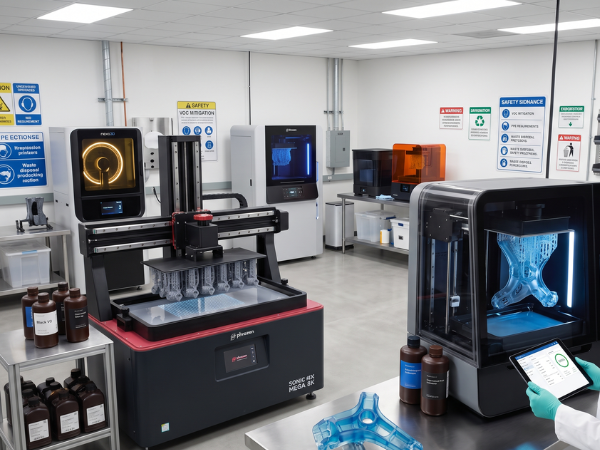
Short Answer: Large-format systems demand extensive physical footprint clearance, active ventilation systems, and structured chemical waste SOPs. Flushing wash solvents down municipal drains is strictly prohibited.
Forum reviews highlight that budget large-format printers like the Jupiter 2 are physically bulky and utilize wide double doors, demanding nearly $41\text{ inches}$ of horizontal clearance. Furthermore, the lack of a standard print plate drip hanger on some budget machines means that when lifting a heavy, hollowed model, residual uncured resin trapped inside the model will spill across the workbench.
The authoritative infrastructure plan must include:
- Fume Mitigation: An extraction enclosure (such as a rigid acrylic or fire-retardant tent enclosure with inline duct fans venting to the exterior).
- Liquid Waste Management: A dedicated wash basin to collect liquid waste. Under no circumstances should cleaning water or contaminated Isopropyl Alcohol (IPA) be flushed down municipal drains. Instead, liquid waste must be stored in sealed carboys and processed through licensed industrial recycling centers.
5. Strategic Procurement Guidelines for B2B Decision-Makers
To maximize return on investment and minimize operational disruption, enterprise procurement managers should match their purchase choices with their specific volume, precision, and facility requirements.
                    [ B2B Procurement Matrix ]
                                │
       ┌────────────────────────┼────────────────────────┐
       ▼                        ▼                        ▼
[ High Precision / Low Labor ] [ High Volume / Cost Focus ] [ High-Speed Production ]
- Select Closed LFD (Form 4L)  - Select Open MSLA (Mega)    - Select LSPc (XiP Pro)
- Best for medical/aerospace   - Best for visual models     - Best for industrial lines
Classifying the Operational Mandate
- High Precision, Certified Materials, and Low Labor Overhead: If the primary use case is medical device prototyping, investment casting patterns, aerospace-grade visual models, or functional engineering jigs, organizations should standardize on closed or highly validated semi-open ecosystems. The Formlabs Form 4L provides the most consistent plug-and-play workflow. By eliminating manual calibration and offering highly collimated light engines, these systems reduce print-prep labor to minutes and ensure repeatable, certifiable mechanical outputs that easily justify the higher capital and consumable costs.
- High-Volume Visual Outputs and Budget Sensitivity: For design studios, theatrical prop makers, or architectural firms where cosmetic volume outweighs strict dimensional certification, open-source MSLA platforms are highly competitive. The Phrozen Sonic Mega 8K V2 delivers an expansive build volume and high detailed resolution at a highly accessible price point. To succeed with these platforms, organizations must allocate sufficient internal labor resources to handle manual post-processing, settings calibration, and regular vat maintenance.
- High-Throughput Serial Production: When the manufacturing workflow demands rapid, semi-continuous part output that rivals traditional injection molding in speed, Nexa3D’s XiP Pro (or NXE 400Pro) systems are the optimal choice. Powered by LSPc technology, these systems can generate up to $19.5\text{ liters}$ of cured parts in under two hours, making them ideal for high-pressure manufacturing lines, specialized elastomeric production, and rapid tooling.
Assessing Infrastructure Readiness
Before signing a procurement agreement, facility managers must verify that the target installation site has the appropriate environmental controls. A compliant large-format resin print room must feature dedicated, non-recirculating HVAC exhaust or a localized fume extraction hood to handle VOCs.
The site must accommodate not only the physical footprint of the printer with its doors fully extended but also an equivalent footprint for washing basins and UV curing chambers. Finally, standard operating procedures must be established for handling Isopropyl Alcohol safely, including the deployment of explosion-proof storage cabinets and a formalized contract with a local chemical waste disposal service. By addressing these structural variables during the procurement phase, enterprise buyers can successfully integrate a large format resin 3D printer into their broader manufacturing workflows.
6. Final Verdict: Choosing Your Additive Path
The large-format resin 3D printing market of 2026 offers highly specialized pathways. Procurement is no longer about choosing the “best” printer, but about matching technology with operational realities. Closed ecosystems like Formlabs’ LFD offer low-labor predictability, while open-source MSLA systems provide unparalleled volumetric value at the cost of high manual overhead. For those running continuous serial manufacturing lines, high-speed LSPc systems present a scalable future.
Next Steps for B2B Decision-Makers:
Assess your facility’s spatial clearance and HVAC capability, calculate your internal labor cost per print hour, and request a benchmark part in your target engineering material. Only then can you accurately map your three-year TCO and secure a resilient, high-yield additive future.