





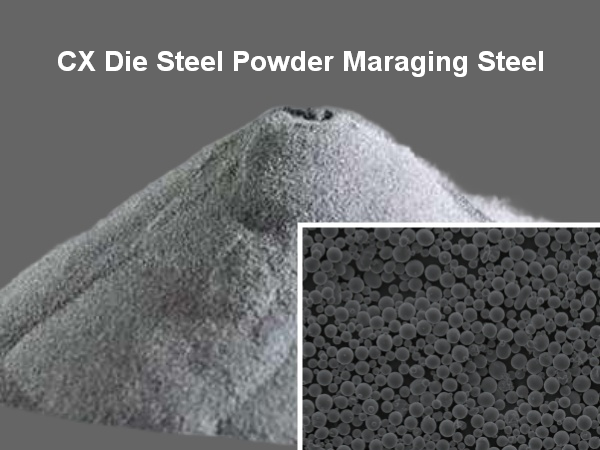
| Category | Key Metrics | Typical Parameter Range / Values |
|---|---|---|
| Applicable Processes | Manufacturing Process | SLM (Selective Laser Melting) |
| Typical Applications | Application Scenarios | Injection molds, extrusion dies, and engineering parts |
| Chemical Composition (wt.%) | Fe (Iron) | Bal. (Balance) |
| Ni (Nickel) | 8.4 – 10.0% | |
| Cr (Chromium) | 11.0 – 13.0% | |
| Mo (Molybdenum) | 1.1 – 1.7% | |
| Al (Aluminum) | 1.2 – 2.0% (High Al content) | |
| C (Carbon) | ≤0.05% | |
| Si (Silicon) | ≤0.4% | |
| Mn (Manganese) | ≤0.4% | |
| P, S, O, N (Impurities) | P≤0.015, S≤0.015, O≤0.03, N≤0.02 | |
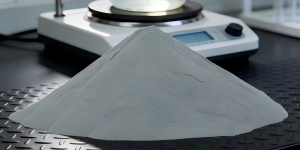
| Physical Properties (Powder) | Particle Size Distribution (D50) | 30 – 40 μm |
| Particle Size Range (D10/D90) | D10 ≥15 μm / D90 ≤60 μm | |
| Sphericity | ≥0.9 (i.e., ≥90%) | |
| Apparent Density | ≥4.0 g/cm³ | |
| Tap Density | ≥4.5 g/cm³ | |
| Flowability | ≤20 s/50g | |
| Mechanical Properties (Built Parts) | Status: As-Deposited | Hardness: 34-38 HRC Yield Strength: ≥1100 MPa Elongation: ≥15.0% |
| Status: Heat-Treated | Hardness: 48-52 HRC Yield Strength: ≥1350 MPa Elongation: ≥10.0% |
1. Key Advantages of this CX Die Steel Powder
High Strength: With a yield strength exceeding 1350 MPa, it demonstrates extremely strong load-bearing capacity, making it suitable for mold inserts subjected to high pressure.
High Aluminum (Al) Feature: The table shows an aluminum content as high as 1.2-2.0%. This usually implies that the material may be strengthened through aluminide precipitation, or it has been specially adjusted to improve oxidation resistance or flowability during printing. This is significantly different from standard 18Ni300 (typically Al < 0.15%).
Hardness Range: The heat-treated hardness is 48-52 HRC. This hardness is slightly lower than MS1’s 54-57 HRC, but it still falls within the high-hardness tool steel category while maintaining good toughness (elongation ≥10%).
2. CX Die Steel Powder Application in Additive Manufacturing
CX Die Steel Powder for SLM is a high-performance tool steel powder specifically engineered for the Selective Laser Melting (SLM) process. Its core applications are centered on the manufacturing of high-precision, highly corrosion-resistant, and high-strength industrial molds and critical structural components.
This material is particularly well-suited for the following scenarios:
- Injection Molds: It is especially ideal for producing parts containing corrosive media (such as PVC, flame-retardant plastics, and medical-grade plastics). Its excellent corrosion resistance significantly extends mold lifespan and reduces downtime caused by rust-related maintenance.
- Extrusion Dies: Capable of maintaining dimensional stability and superior surface finish even under high-temperature and high-pressure environments, making it perfect for metal extrusion processes like aluminum profiles and copper tubing.
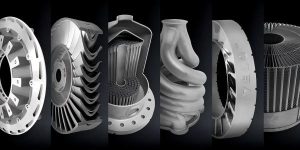
- Engineering Structural Components: Suitable for precision parts in fields like aerospace, automotive, and energy that must withstand complex loads while requiring strong corrosion resistance. Typical examples include hydraulic valve bodies, pump housings, and connectors.
- Repair and Remanufacturing: It can be used for localized additive repair of worn or corroded molds and tools, effectively restoring their geometric accuracy and mechanical properties while reducing the overall cost of replacement.
The material’s tailored composition (high chromium, high nickel, and aluminum content) endows it with comprehensive advantages under harsh operating conditions. It serves as an ideal alternative to traditional maraging steels (like MS1) in corrosive environments and acts as a key material enabler for the high-end mold manufacturing industry’s evolution towards “long service life and maintenance-free” operations.
3. What is CX Die Steel Powder for SLM?
CX Die Steel Powder is a corrosion-resistant maraging tool steel specifically engineered for metal 3D printing technologies like Selective Laser Melting (SLM).
In simple terms, it combines the “ultra-high strength” of traditional maraging steels (like MS1) with the “excellent corrosion resistance” of stainless steel. In the realm of 3D printed tool steels, CX is hailed as the “expert in corrosion resistance.” Compared to standard MS1 (18Ni300), parts printed with CX powder not only possess exceptional strength and hardness but also maintain superior rust resistance in humid or corrosive environments. It is perfectly suited for manufacturing corrosion-resistant injection molds, medical molds, and high-performance industrial components.
Below is a detailed breakdown of CX Die Steel Powder, including grade comparisons, core specifications, and printing considerations:
3.1 Core Grades & Chemical Composition
CX also belongs to the maraging steel family, but its alloy composition has been adjusted (primarily the Chromium content) to achieve corrosion-resistant properties.
- Grade Equivalents:
- Commercial Grade: CX (Custom Stainless / Corrosion-resistant eXtreme)
- Material Type: Corrosion-resistant Maraging Stainless Steel
- Typical Chemical Composition (wt.%):
- Cr (Chromium): Approx. 11.0% – 13.0% (Core element providing corrosion resistance)
- Ni (Nickel): Approx. 8.0% – 10.0% (Forms the martensitic matrix)
- Mo (Molybdenum): Approx. 4.0% – 5.0% (Provides strength and age-hardening effects)
- Ti (Titanium): Approx. 0.6% – 1.0% (Key for age-hardening precipitation)
- Al (Aluminum): ≤ 0.15%
- C (Carbon): ≤ 0.03% (Ultra-low carbon ensures excellent weldability and toughness)
- Fe (Iron): Balance
3.2 Basic Specification Table for CX Die Steel Powder
The following are the typical physical and mechanical properties of CX powder in Additive Manufacturing (SLM):
| Category | Key Metric | Typical Parameter Range |
|---|---|---|
| Physical Properties | Density | Approx. 7.8 – 8.0 g/cm³ |
| Powder Morphology | Sphericity ≥ 95% | |
| Particle Size (D50) | 15 – 45 μm or 15 – 53 μm | |
| Mechanical Properties | Condition | As-built |
| Tensile Strength | Approx. 1100 – 1200 MPa | |
| Yield Strength | Approx. 1000 – 1100 MPa | |
| Elongation | Approx. 15% – 20% | |
| Hardness (HRC) | Approx. 30 – 35 HRC | |
| Typical Applications | Use Cases | Corrosion-resistant injection molds, medical device molds, food packaging molds, chemical parts |
3.3 SLM Printing Considerations & Key Processes
When printing with CX powder via SLM, keep the following in mind to achieve dense, defect-free parts:
- Excellent Balance of Corrosion Resistance & Strength: The biggest highlight of CX is that it breaks the traditional notion that “high-hardness tool steels cannot be corrosion-resistant.” After heat treatment, printed parts can reach a hardness of around 50 HRC while resisting corrosion from acidic plastic decomposition gases (e.g., from PVC).
- Heat Treatment Process: Similar to MS1, CX is relatively soft in the as-built state (approx. 30 HRC), making it easy to perform CNC finishing, tapping, or polishing. After machining, an aging heat treatment (typically holding at around 480°C – 520°C for several hours) is required to precipitate intermetallic compounds, significantly boosting hardness and strength.
- Process Window: Studies show that CX has a broad process window in SLM printing. For instance, parameters like a laser power of 300W and a scanning speed of 950 mm/s can yield high-quality parts with a relative density exceeding 99.8% and extremely low porosity.
- Conformal Cooling Channels: CX is equally ideal for manufacturing mold inserts with complex internal conformal cooling channels. Thanks to its good thermal conductivity and corrosion resistance, it significantly shortens injection molding cycles and prevents channels from rusting or clogging due to prolonged contact with cooling water.
- Recommended Printing Parameters:
- Layer Thickness: Typically set to 30μm or 40μm.
- Minimum Wall Thickness: It is recommended to design above 0.3mm – 0.5mm to ensure print success and structural integrity.
Summary:
If you need to manufacture molds that require both high hardness and corrosion resistance (e.g., for processing flame-retardant plastics, medical catheters, or food-grade products), or if the parts need to operate in harsh environments, CX Die Steel Powder is currently one of the most competitive premier choices in the metal 3D printing field.
4. Does CX Die Steel Powder Have Similar Materials?
The approximate materials to CX Die Steel Powder mainly include MS1 (18Ni300), H13, and Corrax. These materials all fall under the category of tool steels or high-strength structural steels, but each has its own focus regarding corrosion resistance, strength, toughness, and heat treatment processes. Below is a comparison of their core parameters against CX powder:
| Category | Key Metric | CX Die Steel Powder | MS1 (18Ni300) | H13 (Hot Work Tool Steel) | Corrax (Corrosion-resistant Tool Steel) |
|---|---|---|---|---|---|
| Material Type | Matrix & Characteristics | Corrosion-resistant Maraging Steel | Maraging Steel | Cr-Mo Hot Work Tool Steel | Precipitation Hardening Stainless Steel |
| Core Advantage | Main Features | High Strength + Excellent Corrosion Resistance | Ultra-high Strength + High Toughness | High Thermal Stability + Thermal Fatigue Resistance | Excellent Corrosion Resistance + Good Polishability |
| Chemical Composition (wt.%) | Cr (Chromium) | 11.0 – 13.0 | ≤0.30 | 4.75 – 5.50 | 12.0 – 14.0 |
| Ni (Nickel) | 8.0 – 10.0 | 17 – 19 | 0.30 – 0.60 | 1.0 – 2.0 | |
| Mo (Molybdenum) | 4.0 – 5.0 | 4.5 – 5.2 | 1.10 – 1.75 | 0.8 – 1.2 | |
| Ti (Titanium) | 0.6 – 1.0 | 0.6 – 0.8 | ≤0.10 | ≤0.20 | |
| C (Carbon) | ≤0.03 | ≤0.03 | 0.32 – 0.45 | ≤0.03 | |
| Mechanical Properties (Heat-Treated) | Hardness (HRC) | 54 – 57 | 54 – 57 | 50 – 54 | 48 – 52 |
| Yield Strength (MPa) | ≥1900 | ≥1900 | ≥1300 | ≥1400 | |
| Elongation (%) | ≥4.0 | ≥4.0 | ≥10.0 | ≥8.0 | |
| Physical Properties | Density (g/cm³) | ~7.9 | ~8.1 | ~7.8 | ~7.8 |
| Powder Morphology | Sphericity ≥95% | Sphericity ≥90% | Sphericity ≥90% | Sphericity ≥90% | |
| Typical Applications | Use Cases | Corrosion-resistant Injection Molds, Medical Molds | High-strength Structural Parts, Conformal Cooling Molds | Die Casting Molds, Hot Forging Molds | Food/Chemical Molds, High-precision Mirror-finish Molds |
4.1 Summary & Recommendations
- Pursuing Ultimate Strength & Toughness: Choose MS1 (18Ni300). It is currently the benchmark for strength and toughness in 3D printed tool steels. However, note that its corrosion resistance is relatively poor, making it unsuitable for humid or corrosive environments.
- Pursuing a Balance of Corrosion Resistance & Strength: Choose CX Die Steel Powder. While maintaining strength close to MS1, it achieves excellent corrosion resistance by adding chromium, making it an ideal choice to replace MS1 in corrosive environments.
- Pursuing Heat Resistance & Thermal Fatigue Resistance: Choose H13. It is specifically designed for high-temperature applications, such as die casting and hot forging molds, but its strength and corrosion resistance are inferior to CX and MS1.
- Pursuing Ultimate Corrosion Resistance & Polishability: Choose Corrax. It performs best in terms of corrosion resistance and surface finish, but its strength and hardness are slightly lower than CX and MS1, making it suitable for molds with extremely high surface quality requirements.
5. Customization Services by Forgecise
Forgecise provides comprehensive die steel powder customization solutions, covering the full range of products from standard maraging grades to customer-specific high-performance formulations. We support mainstream die steel grades such as MS1 (18Ni300/1.2709), CX, H13, and 42CrMo4, and can precisely adjust composition, particle size distribution, and sphericity according to your specific application requirements. Whether it is small-batch samples for R&D (starting from 1kg) or ton-level orders for mass production, we ensure high purity, low oxygen content, and excellent flowability of our powders, meeting the rigorous requirements of various additive manufacturing processes including SLM, DED, and BJT.