


Felix Lee

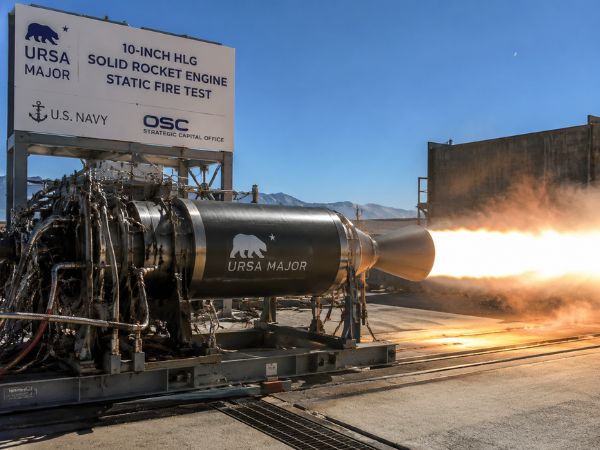
A metal 3D printed solid rocket engine prototype undergoing a static fire test at an outdoor aerospace testing facility, with bright exhaust flames, industrial equipment, and Ursa Major branding visible on the engine and test structure.

Metal 3D Printed Solid Rocket Engine: How Ursa Major Is Changing Rocket Manufacturing

Quick Answer Ursa Major has validated a new approach for building solid rocket engines through a U.S. Navy and Strategic Capital Office (OSC) Pathfinder project. The company designed, manufactured, and completed a static fire test of a 10-inch High Load Grain (HLG) solid rocket engine prototype. The project focused not only on engine performance but

Metal 3D Printed Solid Rocket Engine: How Ursa Major Is Changing Rocket Manufacturing Read More »
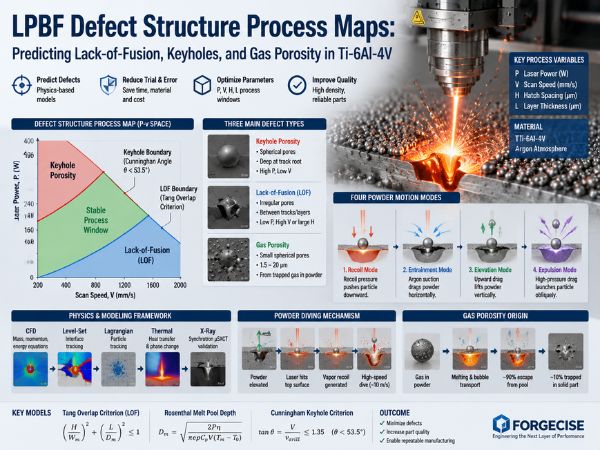
A realistic scientific visualization of Laser Powder Bed Fusion (LPBF) defect prediction showing a titanium alloy powder bed, laser melting process, melt pool dynamics, and a Defect Structure Process Map. The image illustrates key manufacturing defects including lack-of-fusion, keyhole porosity, and gas porosity, along with laser power, scan speed, hatch spacing, and physics-based simulation models.

LPBF Defect Structure Process Maps: Predicting Lack-of-Fusion, Keyholes, and Gas Porosity in Ti-6Al-4V

By Felix Lee, CEO at Forgecise Expert Review & Fact-Checked by Forgecise Metallurgical Research Group Last Updated: July 25, 2026 Quick Summary What is a Defect Structure Process Map (DSPM) in LPBF? A Defect Structure Process Map (DSPM) is a physics-based chart that plots laser power ($P$), scan speed ($V$), and hatch spacing ($H$) to

LPBF Defect Structure Process Maps: Predicting Lack-of-Fusion, Keyholes, and Gas Porosity in Ti-6Al-4V Read More »

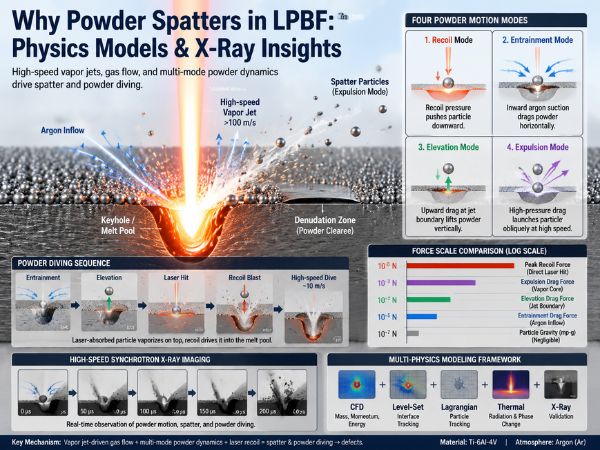
A realistic scientific visualization of Laser Powder Bed Fusion (LPBF) showing a high-power laser melting a Ti-6Al-4V powder bed, with vapor jets, Argon gas flow, powder spatter particles, melt pool dynamics, and four powder motion modes including recoil, entrainment, elevation, and expulsion. The image also includes physics simulation diagrams and high-speed X-ray imaging concepts.

Why Powder Spatters in LPBF: Physics Models & X-Ray Insights

By Felix Lee | CEO at Forgecise Published July 25, 2026 Search Summary Why does metal powder spatter in Laser Powder Bed Fusion (LPBF)? Metal powder spatters because high-power lasers vaporize metal, blasting out a fast vapor jet ($>100\text{ m/s}$). This jet pulls in surrounding Argon shielding gas, creating suction and pressure drags that drag,

Why Powder Spatters in LPBF: Physics Models & X-Ray Insights Read More »

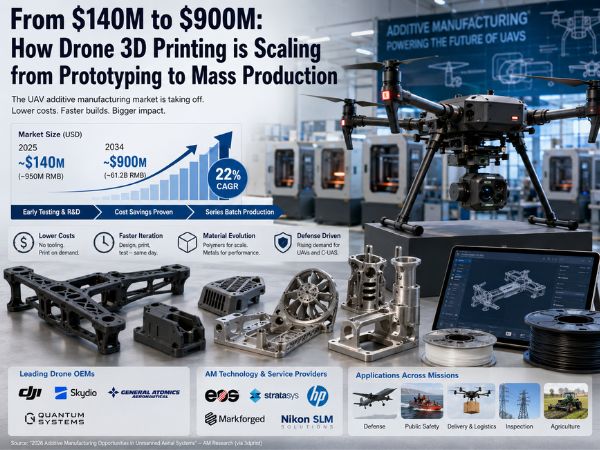
A realistic hero image of an advanced drone manufacturing facility featuring an industrial UAV, metal and polymer 3D-printed drone components, additive manufacturing equipment, and a market growth infographic illustrating the expansion of drone 3D printing from rapid prototyping to large-scale production.

From $140M to $900M: How Drone 3D Printing is Scaling from Prototyping to Mass Production

Author: Felix Lee (CEO at Forgecise) Published Date: June 26, 2026 Read Time: 6 min read Category: Aerospace & Manufacturing Key Takeaways (Quick Facts for Readers) 1. The Growing UAV Additive Manufacturing Market A industry report titled 2026 Additive Manufacturing Opportunities in Unmanned Aerial Systems: Market Analysis and Forecast from research firm AM Research shows

From $140M to $900M: How Drone 3D Printing is Scaling from Prototyping to Mass Production Read More »

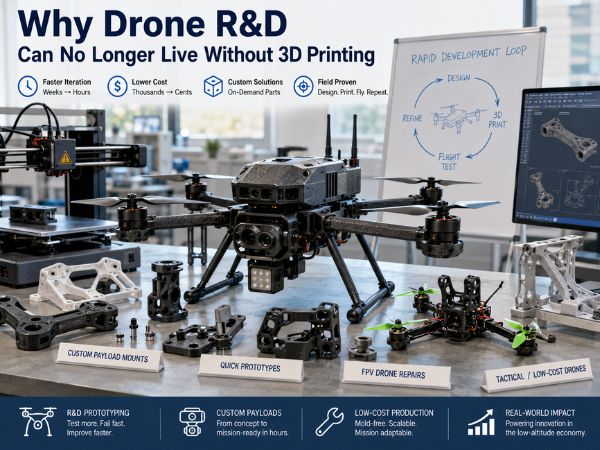
A realistic hero image of a modern drone engineering laboratory featuring a professional UAV, desktop 3D printers producing structural components, CAD software displayed on a monitor, and multiple 3D-printed drone prototypes and custom payload mounts, illustrating rapid prototyping and additive manufacturing for drone research and development.

Why Drone R&D Can No Longer Live Without 3D Printing

Author: Felix Lee (CEO at Forgecise) Published: June 24, 2026 Reviewed by: Forgecise Engineering Team Reading Time: 7 Minutes Executive Summary Schema.org Markup The Twin Engine of Low-Altitude Flight Interest in low-altitude aviation is growing fast. Money, policy, and engineering talent continue to pour into this airspace. Yet behind the main headlines, another industry grows

Why Drone R&D Can No Longer Live Without 3D Printing Read More »

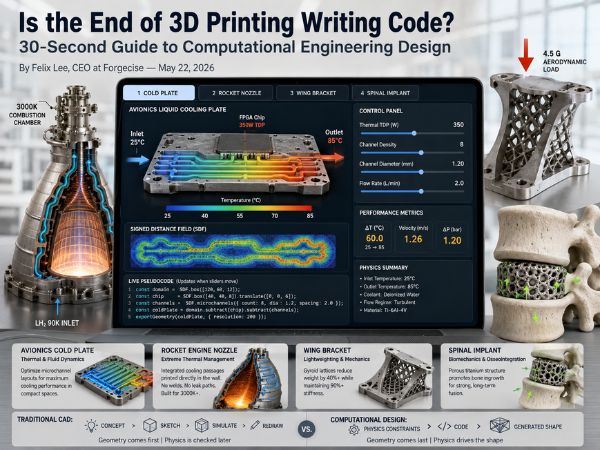
A realistic hero image showing a laptop running a computational engineering design simulator for metal 3D printing. The interface displays an avionics liquid cooling plate with thermal simulation, Signed Distance Field (SDF) visualization, live code, and engineering controls. Surrounding the laptop are a rocket engine nozzle, a gyroid aerospace bracket, and a porous spinal implant, illustrating code-driven additive manufacturing applications.

Is the End of 3D Printing Writing Code? 30-Second Guide to Computational Engineering Design

Code-driven 3D printing uses parameters and algorithms to create or modify geometry. Computational design can help explore cooling channels, lattice structures and customized shapes, but generated geometry still needs engineering analysis, manufacturing checks and physical validation. A visual animation is not proof of structural, thermal or medical performance. What code changes in the design workflow

Is the End of 3D Printing Writing Code? 30-Second Guide to Computational Engineering Design Read More »

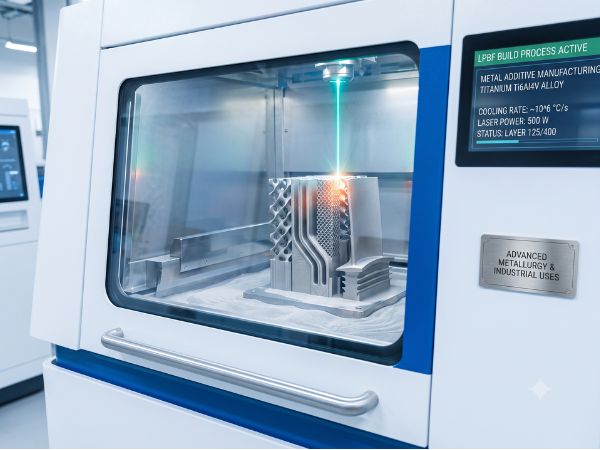
A high-tech laser powder bed fusion (LPBF) machine printing a complex metal part with lattice structures. A blue screen on the right displays real-time data including "Ti6Al4V ALLOY" and "COOLING RATE: ~10^6 °C/s," alongside an etched plaque titled "ADVANCED METALLURGY & INDUSTRIAL USES."

Metal Additive Manufacturing: Processes, Metallurgy, Industrial Uses, and Technical Roadmap

By Felix Lee, CEO at Forgecise | Published: July 24, 2026 Metal additive manufacturing builds metal components layer by layer from a digital model. This guide compares LPBF, electron beam melting, and directed energy deposition, then explains how feedstock, design, and post-processing affect process selection. For equipment selection, explore our metal SLM 3D printer systems;

Metal Additive Manufacturing: Processes, Metallurgy, Industrial Uses, and Technical Roadmap Read More »

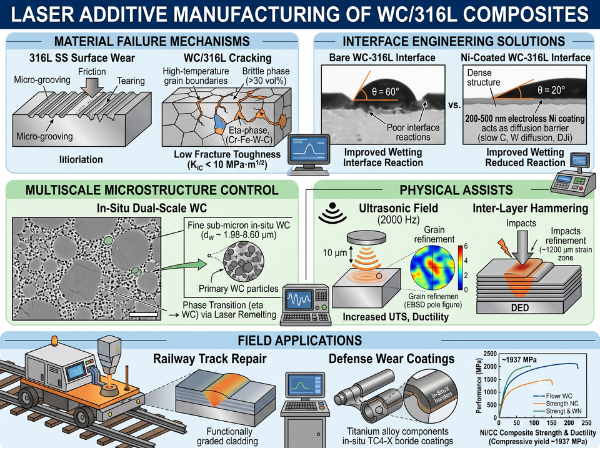
Technical diagram summarizing laser additive manufacturing of WC/316L composites, covering failure mechanisms, Ni-coating interface engineering, dual-scale microstructure control, ultrasonic physical assists, and field repair applications.

Laser Additive Manufacturing of WC/316L Composites: From Crack Mechanisms and Interface Engineering to Multiscale Control

WC-reinforced 316L combines a stainless-steel matrix with tungsten-carbide reinforcement to investigate improved wear performance. Laser additive manufacturing can change the reinforcement, interface and matrix during processing. Results depend on the feedstock and thermal history; performance measured in one experiment is not a production specification for another system. Distinguish the manufacturing routes Laser powder bed fusion

Laser Additive Manufacturing of WC/316L Composites: From Crack Mechanisms and Interface Engineering to Multiscale Control Read More »

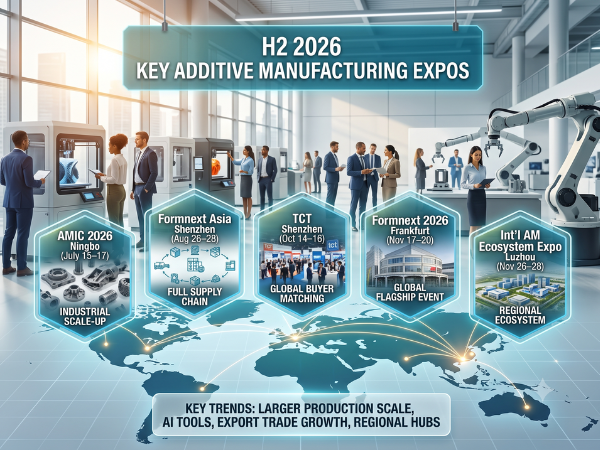
Infographic displaying the 5 key additive manufacturing expos in H2 2026, including AMIC Ningbo, Formnext Asia Shenzhen, TCT Shenzhen, Formnext Frankfurt, and Luzhou AM Expo, overlaying a modern 3D printing factory and global trade map.

5 Key Additive Manufacturing Expos in H2 2026: The Complete Industry Roadmap

Author: Felix Lee (CEO at Forgecise) Published Date: July 5, 2026 Category: Industry Insights / Additive Manufacturing / 3D Printing Executive Summary As 3D printing shifts from prototyping to mass production, five major events in H2 2026 will show where the industry is going: AMIC 2026 (Ningbo), Formnext Asia Shenzhen 2026, TCT Shenzhen 2026, Formnext

5 Key Additive Manufacturing Expos in H2 2026: The Complete Industry Roadmap Read More »

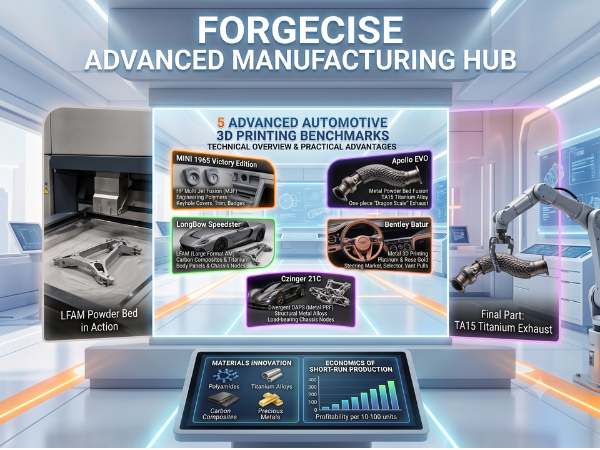
An infographic titled "5 Advanced Automotive 3D Printing Benchmarks" within a digital display in a modern manufacturing facility. The left panel shows a 3D printer with a metal chassis part, and the right panel shows a robot arm holding a finished metal exhaust. The center features five vehicle examples: MINI, Apollo EVO, LongBow Speedster, Bentley Batur, and Czinger 21C, with their printed components and technologies. At the bottom, a touch screen details "Materials Innovation" and "Economics of Short-Run Production" with data.

From Concept to Chassis: 5 Recent Case Studies of Additive Manufacturing in High-End Automotive

By Felix Lee, CEO at Forgecise | Published July 2026 Quick Summary: High-performance and luxury carmakers have moved 3D printing out of the prototype lab and onto the assembly line. Because supercars and limited-run vehicles use low production numbers, traditional factory molds cost too much. Today, manufacturers use additive printing for polymer cabin trims, aerospace-grade

From Concept to Chassis: 5 Recent Case Studies of Additive Manufacturing in High-End Automotive Read More »