



Shouyu

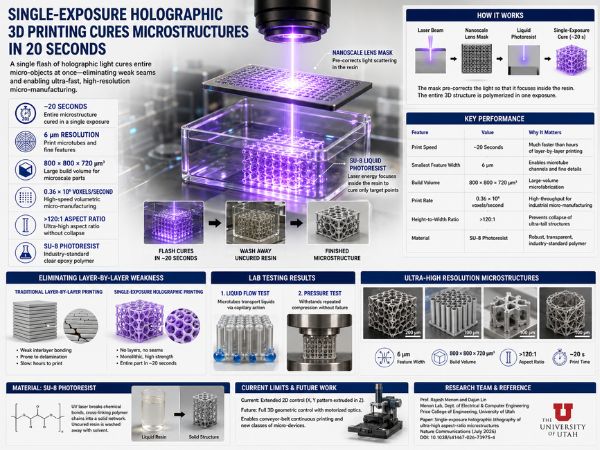
Bright scientific infographic showing a single-exposure holographic 3D printing system using a laser and nanoscale lens mask to cure an entire SU-8 microstructure inside liquid photoresist in about 20 seconds.

Single-Exposure Holographic 3D Printing Cures Microstructures in 20 Seconds

By Felix Lee, CEO at Forgecise Published: July 2026 | Reading Time: 6 mins | Reviewed for Accuracy: Advanced Additive Manufacturing Series Quick Summary Researchers at the University of Utah have built a new 3D printing technique called single-exposure holographic lithography. Instead of building microstructures layer by layer over several hours, this tool uses laser

Single-Exposure Holographic 3D Printing Cures Microstructures in 20 Seconds Read More »
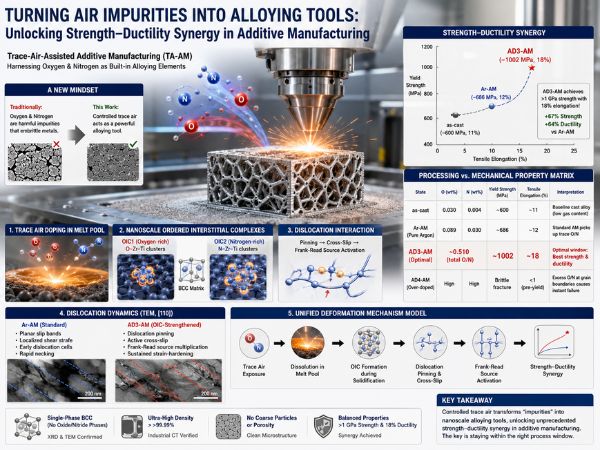
Bright scientific infographic showing trace-air-assisted metal additive manufacturing, where controlled oxygen and nitrogen enter a laser melt pool and form nanoscale ordered interstitial complexes that improve both strength and ductility in a titanium-zirconium-niobium medium-entropy alloy. Caption

Turning Air Impurities into Alloying Tools: Unlocking Strength-Ductility Synergy in Additive Manufacturing

By Felix Lee | CEO at Forgecise Published: August 2026 | Reading Time: 7 min Categories: Additive Manufacturing, Physical Metallurgy, Medium-Entropy Alloys, Advanced Materials Executive Summary & Direct Answer In metal 3D printing, engineers usually treat oxygen and nitrogen ($\text{O/N}$) as harmful impurities that make metal brittle. A 2026 study published in Nature Communications by

Turning Air Impurities into Alloying Tools: Unlocking Strength-Ductility Synergy in Additive Manufacturing Read More »

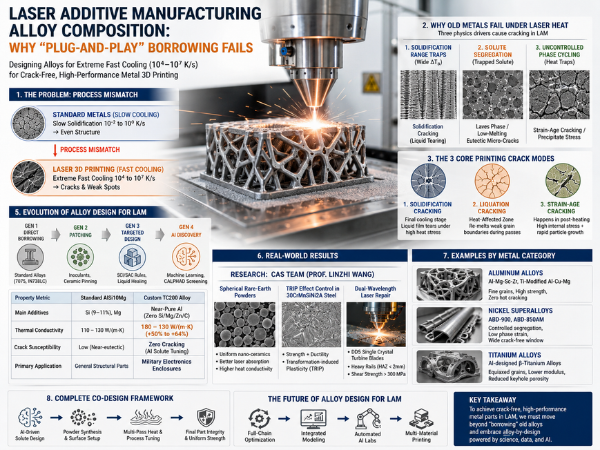
Alt Text Bright technical infographic showing a laser additive manufacturing system printing a complex metal part, with diagrams comparing slow-cooled conventional alloys and rapid laser cooling, common crack mechanisms, alloy design generations, and AI-driven material development.

Laser Additive Manufacturing Alloy Composition: Why “Plug-and-Play” Borrowing Fails

Author: Felix Lee | CEO at Forgecise Published: July 28, 2026 Topic: Laser Additive Manufacturing (LAM) Dedicated Alloy Design Quick Key Takeaway: Standard metals (like 7075 aluminum or IN738 superalloys) were made for slow cooling ($10^{-2} \text{ to } 10^0 \text{ K/s}$). Laser 3D printing cools metal extremely fast ($10^4 \text{ to } 10^7 \text{

Laser Additive Manufacturing Alloy Composition: Why “Plug-and-Play” Borrowing Fails Read More »

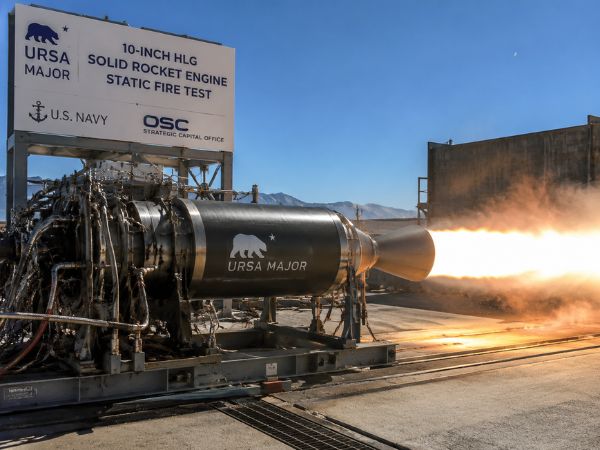
A metal 3D printed solid rocket engine prototype undergoing a static fire test at an outdoor aerospace testing facility, with bright exhaust flames, industrial equipment, and Ursa Major branding visible on the engine and test structure.

Metal 3D Printed Solid Rocket Engine: How Ursa Major Is Changing Rocket Manufacturing

Quick Answer Ursa Major has validated a new approach for building solid rocket engines through a U.S. Navy and Strategic Capital Office (OSC) Pathfinder project. The company designed, manufactured, and completed a static fire test of a 10-inch High Load Grain (HLG) solid rocket engine prototype. The project focused not only on engine performance but

Metal 3D Printed Solid Rocket Engine: How Ursa Major Is Changing Rocket Manufacturing Read More »

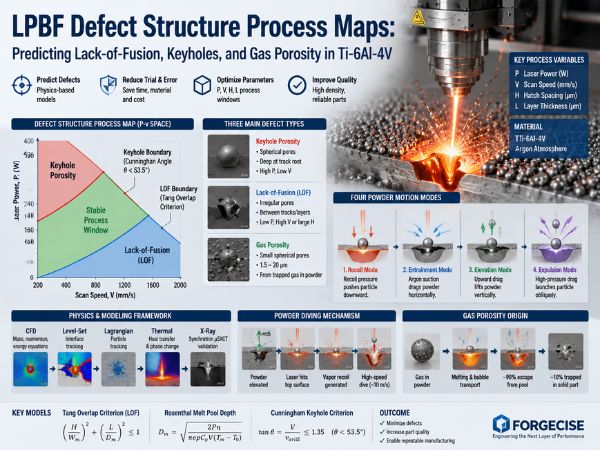
A realistic scientific visualization of Laser Powder Bed Fusion (LPBF) defect prediction showing a titanium alloy powder bed, laser melting process, melt pool dynamics, and a Defect Structure Process Map. The image illustrates key manufacturing defects including lack-of-fusion, keyhole porosity, and gas porosity, along with laser power, scan speed, hatch spacing, and physics-based simulation models.

LPBF Defect Structure Process Maps: Predicting Lack-of-Fusion, Keyholes, and Gas Porosity in Ti-6Al-4V

By Felix Lee, CEO at Forgecise Expert Review & Fact-Checked by Forgecise Metallurgical Research Group Last Updated: July 25, 2026 Quick Summary What is a Defect Structure Process Map (DSPM) in LPBF? A Defect Structure Process Map (DSPM) is a physics-based chart that plots laser power ($P$), scan speed ($V$), and hatch spacing ($H$) to

LPBF Defect Structure Process Maps: Predicting Lack-of-Fusion, Keyholes, and Gas Porosity in Ti-6Al-4V Read More »

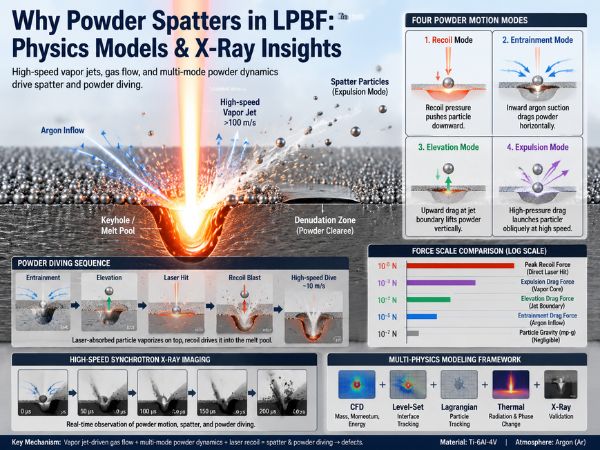
A realistic scientific visualization of Laser Powder Bed Fusion (LPBF) showing a high-power laser melting a Ti-6Al-4V powder bed, with vapor jets, Argon gas flow, powder spatter particles, melt pool dynamics, and four powder motion modes including recoil, entrainment, elevation, and expulsion. The image also includes physics simulation diagrams and high-speed X-ray imaging concepts.

Why Powder Spatters in LPBF: Physics Models & X-Ray Insights

By Felix Lee | CEO at Forgecise Published July 25, 2026 Search Summary Why does metal powder spatter in Laser Powder Bed Fusion (LPBF)? Metal powder spatters because high-power lasers vaporize metal, blasting out a fast vapor jet ($>100\text{ m/s}$). This jet pulls in surrounding Argon shielding gas, creating suction and pressure drags that drag,

Why Powder Spatters in LPBF: Physics Models & X-Ray Insights Read More »

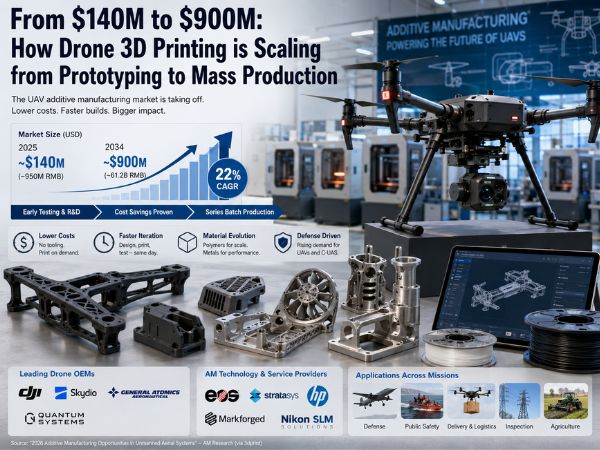
A realistic hero image of an advanced drone manufacturing facility featuring an industrial UAV, metal and polymer 3D-printed drone components, additive manufacturing equipment, and a market growth infographic illustrating the expansion of drone 3D printing from rapid prototyping to large-scale production.

From $140M to $900M: How Drone 3D Printing is Scaling from Prototyping to Mass Production

Author: Felix Lee (CEO at Forgecise) Published Date: June 26, 2026 Read Time: 6 min read Category: Aerospace & Manufacturing Key Takeaways (Quick Facts for Readers) 1. The Growing UAV Additive Manufacturing Market A industry report titled 2026 Additive Manufacturing Opportunities in Unmanned Aerial Systems: Market Analysis and Forecast from research firm AM Research shows

From $140M to $900M: How Drone 3D Printing is Scaling from Prototyping to Mass Production Read More »

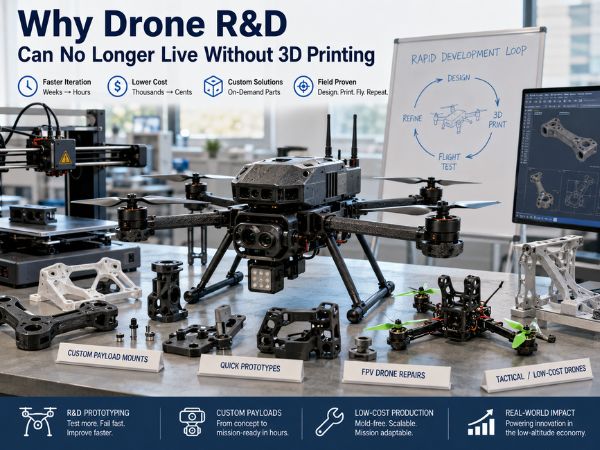
A realistic hero image of a modern drone engineering laboratory featuring a professional UAV, desktop 3D printers producing structural components, CAD software displayed on a monitor, and multiple 3D-printed drone prototypes and custom payload mounts, illustrating rapid prototyping and additive manufacturing for drone research and development.

Why Drone R&D Can No Longer Live Without 3D Printing

Author: Felix Lee (CEO at Forgecise) Published: June 24, 2026 Reviewed by: Forgecise Engineering Team Reading Time: 7 Minutes Executive Summary Schema.org Markup The Twin Engine of Low-Altitude Flight Interest in low-altitude aviation is growing fast. Money, policy, and engineering talent continue to pour into this airspace. Yet behind the main headlines, another industry grows

Why Drone R&D Can No Longer Live Without 3D Printing Read More »

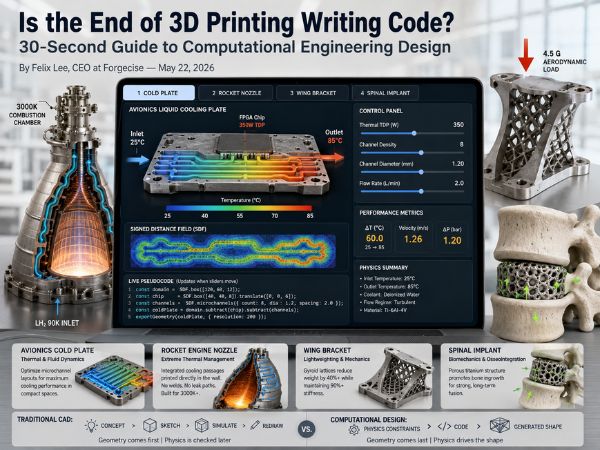
A realistic hero image showing a laptop running a computational engineering design simulator for metal 3D printing. The interface displays an avionics liquid cooling plate with thermal simulation, Signed Distance Field (SDF) visualization, live code, and engineering controls. Surrounding the laptop are a rocket engine nozzle, a gyroid aerospace bracket, and a porous spinal implant, illustrating code-driven additive manufacturing applications.

Is the End of 3D Printing Writing Code? 30-Second Guide to Computational Engineering Design

By Felix Lee, CEO at Forgecise — May 22, 2026 Quick Summary (Direct Answer) What is Computational Engineering Design in 3D Printing? Computational Engineering Design uses math functions and algorithms—rather than manual CAD drawing—to build 3D printing geometries. Engineers input physical boundary conditions like temperature limits, structural loads, and fluid rates. The code then generates

Is the End of 3D Printing Writing Code? 30-Second Guide to Computational Engineering Design Read More »

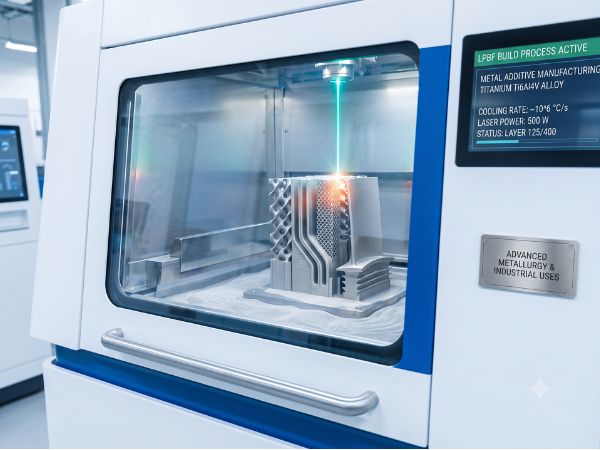
A high-tech laser powder bed fusion (LPBF) machine printing a complex metal part with lattice structures. A blue screen on the right displays real-time data including "Ti6Al4V ALLOY" and "COOLING RATE: ~10^6 °C/s," alongside an etched plaque titled "ADVANCED METALLURGY & INDUSTRIAL USES."

Metal Additive Manufacturing: Processes, Metallurgy, Industrial Uses, and Technical Roadmap

By Felix Lee, CEO at Forgecise | Published: July 24, 2026 1. Introduction to Metal Additive Manufacturing (MAM) 1.1 What is Metal Additive Manufacturing? Metal Additive Manufacturing (MAM)—often called industrial metal 3D printing—changes how we make high-performance metal parts. Traditional subtractive manufacturing (like CNC milling or turning) shapes parts by cutting material away. Formative manufacturing

Metal Additive Manufacturing: Processes, Metallurgy, Industrial Uses, and Technical Roadmap Read More »